What is the highest number you can state?

Nickmick, you can't do infinities, look at the last number.


-----Posted Added-----


I however can count to this number
∞ - 1
Which basically just beats out all of your number's by taking 1 from absolute ∞
 
That's still a concept of infinity, though, Kyle. You have to state a value, so your ∞ has to be finite.
 
∞ - 1 = ∞
∞ + 1 = ∞
∞ / 2 = ∞
∞ * 2 = ∞
∞^2 = ∞
sqrt(∞) = ∞

Right? :P


The binary representation of the biggest number I know of is
1111111111111111111111111111111111111111111111111111111111111111, decimal representation is
18 446 744 073 709 551 615
which is an unsigned long double :P
 
Our 3 year old came up to us one day, and just blurted out... "I love you nine hundred" while holding her arms out like to hug a large tree trunk. That to me was about as high as someone can get with a number.
 
Someone has already mentioned this thread is stupid, right? Just checking.

Not often enough I think.

Also, really cool are only people who can count to 1023 on their fingers.
 
Also, really cool are only people who can count to 1023 on their fingers.
59048 is quite achievable too. I haven't the dexterity for higher than that.
 
Who says if you take one away from infinite, thats one away from a number thats not infinite. I won. :lol:

Actually, the definition of infinite. If there would be a number x, where you could just add one and it becomes infinite, it would not be infinite at all (As it is still limited).
 
Someone has already mentioned this thread is stupid, right? Just checking.

Hey, we play Orbiter, were obsessed with Math. Playing Orbiter got me an A in Calculus when I was in College back in 2005.
 
But what is the result of ∞^-∞?

;)
 
∞^-∞ = 1 / (∞^∞) = 1 / ∞ = 0

Wrong... slightly. 1 / 0 or 1 / ∞ are not defined, but you can calculate the limit of a function x^-x ;)
 
Wrong... slightly. 1 / 0 or 1 / ∞ are not defined, but you can calculate the limit of a function x^-x ;)

1 / ∞ not defined??? Very strictly speaking you may be right, but if I interpret it as lim(x->∞, 1/x), then it clearly is 0.

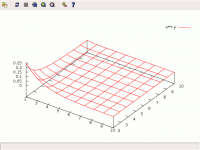
Similarly, you can calculate the limit of x^-x, or, more generally, x^-y. I added a graph of x^-y (see below) for the range [2:10]*[2:10]. As you can see, it goes to zero for every direction (x>0, y>0). I calculated the limit in some directions, and it all becomes zero, as long as x>1 and y>1. I forgot how to do the general case though.

If you can say that ∞/2 = ∞, then I think you can also say 1/∞ = 0 and ∞^-∞ = 0.
 

Attachments

  • limits.png
    limits.png
    11 KB · Views: 3
Back
Top