
What will your genetic relatives be doing in the year 1,362,010?

Turbinator

New member
Joined
Dec 12, 2009
Messages
1,145
Reaction score
0
Points
0
Location
Tellurian
In 1,360,000 years from now. When we as a species have evolved in to something unrecognisable. A star, called Gliese 710 will pass within 0.337 ± 0.177 parsecs (that is 1 light year) of our Sun. It has an 86 percent chance of passing through the Oort cloud. There is even a 1/10,000 chance of the star penetrating into the sub 1,000 AU region, that would generate massive impact events on all of our Planets from all the comets that would be knocked out of the Oort cloud. Presently, Gliese 710 is 62.9 light years away.


The star has an 86% chanche of passing trough this cloud:
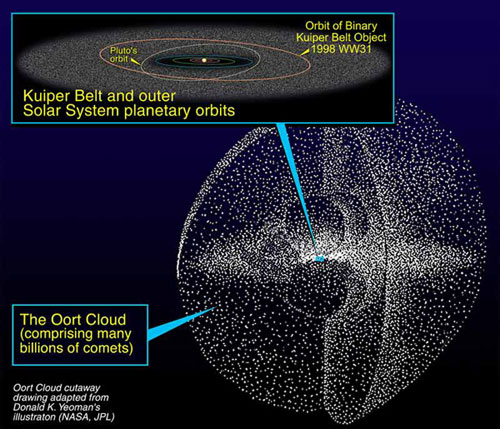
Kuiper_oort.jpg


The star with the second greatest perturbational effect in the past or future 10 million years was Algol, a triple star system that passed no closer than 9.8 light years, 7.3 million years ago.


.​
 
Last edited:
That is, if humanity isn't wiped out before that time. I.E. Asteroid, Comet, Rogue planet, war, something Sun related etc.
 
Playing Orbiter1,362,010P1. Sorry, I couldn,t resist that.
 
Last edited:
That is, if humanity isn't wiped out before that time. I.E. Asteroid, Comet, Rogue planet, war, something Sun related etc.

My atoms will still be around, and that's all that matters. :thumbup:
 
Last edited:
Moving a star is a problem. On the other hand, given 1.3 million years of development, you'd think it'd be pretty easy to fix the problems this encounter would cause. It wouldn't be instant, so the effects could be recorded, tracked, and mitigated quite easily.

I wonder how often events like this occur...
 
I'd be very disappointed if a majority of them were still living in the Sol system, or the Local Spur for that matter.
 
My atoms will still be around, and that's all that matters. :thumbup:
I see what you did there. :lol:

Though they aren't your atoms. They're just allegiance-free atoms who have been briefly arranged into the shape of a Turbinator...
 
I'd be very disappointed if a majority of them were still living in the Sol system, or the Local Spur for that matter.

I wouldn't. It's a great place to live!

Save for that pesky Gliese 710. Oh well, I guess any inhabitants of that place won't have things much better.

I wonder, if there was a habitable planet orbiting Gliese 710, and they discovered the likelihood of this event... would they say that Sol is hurtling towards them, to pass close by in 1.3 million years? :P
 
My descendants will be looking ruling the land, sea and air as the Kings of the World via the legacy that I created. All your descendants will be serving them like slaves. This is the world as it shall be under my Rule. It will be awesome!
 
I wouldn't. It's a great place to live!

Save for that pesky Gliese 710. Oh well, I guess any inhabitants of that place won't have things much better.

I wonder, if there was a habitable planet orbiting Gliese 710, and they discovered the likelihood of this event... would they say that Sol is hurtling towards them, to pass close by in 1.3 million years? :P
If a habitable planet is discovered, the flyby would be the best opportunity to send a "hello" over. Shortest interstellar trip ever!
 
If a habitable planet is discovered, the flyby would be the best opportunity to send a "hello" over. Shortest interstellar trip ever!

Yeah, but you have to wait 1.3 million years for it to happen! :lol:

Get up to around 50km/s, and you can traverse the 63 light-years to Gliese 710 in under 400 000 years! :rofl:
 
Yeah, but you have to wait 1.3 million years for it to happen! :lol:

Get up to around 50km/s, and you can traverse the 63 light-years to Gliese 710 in under 400 000 years! :rofl:
Presumably if there is still a human civilisation kicking around in 1.3 million years, they'd be at least somewhat more advanced than us now, no? So we can at least hope that the enormous hurdles in achieving relativistic velocities (and beyond??) may have been...hurdled by then.

Even then, the 1 000 AU it may penetrate to is a vastly more manageable distance than the current 63ly to Gliese 710, or the 4.2ly to Proxima Centauri.
 
Presumably if there is still a human civilisation kicking around in 1.3 million years, they'd be at least somewhat more advanced than us now, no? So we can at least hope that the enormous hurdles in achieving relativistic velocities (and beyond??) may have been...hurdled by then.

Even then, the 1 000 AU it may penetrate to is a vastly more manageable distance than the current 63ly to Gliese 710, or the 4.2ly to Proxima Centauri.

Yeah, but you have to wait 1.3 million years for the star to come that close. It is likely that in a fraction of that time, technology could be developed to travel to that star anyway. In a matter of time that is a tiny fraction of 1.3 million years...

In short, this conjunction has absolutely no bearing on serious discussion of interstellar spaceflight.

Building a spacecraft in the next 100 years to reach Alpha Centauri would be easier than building a spacecraft in the year 1 300 000 to reach Gliese 710. We all know how things can change and funding can disappear. Imagine trying to guarantee funding for a project spanning millions of years! :uhh:

EDIT:
I hope my relatives will live on Gliese 581 g then.

You mean that planet that doesn't exist? :dry:
 
Last edited:
Back
Top