
Discussion Will Russia send a rover to Venus?

sorindafabico

New member
Joined
Mar 23, 2011
Messages
1,231
Reaction score
2
Points
0
Location
Porto Alegre
There aren't many english sources about this, I don't know if it's a hoax. Can anyone confirm?

Russia plans to send an exploration rover to Venus in the mid-2020s, according to Lev Zeleny, director of the Russian Academy of Sciences’ Institute of Space Research. “The rover will reach Venus in a relatively short time and will work there for several hours, unlike previous rovers they were sent to Venus is 1975 and 1978 and transmitted data for minutes,” he said. He said that the dark spots observed on Venus’ surface, which changed their shapes, could be caused by chemical substances, such as sulfur.

The rover will be a part of future Venera programme which prime purpose is to make radar remote-sensing observations around the planet Venus in a manner similar to that of the Venera 15 and Venera 16 probes in the 1980s.
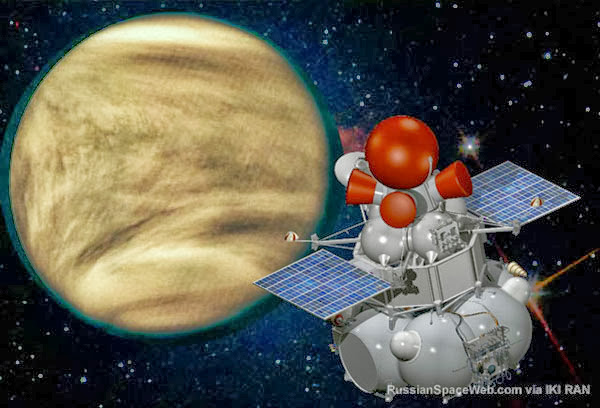
venera_d_var2_2009_1.jpg

The Venera-D spacecraft approaching clouds-veiled Venus. Shown configuration was only one of several designs envisioned at the conclusion of the project's definition phase in September 2009. A ball-shaped capsule containing the main lander can be seen at the top, with four mini-capsules carrying atmospheric balloons attached just below it. Individual entry capsules for each balloon would allow to deploy scientific sensors over much wider regions of the planet then it would be possible if they were all released from a single descent vehicle. Credit: russianspaceweb.com
 
I expect a Russian rover on Mars first. Maybe they mean probe. (what would a rover do in 'hours'?)
 
Maybe they mean probe.

They refer to previous Venus probes as "rovers", so this may be the case.

No rovers have been landed on Venus so far.
 
Everything being exposed to extreme heat and pressure.

Mechanically the temperatures and pressures aren't insurmountable problems (I work in combustion). The problem is keeping the control and communications circuitry from frying. They could cold-soak a heat sink during the voyage and contain it all in an insulated container, but sooner or later everything will heat up.

I wonder if a closed-loop refrigeration cycle could be made to work in such an environment within a decent mass/form factor? That would be an interesting thermodynamics / heat transfer problem to work out.
 
Some sort of Stirling engine cooler could work on such a temperature gradient and mass budget.

I don't think we need to go far - regular silicon electronics can be made to work at just over 200*C, and silicon carbide can operate up to 600*C, well above Venus ambient (but we can't make ICs out of it yet AFAIK).

It might be interesting to try and design a Venus native environment electronics and hardware - that way the thing could be a real rover, lasting for months.
 
I haven't seen any new information of Venera-D in a while, but a quick search brought up this presentation from November 2012 that mentions a lander. The drawings for the lander and orbiter resembles that of previous missions, but there's no rover. Balloons are included.
 
Wouldn't a submarine be a better choice for motion on Venus?:rofl:
 
One very full and recent presentation on Venera-D is available here (in English):
http://www.lpi.usra.edu/vexag/Nov2012/presentations/13_VeneraD_Zasova.pdf

There's no rover there, of course.

Actually, I'm not holding breathe, because we've got coming:
- an imminent USA default leading to the global economic turmoil for years;
- revamping of Russian space industry administration and cutting of expenditure (already under way);
- revamping of Russian Academy of Science administration and cutting of expenditure (already under way).

Better come around for Russian timber, hemp and wheat rather than space probes next 10 years at least.
 
Last edited:
a quick search brought up this presentation from November 2012 that mentions a lander.
One very full and recent presentation on Venera-D is available here (in English):
http://www.lpi.usra.edu/vexag/Nov2012/presentations/13_VeneraD_Zasova.pdf
Just saying.

I recall Venera-D originally being planned to launch in 2016, will be scaled down, then 2018, and now it's in the 2020s. Roscosmos also wants cooperation from NASA.

The last news I've heard about Roscosmos's funding is that it's promised to be increased steadily over the next few years. Yet Venera-D is having a hard time.
 
Don't know. Too ambitious given the bad track record (Fobos-grunt...).
I think that Roscosmos should try to send rover to the Moon. Much simpler mission, specially regarding communications and shorter duration flight.
 
That's far from impossible, Soviet Union did it before, the only nation that ever landed something in that hell... Yeah, they could afford to design probes by trial and error back then...
 
That's far from impossible, Soviet Union did it before, the only nation that ever landed something in that hell...

That's not strictly true. One of the [ame="http://en.wikipedia.org/wiki/Pioneer_Venus_Multiprobe"]Pioneer Venus[/ame] probes survived and continued to transmit for over an hour after impact, despite being a descent probe.
 
That's not strictly true. One of the Pioneer Venus probes survived and continued to transmit for over an hour after impact, despite being a descent probe.

For a circular (or hemispherical) surface area and a Cd of 0.5, I get a terminal velocity of about 10m/s at the surface of Venus. Neat.
 
Last edited:
We could debate on the difference between crashing and landing... :yes:

But after all, that doesn't makes any difference on Venus. Anyway you end crashed, crushed, toasted, boiled or corroded by acid storms. Lovely place.
 
Mankind once wrote stories. About aliens on Venus. About Venus being a second Earth.
Then there was space exploration and the more we knew about it the more we were like:

"Uh, that place...let's just forget about it."
 
amazing! it survived impact with no parachute :cool:

that's one well built probe
 
amazing! it survived impact with no parachute :cool:

that's one well built probe

In Venus atmosphere - that means just 5-10 m/s velocity on impact, what is the same speed as a parachute landing on Earth.
 
Back
Top