Writing some fiction, need to make some calculations

Archabacteria

New member
Joined
Apr 2, 2010
Messages
41
Reaction score
0
Points
0
So far I've gotten a few numbers down at least.
The mass of a certain planet in this book is five earth masses, or 2.98685e+25. It is slightly less dense overall than Earth (I wanted a bigger radius around the equator and figured that was the way to do it- if there's another way do tell- I had planned on the equator getting most of the sun and the tip of the poles being cold enough to have liquid methane, with the inhabitable parts hovering around tropical to temperate conditions).

I haven't figured out the exact pressure in KPa, but the atmospheric composition is around 25% oxygen, 73% nitrogen, 1% water vapor (on average), and 1% gases that are mostly carbon dioxide.

Plans for day length (including time when the actual sun isn't facing the planet- or rather, when the planet isn't facing the sun) are around 32 hours.

It orbits a K5V star at a distance I also need help determining (should be around the Goldilocks zone, if that's even possible to calculate using hard maths I don't understand)

The last three above paragraphs include the problems I want help figuring out. Could also use the relative gravity compared to Earth (in G).

If you have to ask, it won't be in the storyline, but the glossary section is intended to be a doorstopper by itself.
 
Last edited:
I had planned on the equator getting most of the sun and the tip of the poles being cold enough to have liquid methane, with the inhabitable parts hovering around tropical to temperate conditions).

Methane has a boiling point of about 112 Kelvin, while "tropical temperatures" are somewhere between 310 and 325 K, I would assume.

If you have any atmosphere a human can breathe, such huge temperature differences are very implausible, because such a dense atmosphere will distribute the temperature way too good around the planet. They are totally unbelievable if you have 4% of water vapor in the atmosphere, which is one of the most potent greenhouse gases (where do they come from anyways? any significant amounts of water in the atmosphere is almost certain proof that you have a runaway greenhouse effect taking place, which means that pretty soon the whole ocean will be part of the atmosphere and temperatures pretty high...) Plus, you can't have water vapor and methane lakes together any way you turn it, since the boiling point of the one is waaaaay higher than of the other.

(should be around the Goldilocks zone, if that's even possible to calculate using hard maths I don't understand)

That is no problem at all, but I don't have the equations handy currently. The goldilocks zone (or, as the experts say: ecosphere) is pretty small for a K0V though, plus it's highly implausible that there is enough dust around in it to form a super-earth. You might want to reduce the planets mass somewhat and take a bit of a heavier star, or reduce the mass a bit and take a LOT heavier star (about an F5V at least, I'd say).

Then again, there's always orbital migration or pure chance, for which there's plenty of opportunity in the galaxy. For you as a writer it is important to know that such a planet would be a dazzling find and treat it accordingly. However, you'll have to forgett about tropical forests and methane lakes on the same planet with a breathable atmosphere. That's just way too implausible, at least when going after current theories.

The only justification for having such a planet is as main plot device where the explorers discover some alien device with rapidly oscilating hands that allows the planet to keep in this impossible state. Just adding this thing to the glossary won't exactly make it a doorstopper, it will raise a lot of eybrows of people interested enough to actually read it.
 
Last edited:
Alright, that removes that. I'll reduce the water to 1% (or even lower if you insist) and forget the methane lakes for the future.

As for the star's mass, I thought K0V, being hotter, would have more mass since it approaches being as hot as a low-end G-type star. But hey, you're the scientist, so what the hell. K5V it is. (Though I'll admit I selected an orange star just to wonder about the colors of the sunset with a different color sun)

Thanks for the review of my numbers. Helps me put things where they should be.
 
(where do they come from anyways? any significant amounts of water in the atmosphere is almost certain proof that you have a runaway greenhouse effect taking place, which means that pretty soon the whole ocean will be part of the atmosphere and temperatures pretty high...)

Maybe it is just a humid planet? That would be pretty much the same thing, wouldn't it?

I dunno... it is a very fine line... maybe it is just a thick aired place that is far away from the star, and/or has a high albedo (due to large amounts of cloud), where the water vapour keeps the planet warm.


The goldilocks zone (or, as the experts say: ecosphere) is pretty small for a K0V though, plus it's highly implausible that there is enough dust around in it to form a super-earth. You might want to reduce the planets mass somewhat and take a bit of a heavier star, or reduce the mass a bit and take a LOT heavier star (about an F5V at least, I'd say).

Small how, in terms of radius? Or distance between the inner and outer radius?

It is sure not small when compared with that of say, a small M class star. HR 511 has a luminosity 0.53 that of Sol, whereas Gliese 581 (an M3V) is only 0.013 solar luminosities.

Highly implausible for there to be enough dust around the object to form such a large planet? We've found planets with that mass and more around a star less than half the mass, and they're quite well known.

Why an F5V? That is more massive than Sol, even.

The only justification for having such a planet is as main plot device where the explorers discover some alien device with rapidly oscilating hands that allows the planet to keep in this impossible state. Just adding this thing to the glossary won't exactly make it a doorstopper, it will raise a lot of eybrows of people interested enough to actually read it.

Does the alien artifact have to handwave though?

What if they just left behind a big fridge?
 
I would have problems believing a planet with 5 Earth masses would have a breathable atmosphere. The atmosphere would be over 20 times thicker than ours enough to crush us and at that pressure nitrogen becomes poisonous to us. Also as Jeddida said befor the atmosphere would keep the planet at a similar tempuracher. The poles, if your planet has a 0 degree axial tilt, would probly be around -20 Farenhiet, cold enouph for ice caps. The surface gravity on this type of world will be aroung 2g's so life here will probly have a lower stance than life on Earth.
 
Better not waste your time too much on chemistry. If you describe a rifle in your novel, somebody will have to use it. Just look at "Dune", which did get deep into the details, but still never mentioned anything not related to the story.

if you ever need to describe partial pressures and such, look at the effect you want to have, and then give the planet more depth. 1 % water vapor for example, is a lot. 100% relative humidity is maybe just 0.0001% water vapor in the atmosphere at your desired temperature range:

Relative_Humidity.png


1% steam means 10 gram per kilogram air: That is 100% RH at 15°C - at local conditions. For the whole atmosphere, at all temperatures and pressures, this will be hard to achieve.
 
I would have problems believing a planet with 5 Earth masses would have a breathable atmosphere. The atmosphere would be over 20 times thicker than ours enough to crush us and at that pressure nitrogen becomes poisonous to us. Also as Jeddida said before the atmosphere would keep the planet at a similar temperature. The poles, if your planet has a 0 degree axial tilt, would probably be around -20 Fahrenheit, cold enough for ice caps. The surface gravity on this type of world will be around 2g's so life here will probably have a lower stance than life on Earth.
Not necessarily breathable to us. Just breathable to things that live there. And actually, I increased the oxygen so that life would be larger overall (if you think it needs more oxygen, I was trying to avoid occurrences of flash fires if they managed to have any sort of electricity or use of fire.). Such as the giant dragonfly that seem to have been around a long time ago. In general the design for creatures from that world was 'larger than here on Earth'. For example the main sentient species there is around 7 feet tall on average for a fully grown individual, and they manage by having much, much stronger bones. Right now I'm attributing it to them having evolved to take titanium into the bone structure.

EDIT to above post:And because this forum doesn't alert me to such things, I just noticed your post. Plans were for a tropical rainforest in the inhabited parts, so I suppose your figures will do.
As for mucking about with the chemistry, I'm just doing this part because I haven't got much else of an idea of what to do in the actual novel itself.
 
Last edited:
As for mucking about with the chemistry, I'm just doing this part because I haven't got much else of an idea of what to do in the actual novel itself.

Well, I won't flame you for that. Tolkien started similar. :lol:

But you should really at a point get to story and not to a description of a hypothetical planet. If you have alien artifacts, what do they mean to the other characters (which includes non-living entities, like planets). How do they get discovered? How is it known that they are alien (that is not so trivial)?

A lot of coarse stuff, before you can even write a chapter.
 
Well, I meant that I've written a bunch and now I'm out of steam for now. If you like I can put up the current stuff. I'm no Tolkien though, my writing style tends to be a bit too brief... Especially in character descriptions. It's either too brief or so long that people get bored.

Right now the aliens have crashed on Earth because something attacked them in Jupiter's orbit while they were heading there (a few years prior they had sent out probes, a few came back with interesting data- including one that homed in on Titan, and another that was found orbiting Earth by a passing shuttle mission. Highly unlikely, I know, but I don't have much else to have it found by to reason it being stored in a high-level area of an air force base.) There's some more, but I'm not sure if I like all of the new paragraphs yet. The sphere (they have their probes as spheres) is golden (or at least it is when it has been captured by an unknown civilization- a small precaution, the Altair (I'm calling my aliens that) can see in infrared and they're aware that it isn't horribly common) and has markings on it that appear to be words, but cannot be traced to any known civilization. As well as being found in orbit.

Incidentally, speaking of this sphere, its diameter is around 0.3048m or a foot in length. In case anyone feels like making it into a ship for Orbiter. It'd be interesting, flying that thing around. Just assume that you are the probe, rather than a pilot. The holes for hover and 'main engine' (technically it doesn't have a main engine- it would use linear RCS) are too small to be seen, and they wouldn't mark the golden covering because the golden covering is an illusion. (It can bend light to manipulate how the sphere is seen. Like cloaking, only it could make itself look like an uninteresting rock if it felt like it.)
 
Last edited:
Maybe it is just a humid planet? That would be pretty much the same thing, wouldn't it?

not quite. the air can only have a certain amount of water in it, depending on the temperature. If the air is too cold, the water condenses in the air in the form of fog. So either you'll have very high temperatures and a very humid planet, or you'll have so much fog that you can't see your hand in front of your eyes. I'm not even sure if we could breathe that air without drowning...

But hey, you're the scientist, so what the hell.

ah no, I'm not. I merely bothered too much with that stuff in my free time the last two years... :lol:

Highly implausible for there to be enough dust around the object to form such a large planet? We've found planets with that mass and more around a star less than half the mass, and they're quite well known.

yes, but it's quite a feat to find one of those in the habitable zone of such a small star. It might get there by orbital migration though, so yeah... you can put it there, It's certainly not impossible, as a writer you just have to be aware that it's not an every day occurence.

I thought K0V, being hotter, would have more mass since it approaches being as hot as a low-end G-type star.

That would be a K9V, that's just below a G0V. you're countng the wrong way ;)

Actually I said an F5V, but in retrospective that might indeed be a bit too massive. As said by T.Neo above, you can go with a K-star, just keep in mind that it's a rare planet.

Small how, in terms of radius? Or distance between the inner and outer radius?

a K0V, true on both accounts. Although it is of course still a fair bit larger than of middle to lower size MV-stars.

Does the alien artifact have to handwave though?

What if they just left behind a big fridge?

To ccol the poles to around 100 Kelvin? how would you suggest achieving the feat without waving hands?


Sorry for wildly mixing the quotes of T.Neo and Archabacteria, by the way. I went about the reply rather unstructured...:facepalm:
 
Last edited:
Well, if I'm counting backwards, than I guess I'll change that as well. And I might change to a G or F class, since no one can really figure out the color of sunset on a planet with a star of a different color, even given the atmosphere.
 
Well, if I'm counting backwards, than I guess I'll change that as well. And I might change to a G or F class, since no one can really figure out the color of sunset on a planet with a star of a different color, even given the atmosphere.

Do you really want this is the question. Writing a ray tracer, that does refraction and reflection properly is not the problem, but the range of effects is huge and the pure computing effort is not that low (since refraction means the creation of one new ray of light for every wavelet at every refraction). Tiny variations like a bit of volcanic dust, can paint a complete new pallet of colors into the sky.

It is possible to calculate in a computer, why gold is golden... which is much harder than the sky on a exotic planet.

Really, I can tell you: Decide any halfway sane choice of colors, and let an scientist get a Nobel Prize of Physics for proving you wrong.
 
not quite. the air can only have a certain amount of water in it, depending on the temperature. If the air is too cold, the water condenses in the air in the form of fog. So either you'll have very high temperatures and a very humid planet, or you'll have so much fog that you can't see your hand in front of your eyes. I'm not even sure if we could breathe that air without drowning...

Well, considering the other things going on with the atmosphere, that may well be a non-issue.

It has it advantages... an extremely moist atmosphere would eliminate the threat of dessication for organisms living on land, for example.

Fish in microgravity can breathe air that is at 100% humidity, or so I've heard.

yes, but it's quite a feat to find one of those in the habitable zone of such a small star. It might get there by orbital migration though, so yeah... you can put it there, It's certainly not impossible, as a writer you just have to be aware that it's not an every day occurence.

Well... maybe. But as we've seen Gliese 581 already has planets that large in the habitable zone; it is by no means impossible.

Orbital migration might not be an everyday occurance, but then again, neither is a habitable planet itself. I think it might happen more often than we realise; young systems are not the stable, organised systems like ours currently... there was a hypothesis that Uranus and Neptune not only moved out in their orbits, but also switched places.

And then we have the hot Jupiter example(s). Admittedly the fact that we keep finding them has a lot to do with our detection methods, but it also shows us that they exist and are out there.

That would be a K9V, that's just below a G0V. you're countng the wrong way

Uh... :facepalm:

I feel stupid now. :)

Actually I said an F5V, but in retrospective that might indeed be a bit too massive.

I would think so... that is already larger than Sol.

To ccol the poles to around 100 Kelvin? how would you suggest achieving the feat without waving hands?

I never said cooling the poles, just building a big fridge. :P

If humans can take an abandoned airship hanger of 5.5 million m^3 and turn it into a heated-year-round-to-25C-fake-island-resort, can't advanced aliens turn a sufficiently sized structure into a -161C... what would it be... cryo-dome? :P

It doesn't have to be overly big, just impressive. That's the only way I could imagine methane lakes existing anywhere on the planet.
 
Well, if I'm counting backwards, than I guess I'll change that as well.


Uh... :facepalm:

I feel stupid now. :)

Don't, both of you. Looks like I had a temporary lapse of memory here, I was the one counting backwards in that instance. The indication does indeed go downwards (I.E. A k0V IS just bellow a G9V). I actually woke up in the middle of the night realising that I messed it up. No idea how that happened, I hope I'm not getting senile already... :shifty:

Fish in microgravity can breathe air that is at 100% humidity, or so I've heard.

No idea what fish can brethe in Microgravity. A Human practically needs air at 100% relative humidity, your nostrils do the job of enriching the air. The trouble is so much free-floating water in the air (i.e. not bound in the mix), which might lead to amassing water in the lungs, resulting in drowning (there are people "drowning" a day or two after having had a swimming accident, because they didn't bother to check wheather they had any water left in their lungs).
 
Last edited:
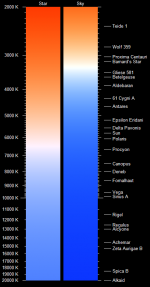
Well, if I'm counting backwards, than I guess I'll change that as well. And I might change to a G or F class, since no one can really figure out the color of sunset on a planet with a star of a different color, even given the atmosphere.


  • A useful page with star types and habitable zones
  • The sky on alien worlds at Orion's Arm
  • A sky and star color chart (originally at DeviantArt, but now removed from there):
 

Attachments

  • Star_and_Sky_Colour_Chart_by_chaos_syndrome.png
    Star_and_Sky_Colour_Chart_by_chaos_syndrome.png
    35.4 KB · Views: 8
Did a rather simple multiplication by myself, if the five Earth masses were to attract exactly five times more atmosphere, the pressure would be 507Kpa. I think humans would need a filtered breathing apparatus to filter out the excess oxygen and nitrogen to pressures that are tolerable.
 
Not to mention exoskeletons to support the weight of four atmospheres too many, and four of your their own masses crushing them. :rolleyes:
 
To resist the pressure, Izack, the pressure... atmospheric pressure does not crush you from above, it crushes you from... everywhere.

Gravity doesn't scale like that, AFAIK. For one the radius of the planet will not scale linearly with the mass increase because it does not correlate directly to volume increase, and such a planet will also accrete more silicates etc, and thus be less dense.
 
Back
Top