
Turbinator
New member
More R&D, legal, and approval money that they would rather be spending on a new Porsche collection.


 . I mean, if the pitot says you're stalling and the ground speed on the GPS is nowhere near stall speed, you surely aren't stalling, even if the real speed is also influenced by angle of climb/descent.
Some of the solutions made me chuckle:thumbup: and yes, there are a ton of things they could do. I was wondering, couldn't they do a rough estimation of the airspeed by looking at the GPS ground speed? (I don't know if they have it in RL, but FS2004 has it :lol
Also said earlier here, if pitot goes on vacation, it should be easy to just set the engines for a speed that guarantees a good enough margin on either sides (stalling vs overspeeding). Then, even assuming that the gyros are out (although I don't know how they could be affected by icing), you could sort of roughly eyeball the trim so that it doesn't pit you into the chair or catapult you into the ceiling. Inertial forces may be deceiving here, but maybe experienced pilots can tell easier whether they're climbing or descending.
I guess it all comes down to improvements vs cost. The good old principle that it's cheapser to pay compensation to the victims/relatives of victims than to retrofit the planes. It's basically the airline and the producer saying "Well, you're flying in planes with potential flaws, but it's cheaper to let you die than solve the flaws, so tough luck". I don't know if the FAA has procedures in place to look out for this, but they should be all over it.

Flying 'by your gut' is a bad idea too. You can easily fly a diving corkscrew into the ground with 1g holding you to the floor (i.e. feels straight and level to the pilot and passengers). I think a jet was lost over South America in this manner years ago - instruments went bad, pilots lost situational awareness and they flew into an inverted corkscrew dive and plowed into the jungle.

I mean, if the pitot says you're stalling and the ground speed on the GPS is nowhere near stall speed, you surely aren't stalling, even if the real speed is also influenced by angle of climb/descent.

Setting throttle and trim for hands-free stable flight is an option, assuming you have a positively stable aircraft and you are not being tossed around like a rubber duck in a bathtub.
In Airbus' implementation, BUSS, it requires the pilots to pull the plug on the some important air data units or something. And then those electronics are useless for the rest of the flight. So airlines and pilots are reluctant to use it. And it costs almost 1/2 million usd to boot! It is standard on the A380.

Where is the advantage to have the GPC displays on LCDs instead of CRTs, and the readings of the analogue AVVIs and AMIs on LCDs (and the other stuff like the aero surface position indicators etc.)? The orginal Shuttle cockpit had more charm.
And nobody even wants to simulate that (not in orbiter and not in the space shuttle mission simulator)
And if you think about implementing a modern FADEC without electronics: Forget it.
I would, many others in the SSU-Team as well. We just lack the menpower to do two cockpits at once and the current MEDS cockpit not just had already been there, it also had priority.
But I think simulating STS-1 with the MEDS is just perverse. :facepalm:
And that's only until the MEDS flew for the first time on Atlantis. There was actually more than 97 missions which flew with CRTs. So, why does the MEDS cockpit have priority to almost all people who work on Shuttle simulations?
The CRTs are not like your old computer screens, they had been old classic monochrome storage tubes: No pixels. But also no colors and a very low refresh rate. The electron beam painted the picture by charging or discharging areas on the screen, pretty much the inverse of a old style TV camera.
Making these CRTs space-proof was a major pain in the ass as far as I can tell, since the technology is pretty radiation sensitive.
Would you prefer to fly in Orbiter with an "Analog Surface MFD" instead of the one coming with Orbiter?
Well, I know the advantages (maintenance, weight, power consumption, colour and precision etc.). My point is that the old technology also worked very well, and still does wherever it is used.
 Both can get there, in different time and at different standards of comfort.
 Yep. That's what the CRTs were and did. And this for nearly 20 years. So I don't really see that much importance that they were replaced late into the program.
More rugged, more radiation-resistant, much lighter, similar power consumption.Just because it worked well, this doesn't mean it worked good. Especially when compared to today. What would you choose for traveling from Frankfurt to Tokio, a Ju 52 or a Airbus A380?
I would chose a 747-300. It has got an epic 3-crew-member analogue cockpit, compared to the boring 747-400 2-crew-member glass cockpit (not to mention the terrible A380 flightdeck). Same comfort, same speed and nice classic analogue technology that works very well just as glass cockpits do
And higher per seat costs would be nice. In my opinion we have too much traffic and people in the sky anyway.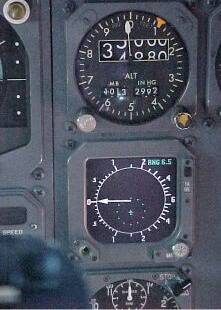

Higher per seat costs and a slightly shorter range than the -400 did not prevent the -300 from flying from Frankfurt to Tokio. There are still about 3,000 km left
Found your own airline, buy the planes you like because they have the right gauges for your nostalgia, demand $10000 per seat in economy for your plane...and try to stay afloat.


