Updates LRO/LCROSS News and Updates

Perhaps the dark zones were iluminated by the sun in the past, and no ice survived the heat, and the centaur hit hard rock.
 
I completely understand what you're saying, but just have the CSM at the right place, and the right time to take pictures. It would be a challenging thing to do, but possible....

I'm doubtful that in 1969 the technology to take high-resolution photographs -- infrared, spectrographic, or otherwise -- in order to analyze the molecular makeup of the moon dust in mid-flight yet existed. You might have been able to get photos of a dust plume in that era but you wouldn't have been able to conduct any serious science based on that, I think. (It took the combined scientific efforts of laboratories around the world years to decipher the lunar samples they could actually get their hands on.)
 
They found the plume after all.
lcross_debris_plume.jpg
 
LRO finds evidence of life on the moon

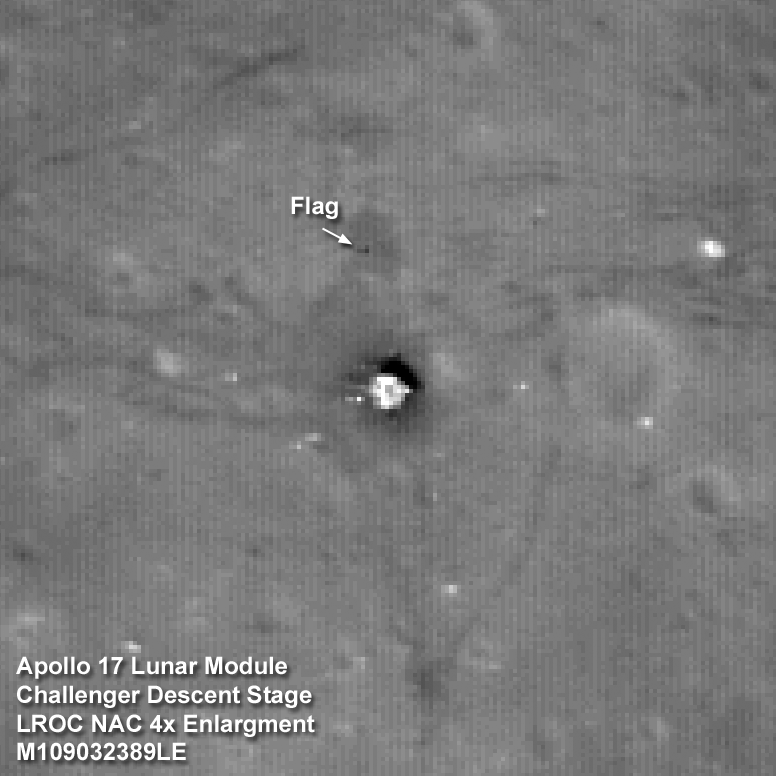
LRO has imaged the Apollo 17 landing site and even found the flag.

challenger_4x.png
 
I've made a comparison of the LRO image and the Apollo 17 ascent footage:

4c8.jpg


End of story!
 
People already started to claim that this is another NASA fake... :sick:


And you didn't see that coming?!?


I love the comparison between LRO and Apollo. Nicelly done.

I love how the scenery hasn't changed. While I completelly understand why, it's just hard to let go of the fact that nearly 40 years have passed... and nothing's changed.
 
Moonwalker would you consider putting a credit on that so it may be posted elsewhere?

I'll see...

And you didn't see that coming?!?

Of course. NASA can't do anything, certain people will always remain donkeys.

I love the comparison between LRO and Apollo. Nicelly done.

Thanks. I've done more already after the first LRO images were available. It's basically comparisons with video still images from onboard the LMs during approach. It's amazingly "easy" (if you have a good sense of direction) to actually figure out the track above ground the Apollo Lunar modules flew during approach, just by comparing the craters of the old footage with the latest LRO images. I think I'll add credits and maybe load them up as well...

I love how the scenery hasn't changed. While I completelly understand why, it's just hard to let go of the fact that nearly 40 years have passed... and nothing's changed.

Yes. The most amazing thing is that most of the stuff likely could last for thousands if not even millions of years as long as meteorites don't destroy it. I don't know the influence of the sun and temperatures that occur to all that Apollo materials up there. But since there is no atmosphere and most importantly no humidity at all, things are aging more than slowly I think. It is likely that the stuff still looks "new" i.e. the way it looked when Cernan and all the other guys left the surface (it's quite a nice museum up there for potentially future tourists...). It's strange to imagine that there is a possibility that some of the footprints could even last maybe for as long as the Moon will last...
 
Last edited:
Just imagine... since there's no atmosphere, there won't be any dust accumulation. After 40 years of sitting out there, stuff might still look shiney...

As far as the meteorites... the face of the Moon facing Earth is far better protected then the far side, because when the near side of the Moon is facing prograde, the influence of Earth is far more likely to clear meteorites.

As is, the statistical probability of an impactor landing anywhere on the Moon is around 25 times lower then entering Earth's atmosphere. Earth is a gian vacuum cleaner...

I sure hope the Apollo landing sites are closed off from tourists, with the only way of observing them by sky cranes or gondollas or something... the sites are a time capsule and I think they should be preserved as they are for generations to come.
 
from http://lcross.arc.nasa.gov/
NASA BRIEFS PRELIMINARY PLUME FINDINGS FROM MOON MISSION
NASA will hold a news conference Friday, November 13 to talk about early science results from its successful moon impacting mission, the Lunar Crater Observation and Sensing Satellite, or LCROSS. The satellite gained worldwide attention when it plunged into a crater near the moon's south pole on Oct. 9. The briefing from NASA's Ames Research Center in Moffett Field, Calif., will begin at 9 a.m. PST. It will be broadcast live on NASA Television: http://www.nasa.gov/ntv
 
Last edited:
Well, there *was* water on the moon.

And then we bombed the moon and vaporized all the water. :P
 
Back
Top