Updates LRO/LCROSS News and Updates

LCROSS Update

LCROSS is healthy and on Target. We have waived final Trajectory correction maneuver and are instead going to use the separation delta-v to do final targetting cleanup. We predict a 3sigma accuracy in the neighborhood of 700 Meters, error mostly being due to OD knowledge, centaur cold side off-gassing as it gets exposed to the sun, some error bands in the mass knowledge of the centaur, and map tie error on the lunar map.

LRO has performed successfully an orbital phasing burn (10secs) to modify it's orbit slightly to time their orbital position to be in view of the impact event. Hubble is preparing to reorient for lunar viewing and will record the event through 4 orbits (viewing time per orbit is limited due to the fast motion of the moon, so they are doing some tricks to support two viewing periods per orbit that limit image smear).

Centaur Lunar Impact target;
Lat -84.66051 deg
Long -48.568691 deg
Alt -3.82665205 km
dist to Moon Center 1733.5733479 km
Epoch 9 oct 2009 11:31:19.5157

We have good fuel margin (based on our past anomaly it was a worry for awhile. We should reach impact with more than 30kg remaining, we're at about 40kg with a knowledge error potential of +/-12kg or so, and we only need about 5kg to complete the rest of the mission. Knowledge error is based on temp and pressure accuracy, transducer drift and calibration error, etc. In general, we are in good shape.

---------- Post added at 06:39 PM ---------- Previous post was at 06:29 PM ----------

A note on terrain for Cabeus proper crater. We're hitting a point that is about 2.5 kilometers below the crater walls. There is a nicely aligned valley in the crater ridge that allows the Sun to illuminate down to 1.5 Kilometers, and the Earth viewing angle allows visibility down to about 2.1km. The ideal viewing ejecta to get the best water analysis will be in the sub 4km range, so Earth viewing spectrometers will be able to see a good portion of the 'wet' ejecta, 2 km or so. Smaller particles will reach the 10km range and illuminated should be visible from Earth. Impact time was tuned to Hubble visibility which comes around the limb of the Earth at 11:18 UTC (thus the 11:30 impact time). The other criteria was to make it viewable from Keck Observatories in Hawaii, so they need to be dark and the moon Above 30deg elevation (to keep Earth atmospheric water from skewing results too bad). As a result, about 2/3rds of North America will have decent viewing of the Moon in the dark at that time. There was other criteria as well, sun incedent angle, phase of the moon, libration of the Moon and Earth angle to impact target, etc. that all played a role in picking the impact day and time.
 
LRO has performed successfully an orbital phasing burn (10secs) to modify it's orbit slightly to time their orbital position to be in view of the impact event. Hubble is preparing to reorient for lunar viewing and will record the event through 4 orbits (viewing time per orbit is limited due to the fast motion of the moon, so they are doing some tricks to support two viewing periods per orbit that limit image smear).

Will one of the tricks Hubble will use be turning slightly to compensate for the Moon's motion, like Cassini did on the last Enceladus flyby at Saturn?

Also, since the Moon and Hubble both orbit prograde, shouldn't the Moon's orbital motion allow (very) slightly more viewing time per orbit than say, viewing a star?
 
Hubble will be using an attitude slewing motion tor track the Lunar target. I'm not privy to the full details, but I have heard this will give them in the neghborhood of 7 minutes of imaging time, and they plan to do the slewing motion twice per orbital view period to give them two imaging opportunities per orbit. This was done to provide the best imaging opportunity in terms of image smear, which is a major problem with the Hubble pointing to a near field object. Even though Hubble and Moon are both prograde orbits, the relative motion between hubble and the Moon is much greater than for fixed stars, and Hubble control systems weren't designed for accurate pointing control at such high motion rates. They are playing some tricks to catch the imaging point in the 'knee' of the motion curve where their slew motion and Moon motion are synchronized. So why they can 'see' the Moon a slightly longer time due to the prograde synchronicity, the ability to track the Moon through the whole orbital view period is beyond their pointing control capability.
 
Final Targetting Analysis

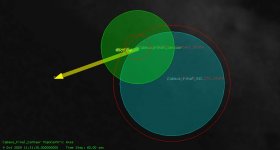
The picture contains our final assessment of the projected Centaur impact point (small red circle within Green region) and the SSC (LCROSS Shephard Spacecraft) (large red circle targeted at the Blue region). We are well within our targetting reuirement (the Green region). The SSC impact is target to be on the anti-sun side of the Centaur impact to get the best solar incidence on the ejecta for viewing by instruments on the spacecraft, particularly the side-viewing spectrometer which is designed to look directly at the Sun, thus materials between the sun and the instrument will make clear absorbtion lines that can be compared directly to our calibrated Sun spectra.
 

Attachments

  • Centaur Impact analysis prediction.jpg
    Centaur Impact analysis prediction.jpg
    27.4 KB · Views: 21
For those that like to follow things in real time, here is a scenario I made based on state vectors from JPL Horizons. The scenario starts just after the braking burn so the LCROSS is behind the Centaur and travelling 50 m/s slower than it. Impact is at 11:32:23 CT or 11:31:17 UTC, just two seconds earlier than predicted. Note that the impact point (67.55°W 83.84°S) is not accurate due to Orbiter not modelling the precession of the Moon's axis. No addon required, fly the trajectory in a DG. You could, of course, copy the state vectors into a scenario featuring BrianJ's excellent LRO/LCROSS addon.
Code:
BEGIN_DESC
Fly a DG on the same trajectory as LCROSS.
END_DESC

BEGIN_ENVIRONMENT
  System Sol
  Date MJD 55113.104930555
END_ENVIRONMENT

BEGIN_FOCUS
  Ship LCROSS_CENTAUR
END_FOCUS

BEGIN_CAMERA
  MODE Cockpit
  FOV 50.00
END_CAMERA

BEGIN_MFD Right
  TYPE Surface
END_MFD

BEGIN_SHIPS
LCROSS_CENTAUR:DeltaGlider
  STATUS Orbiting Moon
  RPOS -6918760.669020776 -37474466.09096159 -487358.5797526121
  RVEL 176.6615296453867 918.7445792950260 8.263302081888080
  AROT 89.26 -10.50 -161.78
  PRPLEVEL 0:1.0 1:1.0
  NOSECONE 0 0.0000
  GEAR 0 0.0000
  AIRLOCK 0 0.0000
END
LCROSS_SSC:DeltaGlider
  STATUS Orbiting Moon
  RPOS -6918766.334 -37474495.55 -487358.8447
  RVEL 167.2205651 869.6459726 7.821703156
  AROT 89.26 -10.50 -161.78
  PRPLEVEL 0:1.0 1:1.0
  NOSECONE 0 0.0000
  GEAR 0 0.0000
  AIRLOCK 0 0.0000
END
END_SHIPS
 
I'm really bummed out that the weather is going to be absolute crap through tomorrow night. But, I'll still be getting up to watch the live coverage.
 
Note that the impact point (67.55°W 83.84°S) is not accurate due to Orbiter not modelling the precession of the Moon's axis.
For anyone interested to try it, if you run the above scenario with the latest Orbiter Beta, the impact point is 84.648°S 48.733°W. Compare to the NASA predicted impact point of 84.661°S 48.569°W. This is an error of just 608 m and within the error of the precession model (approx 0.03°, approx 1 km) and within the impact site accuracy mentioned above by Likeshadow (700 m).

The impact time is the same as above (11:32:23 CT or 11:31:17 UTC) and I suspect that the difference from NASA predicted (11:31:19 UTC) is due to both Orbiter's spherical lunar surface (difference of approx 2 km) plus the depression of the crater floor itself. Impact velocity is approx 2.5 km/s, so it is at least a plausible explanation. EDIT: I just noticed that Likeshadow mentioned that the impact site is 1733.6 km from the lunar centre. That is 4.4 km below the surface in Orbiter, a difference in impact time of approx 1.8 s.

Overall a very pleasing result. Now, if we just had some high res polar textures...

---------- Post added at 17:30 ---------- Previous post was at 16:01 ----------

Some pictures featuring tofitouf's/McWgog's L9 Moon textures.

On target for impact:
picture.php


10 ms before impact:
picture.php
 
Last edited:
Here we go. Hope all the data acquisition and relay systems work OK for those last 4 minutes!!

Link to Mauna Kea Observatory webcast on the LCROSS home page:
http://lcross.arc.nasa.gov/

NASATV live coverage just started:
http://www.nasa.gov/multimedia/nasatv/index.html


For anyone interested to try it, if you run the above scenario with the latest Orbiter Beta, the impact point is 84.648°S 48.733°W. Compare to the NASA predicted impact point of 84.661°S 48.569°W. This is an error of just 608 m and within the error of the precession model (approx 0.03°, approx 1 km) and within the impact site accuracy mentioned above by Likeshadow (700 m).

The impact time is the same as above (11:32:23 CT or 11:31:17 UTC) and I suspect that the difference from NASA predicted (11:31:19 UTC) is due to both Orbiter's spherical lunar surface (difference of approx 2 km) plus the depression of the crater floor itself. Impact velocity is approx 2.5 km/s, so it is at least a plausible explanation. EDIT: I just noticed that Likeshadow mentioned that the impact site is 1733.6 km from the lunar centre. That is 4.4 km below the surface in Orbiter, a difference in impact time of approx 1.8 s.

Beautiful :-) Tip 'o the hat to the "Moon .cfg in Orbiter Beta" thread team:speakcool:

---------- Post added at 11:36 AM ---------- Previous post was at 11:20 AM ----------

Anybody recognise the LCROSS model they used for the seperation animation on NASATV ?!! Yessssss :-) Thanks, Mr.Shirley at ARC.
 
Thanks Pete. I'm well chuffed ;-)

Couldn't see anything that looked like an ejecta plume on the webcast though. I wonder if they could see anything from Mauna Kea?
 
I was expecting a visual on the plume from the LCROSS. Ah well, those last few pictures were awesome, just a couple shots of the crater floor before impact.

Looking forward to the LRO data coming down in a couple hours, that might have gotten a clearer look at it.
 
Thanks Pete. I'm well chuffed ;-)

So you should be! That's a fairly significant event that you've just supplied the 3D model to!

Maybe one day Orbiter will finally make it into the big times! :)
 
Congrats to the LCROSS team on a spectacularly successful mission! I got to see it live on Good Day Atlanta (but the dang anchors wouldn't shut up with their misinformation for 5 freaking seconds!) and it looked great. I hope some really useful data is able to be gathered even if water wasn't at this particular site.
And congrats BrianJ on leaving your mark on history!
 
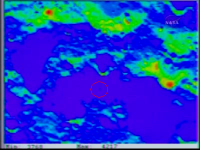
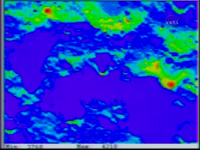
I think that I've been able to find the Centaur impact on LCROSS's thermal IR camera. It occurs just as the Flight Director says "All stations, flight. mark Centaur impact" and is in the same location as where LCROSS impacts.
 

Attachments

  • vlcsnap-2718607.png
    vlcsnap-2718607.png
    202.8 KB · Views: 30
  • vlcsnap-2719221.png
    vlcsnap-2719221.png
    194.6 KB · Views: 26
Back
Top