Likeshadow
New member
LCROSS Update
LCROSS is healthy and on Target. We have waived final Trajectory correction maneuver and are instead going to use the separation delta-v to do final targetting cleanup. We predict a 3sigma accuracy in the neighborhood of 700 Meters, error mostly being due to OD knowledge, centaur cold side off-gassing as it gets exposed to the sun, some error bands in the mass knowledge of the centaur, and map tie error on the lunar map.
LRO has performed successfully an orbital phasing burn (10secs) to modify it's orbit slightly to time their orbital position to be in view of the impact event. Hubble is preparing to reorient for lunar viewing and will record the event through 4 orbits (viewing time per orbit is limited due to the fast motion of the moon, so they are doing some tricks to support two viewing periods per orbit that limit image smear).
Centaur Lunar Impact target;
Lat -84.66051 deg
Long -48.568691 deg
Alt -3.82665205 km
dist to Moon Center 1733.5733479 km
Epoch 9 oct 2009 11:31:19.5157
We have good fuel margin (based on our past anomaly it was a worry for awhile. We should reach impact with more than 30kg remaining, we're at about 40kg with a knowledge error potential of +/-12kg or so, and we only need about 5kg to complete the rest of the mission. Knowledge error is based on temp and pressure accuracy, transducer drift and calibration error, etc. In general, we are in good shape.
---------- Post added at 06:39 PM ---------- Previous post was at 06:29 PM ----------
A note on terrain for Cabeus proper crater. We're hitting a point that is about 2.5 kilometers below the crater walls. There is a nicely aligned valley in the crater ridge that allows the Sun to illuminate down to 1.5 Kilometers, and the Earth viewing angle allows visibility down to about 2.1km. The ideal viewing ejecta to get the best water analysis will be in the sub 4km range, so Earth viewing spectrometers will be able to see a good portion of the 'wet' ejecta, 2 km or so. Smaller particles will reach the 10km range and illuminated should be visible from Earth. Impact time was tuned to Hubble visibility which comes around the limb of the Earth at 11:18 UTC (thus the 11:30 impact time). The other criteria was to make it viewable from Keck Observatories in Hawaii, so they need to be dark and the moon Above 30deg elevation (to keep Earth atmospheric water from skewing results too bad). As a result, about 2/3rds of North America will have decent viewing of the Moon in the dark at that time. There was other criteria as well, sun incedent angle, phase of the moon, libration of the Moon and Earth angle to impact target, etc. that all played a role in picking the impact day and time.
LCROSS is healthy and on Target. We have waived final Trajectory correction maneuver and are instead going to use the separation delta-v to do final targetting cleanup. We predict a 3sigma accuracy in the neighborhood of 700 Meters, error mostly being due to OD knowledge, centaur cold side off-gassing as it gets exposed to the sun, some error bands in the mass knowledge of the centaur, and map tie error on the lunar map.
LRO has performed successfully an orbital phasing burn (10secs) to modify it's orbit slightly to time their orbital position to be in view of the impact event. Hubble is preparing to reorient for lunar viewing and will record the event through 4 orbits (viewing time per orbit is limited due to the fast motion of the moon, so they are doing some tricks to support two viewing periods per orbit that limit image smear).
Centaur Lunar Impact target;
Lat -84.66051 deg
Long -48.568691 deg
Alt -3.82665205 km
dist to Moon Center 1733.5733479 km
Epoch 9 oct 2009 11:31:19.5157
We have good fuel margin (based on our past anomaly it was a worry for awhile. We should reach impact with more than 30kg remaining, we're at about 40kg with a knowledge error potential of +/-12kg or so, and we only need about 5kg to complete the rest of the mission. Knowledge error is based on temp and pressure accuracy, transducer drift and calibration error, etc. In general, we are in good shape.
---------- Post added at 06:39 PM ---------- Previous post was at 06:29 PM ----------
A note on terrain for Cabeus proper crater. We're hitting a point that is about 2.5 kilometers below the crater walls. There is a nicely aligned valley in the crater ridge that allows the Sun to illuminate down to 1.5 Kilometers, and the Earth viewing angle allows visibility down to about 2.1km. The ideal viewing ejecta to get the best water analysis will be in the sub 4km range, so Earth viewing spectrometers will be able to see a good portion of the 'wet' ejecta, 2 km or so. Smaller particles will reach the 10km range and illuminated should be visible from Earth. Impact time was tuned to Hubble visibility which comes around the limb of the Earth at 11:18 UTC (thus the 11:30 impact time). The other criteria was to make it viewable from Keck Observatories in Hawaii, so they need to be dark and the moon Above 30deg elevation (to keep Earth atmospheric water from skewing results too bad). As a result, about 2/3rds of North America will have decent viewing of the Moon in the dark at that time. There was other criteria as well, sun incedent angle, phase of the moon, libration of the Moon and Earth angle to impact target, etc. that all played a role in picking the impact day and time.
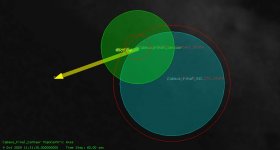


 Tip 'o the hat to the "Moon .cfg in Orbiter Beta" thread team:speakcool: