An SSTO as "God and Robert Heinlein intended".

So if SpaceX did offer an IPO tomorrow you would not buy that stock? Even considering that if they succeeded at Elon's avowed dedication to reducing the cost of space to the $100 to $200 per kg range by reusability would mean they would dominate the market?

I would, but not because of such promises, that had already been empty from a government agency. and if you would ask me, how much of my eggs I would put into his basket, I would be rather discrete... but you can be sure, it wouldn't be more than 20% of my eggs.

SpaceX is a pretty promising company, which has a pretty good performance in spaceflight, but no outstanding performance. It doesn't redefine spaceflight that much, except that it has a slightly different relation to its main customer. But then, practically, I don't see them do something really new. They build old school rockets with modern avionics and modern project management. Their current prices are in a realistic range, their promises where they want to end in a undefined future are not. These promised prices are not the "Agenda 2022" of SpaceX.

The Microsoft of Spaceflight is not NASA, it is EADS Astrium, but I am not sure if Elon Musk realized that, when he compares SpaceX to NASA or Lockheed-Martin in NASA/Air Force contracts.
 
But that is for the 53,000 kg launcher, which is about $2,000 per kg, about $1,000 per pound.

The cost increases apply to F9 as well, and Falcon 9S9/Falcon 9 Heavy, before Falcon Heavy was announced.

So if SpaceX did offer an IPO tomorrow you would not buy that stock? Even considering that if they succeeded at Elon's avowed dedication to reducing the cost of space to the $100 to $200 per kg range by reusability would mean they would dominate the market?

If they could reduce launch prices by 25% they could dominate the market (or be well on their way to dominating the market) anyway.

If SpaceX proved themselves in several key areas, I might buy their stock. But I wouldn't bet on them cutting launch costs to $100-200/kg.

Yes, I am going to keep emphasizing that point about privately financed launchers cutting the cost to space until it sinks in.

I agree that more efficient development can cut launch costs, but this has nothing to do with SSTO. Privately developed vehicles can be TSTO. Privately developed vehicles can be expendable. Etc.

It also has nothing to do with a large number of your 'mantras' that you almost obsessively repeat rather than actually answering questions or substantiating your claims (which is pretty much what you've just done here- again).

What that means is that it would only cost $300 million if it were privately financed.

Falcon 9 officially cost something like $500 million to develop (I believe this includes some Falcon 1 development, but this is fair since F1 was a sort of precursor to F9)...

Then any of the large defense contractors could develop their own manned launchers out of their own "pocket change".

Lockheed Martin and Boeing relatively recently developed launchers (not manned, though potentially so and hopefully in future for Atlas), and both are the epitomy of "large defense contractor". Their development cost was more akin to that usually expected (in the $4-5 billion range, I believe).

Which further highlights your almost cargo-cult thinking: reductions in development costs don't magically happen because the vehicle in question is developed by a private entity rather than a government one. Reductions in development costs occur due to the way the development is conducted.

The technology used is a large part of this. SSTO is again at a disadvantage here.
 
Then any of the large defense contractors could develop their own manned launchers out of their own "pocket change".

I wanted to give T.Neo time to reply first to it, but now...do you remember Orbital Sciences? Minotaur series? Pegasus? Cygnus today?

They have never been a large defense contractor, but essentially did all this with a high individual risk for the company, being practically the preferred ICBM disposal company of the Air Force. They have a mere billion of assets, 3700 employees, and still they started really small once in 1982. Launched almost 600 rockets in their history, almost as many as NASA did, if I remember correctly. How many rockets did SpaceX launch so far?
 
How many rockets did SpaceX launch so far?

Well, SpaceX has been around for roughly 10 years. It has launched (successfully) four times.

Within the first 10 years of its life, Orbital had only launched- if I read correctly, twice. Taurus first launched in 1994, Minotaur only in 2000.

So maybe it is a bit unfair to compare SpaceX to a company that has been launching vehicles for over 20 years already, and they're also different companies... a lot of comparisons between the two could be flawed. But I agree, OSC definitely deserves mention.
 
actually wrong, they had already 8 launches until 1990 - makes 8 launches in 8 years.

A launch a year for 8 years? If Pegasus was first launched only in 1990, what were the other vehicles being launched?

Do vehicles not developed or manufactured/integrated in-house count?
 
A launch a year for 8 years? If Pegasus was first launched only in 1990, what were the other vehicles being launched?

Do vehicles not developed or manufactured/integrated in-house count?

Not sure what launches this had been, but I think it had been mostly sounding rockets in 1990 and two Pegasus launches.
 
Ok, here are a few that jumped out at me.
This is a baseless and most likely incorrect assumption. Even if your aerospike made out of wonder-materials performs as advertised you do not appear to have accounted for the structural modifications that would need to be made to the stage itself to accomidate the spike and repositioned engines.
I'll repeat what Urwumpe said...
*Which modern materials?
*Is it really only because of the materials or are different structural solutions also required?
*How probable?
*Where are you getting "half"?
You do realize that altitude compensation does not increase ISP correct? It simply cuts your ambient pressure losses. Have you actually plotted out your thrust curve from sea-level up through MAX-Q and back?
Speaking as an engineering student, I stopped and laughed at this point. :lol: The modifications you propose would require signifigant structural changes and re-working of the engine's auxillary components. (Fuel-pumps, cooling, etc...) Depending on how much re-design is actually required it might actually be easier to start from scratch.
Mass has very little to do with cost. The chief driver of $ per Kilogram is the number of man-hours required per launch. (and in the case of a re-usable booster recovery/refurbishment as well)

1.)Lightweight aerospikes.

Ceramic Materials for Reusable Liquid Fueled Rocket Engine Combustion Devices.
Part of the Integrated High Payoff
Rocket Propulsion Technology (IHPRPT) program, the efforts
of the directorate include:
1.Developing continuous fiber reinforced ceramic matrix
composites (CMCs) for actively cooled thrust chambers and
nozzles
2.Demonstrating the feasibility of a transpiration-cooled thrust
chamber
3. Evaluating ceramic matrix composites for radiation cooled
nozzles.
The goal is to develop and demonstrate these new technologies
so that they may be incorporated into future rocket
engines. Using lightweight ceramics has the potential to reduce
the weight of the combustion devices by up to 50%.

...
Table 1 lists the materials and type of construction of
numerous combustion devices, both historical and current. As
the table shows, the materials of choice (for all the engine manufacturers)
for combustion devices in large liquid fueled rocket
engines have historically been stainless steels, nickel-based
superalloys, and copper alloys. These materials are selected for
their high strength and high thermal conductivity in order
to cope with the stresses and extreme thermal environments
of rocket engines. Since these alloys also have high densities
(8-9 g/cm3), widespread reliance on them has traditionally
resulted in heavy engines.
Designers would like to reduce the weight of rocket
engines. A key performance criterion for engines is thrust-to-weight
ratio. Lighter engines and launch vehicles would allow
heavier payloads to be placed into orbit at a lower cost. One
path to lighter weight engines is replacement of conventional
high-density engine alloys with lightweight, high specific
strength ceramic composites. Two attractive candidates for
this application are carbon fiber reinforced silicon carbide
(C/SiC) and silicon carbide fiber reinforced silicon carbide
(SiC/SiC). These materials have low densities (2.0-2.4 g/cm3)
and high strengths that they maintain to relatively high temperatures
(2400-3000°F).
http://ammtiac.alionscience.com/pdf/AMPQ8_1ART06.pdf

  Reportedly such lightweight, high temperature ceramics have already been used on hypersonic, scramjet test vehicles. Keep in mind also that for this application while you are adding on the weight of the aerospike you are also removing much of the weight of the nozzles.
  For the size of the engines fitting within the Falcon 9 diameter around a central spike, remember most of the nozzles will be removed. As it is now, 8 engines are in a square pattern with the ninth engine in the center. So there are 4 corner engines with 1 engine between any pair of these corner engines. Then these engines between the corner engines can be moved outside instead to the circumscribed circle around the square. Taking into account the extra space without much of the nozzle width the ninth engines should fit in this space as well.
  Furthermore, I realized that you don't need all 9 engines now. With the upper stage removed and with the smaller payload, and with the higher thrust and lighter weight of the Merlin 1D, you would need only 5 to 6 of the engines for liftoff. This makes the dry mass even lighter, which can go to further payload.
  The engines combustion chamber and turbopumps will not have to be changed, only the nozzle. From images of the Merlin 1C it looks like the nozzle is bolted on. So you would bolt on a shorter nozzle, like you bolt on a longer addition when you producing the Merlin Vacuum.

2.)Weight of added reentry/landing systems.
a.)Thermal protection.

  Robert Zubrin has given an estimate of 15% of the landed weight for the weight of thermal protection systems(TPS):

Reusable launch system.
http://en.wikipedia.org/wiki/Reusable_launch_system#Reentry_heat_shields

  However, I gather this was in relation to the older capsules, Mercury, Gemini, Apollo, etc. Indeed the weight of the ablative heat shield on the Apollo capsule was about 15%:

Apollo Command/Service Module.
2.7 Specifications
http://en.wikipedia.org/wiki/Apollo_Command/Service_Module#Specifications

  However, the space shuttle with its mostly silica tiles was able to reduce the TPS weight to about 8% of the maximum landing weight of 104,000 kg:

Space Shuttle thermal protection system.
3.3 Weight considerations.
http://en.wikipedia.org/wiki/Space_shuttle_thermal_protection_system#Weight_considerations

   Also, for the X-37b the TUFROC leading edge material instead of the shuttles RCC and the TUFI AETB material instead of the shuttles silica tiles are either of equal or lower weight than the shuttles TPS materials while being tougher and requiring less maintenance:

X-37B Orbital Test Vehicle.
http://www.boeing.com/defense-space/ic/sis/x37b_otv/x37b_otv.html

   For ablative TPS, the PICA-X material used on the Dragon capsule weights about half the weight of the AVCOAT material used on the Apollo heat shield:

Re: Dragon v/s Orion.
http://forum.nasaspaceflight.com/index.php?topic=23522.msg754168#msg754168

while being able to survive lunar and even Martian reentry speeds.

   SpaceX has found that at least for LEO reentry speed judging from the minimal degradation on the Falcon 9/Dragon test flight, the PICA-X heat shield could be reused hundreds of times.

   Also, for vertical powered landings a la the DC-X, you might not even need an extra heat shield for base first landings. One proposal for a VTVL SSTO uses low thrust during the descent as well as the high temperature-resistant aerospike to serve as the reentry thermal protection. You would need to retain more mass in propellant or some inert gas for this purpose though.

b.)Weight of the wings and the landing gear.

  A common estimate is that the weight of wings is 10% of the landed weight. This comes from aircraft examples though where the wings have to carry the weight of the fuel which can be as much as the dry weight of the aircraft itself or more.
   An example where the propellant will not be carried in the wings and lightweight composites will be used is the Skylon. According to their released specifications the wing weight will be less than 2% of the take-off weight, which is the appropriate weight to compare to for a horizontal take-off vehicle:

The SKYLON Spaceplane.
by Richard Varvill and Alan Bond
Journal of the British Interplanetary Society, Vol. 57. pp. 22–32, 2004
p. 32.
http://www.reactionengines.co.uk/downloads/JBIS_v57_22-32.pdf

   On that same page the landing gear weight is the only 1.5% of the take-off weight.
   For a vertical take-off vehicle these low weight proportions should apply to the dry weight.

3.)Increasing Isp with altitude compensation.

   The most important characteristic for having a high vacuum Isp for an engine is having a long nozzle, i.e., area ratio, much more so than the chamber pressure. For instance the RL-10B2 while having a combustion chamber pressure of only 40 bar, has a vacuum Isp ca. 465 s. This comes from its very long vacuum optimized nozzle. And the Merlin Vacuum increases its vacuum Isp to 342 s from the 304 s of the Merlin 1C just by having a long nozzle extension attached.
   The problem with this for a SSTO is that long nozzles give poor performance at sea level. In fact it's even worse then this. A vacuum optimized nozzle used at sea level can cause instabilities in the exhaust that can damage or destroy the engine. So the purpose of the altitude compensating nozzle is they can give this high performance of vacuum optimized nozzles, yet still work efficiently as well at sea level.

4.)Saving weight and increasing payload with a next-gen shuttle.

   My comment about the shuttle orbiter being too heavy for high payload delivery was only in regards to the fact that every extra pound you take to LEO has to be subtracted from your payload capacity. The shuttle orbiter at ca. 80,000 kg subtracts majorly from the payload capacity of such a large launcher. With the lightweight composites now available we can cut significantly into that orbiter dry mass and therefore increase our payload.


     Bob Clark

 
Last edited:
1. Ceramic isn't all - you also need a thrust structure inside the spike for taking up the pretty high pressure and carry the ceramic. This all has mass, and you can be sure, it isn't less than for an ablative cooled nozzle extension. Also, it isn't just done by moving the engines - the size of the Aerospike has to be scaled for the exhaust that you produce, which means it will very likely result in an increase in diameter of the rocket for having the same thrust at lift-off. especially since aerospike engines have a lower performance at sea level as traditional nozzles, better performance at medium altitudes, but loose against optimized vacuum nozzles. Which again gives TSTOs arguments...but no SSTOs.

2. You can't just remove the nozzle and the engines will work for a aerospike. This is a lot more design work involved, especially since you often change also the complete propellant flow in the engines, if you remove the nozzle.

3. Skylon landing gear is much more complex, since it also requires water cooling for a launch abort that adds to the complete take off mass, also it has a lot of limitations that reduced the mass but increased the requirements on the spacecraft. Generally, you are much closer to reality, especially for smaller vehicles, with 3-4% of the landing weight. It is actually not even sure if the landing gear like that will survive a launch abort, they are still at a very early design there.

4. You still didn't show concrete numbers for a complete system. You still just mention parts and materials, but never combine them into one system. Your numbers are completely worthless that way. I could for example design a very light dish (for food) from magnesium - but it would be worthless in actual use like that with that material (just put magnesium in a microwave)
 
4. You still didn't show concrete numbers for a complete system. You still just mention parts and materials, but never combine them into one system. Your numbers are completely worthless that way. I could for example design a very light dish (for food) from magnesium - but it would be worthless in actual use like that with that material (just put magnesium in a microwave)

This is only a first order analysis using general mass numbers. A more extensive analysis would use expensive computer software for calculating the various components and their interactions.
This is what you do before you proceed to the expensive detailed calculations.

Bob Clark
 
This is only a first order analysis using general mass numbers. A more extensive analysis would use expensive computer software for calculating the various components and their interactions.
This is what you do before you proceed to the expensive detailed calculations.

Bob Clark

wrong. You mistake a first research into possible solutions as first order analysis. A first order analysis is not even using expensive computer software, you need Excel or similar at most. What you mean is the second phase. When you go over to first one-dimensional simulations (Special software is now getting a bit more expensive, but the price is peanuts compared to the full R&D budget for that phase already), later 3 dimensional (OpenFOAM does not cost anything BTW, being capable to use it properly is a real complex skill though). Eventually you start putting it all together into CAD and simulation models and simulation results that are thousands of Gigabyte large.

The first order research is really just turning ideas into quantifiable and comparable models. You want to compare an aerospike to 9 classic engines, so find a way to describe them in numbers in a comparable scenario.
 
1.)Lightweight aerospikes.

1. What advantage, exactly, does an aerospike provide? If I understand correctly, an aerospike allows for some kind of altitude compensation, but it does not greatly improve vacuum ISP (and in fact diminishes it slightly). Considering that most of the ascent is spent in a vacuum or near-vacuum, shouldn't a scheme to increase vacuum ISP (such as an extendible nozzle or TAN) be more relevant?

2. Other issues aside, what is the kind of cost difference between a ceramic aerospike and a conventional, metal nozzle? How much more (or less) would it cost to manufacture and refurbish?

Furthermore, I realized that you don't need all 9 engines now. With the upper stage removed and with the smaller payload, and with the higher thrust and lighter weight of the Merlin 1D, you would need only 5 to 6 of the engines for liftoff. This makes the dry mass even lighter, which can go to further payload.

Have you done any calculations to show this, or is this just a guess?

The engines combustion chamber and turbopumps will not have to be changed, only the nozzle. Form images of the Merlin 1C it looks like the nozzle is bolted on. So you would bolt on a shorter nozzle, like you bolt on a longer addition when you producing the Merlin Vacuum.

1. What images?

2. How can you tell from a superficial image, how the entire mating arrangement between the nozzle/chamber/etc is laid out?

3. You do realise integrating systems is more complex than just bolting bits of hardware together, right? They have to be built to accomodate eachother. The system has to then accomodate a different dynamic during operation, etc.

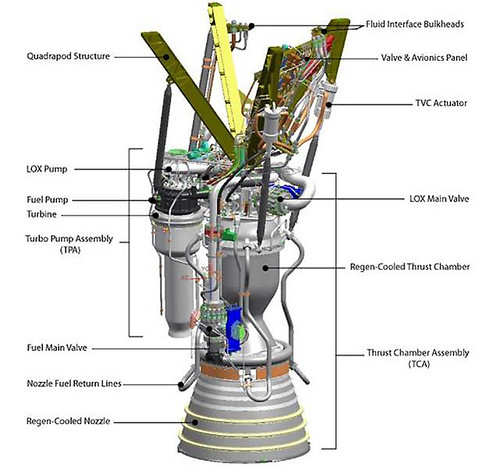
4. The nozzle and chamber are integral to eachother geometry wise. They are labeled as the "Thrust Chamber Assembly" on this diagram. Assuming you figured out how to somehow modify the engine to work as part of an aerospike, and fixed all the annoying 'little' problems (such as where the gas generator exhaust goes), how do you propose to link up the combustion chamber geometry to the aerospike nozzle?

2230438397_487afd40a2.jpg


5. Doesn't MVac have a different throat geometry from the normal Merlins?

while being able to survive lunar and even Martian reentry speeds.

I thought it was pretty obvious that AVCOAT was already capable of surviving lunar reentry speeds. :uhh:

Also, for vertical powered landings a la the DC-X, you might not even need an extra heat shield for base first landings. One proposal for a VTVL SSTO uses low thrust during the descent as well as the high temperature-resistant aerospike to serve as the reentry thermal protection. You would need to retain more mass in propellant or some inert gas for this purpose though.

The idea is to use a plug nozzle or similar as the heat shield, and cool it regeneratively as is done while the engine is operating. It dates back at least to the Bono designs of the 1960s.

which is the appropriate weight to compare to for a horizontal take-off vehicle:

What if you are discussing a vehicle with a wing planform more like that of STS than Skylon? Skylon is a specific case with specific requirements, and specific design outcomes.
 
Last edited:
Considering that most of the ascent is spent in a vacuum or near-vacuum, shouldn't a scheme to increase vacuum ISP (such as an extendible nozzle or TAN) be more relevant?

Most of the time during a rocket launch may be spent in a vacuum, but typically most of the fuel is used in the atmosphere. So an altitude-compensating engine is a very good idea if you're trying to build an SSTO... so long as the added complexity doesn't cost more than you gain.

If I remember correctly, the shuttle's SRBs make up about half the launch mass and that's all burned to get the shuttle above most of the atmosphere. Similarly for the Saturn V, where most of the fuel is in the first stage. That's not a problem for a multi-stage rocket, but it could be a big problem for an SSTO... a small reduction in ISP in atmospheric flight could result in a large increase in fuel mass.

Certainly it's enough of a problem that the early Kistler SSTO design relied on being launched from high altitude where it could use rockets designed for vacuum... the numbers just didn't work otherwise.
 
Due to the exponential nature of the rocket equation, a small increase in ISP can lead to a large increase in performance. So while you may burn some 60% of your first stage propellant climbing up to 30 kilometers, if you can reduce the remaining 40% of propellant by whatever amount, that reduction in mass will cause a ripple effect throughout the rest of the system.

TAN allows you to use high expansion ratio engines (that give high ISP for their chamber pressure in a vacuum) at sea level, where they would be grossly overexpanded otherwise. By injecting propellant into the nozzle, the engine can operate at sea level at increased thrust, but decreased ISP.

This not only allows for greater vacuum ISP later in the flight, but greater thrust (and engine T/W) earlier on in the flight (which can reduce gravity losses).

Another advantage of TAN in a vehicle with a high mass ratio that requires a high initial T/W (such as an SSTO, though TAN isn't intrinsically linked to SSTO) is that acceleration can be limited without the need to deep-throttle the engine(s), by shutting off the TAN propellants.
 
Last edited:
1. What advantage, exactly, does an aerospike provide? If I understand correctly, an aerospike allows for some kind of altitude compensation, but it does not greatly improve vacuum ISP (and in fact diminishes it slightly). Considering that most of the ascent is spent in a vacuum or near-vacuum, shouldn't a scheme to increase vacuum ISP (such as an extendible nozzle or TAN) be more relevant?

I looked at the paper talking about the Thrust Augmented Nozzle (TAN). I like that idea too. I wanted a method that could quickly be applied to an already existing engine. This seems to fit the bill.

The aerospike can be designed to have the same area ratio as a usual bell nozzle of long length. The advantage then is that it can also operate well at sea level, while the large bell nozzle would lose at sea level or even damage the engine.

There may very well be other methods of altitude compensation that can more easily adapted from current engines.


Bob Clark
 
I wanted a method that could quickly be applied to an already existing engine. This seems to fit the bill.

At least some people seem to believe that it is possible to augment already existing engines, but as I understand it the practicality (or downright possibility) of doing so depends on the engine.

Also, it would not just be a "hurz i just bolted this TAN thingy on mah engine lulz it works now betterer" excersise, but still far, far easier than building some sort of zombie aerospike as you suggested (if said zombie aerospike is possible at all).

The aerospike can be designed to have the same area ratio as a usual bell nozzle of long length. The advantage then is that it can also operate well at sea level, while the large bell nozzle would lose at sea level or even damage the engine.

So I take it aerospikes do improve vacuum ISP performance (i.e. higher ISP for chamber pressure)? I think I understand it more clearly now...

There may very well be other methods of altitude compensation that can more easily adapted from current engines.

Such as?
 
Last edited:
The problem is that real aerospikes never get the performance that was theoretically calculated for them. Especially at vacuum, the flow separation phenomena are really annoying. In theory, the critical outside of the engine is perfectly smooth and has no flow separation, in reality you have a strong boundary layer right where it disturbs the proper expansion.

Without more engine test data about them, especially about annular aerospikes (linear are tested better), you can't make much predictions about the possible performance there.
 
At least some people seem to believe that it is possible to augment already existing engines, but as I understand it the practicality (or downright possibility) of doing so depends on the engine.

Also, it would not just be a "hurz i just bolted this TAN thingy on mah engine lulz it works now betterer" excersise, but still far, far easier than building some sort of zombie aerospike as you suggested (if said zombie aerospike is possible at all).


So I take it aerospikes do improve vacuum ISP performance (i.e. higher ISP for chamber pressure)? I think I understand it more clearly now...


Such as?

I was including the TAN among the possibilities that might be adapted more easily than the aerospike to current engines.

The expansion-deflection nozzle Skylon was planning on might be another, but I've heard conflicting opinions on its effectiveness.


Bob Clark
 
I was including the TAN among the possibilities that might be adapted more easily than the aerospike to current engines.

The expansion-deflection nozzle Skylon was planning on might be another, but I've heard conflicting opinions on its effectiveness.

Based on my very cursory understanding of both TAN and expansion-deflection nozzles, it feels like TAN modification of existing engines would be more possible than changing already-existing engines to use expansion-deflection nozzles...
 
Really? Where did you hide the evidence for that?

In the post #217 in the section "Falcon 9 with aerospike nozzle becomes SSTO", I calculated the payload even with reentry/landing systems as 4,500 kg while the mass of the Dragon capsule is 4,200 kg.
But it will be more interesting to calculate some payloads using the online Schilling payload estimator:

Launch Vehicle Performance Calculator.
http://www.silverbirdastronautics.com/LVperform.html

This is interesting because it allows you to compare the payload when you use all 9 engines for the SSTO usage or reduce the engines to save on dry weight. I thought you would be able to increase payload by saving on dry weight by reducing the number of engines. But it occurred to me that keeping the large number of engines you reduce the time for the vertical thrust portion and therefore reduce gravity drag, which is a significant part of the delta-V required to orbit.
I found that the payload did indeed increase a fair amount with heavier engine weight, i.e., more engines.


Bob Clark
 
Back
Top