Science How i belive a flying car could be built

I'm confused about this, as there are several existing
electric aircraft
electric aircraft that can run for rather more than 20min on rather less than a ton of batteries...

That's because they're usually very light, low power designs, that often also utilise thermals and make use of solar power.

The engine power output I used- that of the Pratt & Whitney Canada PT6 has output powers in the hundreds of kilowatts; the output values that I can see for electric aircraft, are in the tens of kilowatts at most.

EDIT:

The Moller Skycar M400, which is the most comparable "aircraft", has four 134 kW engines, a far cry from the few tens of kilowatts used by those electric aircraft.

EDIT EDIT:

And with those running at full power for 20 minutes, you get something like 900 kilograms of lithium-ion batteries; quite close to my original estimate.

That is opposed to around 49 kilograms of Gasohol E-10 (10% ethanol, 90% petrol by volume), 50.8 kilograms of bio-diesel, 46.2kilograms of petrol, 48.72 kilograms of Avgas, and 71.46 kilograms of Ethanol (factoring in 30% engine efficiency).

It is clear which method of energy storage, is best...
 
Last edited:
That's because they're usually very light, low power designs, that often also utilise thermals and make use of solar power.

The engine power output I used- that of the Pratt & Whitney Canada PT6 has output powers in the hundreds of kilowatts; the output values that I can see for electric aircraft, are in the tens of kilowatts at most.

EDIT:

The Moller Skycar M400, which is the most comparable "aircraft", has four 134 kW engines, a far cry from the few tens of kilowatts used by those electric aircraft.

EDIT EDIT:

And with those running at full power for 20 minutes, you get something like 900 kilograms of lithium-ion batteries; quite close to my original estimate.

That is opposed to around 49 kilograms of Gasohol E-10 (10% ethanol, 90% petrol by volume), 50.8 kilograms of bio-diesel, 46.2kilograms of petrol, 48.72 kilograms of Avgas, and 71.46 kilograms of Ethanol (factoring in 30% engine efficiency).

It is clear which method of energy storage, is best...
I think you picked only the ones out of that page that you wanted to see. Plus, you're comparing to a turboprop, which are the sort of things you see in commercial airplanes and very high-end personal airplanes, not light airplanes. It's not exactly a fair comparison.

How about the SkySpark: http://www.skyspark.eu/web/eng/velivolo.php ... 75kW motor, they claim 2hours without refueling (uses hydrogen fuel cells).

Or the Yuneec International 430: [ame="http://en.wikipedia.org/wiki/Yuneec_International_E430"]Yuneec International E430 - Wikipedia, the free encyclopedia[/ame] ... 40kW motor, and they claim 2-2.5hours endurance.
 
No, but the engines of an M400 are a fair comparison; better than both a turboprop engine or that of a light aircraft; this cannot exactly be compared to a light aircraft, due to it's novel VTOL flightplan, relying on thrust for lift.

I purposely looked for the highest powers I could find; if I missed something, let me know. Hydrogen fuel cells are irrelevant to this particular case as I was referring to batteries in particular.

The total energy that both of those aircraft are producing in their total flight times is less than what the motors of the M400 outputs in 20 minutes; the SkySpark is producing less than half, and the Yuneec International 430 is producing less than a quarter of the energy that an M400 would output in 20 minutes.

I am not saying that an electric aircraft is not possible- which it is, but that various hydrocarbon fuels are far superior in terms of energy density than battery technology, even when factoring in engine efficiency. And that is what makes battery technology hopelessly inefficient for any sort of vehicle like a "flying car".
 
Last edited:
i have concluded that we do need wings... it's not a real flying car if it doesn't have them.... it'd be more of a "very compact helicopter" instead....

so i have devised a way to fold a rather long wing into a tiny space by using flexible sections which deploy then... inflate :blink:

look:
picture.php


inside the lift center of the wing, runs a parallel-hinged railing, which works similarly to the airbrakes on some sailplanes like this one:
rc-gliders-1.jpg


once the panels are fully deploy and locked, the railing is "pulled in", which pivots the hinges until they are locked perpendicular to the wing's surface - this forces up the flexible internal struts creating the curved profile we all know so well


wings such as this would not allow a very high top speed, i think... perhaps they could swing back according to airspeed so we could go faster :cool: - which would also add a lot to the "awesome factor"


i reckon an alternative solution would be to attach them to the roof of the vehicle (parasol style) - which should be even a little more stable, i believe.... but then, we'd have an odd-looking bulge on the top... and swinging them backwards would be a little more tricky :hmm:

i'll sketch that up later... :rolleyes:
 
i have concluded that we do need wings... it's not a real flying car if it doesn't have them.... it'd be more of a "very compact helicopter" instead....

so i have devised a way to fold a rather long wing into a tiny space by using flexible sections which deploy then... inflate :blink:

look:

inside the lift center of the wing, runs a parallel-hinged railing, which works similarly to the airbrakes on some sailplanes like this one:

once the panels are fully deploy and locked, the railing is "pulled in", which pivots the hinges until they are locked perpendicular to the wing's surface - this forces up the flexible internal struts creating the curved profile we all know so well
Keep in mind that when in the air, the wings are going to be supporting the entire weight of the vehicle. Somehow I doubt that the system you portray there would be able to do so effectively. If it were that easy to make folding wings that could support the weight of the vehicle, I think that someone would've done it that way already, don't you?

wings such as this would not allow a very high top speed, i think... perhaps they could swing back according to airspeed so we could go faster :cool: - which would also add a lot to the "awesome factor"
Going faster isn't about "swinging them back." Plenty of planes go 200+ knots on straight wings.
 
So, basically something like that?
oka-w-air2-.jpg

oka-w-air-anima.gif

oka-w-sapsan.jpg

The problem is the wings like that make it a lousy city flyer.

Something like this might be better:
oka-w-007-move.gif

But still, impractical.

Now, that would be a more realistic hovercar:
oka-w-airbag.jpg
 
Honestly I don't see why you don't just grab a car, give it an aerodynamic body, foldable wings stick a propeller on the front (or back) and let it fly away. Just saying.

Darren

Edit: Well of course you need vertical stabilisers and such but you get the basic idea.
 
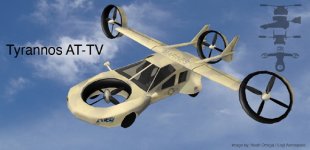
DARPA already got the T-Shirt:

Who remembers the "Transformer TX" flying-car project, intended to equip the US Marines with a small four-seat vehicle able to drive about on the ground like a jeep, hover like a helicopter, or fly like a plane? The first team to publicly offer a contending design has now stepped forward.

Quoted from:
http://www.theregister.co.uk/2010/07/07/tyrannos_transformer_tx/
(The article has some 5 pages, the link goes to the first one.)

I attached a photo so you can see it :-)
 

Attachments

  • tyrannos_1.jpg
    tyrannos_1.jpg
    140.4 KB · Views: 7
Keep in mind that when in the air, the wings are going to be supporting the entire weight of the vehicle. Somehow I doubt that the system you portray there would be able to do so effectively. If it were that easy to make folding wings that could support the weight of the vehicle, I think that someone would've done it that way already, don't you?

it seems so at first, but i'm not too sure.... we do have to consider the materials we have today which were not available even a couple of years back :hmm:

and it's not technically the -whole- weight of the vehicle... some of it (even if just a bit) is held by lift from the body itself, which has a flat underside with a hardly negligible area :rolleyes:

Going faster isn't about "swinging them back." Plenty of planes go 200+ knots on straight wings.

true... that was more of a brain-fart idea... i just thought i'd look "cool" :lol:
straight wings don't really imply slow, i mean, look at the lancair Legacy :tiphat:


still, perhaps a telescopic wing setup would be more suitable, then.... or even a combined folding-telescopic solution....

the telescopic sections could be extended by a scissor-armature like the one portrayed in the animation, but elegantly housed inside the wing, this time :idea:


Pyromaniac605 said:
Honestly I don't see why you don't just grab a car, give it an aerodynamic body, foldable wings stick a propeller on the front (or back) and let it fly away. Just saying.

isn't that what we're doing here?:lol:

but thing is.... cars have terrible aerodynamics (remember the Rocket Robin Reliant from Top Gear? :blink:)... and plus, the general configuration of a car makes it a very awkward platform to place rotor-ducts, which would probably make for a car that's too bulky to fit into any regular parking space :facepalm:


i'm gonna have to make another animation :P
 
Honestly I don't see why you don't just grab a car, give it an aerodynamic body, foldable wings stick a propeller on the front (or back) and let it fly away. Just saying.

It doesn't work that way; it's far, far, far more complicated than that.

Moach, I'm not trying to sound malicious here, but designs need to be based on simulations and experimental evidence, or at the very least, sound math. I can't stress this enough- without the proper math, things can become bad. HVIPS bad. :P

Those wings are far too small; I don't care what they're made of. Looks like they'd break if they held up only a few kilograms. The unfolding mechanism would be quite clumsy, too.

There comes a point where, if your engines are lifting enough, wings are a waste of time, and if your wings are lifting enough, it's a waste of time to get lift from the engines.
 
Last edited:
It doesn't work that way; it's far, far, far more complicated than that.

Moach, I'm not trying to sound malicious here, but designs need to be based on simulations and experimental evidence, or at the very least, sound math. I can't stress this enough- without the proper math, things can become bad. HVIPS bad. :P

Those wings are far too small; I don't care what they're made of. Looks like they'd break if they held up only a few kilograms. The unfolding mechanism would be quite clumsy, too.

There comes a point where, if your engines are lifting enough, wings are a waste of time, and if your wings are lifting enough, it's a waste of time to get lift from the engines.


yes, too much engine, you don't need wings... and too much wings and you don't need engine :uhh: - there's a fine line in between which we call VTOL :lol:

never mind that animation... it´s not really up to scale (or properly drawn, for that matter) i'm aware those wings are too small, but if i drew them any larger they wouldn't fit in the image :facepalm:

but scratch that idea... a telescopic wing is a lot more solid design... let me sketch that up, hold on :thumbup:


i'm trying to get my concepts sorted out before i go into specific math...
in my experience building airplane models i develped "an eye" for what flies and what doesn't - so i kinda trust my guesstimates when i'm just thinking out loud...
of course, going any further usually involves getting some proper figures straight :rolleyes:

i too, learned that the hard way...
don't worry, sooner or later everyone does something akin to pointing the thrusters towards the passenger cabin :cheers: (jokin')
 
yes, too much engine, you don't need wings... and too much wings and you don't need engine

Not so much "don't need", rather just "too much trouble".

if i drew them any larger they wouldn't fit in the image

I have a feeling they wouldn't even fit on the car...

I mean, too big a wingspan, and the thing becomes cumbersome flying in an urban environment. Even without wings, I wonder what sort of standoff distance these things would need to have...

but scratch that idea... a telescopic wing is a lot more solid design... let me sketch that up, hold on

A telescopic wing doesn't come without problems.

I mean, folding wings aren't impossible (see the various fold-up winged aircraft aboard aircraft carriers), but they usually have to be pretty sturdy and they can't unfold in flight (obviously, in the case of a fixed-wing aircraft, but still).

sooner or later everyone does something akin to pointing the thrusters towards the passenger cabin (jokin')

Well... it was more a case of trying to fit too much power into too small a powerplant. ;)

There's a lesson to learn there, but if a flying car has a power output of a terawatt, you are doing something wrong...
 
remember that "urban environment" doesn't equate to this:
8368-fifth_element_super.jpg


it's more like this:
images


there's no way we can have winged craft gleefully strolling between buildings - not only it's phenomenally unsafe, it doesn't solve the traffic problem (there's SOOOooo much more room up above) - and totally defeats the purpose.... if you're gonna drive between buildings, you might as well do it on the ground :thumbup:

people often make that mistakenn assumption when suggested flying cars... (i blame hollywood for that) but it's a totally impractical concept, which is not only madly dangerous, it also simply gives us traffic jams in the air :facepalm::lol:

once you get the picture of the open-spaced nature of aerial commute in your head - it all starts to make perfect sense again... even if every car on earth were to to magically sprout wings and take off - they would still be hundreds of meters apart... that third dimention really does make a lot of difference

i envision this type of traffic would involve a "safety layer" - a minimum altitude where speed is restricted and should be reserved for takeoff/landing transitions...
no building would be taller than the height of this layer - with the exception of the eventual skyscraper (which should have a "buffer zone" around)

at restricted speeds, the distance sensors should allow for the FWB system to simulate "soft walls" around anything that might oppose the trajectory of your vehicle - making the whole world baby-proof!

real traffic would take place on higher airways (the higher, the faster) - which would require automated guidance to be enabled in order for one to "enter"
such airways would be dynamically layed out by a central server which is monitored and coordinated with local airport traffic - then relayed over to the vehicles' computers by a common radio channel (using bytecode protocols)

pilots with advanced licences (which require special training) could be allowed to contact ATC by themselves and navigate manually along with "legacy" air traffic -- the flight computer in each car requires a login-and-password validation agains the central server before takeoff is even allowed - this also let's tthe system know what type of driver you are and what you should be permitted to do


as for the wings, they would only extend once the car is airborne and free of obstacles such as trees and buildings - their purpose is to minimize fuel consumption over mid-long range trips... for short hops they shouldn't even need to deploy - and for going a few blocks worth of distance, you can just well... drive there :rolleyes: - it is still a car, anyways

VTOL/winged mode transitions would be performed at hover speed, so the wings deploy without wind stress - once fully locked in place, the car (now an "airplane") can accelerate until wing lift outweighs the mass of the car, at which point all the engines have to do is push :thumbup:


:cheers:
 
Last edited:
Well, obviously you are going to be flying above the buildings. But it does not solve the crowded airspace issue; think about how crowded airports get... I'm pretty sure a city full of "flying cars" would be worse.

Elimination of wind stress doesn't eliminate the problems of folding wings; I am no Navy airplane maintainance officer, but I don't think those mechanisms are particularly practical for unfolding in the air...
 
Well, obviously you are going to be flying above the buildings. But it does not solve the crowded airspace issue; think about how crowded airports get... I'm pretty sure a city full of "flying cars" would be worse.

which is why the airways are coordinated by big computers and constantly monitored by engineers to ensure they fit around airport traffic - also, the flying cars can stop and hover if they need to... airliners usually cannot....

Elimination of wind stress doesn't eliminate the problems of folding wings; I am no Navy airplane maintainance officer, but I don't think those mechanisms are particularly practical for unfolding in the air...

i've seen F-18's deploy their own wings in videos... some sort of hydraulic contraption makes them move...
look at this[ame="http://vimeo.com/2079242"]folding wings[/ame] - if this (very awesome) WWII monster can do it like that, i sure think my little car could do it during hover :thumbup:
 
Last edited:
which is why the airways are coordinated by big computers and constantly monitored by engineers to ensure they fit around airport traffic - also, the flying cars can stop and hover if they need to... airliners usually cannot....

A costly solution for a costly problem is still... costly.

Hovering doesn't solve a problem... it just stops the vehicle. It doesn't remove you from the area.

- if this (very awesome) WWII monster can do it like that, i sure think my little car could do it during hover

It might need to move a big wing, but it also has a large aircraft to house all that machinery.

Stuffing fans and whatnot into a car sized, car shaped vehicle is difficult enough... it isn't like you can plonk a tank onto the thing and expect it to still fly.
 
A costly solution for a costly problem is still... costly.

Hovering doesn't solve a problem... it just stops the vehicle. It doesn't remove you from the area.

perhaps not as costly as one might think... the load on the servers would comparable to that on MMO-gaming ones... the amount of info being transmitted to and from each car is pretty slim - it's not like ppl would be downloading movies up there :lol:

it's obviously not gonna be "free" - but it's not like it's something that's never been done before...


and while stopping doesn't "remove" you from an unsafe area - it does, however stop you from entering one in the first place, provided a minimal antecipation...

also, upon an airway change notification, all cars involved would react within milliseconds, as opposed to regular ATC where instructions are given one-by-one, and might take some time to get a response


It might need to move a big wing, but it also has a large aircraft to house all that machinery.

Stuffing fans and whatnot into a car sized, car shaped vehicle is difficult enough... it isn't like you can plonk a tank onto the thing and expect it to still fly.

indeed... i have yet to model that thing in 3D so i can figure out the best way to do it :thumbup:
 
Except... an MMO server doesn't deal with people's lives (you hope). What happens if there's a computer glitch? etc?

Also, the entire sky is an unsafe area, so...
 
i've seen F-18's deploy their own wings in videos... some sort of hydraulic contraption makes them move...

if this (very awesome) WWII monster can do it like that, i sure think my little car could do it during hover :thumbup:

That is on the ground, not in flight. It also comes with quite a lot of mass penalties for the mechanism. For carrier planes, the additional mass is compensated by the fact that you can fit more, slightly less effective planes into the ship.

And especially, you need trained people right next to the plane to detect issues, for example if the wing did not lock during unfolding. Otherwise, you could try to get shot from the carrier with half of your wing flapping useless in the air.

---------- Post added at 05:43 PM ---------- Previous post was at 05:40 PM ----------

Just to give another thought to the discussion: Can you even imagine how terrible the turbulences are inside a normal city? Just as pedestrian, somebody who is practically immune to turbulences, you can get quite some buffeting by stronger winds.
 
Except... an MMO server doesn't deal with people's lives (you hope). What happens if there's a computer glitch? etc?

Also, the entire sky is an unsafe area, so...


it's not people's lives (usually) - but there are millions of dollars at stake... although none will admit it, for large corporations it's pretty much the same

if a glitch aboard a car happens (and it will, Murphy never fails) one of the other three redundant processors will identify the fault and reboot the offending module


That is on the ground, not in flight. It also comes with quite a lot of mass penalties for the mechanism. For carrier planes, the additional mass is compensated by the fact that you can fit more, slightly less effective planes into the ship.

And especially, you need trained people right next to the plane to detect issues, for example if the wing did not lock during unfolding. Otherwise, you could try to get shot from the carrier with half of your wing flapping useless in the air.


yes - that is correct... which is why i'm trying to devise a system that's as failsafe as possible - the .gif above was just a starting idea.... that particular design is hardly reliable - i'm still pondering over a something more solid...

and in the absence of maintenance folks around to check if the wings are locked ok - that job will have to go along with the million other responsabilities of the quadruply-redundant flight computer and sensor systems


Just to give another thought to the discussion: Can you even imagine how terrible the turbulences are inside a normal city? Just as pedestrian, somebody who is practically immune to turbulences, you can get quite some buffeting by stronger winds.

yes... the closer you are to the ground, the stronger the turbulence gets...
i've felt it up close - landing in the Congonhas regional airport (SBSP) is quite a white-knuckle experience

which is one of the reasons why no car should be able to takeoff without a selected destination and proper clearance from the system - and it's a damn good reason not to fly between buildings too

:cheers:
 
Back
Top