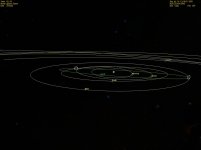
I must say too that in my first few months with Orbiter I had unlimited fuel on and completely polluted the solar system with my fuel exhaust. (sorry interplanetary EPA)
:rofl: I love the IEPA apology.
I spent a lot of time with Orbiter this weekend, trying everything from off-plane transfers to landing on Phobos. Landing on Phobos is impossible in Orbiter, as something is odd about the mesh. I never actually landed on it, but rather descended through it and finally came to rest in the very center. After that, I was stuck inside of Phobos, unable to escape, in a permanent orbit with Phobos around Mars. Sounds like the end of a sci-fi movie plot, eh? :lol:
As for off-plane transfers from orbit, I tried every thing imaginable in Transx, before finally trying my escape at different times, angles, etc. What I found is no matter what direction I burn I pretty much wind up in the same orbit around the sun, meaning the theory of relativity still holds even in Orbiter.

Relative to earth, that 51.6 degree inclination seems large. But, after ejection, my inclination to the sun is much different and is based more so on the orbit of earth around the sun rather than my orbit around the earth - a physics lesson learned the hard way.
What I did find with the different ejection directions is the fuel costs involved and the differences in the orbits around the sun after ejection. And they are minimal. Here were a couple of test scenarios, all done from the "DG in Orbit" scenario:
Scenario 1: Planned ejection from orbit on night side of earth
- Fast forwarded time until Earth's TL, with respect to a sun orbit, was equal to 180 degrees
- Set up an ejection date of 51998.7492
Results: Estimated DV for escape = 3,207
-------------------------------------------------------
Scenario 2: Planned ejection from orbit on day side of earth
- Fast forwarded time until Earth's TL, with respect to a sun orbit, was equal to 180 degrees
- Set up an ejection date of 51998.7798
Results: Estimated DV for escape = 3,162
_____________________________________________________
Summary:
As you can see, the difference between a night an day escape is only 45 DV. I'm not certain why a day escape took less, unless it was a small anomaly in the figures or calculations.
_____________________________________________________
On to planned trips to Mars.
Scenario 1: Planned transfer to Mars from orbit on night side of earth
- Fast forwarded time until Earth's TL, with respect to a sun orbit, was equal to 180 degrees
- Set up an escape date of 51998.7492
- Set up the closest approach to 5.056 G (I did this for easy comparison purposes, not for accuracy, so I didn't add any outward or plane change vel)
Results: Estimated DV for trip to Mars= 2,308
-------------------------------------------------------
Scenario 2: Planned transfer to Mars from orbit on day side of earth
- Fast forwarded time until Earth's TL, with respect to a sun orbit, was equal to 180 degrees
- Set up an escape date of 51998.7798
- Set up the closest approach to 5.056 G (I did this for easy comparison purposes, not for accuracy, so I didn't add any outward or plane change vel)
Results: Estimated DV for trip to Mars= 2,311
_____________________________________________________
Summary:
As you can see, the difference between a night an day transfer is only 3 DV. What's that? Less than a 1/4 second burn?

Now, some might ask how the DV for a transfer to Mars can be less than that for an eject. It's because Transx is estimating the DV from the orbit around the sun rather than from your current orbit. The eject stage has its DV and the escape stage has its DV. So, if you add the DV from the eject stage to the DV from the escape stage, you should get pretty close to your total DV needed for the trip. Please correct me if I'm wrong on this.
_____________________________________________________
Now, for some actual burns from orbit.
First, here are the specs of Earth's orbit around the sun:
- SMA: 149.5 G
- SMI: 149.5 G
- PER: 147.0 G
- APR: 152.1 G
- ECC: 0.0169
Scenario 1: Burn from orbit on night side of earth
- Fast forwarded time until Earth's TL, with respect to a sun orbit, was roughly equal to 180 degrees.
- Eyeballed the the night burn. A night burn sets the ejection path in the direction of the sun.
- Burned until eccentricity equaled 1.0050
- Fast forwarded time until the Earth SOI equaled 0.00
Results of orbit around the sun:
- SMA: 148.4 G
- SMI: 148.4 G
- PER: 147.5 G
- APR: 149.3 G
- ECC: 0.0060
- Relative Inclination to the ecliptic: 0.15
-------------------------------------------------------
Scenario 2: Burn from orbit on day side of earth
- Fast forwarded time until Earth's TL, with respect to a sun orbit, was roughly equal to 180 degrees.
- Eyeballed the the day burn. A day burn sets the ejection path in the opposite direction of the sun.
- Burned until eccentricity equaled 1.0050
- Fast forwarded time until the Earth SOI equaled 0.00
Results of orbit around the sun:
- SMA: 150.8 G
- SMI: 150.7 G
- PER: 144.6 G
- APR: 157.0 G
- ECC: 0.0409
- Relative Inclination to the ecliptic: 0.15
_____________________________________________________
Summary:
Clearly, there is really no significant difference between the two. Ejecting from the night side in the direction of the sun creates an orbit just inside Earth's orbit, but only about 1G inside Earth's orbit. Ejecting from the day side results in an orbit about 1G outside Earth's orbit.
Now, looking at the numbers for inclination. Regardless of which direction I launch, with a 51.6 degree inclination to the ecliptic, my relative inclination to the ecliptic is only off 0.15 degrees once I'm in orbit around the sun. I didn't check to see which side of the ecliptic the 0.15 degrees was, but I would assume they would be on opposing sides with the opposite ejects. Either way, one can only logically deduce I completely wasted my time trying to figure out how to do it. I'm curious as to what the resulting inclination would be if I ejected from a polar orbit. Hmmm. I'm sure there's a mathematical formula for computing that, but it's more fun to try in Orbiter.
So, the relative plane change from Earth orbit of 51.6 degrees to the ecliptic vs a relative plane plane change from Sun orbit of 0.15 degrees is a matter of speculation. My question is this: Is a 51.6 degree plane change in Earth orbit more costly than a 0.15 degree plane change in sun orbit?



 I've learned SO much about Transx from your videos. After mastering TransferMFD, which I have successfully used to travel to the outer planets numerous times, I decided it time to check out Transx and your videos were like gold to me. I'm one of those "why" people, and you do such a great job explaining things the "whys" of what you are doing. I looked every where for a Flytandem video explaining an eject from orbit using Transx, but never found one.