TransX Transx from parking orbit / ISS to Mars

cessnapilot

New member
Joined
Jan 26, 2011
Messages
33
Reaction score
0
Points
0
I've watched every Flytandem video available. I've Googled it, and only found one result which did not work. I've spent countless hours attempting this, and I'm finally giving in to bow down to you more experienced Transx users.

Is it possible to use Transx to plan and execute a transfer from an off-plane parking orbit to Mars, or any other planet for that matter? Or, more precisely to plan a transfer from the ISS to Mars, or from any other off-plane orbit around the earth?

It seems the problem has to do with the off-plane aspect of the orbit. Every video and tutorial I've seen so far only explains how to use Transx to launch into a co-planar orbit and then move on to the next stage. However, I'm interested in a transfer from an existing off-plane orbit, such as a transfer to Mars, shortly after un-docking from the ISS. The primary reason I started using Transx is due to its ability to do off-plane maneuvers. However, this doesn't seem to be the case if your ship is in an off-plane orbit.

What I'm trying to avoid doing is wasting enormous volumes of fuel performing a plane alignment while in orbit, which is MUCH more costly than performing a plane alignment "as you go".

Presently, my procedure is to burn in the present plane, escape the earth's influence, and then use Transx to plan the transfer to Mars, Jupiter, etc.

Your help and suggestions would be most appreciated.
 
Could you post the saved scenario from the point of undocking from ISS? That way the steps I give you won't be generalized and the steps I give you will be more precise and you won't have to guess at anything. Once you use transx to get to Mars the whole solar system will open up for you and you will spend countless hours going to all the planets their moons and the asteroids.

One caveat: transx is a remarkable mfd and of course it can do off plane transfers, but two plane transfers are a lot easier to deal with primarily because when you do a pure off plane transfer you have to deal with all three variables on every mid course correction and each variable when adjusted tweaks the other two so you have to go back and forth many more times than when you do a two plane transfer, and sometimes it is extremely frustrating. Also in an off plane transfer you invariable come into the planet way off of the ecliptic and the planets equator and sometimes this is not desirable.
 
Last edited:
Thanks for the response!

Two great scenarios to attempt this are already included in Orbiter. The first is "MKIV in Orbit" and the other is "Docked to ISS". Both use the stock glider, which I don't typically use. However, since those scenarios are already there, I have been using them to attempt to accomplish the transfer from Orbit, albeit unsuccessfully.

Unfortunately, all the tutorials I've watched and read all show you how to plan from launch, which I can do successfully. However, they all launch into a co-planar orbit with respect to Mars, Jupiter, etc, depending upon the Transx target.

I can also get to the outer planets using Transx from orbit by 1 of 2 ways:
1) By first aligning planes while in orbit using massive amounts of fuel, then setting up Transx.
2) By first escaping Earth's SOI, then setting up Transx, which increases the amount of time for intercept.

If I could figure out how to set up the plan from Orbit, or docked at the ISS, and then do the transfer, that would be best in terms of fuel and time. I did find one article on Google that said the best way to do it from orbit would be to use the "orbit eject" function of Transx. However, there is no orbit eject function I can find, and his key combo he mentions doesn't work. The article was written in 2003, so maybe previous versions had a way to do it. Here is the link to the article: http://www.orbitermars.co.uk/txmanfnorbej.htm.

Thanks in advance.
 
Okay I will run through the Mark IV in orbit scenario and see what it takes to get to Mars off plane, and then I'll get back to you via private message, one of which I have already sent you. There is also a text chat function here on the forum that we could use, in fact I sent you a message via that also since I saw you were logged on.
 
It's a fun challenge to get from one place to another when starting from already being in orbit. Some orbits are easy some need creativity to get something that works. Planning from the ground up is much more straightforward.

OK so you have yourself as the DG Mk IV in orbit scenario. This is what I did a couple of minutes ago. I'll walk you through my thought process...

I opened TransX did escape forward and target Mars. I added a lot of Prograde and plane change and it created a Stage 1 trajectory. I swung the eject orientation around and never did either the existing orbit match or even the axis of intersect between the existing orbit and the plan line up with the Pe of the plan. If the axis lined up we would be able to first do a partial burn at the Pe of the plan to raise to a high Ap and there do a low cost plane change to drop back down in plane with the plan.

So I needed a different eject direction... This time I looked for a later arrival at Mars but one to leave fairly soon after start of scenario. I found the following eject parameters for stage 2 if you wish to plug it in...

Prograde 2703 m/s
Date 51995.8195
Outward -2196 m/s
Plane Change -58 m/s

Now this allowed in stage 1 to set the eject orientation at -16.6 degrees and the axis of the current orbit lined up with the eject orbit.

I wanted to see if the moon would mess with getting a high Ap and saw it was going to be a problem. It was something like 9 days from perfectly in line with my climb to the high Ap so making lemonade I think one could use it for the plane change to save some fuel. Cool. So roughly, if I wait about 5 days after scenario start then head to the moon for a free return and do a plane change using the moon (swinging around the moon probably around MJD 51991.5) I would be able to return in plane with the plan and then at the Pe add probably just 500 or 600 m/s and be on my way to Mars.

Haven't flown it yet.
 
Eject orientation

Just exactly how does eject orientation figure into a flight plan? what does it do and what do you do different if eject orientation changes? I have never been able to understand what eject orientation is exactly.
 
Here's a way to understand eject orientation.
Imagine holding a ball in the palm of your hand out at arms length. This is the Earth. You want to leave Earth in a direction directly away from your point of view. We should pretend also that our view of the ball is like a clock. So to leave away from you, you could be in a parking orbit coming toward you at the 9 o'clock across the near side of the ball and leaving at the 3 o'clock. Or coming toward you at the 10 o'clock going across the clock and leaving at the 4 o'clock. In both cases this can allow you to eject away from Earth directly away from you. More example that work are coming at 6 o'clock leaving at 12, or coming at 2 and leaving at 8. etc. All these options are orienting the eject orbit from the Earth and all have the same eject direction directly which is directly away from you.
But imagine that your parking orbit is going around the circumference of the clock as you are looking at it. No matter what you do with eject orientation, you are still about 90 degrees out of plane to leave (eject) on the desired heading (away from you). This is why initial parking orbits are to paraphrase , like a box of chocolates. And this is why it's best to plan from the ground up.
Doesn't mean that starting with an existing orbit isn't fun. It's fun like a box of...

---------- Post added at 09:00 AM ---------- Previous post was at 08:07 AM ----------

I spent a couple of hours refining the stock scenario "DGMk4 in orbit". It does indeed have a fun free return of the moon to set up an eject to Mars. Just ~3600 m/s total dv.

I'll give a scenario with TransX plan but first how it was done. I started looking at eject plans to Mars and first thought of the upcoming window when I could do a direct (off plane) transfer to the moon. But this date required a lot of outward or plane change. So I tried the next month. Much better.

I found the exact date when I would return from Earth on the next month's pass. And I looked at the angle the return orbit came back to Earth. Then plugged that Earth Pe date as a starting value for the Eject date to Mars. Then I played with the eject parameters to get a departing orbit that has the moon back to Earth orbit centered inside it. Here's what I came up with...

from start of scenario, warp ahead to 52016.68 and set up the following maneuver.. Pro=3112, date adjust forward until it allows arrival at the moon.

Forward to moon stage, escape forward and set up a sling back to Earth with Out= -134.5 Inc= -1.5 . Then back in stage 1 adjust the maneuver very precisely to make it hit exactly that sling. I mean EXACTLY. You will need to have date on Hyoer and that is even nowhere near precise enough so use a bit out outward to help fine tune the date.

At this point set up stage 4 by Setup view, escape, forward.

In stage 3, you now have your return orbit set up. Don't worry if it's touching the atmosphere at this point as in the flight it tends to expand to a wider pass.

Set up a maneuver in stage 3. Yes it's possible. Back up to Stage 1 and bring up the maneuver view. Then forward to stage 3, it will hold onto maneuver view. Add some prograde, about 500 m/s, and then adjust the date to match the Earth Pe date as shown in stage 3.

Now you can't see your maneuver in stage 4 yet. But here's how. Leaving one MFD setting up the maneuver at Earth Pe use the other to show stage 3, setup, Var to find "advanced" turn it ON. Then Var to show "Plan Type". Change it to "Initial" using the ++. Now go forward to stage 4.

Use the other MFD to fine tune the prograde amount so minimize you approach to Mars.

Note: when you changed stage 3 to initial, you lost your sling plan around the moon. But you are still there by means of your maneuver in Stage 1. When you fly the plan you will need to set up your sling around the moon again to be sure you are slinging at exactly -134.5 and -1.5.

Here's the TransX plan with only the maneuvers shown so you can see the trip all the way to Mars. first maneuver 3111 m/s, second is 493.2 Add in a bit for MCC and the trip fuel is only 3700 m/s.


Code:
BEGIN_DESC

END_DESC

BEGIN_ENVIRONMENT
  System Sol
  Date MJD 52016.6817384217
END_ENVIRONMENT

BEGIN_FOCUS
  Ship GL-01
END_FOCUS

BEGIN_CAMERA
  TARGET GL-01
  MODE Cockpit
  FOV 50.00
END_CAMERA

BEGIN_HUD
  TYPE Surface
END_HUD

BEGIN_MFD Left
  TYPE User
  MODE TransX
  Ship  GL-01
  FNumber 5
  Int 0
  Orbit True
  Vector  -6654061.27374 1016022.25471 -790896.826599
  Vector  1664.25465588 5916.64500536 -4568.81331638
  Double  3.98600439969e+014
  Double  52016.6725401
  Handle Earth
  Handle NULL
  Handle Moon
Select Target
 0 Moon
Autoplan
0 0
Plan type
0 0
Plan
0 0
Plan
0 0
Plan
0 0
Select Minor
 0 None
Manoeuvre mode
0 1
Base Orbit
0 0
Prograde vel.
 0  3110.91197508
Man. date
 0  52016.7361601
Outward vel.
 0  4.075
Ch. plane vel.
 0  0
Intercept with
0 0
Orbits to Icept
0 0
Graph projection
0 0
Scale to view
0 0
Advanced
0 0
Finvars
  Finish BaseFunction
  Int 4
  Orbit True
  Vector  -226781756.911 70507113.5437 327592443.779
  Vector  597.812942058 -184.242215029 -838.161488172
  Double  4.90279493298e+012
  Double  52015.8331534
  Handle Moon
  Handle NULL
  Handle NULL
Select Target
 0 Escape
Autoplan
0 0
Plan type
0 1
Plan
0 0
Plan
0 1
Plan
0 0
Select Minor
 0 None
Manoeuvre mode
0 0
Base Orbit
0 0
Prograde vel.
 0  0
Man. date
 0  52016.6816474
Outward vel.
 0  0
Ch. plane vel.
 0  0
Intercept with
0 0
Orbits to Icept
0 0
Graph projection
0 0
Scale to view
0 0
Advanced
0 0
View Orbit
0 0
Finvars
  Finish BaseFunction
  Int 1
  Orbit True
  Vector  395531229.047 -36610647.9365 -14434379.2767
  Vector  -750.969966704 89.9584140774 205.506267294
  Double  4.03503234902e+014
  Double  52020.1697454
  Handle Earth
  Handle Moon
  Handle NULL
Select Target
 0 Escape
Autoplan
0 0
Plan type
0 0
Plan
0 1
Plan
0 2
Plan
0 2
Select Minor
 0 Escape
Manoeuvre mode
0 1
Base Orbit
0 0
Prograde vel.
 0  493.23
Man. date
 0  52023.1967088
Outward vel.
 0  0
Ch. plane vel.
 0  0
Intercept with
0 0
Orbits to Icept
0 0
Graph projection
0 0
Scale to view
0 0
Advanced
0 1
Pe Distance
 0  7645212
Ej Orientation
 0  0
Equatorial view
0 0
Finvars
  Finish BaseFunction
  Int 2
  Orbit True
  Vector  -124545759316 -30354296.7705 -84461077338.6
  Vector  18576.4437087 -440.806382798 -26800.2951951
  Double  1.32712838556e+020
  Double  52023.1967095
  Handle Sun
  Handle Earth
  Handle Mars
Select Target
 0 Mars
Autoplan
0 0
Plan type
0 2
Plan
0 0
Plan
0 0
Plan
0 1
Select Minor
 0 None
Manoeuvre mode
0 0
Base Orbit
0 0
Prograde vel.
 0  0
Man. date
 0  52016.6816785
Outward vel.
 0  0
Ch. plane vel.
 0  0
Intercept with
0 0
Orbits to Icept
0 0
Graph projection
0 0
Scale to view
0 0
Advanced
0 0
Prograde vel.
 0  0
Eject date
 0  52016.6789382
Outward vel.
 0  0
Ch. plane vel.
 0  0
Finvars
  Finish BaseFunction
  Int 5
  Orbit True
  Vector  -26495327.8189 625636706.113 5817306329.18
  Vector  23.7229398964 -538.516074476 -5096.9306889
  Double  4.28282991638e+013
  Double  52322.2904785
  Handle Mars
  Handle NULL
  Handle NULL
Select Target
 0 None
Autoplan
0 0
Plan type
0 1
Plan
0 0
Plan
0 2
Plan
0 0
Select Minor
 0 None
Manoeuvre mode
0 0
Base Orbit
0 0
Prograde vel.
 0  0
Man. date
 0  52016.6817378
Outward vel.
 0  0
Ch. plane vel.
 0  0
Intercept with
0 0
Orbits to Icept
0 0
Graph projection
0 0
Scale to view
0 0
Advanced
0 0
Draw Base
0 0
Finvars
  Finish BaseFunction
END_MFD

BEGIN_MFD Right
  TYPE User
  MODE TransX
END_MFD

BEGIN_SHIPS
ISS:ProjectAlpha_ISS
  STATUS Orbiting Earth
  RPOS 6564048.75 489816.91 -1410286.21
  RVEL 962.404 -7397.670 1900.213
  AROT 30.00 0.00 50.00
  AFCMODE 7
  IDS 0:588 100 1:586 100 2:584 100 3:582 100 4:580 100
  NAVFREQ 0 0
  XPDR 466
END
Mir:Mir
  STATUS Orbiting Earth
  RPOS -3294414.77 -354372.18 -5789299.16
  RVEL 6722.809 -232.852 -3806.546
  AROT 0.00 -45.00 90.00
  AFCMODE 7
  IDS 0:540 100 1:542 100 2:544 100
  XPDR 482
END
Luna-OB1:Wheel
  STATUS Orbiting Moon
  RPOS 2208511.42 639373.55 -494.44
  RVEL -403.906 1401.487 -1.292
  AROT 0.00 0.00 -152.60
  AFCMODE 7
  IDS 0:560 100 1:564 100
  XPDR 494
END
GL-01:DeltaGlider
  STATUS Orbiting Earth
  RPOS -2937194.02 4694783.76 -3629178.57
  RVEL 7089.974 2646.995 -2038.215
  AROT 32.79 24.92 83.81
  VROT -0.07 -0.01 -0.15
  AFCMODE 7
  PRPLEVEL 0:0.553000 1:0.900000
  NAVFREQ 0 0 0 0
  XPDR 0
  AAP 0:0 0:0 0:0
END
SH-03:ShuttleA
  STATUS Landed Earth
  BASE Habana:4
  POS -82.3982414 23.0005396
  HEADING 70.00
  AFCMODE 7
  PRPLEVEL 0:1.000000 1:1.000000
  NAVFREQ 0 0
  XPDR 0
  PODANGLE 0.0000 0.0000
  DOCKSTATE 0 0.0000
  AIRLOCK 0 0.0000
  GEAR 0 0.0000
  PAYLOAD MASS 0.0 0
END
PB-01:ShuttlePB
  STATUS Landed Earth
  BASE Habana:1
  POS -82.4000000 22.9994604
  HEADING 22.00
  AFCMODE 7
  PRPLEVEL 0:1.000000
  NAVFREQ 0 0
END
GL-02:DeltaGlider
  STATUS Landed Mars
  BASE Olympus:3
  POS -135.4300000 12.7366196
  HEADING 0.00
  AFCMODE 7
  PRPLEVEL 0:1.000000 1:1.000000
  NAVFREQ 0 0 0 0
  XPDR 0
  GEAR 1 1.0000
  AAP 0:0 0:0 0:0
END
SH-01:ShuttleA
  STATUS Landed Moon
  BASE Brighton Beach:1
  POS -33.4375000 41.1184067
  HEADING 0.00
  AFCMODE 7
  PRPLEVEL 0:1.000000 1:1.000000
  NAVFREQ 0 0
  XPDR 0
  PODANGLE 0.0000 0.0000
  DOCKSTATE 0 0.0000
  AIRLOCK 0 0.0000
  GEAR 0 0.0000
  PAYLOAD MASS 0.0 0
END
END_SHIPS

BEGIN_VistaBoost
END
 
Okay, I understand that.(eject orientaion that is, not the flight plan you have shown!) What I don't understand is how to use it in a trajectory plan. I have travelled the solar system using transx and have never changed eject orientation in the transx mfd. If I want to go to Mars lets say, I setup my eject plan using the variables in the stage 2 screen, go back to the stage 1 screen, and then wait til the node line approaches my position and at intersection I launch and obtain a relative inclination that is usually in the .5 degree range. If I want to fine tune it I do another minor burn at one of the nodes in my parking orbit. Then I do my eject burn and I am on my way without ever once tweaking eject orientation. How exactly does eject orientation figure into a flight plan. What actually changes when you tweak it? What changes do I make when I launch? I suspect it allows me to launch earlier or later than if I don't tweak it at all, by adjusting the proscribed launch heading. Am I on the right track?

One other question, If I do a trajectory plan (transx of course!) and only tweak prograde vel. and get it as close as possible to Mars, let me state that I am also quite a bit out of relative inclination, and then do an eject burn, the green orbit line's position in stage two is short of the yellow dotted line IF I go by the estimated deltav countdown counter. As an example it takes about 322 m/s more deltav than the transx counter indicates to bring the green orbit line to coincide with the yellow dotted line(hypothetical orbit). BUT, if I achieve minimum relative inclination before the burn, when I do my eject burn the deltav counter and the green orbit line and the yellow hypothetical orbit line all coincide. What is going on with that?
 
Last edited:
Hi Flytandem! It's an honor to speak with you. :hailprobe: I've learned SO much about Transx from your videos. After mastering TransferMFD, which I have successfully used to travel to the outer planets numerous times, I decided it time to check out Transx and your videos were like gold to me. I'm one of those "why" people, and you do such a great job explaining things the "whys" of what you are doing. I looked every where for a Flytandem video explaining an eject from orbit using Transx, but never found one.

I watched your Earth to Mars videos over and over and over and learned to navigate to other planets using it, from takeoff, of course. However, when trying from orbit, things became MUCH more interesting. I found the same exact thing you did:

I swung the eject orientation around and never did either the existing orbit match or even the axis of intersect between the existing orbit and the plan line up with the Pe of the plan.

Bingo! That was the exact problem I had. And any time I would burn after planning in Transx, I would simply wind up in an elliptical orbit around the sun, and would then have to replan all over again in Transx once I left the SOI of the earth. Without the replan, I never made it to Mars.

So I needed a different eject direction... This time I looked for a later arrival at Mars but one to leave fairly soon after start of scenario. I found the following eject parameters for stage 2 if you wish to plug it in...

Prograde 2703 m/s
Date 51995.8195
Outward -2196 m/s
Plane Change -58 m/s


Wow... I hadn't thought about increasing the eject date by that much, but it makes complete sense now that I can see it in my head. :idea: I usually make all my planes 24 to 48 hours out so that I have time to plan, fine tune the plan in orbit, and fast forward to the burn. DOH! I don't know why it never occurred to me to bump the date out further. I mean, after all, isn't waiting for a window what we do when we launch from earth on missions to the ISS, Moon, Mars, or any other body for that matter? :facepalm:

I will try this weekend and post my results.

Another quick question for you. I like to arrive at the target planet at a reasonable inclination above the ecliptic (0 to 20 degrees), and I usually do this by adjusting outward velocity and plane change during the beginning planning stages of Transx. Would you recommend I do it early on, or wait until I get closer to the target? I guess a better question would be, is it more important for precision with regards to inclination on the front end of planning or the back end?
 
You must adjust inclination at one of the nodes (descending or ascending) in order for it to be anywhere rasonably fuel efficient. Do you know how to use align planes mfd to do that?
 
Yup. But an extra plane change burn is what I was trying to avoid. I've always used TransferMFD to get to other planets without issue as long as I did two things first. 1) Plane Alignment before exiting orbit. 2) Mid-course correction as soon as I left the earth's SOI. The rest, such as parking orbit around Mars, I did manually once I determined the PE. If it was too low or high, I would make an additional correction a few days out to get the PE where I wanted it.

I had no no plans to even use Transx as I was happy with TransferMFD. But, when I read it was capable of off plane transfers, I suddenly became interested and learned to use it. However, it still didn't solve my problem of an off-plane transfer from orbit.

I, like you, am confused about the eject orientation. I never can get it to work correctly. I tried the steps Flytandem suggested earlier, but I must be doing something wrong. when I do the -16.6 degree orientation, the plans don't match up and are 180 degrees opposite of each other. So, I'm either not doing something correctly, or I just don't understand how to use eject orientation.
 
But did you get to Mars with the plan I gave you?

I actually do understand eject orientation, at least as it pertains to a surface launch to a planetary body. Now after FT's excellent explanation, I can launch without waiting for the intersect to pass directly over me!
 
Last edited:
Agreed. From launch, eject orientation is easy to line up. But from an off-plane orbit... uggh.

I haven't tried your plan yet. I will try it some time today. I haven't even tried Flytandem's either. All I did was plug in the numbers he suggested, and indeed, it did set up the planned trajectory to Mars, but the whole eject orientation didn't work...At least not how I envisioned it would. :(

---------- Post added 01-30-11 at 04:10 AM ---------- Previous post was 01-29-11 at 09:19 PM ----------

Ok, well, I tried to figure this out over the last few hours and I find myself banging my head against the wall. No matter what I do, I can't get the relative inclination in stage 1 down to 0 with respect to the eject orientation. I can get it there by adjusting prograde and the date, while also adjusting the eject orientation. However, that sets me off gigometers away from Mars. On the other hand, if I start adjusting the outward and plane change parameters, it throws the relative inclination way off again. The best I can get is 30 degrees or so.

So, I decided to set up the entire plan in stage one instead of stage two. By doing this, I can get everything lined up. But, by doing this in stage one, the plan has me turn retrograde for the burn, which, of course, winds up in a massive crash on earth. And, in the plan, it is showing a positive Dv. So, I guess setting the trip up in stage 1 is just as wrong as stage 2.

I don't know what else to do. It seems to me that I should be able to do this in Transx, but I just can't get stage 1 and stage 2 plans to match up no matter what I do.
 
The best recommendation I can give is to focus on doing trips to Mars from the ground up. Do them dozens or even hundreds of times. Once TransX is instinctive then try something that has the potential for being anything from easy to impossible (at least if trying to do it with minimal deltaV) namely from a random parking orbit.

Don't confuse your orbit inclination at Earth as having anything to do with the orbit you will have while heading to Mars. You could be in a polar orbit at Earth and eject with a single burn and leave Earth exactly on the ecliptic. That's the whole point of eject orientation.

Trying to change planes to any great extent relative to the sun while enroute between Earth and Mars is very expensive in deltaV. The Earth is going about 30 km/sec around the sun. If you had a large change of plane when part way between Earth and Mars you might be looking at many km/sec in deltav. The best option is to try to minimize how much plane change you are making enroute and whatever change of plane you are doing should be done as part of your initial ejection burn from Earth when in Earth's gravity well.

I must say too that in my first few months with Orbiter I had unlimited fuel on and completely polluted the solar system with my fuel exhaust. (sorry interplanetary EPA) This was to plant in my head a basic understanding of the motions involved. After understanding the motions and after getting the feel for what TransX could do, I started caring about minimizing fuel use. And that effort is a seemingly bottomless time sink... and loving it.
 
I must say too that in my first few months with Orbiter I had unlimited fuel on and completely polluted the solar system with my fuel exhaust. (sorry interplanetary EPA)

:rofl: I love the IEPA apology.

I spent a lot of time with Orbiter this weekend, trying everything from off-plane transfers to landing on Phobos. Landing on Phobos is impossible in Orbiter, as something is odd about the mesh. I never actually landed on it, but rather descended through it and finally came to rest in the very center. After that, I was stuck inside of Phobos, unable to escape, in a permanent orbit with Phobos around Mars. Sounds like the end of a sci-fi movie plot, eh? :lol:

As for off-plane transfers from orbit, I tried every thing imaginable in Transx, before finally trying my escape at different times, angles, etc. What I found is no matter what direction I burn I pretty much wind up in the same orbit around the sun, meaning the theory of relativity still holds even in Orbiter. ;) Relative to earth, that 51.6 degree inclination seems large. But, after ejection, my inclination to the sun is much different and is based more so on the orbit of earth around the sun rather than my orbit around the earth - a physics lesson learned the hard way.

What I did find with the different ejection directions is the fuel costs involved and the differences in the orbits around the sun after ejection. And they are minimal. Here were a couple of test scenarios, all done from the "DG in Orbit" scenario:

Scenario 1: Planned ejection from orbit on night side of earth
- Fast forwarded time until Earth's TL, with respect to a sun orbit, was equal to 180 degrees
- Set up an ejection date of 51998.7492

Results: Estimated DV for escape = 3,207

-------------------------------------------------------

Scenario 2: Planned ejection from orbit on day side of earth
- Fast forwarded time until Earth's TL, with respect to a sun orbit, was equal to 180 degrees
- Set up an ejection date of 51998.7798

Results: Estimated DV for escape = 3,162
_____________________________________________________

Summary:

As you can see, the difference between a night an day escape is only 45 DV. I'm not certain why a day escape took less, unless it was a small anomaly in the figures or calculations.
_____________________________________________________

On to planned trips to Mars.

Scenario 1: Planned transfer to Mars from orbit on night side of earth
- Fast forwarded time until Earth's TL, with respect to a sun orbit, was equal to 180 degrees
- Set up an escape date of 51998.7492
- Set up the closest approach to 5.056 G (I did this for easy comparison purposes, not for accuracy, so I didn't add any outward or plane change vel)

Results: Estimated DV for trip to Mars= 2,308

-------------------------------------------------------

Scenario 2: Planned transfer to Mars from orbit on day side of earth
- Fast forwarded time until Earth's TL, with respect to a sun orbit, was equal to 180 degrees
- Set up an escape date of 51998.7798
- Set up the closest approach to 5.056 G (I did this for easy comparison purposes, not for accuracy, so I didn't add any outward or plane change vel)

Results: Estimated DV for trip to Mars= 2,311

_____________________________________________________

Summary:

As you can see, the difference between a night an day transfer is only 3 DV. What's that? Less than a 1/4 second burn? :)

Now, some might ask how the DV for a transfer to Mars can be less than that for an eject. It's because Transx is estimating the DV from the orbit around the sun rather than from your current orbit. The eject stage has its DV and the escape stage has its DV. So, if you add the DV from the eject stage to the DV from the escape stage, you should get pretty close to your total DV needed for the trip. Please correct me if I'm wrong on this.
_____________________________________________________


Now, for some actual burns from orbit.

First, here are the specs of Earth's orbit around the sun:

- SMA: 149.5 G
- SMI: 149.5 G
- PER: 147.0 G
- APR: 152.1 G
- ECC: 0.0169


Scenario 1: Burn from orbit on night side of earth
- Fast forwarded time until Earth's TL, with respect to a sun orbit, was roughly equal to 180 degrees.
- Eyeballed the the night burn. A night burn sets the ejection path in the direction of the sun.
- Burned until eccentricity equaled 1.0050
- Fast forwarded time until the Earth SOI equaled 0.00

Results of orbit around the sun:

- SMA: 148.4 G
- SMI: 148.4 G
- PER: 147.5 G
- APR: 149.3 G
- ECC: 0.0060
- Relative Inclination to the ecliptic: 0.15
-------------------------------------------------------

Scenario 2: Burn from orbit on day side of earth
- Fast forwarded time until Earth's TL, with respect to a sun orbit, was roughly equal to 180 degrees.
- Eyeballed the the day burn. A day burn sets the ejection path in the opposite direction of the sun.
- Burned until eccentricity equaled 1.0050
- Fast forwarded time until the Earth SOI equaled 0.00

Results of orbit around the sun:

- SMA: 150.8 G
- SMI: 150.7 G
- PER: 144.6 G
- APR: 157.0 G
- ECC: 0.0409
- Relative Inclination to the ecliptic: 0.15
_____________________________________________________

Summary:

Clearly, there is really no significant difference between the two. Ejecting from the night side in the direction of the sun creates an orbit just inside Earth's orbit, but only about 1G inside Earth's orbit. Ejecting from the day side results in an orbit about 1G outside Earth's orbit.

Now, looking at the numbers for inclination. Regardless of which direction I launch, with a 51.6 degree inclination to the ecliptic, my relative inclination to the ecliptic is only off 0.15 degrees once I'm in orbit around the sun. I didn't check to see which side of the ecliptic the 0.15 degrees was, but I would assume they would be on opposing sides with the opposite ejects. Either way, one can only logically deduce I completely wasted my time trying to figure out how to do it. I'm curious as to what the resulting inclination would be if I ejected from a polar orbit. Hmmm. I'm sure there's a mathematical formula for computing that, but it's more fun to try in Orbiter. ;)

So, the relative plane change from Earth orbit of 51.6 degrees to the ecliptic vs a relative plane plane change from Sun orbit of 0.15 degrees is a matter of speculation. My question is this: Is a 51.6 degree plane change in Earth orbit more costly than a 0.15 degree plane change in sun orbit?

 
Are you saying you still didn't get to Mars? I think you are making way to many assumptions based on an incomplete comprehension of orbital mechanics.
 
I have no problem getting to Mars, Jupiter, or even Neptune. I never have and did it with my first try weeks ago with TransferMFD. Only when I read that Transx was capable of doing off-plane transfers did I become interested in it, and I've flown to Mars, Jupiter, the moon, the ISS, and various other sundry locations with it, from launch and sun orbit. I haven't tried slingshots yet, but I'm certain I'll be tackling that eventually. :)

My problem was trying to figure out how to plan an off-plane transfer from Transx while sitting in an off-plane orbit, without doing a plane change while in orbit or waiting until leaving the Earth's SOI to perform the off-plane transfer. However, it doesn't seem possible with Transx for the reasons Flytandem explained, and not necessary based on my experiments with Orbiter.

My observations and results were actual flight parameters that I keyed into Transx with a complete plan on the scenarios to Mars. The orbit ejects I performed were actual burns, and the numbers I provided were directly from the OrbitMFD. I don't know that I made any assumptions, and any lack of comprehension of mechanics would then be on the Transx creator. ;) I tried to keep all parameters equal, with the exception of the one for which I wanted the results. For example: In order to compare the final values I provided in the orbit eject scenarios, I wanted to make certain that the only thing different was the time of day I performed the ejection. Everything else remained the same and I posted the results.

In 2 of the scenarios, I actually performed the burn and posted the results from OrbitMFD. In the other two scenarios, I created plans in Tranx and posted the estimated values from Transx.

It was a fun learning experience to say the least, and a nice reminder that the theory of relativity applies even in Orbiter. ;)

I think the most fun thing I did this weekend, though, was fly to Mars, orbit Mars, transfer to Phobos, and land on Phobos. I was successful except for the landing, whereby my spacecraft descended into Phobos and came to rest at the very center, where I got stuck and couldn't get out. Kind of funny, actually, and it ruined my plans for a return to the earth. :( You should try it and let me know your results. I have replaced the original meshes for Phobos and Deimos, so I'm not certain if the issue is with those meshes, or if it is an issue with Phobos in general.

Try it and let me know what you find.
 
I don't think Flytandem said it couldn't be done. Maybe I am not clear on the concept. But I did it. I have done it numerous times, in fact when I first learned orbiter it was the only way I got to Mars cause I didn't understand plane changes. I mean at my first mid course I had to add a bit of plane change and outward so Mars and the DG would be at the same place at the same time as it were, but I was still way out of plane. As I said, you increase deltav til the green line coincides with the yellow doted line after tweaking prograde vel. to as close as you can get it. Then at about halfway there you do a mid course correction, but you never come close to aligning planes, and then a few more on the way. I came in completely off plane at about 50+ degrees inclination. I did it three times before I gave you the rough plan. I never went into a "solar" orbit. I made it to Mars totally off plane and then burned to capture.
 
Last edited:
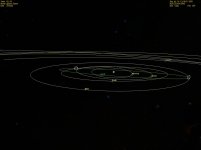
Here is a screen shot using the excellent Videnie utility, of an offplane transfer to Mars from the stock DG in orbit scenario. As you can see it is way out of plane, about 6.5 degrees relative inclination, and I have marked the orbit intersection points. Is this what you are trying to do?
 

Attachments

  • offplane.jpg
    offplane.jpg
    78.6 KB · Views: 33
I don't think Flytandem said it couldn't be done. Maybe I am not clear on the concept. But I did it. I have done it numerous times, in fact when I first learned orbiter it was the only way I got to Mars cause I didn't understand plane changes. I mean at my first mid course I had to add a bit of plane change and outward so Mars and the DG would be at the same place at the same time as it were, but I was still way out of plane. As I said, you increase deltav til the green line coincides with the yellow doted line after tweaking prograde vel. to as close as you can get it. Then at about halfway there you do a mid course correction, but you never come close to aligning planes, and then a few more on the way. I came in completely off plane at about 50+ degrees inclination. I did it three times before I gave you the rough plan. I never went into a "solar" orbit. I made it to Mars totally off plane and then burned to capture.

And your method does work, but it does arrive at Mars somewhat well off-plane. I think I intercepted at about 57 degrees when I tried it.

The problem I was having was not that I couldn't get to Mars, it was that in Transx I couldn't plan the off-plane portion of it using the orbit eject function that Flytandem explained in one of his videos. As he explained, he couldn't get the planned orbit and the planned escape to match up on that screen, which were the same exact results I was getting. Therefore, he concluded that it's best to do the plane-alignment during ascent, which I've also successfully achieved on numerous occasions with Transx, MapMFD, and my favorite, LaunchMFD.

And, often, when I plan the off-plane trajectory from Transx using a combination of all 4 parameters, the maneuver mode will orient me retrograde to earth for the burn, and in some cases, orient me directly toward earth. As you can imagine, the results are disastrous for me, and a nice fireworks show for observers on the ground. If, however, when I plan I don't add outward velocity or plane change velocity, then transx maneuver mode will orient me prograde and all is well.....except I have to replan once I exit earth's SOI, thereby planning a new route from that point that includes adjustments for plane change and outward velocity in order to arrive at Mars at a reasonable inclination.
 
Back
Top