Delta-V to Mars outside the launch windows?

RGClark

Mathematician
Joined
Jan 27, 2010
Messages
1,635
Reaction score
1
Points
36
Location
Philadelphia
Website
exoscientist.blogspot.com
The launch window to Mars comes every two years where the delta-v to get there by a Hohmann trajectory is minimal. This year it was in March, when Exomars was launched. But you can still launch to Mars at different times. It just requires more delta-v.

SpaceX wants to decide on an initial mission for the Falcon Heavy, scheduled to launch at the end of this year:

SpaceX undecided on payload for first Falcon Heavy flight.
May 3, 2016 Stephen Clark
http://spaceflightnow.com/2016/05/03/spacex-undecided-on-payload-for-first-falcon-heavy-flight/

One possibility would be a lander mission to Phobos or Deimos. I calculated from a delta-v chart that it would be doable carrying a Dragon during the minimal delta-v window using an existing solid rocket upper stage for Earth escape. But that minimal delta-v launch window already passed in March.

How do you calculate the delta-v requirements during other times such as the end of the year?

Bob Clark
 
Last edited:
What you're asking is called Lambert's problem - given two position vectors and a time of flight, find the unique trajectory that connects the two positions. For your application, one position is the location of Earth at your selected departure date. The second position is the location of Mars at your selected arrival date. Then with time of flight being arrival date minus departure date, you can determine the transfer trajectory. I prefer Battin's method for solving this problem, but there are others.

Once you know the transfer trajectory, you can calculate the dV leaving Earth's orbit and the dV entering Mars orbit. Or you can go a step further and using the patched conic method, you can figure out the properties of the hyperbolic orbit leaving Earth and thus the dV from your Earth-bound parking orbit. A similar procedure will give you the dV to enter a Mars-bound orbit on the arrival end. Either way, add the two dV's to get your total.

Hope that helps!

---------- Post added at 04:01 PM ---------- Previous post was at 03:53 PM ----------

I should mention that in Lambert's problem, there are actually two resulting transfer orbits - one traverses the small angle between the two positions, the second goes the long way around the central body. As you might guess, one transfer typically results in a much, much larger dV!
 
By the way is a solid rocket suitable for doing the escape orbit? I thought these weren't accurate enough, without needing a lot of course correction for the spacecraft itself... (just thinking out loud.)
 
Well, you are an Orbiter user, so you have a pretty accurate scientific tool at hand :)

- Install an addon with a lot of dV, e.g. the [ame="http://www.orbithangar.com/searchid.php?ID=3034"]Bullet[/ame].
- Choose a scenario starting in low Earth orbit.
- In the scenario file change the date to the desired launch date.
(There is small app called date.exe in Orbiters Utils-folder to convert UTC to MJD.)
- In the launch pad Modules, activate Transx.
- Start the simulation.
- Switch on the TransX-MFD and plan your flight. It is amazingly accurate, for a free tool.
- Fly the Bullet to Mars. (It has nearly unlimited dV, so small navigational errors do not matter.)

Once this worked, use BrianJ's Falcon Heavy, put a Dragon on top and try the same with an Earth based launch.
 
Last edited:
By the way is a solid rocket suitable for doing the escape orbit? I thought these weren't accurate enough, without needing a lot of course correction for the spacecraft itself... (just thinking out loud.)

Not that much correction, that you can't include it into your DV budget for the probe. For example, you can get some trouble because the performance of a SRM depends on the propellant temperature.
 
Well, you are an Orbiter user, so you have a pretty accurate scientific tool at hand :)

- Install an addon with a lot of dV, e.g. the Bullet.
- Choose a scenario starting in low Earth orbit.
- In the scenario file change the date to the desired launch date.
(There is small app called date.exe in Orbiters Utils-folder to convert UTC to MJD.)
- In the launch pad Modules, activate Transx.
- Start the simulation.
- Switch on the TransX-MFD and plan your flight. It is amazingly accurate, for a free tool.
- Fly the Bullet to Mars. (It has nearly unlimited dV, so small navigational errors do not matter.)

Once this worked, use BrianJ's Falcon Heavy, put a Dragon on top and try the same with an Earth based launch.

My experience is quite accurately listed as "Beginner" under my username.

Bob Clark
 
Sorry, did not want to overstress this. But Obiter's simulation engine - and some addons developed for this - are amazingly good.
If being overwhelmed by the complexity of TransX, there is a short user guide (2 pages). Maybe start first with a Moon shot, before reaching out to the planets. :)
 
I will run this problem through PyKEP when I get a chance. But it maybe a while before I have time to do it.
 
Last edited:
Thanks for the Orbiter suggestions. I will give them a try. However, I probably just need a first level estimate for my purposes. This page I think will have the equations I need:

Orbit Maneuvers.
http://www.braeunig.us/space/orbmech.htm#maneuver

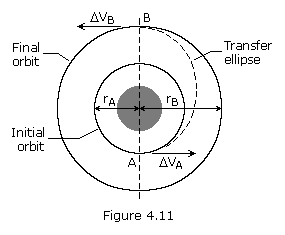
For the Hohmann transfer during the launch window, the transfer trajectory would be the half-ellipse:

fig4-11.gif


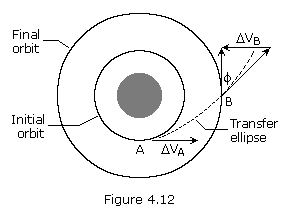
However, for other times it would be some different, shorter or longer, arc of an ellipse:

fig4-12.gif


So it will be the equations given there for this case that I need. For a given Earth solar orbit departure delta-v, the spacecraft's trajectory will intersect Mars orbit at a certain calculatable time. Then we need this delta-v to be such that Mars will be at that same point in its orbit when the spacecraft arrives. Additionally, as shown in the diagram, on arrival at Mars orbit, we will need to apply an additional delta-v to get the spacecrafts orbital velocity to match that of Mars.


Bob Clark
 
Last edited:
The deltaV table on the Atomic Rockets website may be helpful. It lists the delta V for a Hohmann, 2-month and 1.5 month trajectory to Mars and back. The delta V's are for a full mission, including speed for launch and landing, outward and home.
 
If you just want the dV values (rather than the fun of figuring out how to calculate it) then Piper's "Trajectory Planner" is very useful:
[ame="http://www.orbithangar.com/searchid.php?ID=4439"]Trajectory Planner[/ame]
 
I've run the problem through the PyKEP / PyGMO. Here are the results:

| Departure Date | MJD------- | Duration (days) | dv - LEO escape (m/s) | dv - LMO injection (m/s) | Total mission cost (m/s) |
| 3-Mar-16 | 57450 | 204.4 | 3728.8 | 2794.2 | 6522.9 |
|13-Mar-16| 57460| 203.6| 3793.2| 2683.0| 6476.2|
|23-Mar-16| 57470| 202.3| 3912.3| 2671.9| 6584.2|
|2-Apr-16| 57480| 202.0| 4079.7| 2758.6| 6838.2|
|12-Apr-16| 57490| 207.3| 4245.7| 2976.2| 7221.9|
|22-Apr-16| 57500| 230.0| 4228.7| 3434.4| 7663.1|
|2-May-16| 57510| 305.7| 3719.8| 4123.0| 7842.8|
|12-May-16| 57520| 324.8| 3798.1| 4243.8| 8041.9|
|22-May-16| 57530| 352.2| 3866.9| 4321.9| 8188.8|
|1-Jun-16| 57540| 375.0| 3942.7| 4328.4| 8271.1|
|11-Jun-16| 57550| 396.2| 4010.6| 4298.5| 8309.1|
|21-Jun-16| 57560| 416.6| 4065.9| 4252.2| 8318.1|
|1-Jul-16| 57570| 436.2| 4108.0| 4203.6| 8311.6|
|11-Jul-16| 57580| 455.2| 4139.0| 4163.5| 8302.6|
|21-Jul-16| 57590| 473.5| 4162.9| 4140.2| 8303.0|
|31-Jul-16| 57600| 490.9| 4184.3| 4139.9| 8324.2|
|10-Aug-16| 57610| 507.4| 4208.1| 4167.7| 8375.9|
|20-Aug-16| 57620| 522.9| 4238.2| 4228.1| 8466.3|
|30-Aug-16| 57630| 537.4| 4277.0| 4324.7| 8601.8|
|9-Sep-16| 57640| 550.9| 4325.2| 4461.3| 8786.6|
|19-Sep-16| 57650| 563.4| 4381.2| 4641.2| 9022.3|
|29-Sep-16| 57660| 575.0| 4442.0| 4866.9| 9308.9|
|9-Oct-16| 57670| 585.8| 4503.3| 5140.3| 9643.6|
|19-Oct-16| 57680| 595.9| 4560.3| 5461.3| 10021.5|
|29-Oct-16| 57690| 605.3| 4608.3| 5827.6| 10435.8|
|8-Nov-16| 57700| 614.1| 4643.7| 6234.3| 10878.0|
|18-Nov-16| 57710| 622.4| 4664.8| 6673.3| 11338.0|
|28-Nov-16| 57720| 630.3| 4671.1| 7134.1| 11805.2|
|8-Dec-16| 57730| 637.9| 4664.5| 7604.0| 12268.5|
|18-Dec-16| 57740| 645.1| 4647.9| 8069.0| 12716.9|
|28-Dec-16| 57750| 652.2| 4625.2| 8515.8| 13141.0|

Here, I have assumed a simple mission design in which the spacecraft escapes a 200 x 200 km Low Earth Orbit (LEO); makes a direct transfer to Mars; and then inserts into a 200 x 200 km Low Mars Orbit (LMO).

A couple of things to note:

1. The least cost transfer date was indeed in early March.

2. The Earth escape cost is always reasonably low varying between 3,720 m/s and 4,670 m/s.

3. However, the approach speed to Mars varies considerably - as evidenced by the rapidly increasing LMO insertion cost. By the end of the year, this orbit insertion cost is rising by around 50 m/s for every day Earth departure is delayed.

4. Although the shortest transfer time is around 202 days; by the end of the year, optimal transfer times exceed 650 days.
 
Last edited:
...
Here, I have assumed a simple mission design in which the spacecraft escapes a 200 x 200 km Low Earth Orbit (LEO); makes a direct transfer to Mars; and then inserts into a 200 x 200 km Low Mars Orbit (LMO).
A couple of things to note:
1. The least cost transfer date was indeed in early March.
2. The Earth escape cost is always reasonably low varying between 3,720 m/s and 4,670 m/s.
3. However, the approach speed to Mars varies considerably - as evidenced by the rapidly increasing LMO insertion cost. By the end of the year, this orbit insertion cost is rising by around 50 m/s for every day Earth departure is delayed.
4. Although the shortest transfer time is around 202 days; by the end of the year, optimal transfer times exceed 650 days.

Thanks for that. Since you only want to land on Phobos or Deimos, couldn't you do it without getting into Mars orbit?

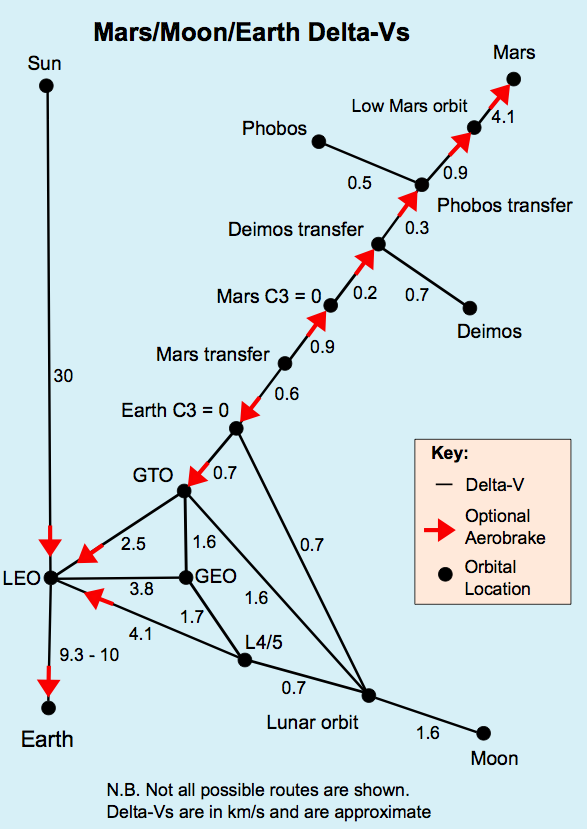
Here's the delta-v diagram I was using to estimate the required delta-v for launch during the minimal delta-v launch window:

Screen+Shot+2014-03-25+at+3.59.14+PM.png


According to the diagram, the spacecraft needs an additional 1.8 km/s after Mars transfer trajectory to get to Phobos. According to SpaceX the Falcon Heavy can take 13,600 kg to Mars transfer. Then under this scenario, we use an extra upper stage and the Dragon's thrusters to provide the remaining 1.8 km/s. So it's actually the Falcon Heavy that does the Earth escape. Also, we need the extra upper stage, because the Dragon does not have enough delta-v for the remaining 1.8 km/s delta-v.

But that is for the launch window. To do the Mars transfer from your data is doable for other times this year. But the delta-v just to get to Phobos, without Mars orbit, will be changed from the delta-v diagram.

An additional problem though is the length of the flight towards the end of the year. If it's going to take two years we might as well wait for the next launch window.

Bob Clark
 
Thanks for that. Since you only want to land on Phobos or Deimos, couldn't you do it without getting into Mars orbit?

One certainly could - but then you would have to tell me a bit more about the 'how' one planned to land on Phobos / Deimos. Given that information, I could then quickly re-optimise using PyKEP / PyGMO.

The 'obvious' way of approaching Phobos / Deimos is via:

a: a low altitude hyperbolic pass of Mars, executing a 'Mars capture burn' at periapsis that sends it into a highly elliptical orbit around Mars. (This corresponds to the C3 = 0 point on your graph)

b: then a periapsis raising manoeuvre to lift the orbital periapsis to the orbital radius of Mars / Phobos;

c: and, finally, at Phobos / Deimos encounter execute a velocity matching burn.

This process can be quickly modelled as a 'bi-parabolic transfer'. So, if you like, I'll re-run the numbers based on this approach sequence.

---------- Post added at 03:43 AM ---------- Previous post was at 02:49 AM ----------

An additional problem though is the length of the flight towards the end of the year. If it's going to take two years we might as well wait for the next launch window.

The flight durations that I have calculated are based on the assumption that one wants to minimise total mission dV. It is possible to get to Mars more quickly, but this will necessarily add to the mission dV costs.

---------- Post added at 06:20 AM ---------- Previous post was at 03:43 AM ----------

RGClark:

Based on the previous table of optimised trajectories, I've estimated the Phobos and Deimos rendezvous costs, post Earth escape.

As you can see, during the March launch window earlier this year, getting to Deimos would have cost around 1.8 km/s (post Earth escape); and getting to Phobos around 2.1 km/s. These estimates seem to align reasonably well with the graph that you provided. However, by the end of the year, costs have risen to circa 7.6 km/s and 7.9 km/s respectively.

Departure Date | MJD------- | Duration (days) | dv - LEO escape (m/s) | dv - Phobos (m/s) | Deimos (m/s)
3-Mar-16 | 57450 | 204.4 | 3728.8 | 2206.5 | 1880.5
13-Mar-16 | 57460 | 203.6 | 3793.2 | 2095.3 | 1769.3
23-Mar-16 | 57470 | 202.3 | 3912.3 | 2084.2 | 1758.3
2-Apr-16 | 57480 | 202.0 | 4079.7 | 2170.9 | 1844.9
12-Apr-16 | 57490 | 207.3 | 4245.7 | 2388.5 | 2062.5
22-Apr-16 | 57500 | 230.0 | 4228.7 | 2846.8 | 2520.8
2-May-16 | 57510 | 305.7 | 3719.8 | 3535.3 | 3209.3
12-May-16 | 57520 | 324.8 | 3798.1 | 3656.1 | 3330.1
22-May-16 | 57530 | 352.2 | 3866.9 | 3734.2 | 3408.2
1-Jun-16 | 57540 | 375.0 | 3942.7 | 3740.8 | 3414.8
11-Jun-16 | 57550 | 396.2 | 4010.6 | 3710.9 | 3384.9
21-Jun-16 | 57560 | 416.6 | 4065.9 | 3664.5 | 3338.5
1-Jul-16 | 57570 | 436.2 | 4108.0 | 3615.9 | 3290.0
11-Jul-16 | 57580 | 455.2 | 4139.0 | 3575.9 | 3249.9
21-Jul-16 | 57590 | 473.5 | 4162.9 | 3552.5 | 3226.5
31-Jul-16 | 57600 | 490.9 | 4184.3 | 3552.2 | 3226.2
10-Aug-16 | 57610 | 507.4 | 4208.1 | 3580.1 | 3254.1
20-Aug-16 | 57620 | 522.9 | 4238.2 | 3640.4 | 3314.4
30-Aug-16 | 57630 | 537.4 | 4277.0 | 3737.1 | 3411.1
9-Sep-16 | 57640 | 550.9 | 4325.2 | 3873.7 | 3547.7
19-Sep-16 | 57650 | 563.4 | 4381.2 | 4053.5 | 3727.5
29-Sep-16 | 57660 | 575.0 | 4442.0 | 4279.2 | 3953.2
9-Oct-16 | 57670 | 585.8 | 4503.3 | 4552.6 | 4226.6
19-Oct-16 | 57680 | 595.9 | 4560.3 | 4873.6 | 4547.6
29-Oct-16 | 57690 | 605.3 | 4608.3 | 5239.9 | 4913.9
8-Nov-16 | 57700 | 614.1 | 4643.7 | 5646.6 | 5320.6
18-Nov-16 | 57710 | 622.4 | 4664.8 | 6085.6 | 5759.6
28-Nov-16 | 57720 | 630.3 | 4671.1 | 6546.4 | 6220.4
8-Dec-16 | 57730 | 637.9 | 4664.5 | 7016.3 | 6690.4
18-Dec-16 | 57740 | 645.1 | 4647.9 | 7481.3 | 7155.3
28-Dec-16 | 57750 | 652.2 | 4625.2 | 7928.1 | 7602.1


---------- Post added at 08:58 AM ---------- Previous post was at 06:20 AM ----------

Just out of curiosity, I extended the table out to the next transfer to Mars window in 2018.

It would seem to me that the next opportunity to launch for Mars would be in late 2017 - and more likely early 2018.

Departure Date | MJD-------| Duration (days) | dV - LEO escape (m/s) | dv - Phobos (m/s) | dv - Deimos (m/s)
7-Jan-17 | 57760 | 659.0 | 4600.6 | 8342.8 | 8016.9
17-Jan-17 | 57770 | 666.1 | 4578.1 | 8714.0 | 8388.0
27-Jan-17 | 57780 | 673.2 | 4561.5 | 9031.9 | 8705.9
6-Feb-17 | 57790 | 680.5 | 4553.4 | 9289.0 | 8963.0
16-Feb-17 | 57800 | 688.2 | 4555.9 | 9480.3 | 9154.3
26-Feb-17 | 57810 | 696.2 | 4570.0 | 9603.0 | 9277.0
8-Mar-17 | 57820 | 704.8 | 4595.9 | 9656.7 | 9330.7
18-Mar-17 | 57830 | 714.0 | 4632.7 | 9643.1 | 9317.1
28-Mar-17 | 57840 | 723.9 | 4678.9 | 9566.0 | 9240.0
7-Apr-17 | 57850 | 734.4 | 4732.0 | 9431.2 | 9105.2
17-Apr-17 | 57860 | 745.7 | 4789.2 | 9246.3 | 8920.3
27-Apr-17 | 57870 | 757.7 | 4847.1 | 9020.4 | 8694.4
7-May-17 | 57880 | 770.4 | 4902.4 | 8763.7 | 8437.7
17-May-17 | 57890 | 783.6 | 4951.9 | 8487.5 | 8161.5
27-May-17 | 57900 | 797.2 | 4993.3 | 8202.9 | 7876.9
6-Jun-17 | 57910 | 811.2 | 5025.1 | 7921.2 | 7595.2
16-Jun-17 | 57920 | 825.2 | 5047.2 | 7652.9 | 7326.9
26-Jun-17 | 57930 | 838.1 | 5060.5 | 7407.4 | 7081.4
6-Jul-17 | 57940 | 852.8 | 5067.1 | 7192.8 | 6866.8
16-Jul-17 | 57950 | 866.0 | 5070.1 | 7016.0 | 6690.0
26-Jul-17 | 57960 | 878.6 | 5072.6 | 6882.3 | 6556.3
5-Aug-17 | 57970 | 890.5 | 5077.9 | 6796.0 | 6470.0
15-Aug-17 | 57980 | 901.6 | 5088.4 | 6760.2 | 6434.2
25-Aug-17 | 57990 | 911.9 | 5105.7 | 6777.1 | 6451.1
4-Sep-17 | 58000 | 276.1 | 7961.0 | 3647.6 | 3321.6
14-Sep-17 | 58010 | 277.8 | 7484.9 | 3494.3 | 3168.3
24-Sep-17 | 58020 | 278.9 | 7060.7 | 3352.0 | 3026.0
4-Oct-17 | 58030 | 279.4 | 6684.0 | 3219.8 | 2893.8
14-Oct-17 | 58040 | 279.4 | 6350.1 | 3097.0 | 2771.0
24-Oct-17 | 58050 | 278.8 | 6054.2 | 2982.7 | 2656.7
3-Nov-17 | 58060 | 277.9 | 5791.7 | 2876.6 | 2550.6
13-Nov-17 | 58070 | 276.5 | 5557.9 | 2778.1 | 2452.1
23-Nov-17 | 58080 | 274.7 | 5348.9 | 2687.3 | 2361.3
3-Dec-17 | 58090 | 272.7 | 5161.0 | 2602.1 | 2276.1
13-Dec-17 | 58100 | 270.3 | 4990.9 | 2523.7 | 2197.7
23-Dec-17 | 58110 | 267.8 | 4836.1 | 2451.5 | 2125.5
2-Jan-18 | 58120 | 265.2 | 4694.2 | 2385.1 | 2059.2
12-Jan-18 | 58130 | 262.5 | 4563.5 | 2324.8 | 1998.8
22-Jan-18 | 58140 | 260.0 | 4443.0 | 2270.7 | 1944.7
1-Feb-18 | 58150 | 257.7 | 4331.6 | 2223.4 | 1897.5
11-Feb-18 | 58160 | 256.0 | 4228.8 | 2183.6 | 1857.6
21-Feb-18 | 58170 | 254.9 | 4133.9 | 2151.8 | 1825.8
3-Mar-18 | 58180 | 254.6 | 4045.9 | 2127.6 | 1801.6
13-Mar-18 | 58190 | 254.9 | 3963.4 | 2109.3 | 1783.3
23-Mar-18 | 58200 | 255.7 | 3885.6 | 2093.9 | 1767.9
2-Apr-18 | 58210 | 256.6 | 3812.0 | 2077.7 | 1751.7
12-Apr-18 | 58220 | 199.2 | 3801.3 | 1993.1 | 1667.1
22-Apr-18 | 58230 | 203.3 | 3682.5 | 1784.2 | 1458.2
2-May-18 | 58240 | 205.8 | 3604.2 | 1689.0 | 1363.1
12-May-18 | 58250 | 204.1 | 3574.8 | 1670.0 | 1344.0
22-May-18 | 58260 | 199.9 | 3601.7 | 1688.3 | 1362.3

 
Last edited:
Thanks for that. Becoming disenchanted with the possibility. Probably could get the 5 km/s to 6 km/s delta-v required. But don't like the nearly two year travel time.
We could get it to travel faster, a la the New Horizons mission profile. But then we would need a quite large delta-v to get it to slowdown. New Horizons was just a fly-by so that was not an issue for that mission.

Maybe a lander for Europa? (See my sig file.)

Bob Clark

---------- Post added at 09:11 PM ---------- Previous post was at 09:32 AM ----------

Another possibility for the first launch of the Falcon Heavy might be to land and return a sample from a near Earth asteroid. This link has a list of NEA's that have close approaches within a one year time-frame. There are several near the end of this year:

http://neo.jpl.nasa.gov/cgi-bin/neo...splay Table;show=1;sort=date;sdir=ASC&from=60

Bob Clark
 
Last edited:
OK, one more stab at the Mars moons proposal. We have discussed before the surprising speed that New Horizons was able to pass the orbit of Mars due to its high departure speed:

Math needed for 5-week flight from Earth to Mars.
http://orbiter-forum.com/showthread.php?p=491363&postcount=78

The transit time of New Horizons to pass Mars' orbit was 78 days for a LEO departure delta-v of 8.4 km/s. But as discussed in that post, the Mars capture delta-v would be close to 12 km/s, prohibitive when added to the departure delta-v.

So instead I'm thinking of other ways of being captured at Mars such as aerocapture:

https://en.wikipedia.org/wiki/Aerocapture

This allows the spacecraft to be captured into Mars orbit with minimal propellant burn.

So using a limiting LEO departure delta-v of 8.4 km/s as with New Horizons and assuming the departure takes place in the time frame of the last quarter of this year to the first quarter of next year, what would be the travel time then?

Bob Clark
 
This is doable. But I'm travelling without computer for a couple of weeks. Will get back to this upon my return to HK.
 
Last edited:
Here, I have assumed a simple mission design in which the spacecraft escapes a 200 x 200 km Low Earth Orbit (LEO); makes a direct transfer to Mars; and then inserts into a 200 x 200 km Low Mars Orbit (LMO).

Don't most Martian missions inject into a highly elliptical orbit and then use successive aerobraking passes (sometimes over months) to pull the orbit in?

So instead I'm thinking of other ways of being captured at Mars such as aerocapture:

I'm fairly certain that aerocapture has never actually been used. It might not be worth it because of the extra weight required for heat shielding and stress mitigation.

OTOH, MSL, I believe didn't bother with establishing orbit at all. It came in from the transfer orbit directly to atmospheric entry.
 
Last edited by a moderator:
Don't most Martian missions inject into a highly elliptical orbit and then use successive aerobraking passes (sometimes over months) to pull the orbit in?
I'm fairly certain that aerocapture has never actually been used. It might not be worth it because of the extra weight required for heat shielding and stress mitigation.
OTOH, MSL, I believe didn't bother with establishing orbit at all. It came in from the transfer orbit directly to atmospheric entry.

Yes, aerobraking has been used when the spacecraft has already been put in capture orbit at Mars. Aerobraking then reduces the size of the orbit. It may also have been used to circularize. I'm not sure about that.

Aerocapture is a more difficult proposition. It would require the spacecraft to plunge deep into Mars atmosphere, skimming the tree tops so to speak. That has not been tried yet. Since this is only a test flight anyway this may be a good chance to test it.

Bob Clark
 
Back
Top