39 days to Mars possible now with nuclear-powered VASIMR.

RGClark

Mathematician
Joined
Jan 27, 2010
Messages
1,635
Reaction score
1
Points
36
Location
Philadelphia
Website
exoscientist.blogspot.com
A criticism of the VASIMR plasma drive was that space nuclear power did not
have sufficient power at the needed lightweight. However, it turns out that
this is due to the heavy electrical generating equipment, not the nuclear
reactors themselves.

Then note that recent research has produced electrical generators at the
needed lightweight, thus making nuclear-powered VASIMR viable:

Nuclear powered VASIMR and plasma propulsion doable now.
http://exoscientist.blogspot.com/2015/08/nuclear-powered-vasimr-and-plasma.html

Bob Clark
 
Now if we could only fly a nuclear reactor to space without a million voices crying out in terror and then not being suddenly silenced... :lol:
 
Now if we could only fly a nuclear reactor to space without a million voices crying out in terror and then not being suddenly silenced... :lol:

We just have to find a source of Uranium outside of LEO that's all. Build the reactor say on the Moon and no one can complain about it. Sadly, I don't think there is a lot of easy to access Uranium on the moon. :(

Dantassii
HUMONGOUS IMS shipbuilder
 
Nah. We already launch RTGs into space despite protests, and we've launched a reactor in the past. The Soviets launched several.

Political pressure will be higher, but that should just drive stronger safety measures. Keeping the fuel elements in a fail-safe configuration so they cannot possibly react until the reactor is ready for earth departure is not a terribly difficult engineering problem.

The real question is "are we ready for VASMIR or other nuclear-electric propulsion yet or aren't we?".

Once we are we will find a way to do it. Since plutonium fuel for RTGs is getting much more scarce there's going to be a greater demand for stuff like this going forward, anyway. Especially since an RTG is just a battery, but a nuclear-electric powerplant provides not only plenty of electrical power for subsystems, but also decreases transit times significantly.
 
One option that isn't engineeringly (that's a word right?) attractive is to simply launch the unrefined ore to refinery stations in orbit and create the fuel elements there.
 
One option that isn't engineeringly (that's a word right?) attractive is to simply launch the unrefined ore to refinery stations in orbit and create the fuel elements there.

Way unnecessary. We currently get away with launching plutonium, there's no reason we can't launch uranium fuel elements. You just have to ensure that they're protected against launch failure and can't achieve fission until the proper sequence of actions is taken.

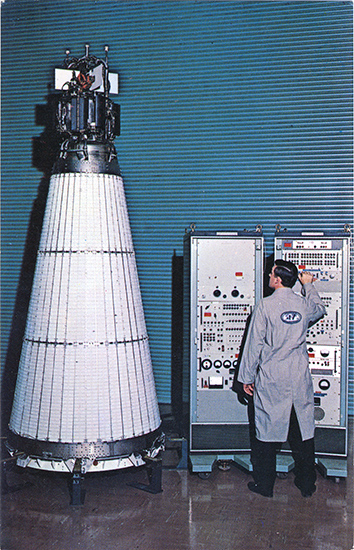
The SNAP-10A orbiting reactor had neutron reflectors around the core which all had to rotate into position for fission to occur. The fuel elements were already in place but were not critical without the reflectors. Basically everything had to go right for fission to occur. And in an emergency the controllers could command squibs to blow the reflectors and separate them from the spacecraft, making fission impossible.

iu


Gotta love the old school test equipment:

SNAP_10A_Space_Nuclear_Power_Plant.jpg


Designing a reactor that doesn't work unless everything goes just right, and which stops fissioning if anything goes wrong, is the goal, and it's not too hard to achieve. But reducing the risk of a nuclear accident beyond a certain point may increase the risk that the mission fails because you couldn't activate the reactor after launch due to a minor problem.

Risk of mission failure is more politically acceptable than risk of atomic accidents, I'd guess.

---------- Post added 08-30-15 at 12:05 AM ---------- Previous post was 08-29-15 at 11:57 PM ----------

post script on SNAP-10A: It's still in orbit and reportedly shed debris sometime ago. THat is not good news, but it is in a high-enough orbit to be only a minor concern. For a VASMIR interplanetary vehicle, it would leave earth orbit early in life instead of hanging around for decades the way that SNAP-10A and the old Soviet reactors are doing...

---------- Post added at 12:51 AM ---------- Previous post was at 12:05 AM ----------

Here's an old government film explaining how it works. Around 3:46 the animation shows the neutron reflectors rotating to go critical. (Someone should make a SNAP-10A addon if there isn't one already...)

 
Last edited:
I still think that you can't really compare RTGs to nuclear reactors - nuclear reactor fuel has a much higher density than RTG fuel in the end and is much harder to contain. RTGs are pretty foolproof, which makes them attractive for spaceflight, despite panicking ecologists raging.

But... you could launch fuel pellets in separate accident-protected cases and assemble them into nuclear fuel elements by telerobotics in space. In Space you also don't need large containment buildings. Launching 100 tons of ore for getting a few grams of 4% enriched Uranium on the other hand sounds ineffective.
 
How Many Watts of power will be needed to get to and from MARS? 10KW, 20KW, more?

Not Watts. Joule. Or Watthours, if you need something you can relate to.

The most powerful VASIMR engine in development right now has 200 kW electrical energy input. Now, you have to consider VASIMR has a quite long burn time in the 39 days mission at full power.

I can't find exact numbers there, but I would expect a 80% duty cycle of the engine, so of the 39 days, the engine will operate on 31.2 days = 748.8 hours.

So, you need 748.8 hours * 200 kW = 149.76 MWh electrical power. As rule of thump, you need six times as much thermal power with a nuclear reactor: 898.56 MWh. That's 3.234 Terajoule energy. You would consume 6 gram U-235 from the nuclear fuel pellets for achieving that.
 
Yes, but assuming you have the total energy, you need the system to deliver that 200kW for the VASMIR to work. In other words, not just enough energy has to be delivered, but it has to be delivered fast enough. This will play into the design of both the reactor and the energy conversion scheme.

SNAP-10A used thermoelectric generators warmed by the sodium coolant. Not sure if that is the best way to go about it these days. We may have better methods for extracting electricity from the reactor, but it has the benefit of being fairly simple. Anyone know of a better method, with a lighter mass?
 
that's a lot more than "one point 21 jigawatts" I guess Dr. Brown needs to go back to the drawing board, or find a better Mr. Fusion.

RTGs have between 8-13 Lbs of fuel, right? but only a about 200 watts of current RMS. So RTGs as we know them are far too small to be of any use.

A reactor of the same or like design as Snap 10, but of more power is needed.
 
More likely will be something like that:

https://en.wikipedia.org/wiki/Safe_Affordable_Fission_Engine

This has been pretty reliable and effective.

Also, the 6 Gram figure above is just for showing how powerful a nuclear reaction really is. In reality, you also need much more fuel elements, which will only partially be consumed, for getting a proper neutron flux. Or you will have problems with the reactor not always running at 100% during a mission. Also fuel elements contain much more mass than just the 4% U-235, that are interesting. Cladding is also important.
 
Studying nuclear physics gave me background, but clearly I'm no physicist, Thanks for the link to updated programs.

GWS chews a lot of solar power (500-1000kw per day I think), and is huge compared to MARS-1, but the VASMR drive, and capsules eat a tremendous amount of power, for such small objects.

I've always been a fan of VASMR, and look forward to it flying.
 
More likely will be something like that:

https://en.wikipedia.org/wiki/Safe_Affordable_Fission_Engine

This has been pretty reliable and effective.

So this would be a closed-cycle gas turbine generator, then? Interesting.

That would have a lot more moving parts than thermoelectrics, but with good quality control that could be acceptable. We buidl moving spacecraft parts that work for decades these days.

Wonder how it stacks up in terms of efficiency and power-to-mass ratio.
 
That would have a lot more moving parts than thermoelectrics, but with good quality control that could be acceptable. We buidl moving spacecraft parts that work for decades these days.

Well, seriously, it would be one major moving assembly (Shaft and rotor), plus the mandatory valve to regulate the flow for the short-term.

But more than that, it is pretty proven technology compared to other options. Brayton cycle gas turbines are pretty well-explored technology.

Likely a bigger reactor would have multiple such turbines, beyond the need for redundancy, for better power conversion efficiency. Two turbines at 100% are better than four at 50%, especially if you want to avoid variable geometry stators and more moving parts (Also smaller turbines could run at higher speeds, improving efficiency)
 
How much power would be needed?

Some time ago I tried to calculate the trip of the 'Hermes' from 'The Martian', 100 days to Mars. I used the VX-200 Vasimr engine as model, bundled 40 of them for 100 ton ship and came up with 8 MW electrical power consumption. The thermal power output of the reactor must be higher, divided by the efficiency factor of the power plant, 0.5 less.

This would be in the range of mobile reactors used on submarines or icebreakers. Not small. With the lack of seawater cooling, the second side needs to be cooled by heat radiators. At an average radiator temperature of 100°C (water-glykol pressurized) the radiator size would be around 100 x 100 m, probably more.
 
Now, you have to consider VASIMR has a quite long burn time in the 39 days mission at full power.

I can't find exact numbers there, but I would expect a 80% duty cycle of the engine, so of the 39 days, the engine will operate on 31.2 days = 748.8 hours.

If this is the way we go, it would be sort of ironic. Several decades and 10s (100s?) of billions of dollars spent on space stations and "long duration" weightlessness research.

The real mission to Mars may have as much actual weightless time as Apollo.

How many G will VASIMR pull?
Perhaps instead of microgravity, we should be researching "decigravity"?
 
How many G will VASIMR pull?
Perhaps instead of microgravity, we should be researching "decigravity"?

Little - the acceleration by the ISS reboost engines will be magnitudes stronger.

Even at the short phases with maximum thrust, we will talk about 5 N thrust per VASIMR.
 
After running the numbers for plasma propulsion for fast flight times to Mars, I came to the surprising conclusion the mission size is actually smaller than with the usual slow travel times. The reason for this unexpected conclusion is the short travel time allows a much smaller habitat for the transit, and therefore smaller propellant load:

Nuclear powered VASIMR and plasma propulsion doable now, Page 2.
http://exoscientist.blogspot.com/2015/10/nuclear-powered-vasimr-and-plasma.html

Bob Clark
 
From the exoscientist link:
"Since in this case the engine is always running at full power this would be 545,000,000 MW ..."

1. I guess it should mean "W", not "MW".
2. Still 545 MW is a lot. (I guess this means thermal power, not sure.)
For comparsion, a Los Angeles class submarine is powered by a 150 MW reactor (later models with 165 MW).

If you google for "Gigawatt power plant" and look at the pictures, the size of the secondary side cooling towers is overwhelming. I don't say it can't be done, but we are talking about an enormous installation in orbit.
 
Back
Top