Well, actually, we can approximately calculate the DV and the travel time needed for getting to Pluto for example.
Earth: 29.78 km/s
Pluto: 4.67 km/s
Difference: 25.11 km/s
DV for spiral trajectory: 50.22 km/s
Now, you can calculate: If you for example launch a probe with a single VASIMR and a heavy nuclear reactor as power source. For simplicity, lets just scale a Russian nuclear Kosmos 1818 satellite up to 200 kW continuous power: this means we get a weight of 50 tons, 18.31 tons of that would be dry weight (10.6 tons of reactor; the rest structure, electronics, GNC and experiments) The remaining 31.68 tons would be fuel for the VASIMR.
Every second, the engine would consume 0.0001 kg of fuel to produce 5N of thrust, so for burning all the fuel needed for the DV : In 3667 days the spacecraft would reach Pluto. Almost exactly 10 years. Not 5.
Doubling the thrust would at that low accelerations still allow using a simple spiral approximation (if the thrust gets too high, we need more complex trajectories with more gravity losses than the assumed almost zero), but you would almost double the spacecraft mass: Instead of halving the ten years, you would just reduce it maybe to 9 years, and eventually approaching something around 6.66 years*, if you would strap infinite reactor/engine pairs to get a camera with a small antenna to Pluto.
My model was sure pretty unrealistic (The TOPAZ reactor only lasts for 3-5 years, little other mass available, for example for attitude control), but the coarse ballpark numbers would be valid: While you could get to Pluto in acceptable time for an unmanned mission and with entering orbit around it, you would need a huge spacecraft with very tiny payload to do so. I am not even sure if you could even hide a small lander in that tiny mass budget.
I would not even exclude the possibility, that a much smaller conventional spacecraft with 15 tons mass and a slightly longer travel time of 15 years, with two gravity assists along the route (Jupiter, Uranus) could be the better option.
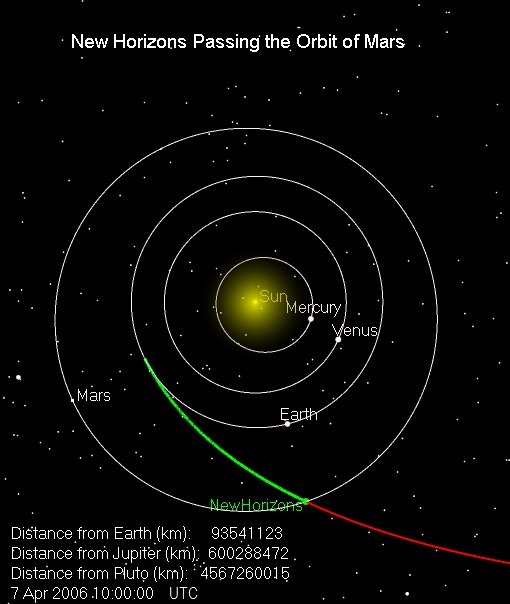
I'm thinking of a straight-line approximation for a high speed trajectory. Recall how New Horizons took a nearly straight-line trajectory towards Pluto because of it's high speed.
Say our nuclear-powered plasma drive vehicle launched tangentially to Earth's orbit. Because of the high speed it travels nearly straight-line along the tangent line from Earth's orbit until it intersects Pluto's orbit. The radial distance from Earth to Pluto now is about 5 billion km. So the tangential distance would be approx. the 5 billion km plus the distance from the Earth to the Sun of 150 million km, so at 5.150 billion km.
For the rocket's departure delta-v I took it to be about the same as the Earth's orbital speed of 30 km/s. Now note that we have to consider what would be the final speed when you take into account the Earth's motion around the Sun and the Sun's gravity, known as the
hyperbolic excess velocity. This will be the transit speed. I'll use this equation given by Dgatsoulis in regards to a discussion about fast trips to Mars:
The ΔV for the injection burn is
ΔV
inj is the delta-v of the rocket, 30 km/s. V
orb is the speed of the Earth around the Sun of about 30 km/s. V
esc is the escape velocity with respect to the Sun at Earth's distance from the Sun, [math]\sqrt{2}[/math]V
orb = 42.4 km/s. And ΔV
tr is the transit speed, the final speed the spacecraft will actually travel at. Unwrapping this we get V
tr = 42.4 km/s.
Then the travel time, using the straight-line approximation, will be 5,150,000,000 km/(42.4 km/s), about 3.85 years.
Note though to get this 30 km/s departure speed we already have 7.8 km/s orbital speed around the Earth. Then we can use again that equation Dgatsoulis cited to see how much delta-v we need to apply when leaving LEO to get a speed of 30 km/s. Plug into the formula now 30 km/s for ΔV
tr, 11.1 km/s for V
esc, and 7.8 km/s for V
orb. Then the delta-v we need on Earth departure is: ΔV
inj = 24.2 km/s.
At arrival at Pluto the spacecraft will have a speed moving approx. radially of 42.4 km/s. Pluto will be moving approx. tangentially at a speed of about 4.7 km/s. Then their relative velocity will be [math]\sqrt{42.4^2 + 4.7^2}[/math] = 42.7 km/s.
So the total delta-v we need would be 24.2 + 42.7 = 66.9 km/s.
I'll assume we're using Hall effect thrusters since they've been used on actual spacecraft for decades now and they have better T/W ratio than VASIMR. High power NASA Hall effect thrusters have been tested at the 100+ kW level and at 5,000 s Isp. Assuming 5,000 s Isp, the mass ratio would be
[math]e^{(66.9/50)}[/math] = 3.8 .
Now, keep in mind the purpose of those blog posts on nuclear powered plasma propulsion was that it is possible to get the needed high specific power using currently available technology, in fact at
orders of magnitude better specific power than 60's era tech such as the TOPAZ reactor.
Say you got 1 kW/kg electric specific power, as has been estimated needed for VASIMR or other plasma propulsion methods. (I actually think the specific electric power can reach the 10's of kW per kg range.) Then at a 100 kW power level it would mass 100 kG.
Hall effect thrusters also mass at the 1 kW/kg level so would mass at 100 kg for 100 kW thrusters. The spacecraft dry mass, aside from payload, will be dominated by these mass values, since for example the tank mass using dense electric propulsion propellants such as Xenon, will be a fraction of the propellant mass.
So say the spacecraft dry mass is say about 200 kg, with the payload, lander or orbiter, at similar mass of 200 kg, then the gross mass will be 3.8 * 400 kg = 1,520 kg.
Likely you would though want a larger spacecraft for such an important mission, and there is also the question of how weight efficient a nuclear reactor could be at only a 100 kW power level. So say it was 10 times larger at 1 MW power level and 15,000 kg gross mass, with a 2,000 kg payload.
This though uses the straight-line approx. Perhaps Dgatsoulis or Keithth G could do a more accurate analysis of the travel time assuming a departure speed from Earth's solar orbit of 30 km/s.
Bob Clark