BaseSync AeroBrake Questions

PaulG

New member
Joined
Sep 12, 2008
Messages
159
Reaction score
0
Points
0
Quite a few questions here.....I'm not looking for tutorials, they really haven't helped much. I'm looking for specific answers.

1) If I use BaseSync to align to a base, what is ReEntry Angle, ReEntry Anticipation and Reference Altitude? I assume Ref Alt is the altitude I'd like to be at when I'm over the base.

2) What is the correct Angle of Attack (AoA) for the DG and Shuttle?

3) How much bank is realistic without burning up for either ship?

4) I read that it is best to do a deorbit burn 180° from the base, so why does BaseSync put the deorbit burn marker much closer?

5) Can a deorbit burn be performed 270° from the base?

6) I noticed that in the demos for the DGIV, the Reentry autopilor puts the AoA at 40° or more and therefore doesn't require a bank for spot on synchronization with the base. Is this a typical AoA?

Thanks all for answering as much as you can.
Paul
 
5) You can burn whereever you like, it all comes down to math and aerobraking.

6) 40° Is typical for DG and even for the shuttle afaik...
 
1) Reentry Angle should be self-explaining.
Reentry Anticipation is the distance in degrees from the Base in that you reach the Reference Altitude.

Take a look at [ame="http://www.orbithangar.com/searchid.php?ID=3428"]Tutorial: Concepts for atmospheric reentry[/ame]by ar81.
 
Thanks, but I'm not sure exactly what reentry angle is:

Entry angle should not exceed 1.5 degrees for Earth.
Ideally it should not exceed 1 degree.
It means you have your deorbit burn at the lowest possible altitude

Cam that last line be explained? Much thanks!

1) Reentry Angle should be self-explaining.
Reentry Anticipation is the distance in degrees from the Base in that you reach the Reference Altitude.

Take a look at Tutorial: Concepts for atmospheric reentryby ar81.
 
5. What's really fun is doing a deorbit burn about 540 degrees ahead ... or, 180 degrees then slowly using an orbit and a half to come in ...
 
Thanks, but I'm not sure exactly what reentry angle is:

Entry angle should not exceed 1.5 degrees for Earth.
Ideally it should not exceed 1 degree.
It means you have your deorbit burn at the lowest possible altitude

Cam that last line be explained? Much thanks!

Your re-entry angle is a function of your distance from your target base to your altitude - the further away from the base you are, the higher your beginning altitude can be. Conversely, a lower altitude will allow you to do your de-orbit braking closer to your target.

As some people have noted the DG (all marks) can glide quite well, providing you manage the energy properly. If you really want to you can brake directly over your target and fly once around the world for your landing - or head straight down (90 degrees)!
 
So how does it all work in? Lets say I'm at the altitude of the ISS, what is the right reentry angle to use? How does one pick?

I notice that if I set the reentry angle to something very close to 0, the deorbit burn mark is about 180 degrees from the target base. How exactly does this all play in with my starting altitude...before I've performed the deorbit burn?

Thanks,
Paul

Your re-entry angle is a function of your distance from your target base to your altitude - the further away from the base you are, the higher your beginning altitude can be. Conversely, a lower altitude will allow you to do your de-orbit braking closer to your target.
 
The only ships I really fly anymore are the XR series, and I tend not to exceed a 0.6 degree slope (reentry angle). I usually go for 0.4 or less, especially with the XR5 and a full cargo bay. Just remember that the closer to 0.0 the angle is, the less heating you will experience and thus, the more survivable the entry will be. Also note that depending on the ship angles below about 0.2 (for the XRs, for instance) will likely cause you to skip out of the atmosphere one or more times. Be aware that your slope (entry angle) will change during the entry depending on your AoA and your ship's atmospheric flying charactaristics (most notably lift/drag). Obviously a Shuttle A (little or no lift generated except by engine power, not certain about drag) will behave differently than a DG.

As for AoA, I use AerobrakeMFD to help tune that so I come in right over my target. I tend not to step out of the 30-45 deg range and prefer 35-40 deg, the closer to 35 the better as it reduces stress and heating...assuming I get the slope at 0.4 or so. Anything steeper and I'll use a higher AoA to keep from burning.

I've always had problems determining what Anticipation I should use, so I tend to stick to the default setting and correct using AerobrakeMFD as needed. Would be nice if someone could explain how to properly determine the Anticipation...though it probably does depend on the ship one flies...to an extent at least... Edit: With one of the above posts, I now have a clearer definition of the entry Anticipation and will be able to experiment more easily with it.

As for starting altitude, it doesn't usually matter to me as long as I can get the slope right...though obviously I don't deorbit from GEO...usually from altitudes near the ISS or Mir.
 
Ah....so then the reentry angle is simply the angle from a reference altitude to the target?

In other words, a 45 ° reentry angle would mean a "glide slope" of a right triangle where the altitude is equivalent to the distance to the base?
 
Ah....so then the reentry angle is simply the angle from a reference altitude to the target?

In other words, a 45 ° reentry angle would mean a "glide slope" of a right triangle where the altitude is equivalent to the distance to the base?

Something like that. Personally I'd never use a 45 deg slope as it would generally mean certain death...

I'm certain that some of our other members (such as Simonpro) could easily give a more detailed and accurate definition, but this one is close enough. Though I do think it's more of the angle measured from your starting altitude (or maybe EI) and ending at your reference altitude or shortly thereafter.
 
Thanks. I have been fooling around a bit, and I think I'm starting to understand this.

Though, I find it nearly impossible to hold the AoA with AeroBrake once I'm in the atmosphere (<100km) everything starts to go out of control. This is with the DG that comes with the base package.

The AoA with DGIV and the autopilot seems to like a 45° angle and holds it much better.....

Just curious as to why the difference.
 
Thanks. I have been fooling around a bit, and I think I'm starting to understand this.

Though, I find it nearly impossible to hold the AoA with AeroBrake once I'm in the atmosphere (<100km) everything starts to go out of control. This is with the DG that comes with the base package.

The AoA with DGIV and the autopilot seems to like a 45° angle and holds it much better.....

Just curious as to why the difference.

I don't know if AeroBrake uses the vessel's control surfaces. Also the stock deltaglider and DGIV (and XR-1) all have different flight models.

For the stock deltaglider I suggest using the trim to maintain AoA.
 
The stock DG won't hold a high AoA, even with the trim set to max, it's only a few degrees. If you go to OH and do a search on "Delta Tweak" or something like that, there is a download which adjusts the stock DG's flight model to allow a more realistic AoA, but I haven't tried it myself.
 
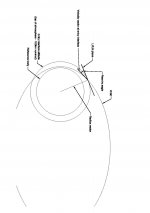
The reentry angle is the angle between the velocity vector and the plane perpendicular to the radius vector when the vessel is at the defined entry interface altitude. I don't use BaseSync so I'm not sure what altitude it uses for the entry interface.

Here is an alternative definition (it amounts to the same thing as mine):
http://www.answers.com/topic/reentry-angle

EDIT: I've attached a drawing to help clarify that.
 

Attachments

  • Reentry_angle.jpg
    Reentry_angle.jpg
    42.4 KB · Views: 72
Ok, I've been trying to make an on-target reentry for a day or two now, but I can't work out a few things:

Firstly, how do I input my target (lets say Cape Canaveral) into the MFDs, and what then?

Secondly, how do I know when/where to do my de-orbit burn, how do I know how long I should do it for, and where can I find all the information about it on the MFDs?

Finally, what happens in the time following the de-orbit burn?

As a sort of miscellaneous question, what altitude should I be doing the burn at, and where does the atmosphere begin?

Thanks,
Dambuster
 
Hi Dambuster:
1) If you're referring to Base Synch MFD, you click a button on the top left marked TGT and then enter the EXACT name (tho' not case sensitive). Check to see it's registered as a target.
Then you click on DEO on the bottom left.
2) DEO will give you the place and time. Enter ANG about 0.8 or 1 degree. ANT is anticipation. Usually 4-5 degrees is enough. Leave ALT at 40km.
The display will show you a yellow line marking your target and a white line marking where you should burn. It also indicates delta-V. When you're near to the white line, assume RETROGRADE position and burn till delta-V reaches zero.
3) Now swing round to prograde, then level horizon. If you have a DG-IV or something like that, checks are in order. Refer to the vessel manual. If in a stock DG, just wait.
As you pass under 100km altitude, lift the nose till AoA is 35-40º. After that you re-enter, and then you burn up and die. Only kidding. You drop the AoA slowly towards around 12º. When you're at around 30km, you should be able to fly like a plane.

This is when you remember crossrange, and discover you're 2000km to the east or west of where you wanted to be.

That's the basic basics. Nobody said it was easy. Practice makes perfect.
ar81's tutorial mentioned above is a great source for more info. DanSteph's DG-IV package includes a tutorial scenario and a helpful autopilot. TYry them too.
 
Ok, thanks a lot. I'll try that as soon as homework and parental restrictions allow me to use the comp with Orbiter on them. I've managed to use the Aerobrake MFD (either that or the BaseSync one) to get it so that my orbit passes within a few hundred metres of the target base. Something that was confusing me was that it looked like it was showing the base as being somewhere over Africa/the Indian Ocean, however I may have been confusing the line marking the base location with the one marking where the de-orbit burn should take place.

Anyway, I can't wait to try all that out!
 
Ok, thanks a lot. I'll try that as soon as homework and parental restrictions allow me to use the comp with Orbiter on them... Anyway, I can't wait to try all that out!

Tell your parents that fooling with Orbiter will make you smarter. It's true.
It made me smarter and I was already the holder of two Nobel prizes for Smartness.
Good luck with the re-entries. Tell us if you do a nice reentry and we'll award you a set of imaginary Orbinaut wings.
 
Out of curiosity, why not a lower altitude? Is this simply to allow for enough room to glide to hit the correct runway?

Leave ALT at 40km.
.


-----Posted Added-----


Very true....this game has strong educational merrit..unlike those shoot-em-up games.

Tell your parents that fooling with Orbiter will make you smarter. It's true.
It made me smarter and I was already the holder of two Nobel prizes for Smartness.
Good luck with the re-entries. Tell us if you do a nice reentry and we'll award you a set of imaginary Orbinaut wings.


-----Posted Added-----


-----Posted Added-----


WDND? (What does Nasa Do) for shuttle reentry? What is a typical real procedure? AoA, deorbit burn location...etc?
 
Last edited:
Back
Top