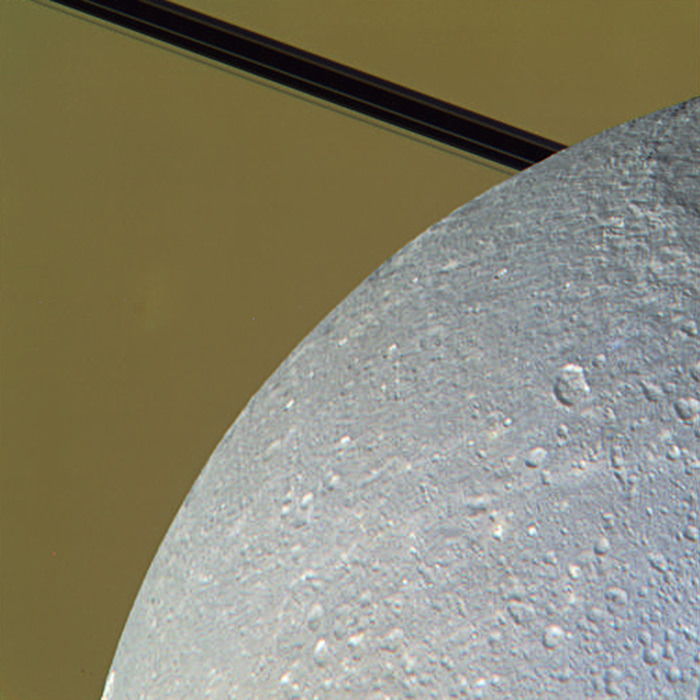
Updates Cassini Mission News and Updates

SPACE.com: Haunting Photos of Saturn Moons Snapped by Cassini Spacecraft

Discovery News: Hanging Out With Janus, Saturn's Dinky Moon: Big Pic:

janus-zoom.jpg

Universe Today: Postcards From Saturn

The Planetary Society Blog: Pretty picture: Janus and Saturn
 
CICLOPS: Rev164: Apr 5 - Apr 23 '12:
Cassini continues its exploration of the Saturn system with the 17-day Rev164, which begins on April 5 at its farthest distance from the planet. This is also called the orbit's apoapse. At this point, Cassini is 2.37 million kilometers (1.47 million miles) from Saturn's cloud tops. The spacecraft is nearing the end of the first equatorial phase of the Cassini Solstice Mission, a phase which lasts until May 2012. During this phase, the spacecraft's orbits lie within the equatorial plane of the planet, providing opportunities to encounter Saturn's numerous moons, image the rings edge-on, and look at Saturn's cloud tops without the rings obscuring the view. Forty-eight ISS observations are planned for Rev164, the vast majority dedicated to Saturn storm monitoring and to encounters with Enceladus and Tethys.

ISS begins its observations for Rev164 three days after apoapse on April 8 with three quick observations of Saturn and its faded northern hemisphere storm. These "Storm Watch" observation sequences are designed to take advantage of short, two-minute segments when the spacecraft turns the optical remote sensing (ORS) instruments back to Saturn as a waypoint between other experiments' observations. These sequences include blue, clear, two methane band, and one full-frame, continuum band filter images. Three more such observations are planned for April 11, with another eighteen planned between April 16 and 23. Also on April 8, ISS will take a look at Titan from a distance of 1.81 million kilometers (1.12 million miles). The observation is an effort to look for clouds in the moon's atmosphere as part of the "Titan Monitoring Campaign" (TMC). This observation of a half-phase Titan is designed to monitor clouds over the moon's Belet dune field. Later that day, ISS will acquire an astrometric observation of Saturn's small, inner moons, including Daphnis, Pallene, Helene, Janus, Methone, and Calypso. Astrometric observations are used to improve our understanding of the orbits of these small satellites, which can be influenced by Saturn's larger icy satellites. Additional astrometric observations will be taken on April 11, 16, 19, 20, and 23.

On April 11, ISS will perform a TMC observation of Titan that will allow for monitoring of cloud features across the Senkyo dune field from a distance of 2.31 million kilometers (1.44 million miles). Another TMC sequence will be acquired on April 13, covering Titan's Saturn-facing hemisphere from a distance of 1.79 million kilometers (1.11 million miles). Later that day, ISS will search for possible satellites at Rhea's L5 point, a Lagrangian point that lies 60 degrees behind the icy moon on its orbit. Similar moons have been found at Dione's and Tethys' L5 points (Polydeuces and Calypso, respectively). A similar sequence covering Rhea's L4 point (60 degrees ahead of it along its orbit) will be acquired on April 15.

On April 14 at 17:03 UTC, Cassini will reach periapse for Rev164 at an altitude of 135,940 kilometers (84,470 miles) from Saturn. ISS observations during the periapse period will be taken during a targeted encounter of Enceladus and later during a close, non-targeted encounter of Tethys.

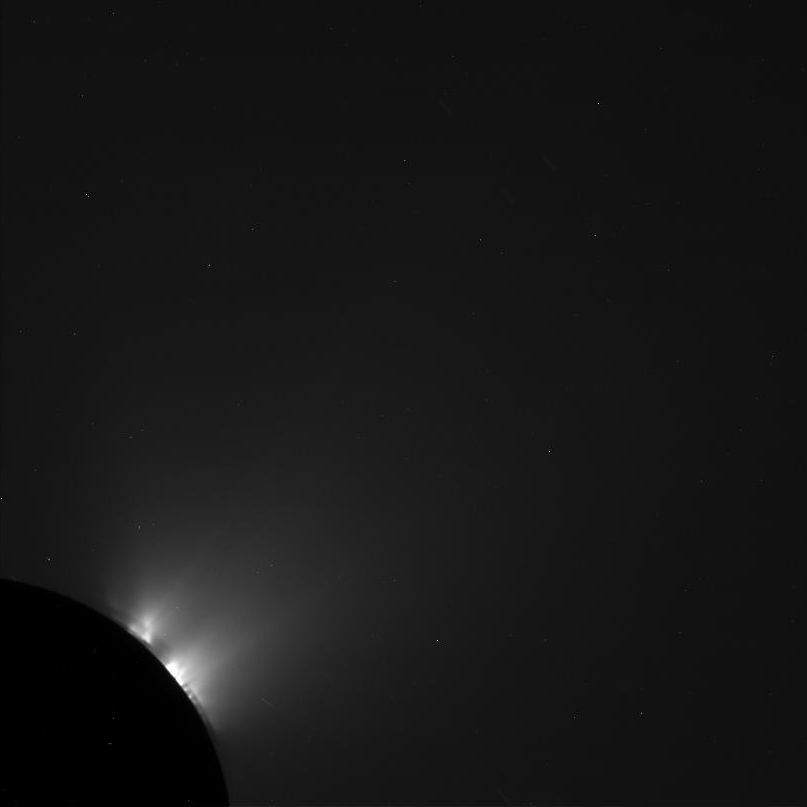
Cassini will fly by Enceladus (E18) at an altitude of 74 kilometers (46 miles) at 14:02 UTC on April 14. ISS will image the icy satellite's south polar plume from distances of 340,500 kilometers (211,600 miles) down to 118,540 kilometers (73,660 miles) while the satellite is just a thin crescent. Next, the Composite Infrared Spectrometer (CIRS) will acquire a series of mid-infrared scans across the night side of Enceladus, as well as a scan across the south polar terrain (found in earlier flybys of Enceladus to be a thermal hotspot). During the two hours surrounding closest approach, the Ion and Neutral Mass Spectrometer (INMS) will be prime, analyzing the composition of Enceladus' south polar plume as the spacecraft flies through it. The spacecraft's path will take it along the length of Baghdad Sulcus, allowing INMS to resolve individual jets from this "tiger stripe" fracture. The sulcus will be in darkness, but ISS will acquire a single narrow-angle camera/wide-angle camera image pair during this observation just as the ISS field-of-view crosses onto Enceladus' day side. The frame will be centered near 74 degrees south latitude, 18 degrees west longitude and taken from an altitude of 74 kilometers (46 miles). The high velocity of the spacecraft will smear the images and leave the NAC image with an useful pixel scale of about 18 meters (59 feet) per pixel instead of what ideally would be a pixel scale of 44 centimeters per pixel (17 inches per pixel) at that range. Because of the smearing, the WAC image will have about the same useful resolution as the NAC, only it will cover a much larger area Afterward, the Composite Infrared Spectrometer (CIRS) will obtain a map of Enceladus sun-lit side using its FP3 channel, focusing particularly on the sub-solar point where the CIRS expects the highest temperatures and best signal-to-noise.

At 22:06 UTC, Cassini will fly by another of Saturn's icy satellites, Tethys, at a close-approach distance of 9,053 kilometers (5,625 miles). This is Cassini's best encounter with the moon since a targeted encounter in September 2005. After a CIRS observation of Tethys' night side, ISS will capture a frame over Tethys' night side, imaging the moon's surface features in Saturn-shine. After closest approach, it will acquire a 22-frame mosaic of Tethys' anti-Saturn hemisphere, including some frames late in the mosaic of the large impact basin Odysseus. Afterward, ISS will ride along with the Visual and Infrared Mapping Spectrometer (VIMS), imaging Tethys through a series of color filters as the moon just about fits the NAC field-of-view.

Later on April 15, ISS will perform a TMC observation of Titan from a distance of 1.51 million kilometers (0.94 million miles). This will allow for monitoring of cloud features across the Fensal-Aztlan region of the moon. Afterward, ISS will search for moons at Rhea's L4 Lagrangian point. On April 19, ISS will watch as Dione occults the southern hemisphere of Rhea. Dione will be 1.82 million kilometers (1.13 million miles) away while Rhea will be 2.44 million kilometers (1.51 million miles) away. The difference in distance will make Dione appear to be about the same size as Rhea. Later that day, ISS will acquire another TMC observation of Titan from a distance of 1.20 million kilometers (0.75 million miles), covering the boundary between Xanadu and Shangri-La. ISS will take another look at the area the next day, this time from a distance of 1.12 million kilometers (0.69 million miles). Later on the 20th, ISS will search for possible satellites at Titan's L5 point. Finally, the camera system will watch as Rhea, 1.79 million kilometers (1.12 million miles) away, occults the southern hemisphere of Tethys, 2.11 million kilometers (1.31 million miles) from Cassini.

On April 23, ISS will take another look at Titan, this time from a distance of 1.69 million kilometers (1.05 million miles) looking at the Belet dune field. Later that day, ISS will ride along with the Visual and Infrared Mapping Spectrometer to image the G ring.

On April 23, Cassini will reach apoapse on this orbit, bringing it to a close and starting Rev165. Rev165 includes a targeted flyby of Enceladus and close, non-targeted flyby of Dione.

{...}
 
NASA / NASA JPL:
Cassini to Dip into Enceladus Spray Again

April 13, 2012

Less than three weeks after its last visit to the Saturnian moon Enceladus, NASA's Cassini spacecraft returns for an encore. At closest approach on April 14, the spacecraft will be just as low over the moon's south polar region as it was on March 27 -- 46 miles, or 74 kilometers.

[table="head;width=225"]
Click on image to enlarge​


NASA's Cassini spacecraft will make a close approach to the south polar region of Saturn's moon Enceladus on April 14, 2012.
Image credit: NASA/JPL-Caltech​
[/table]​


Like the last, this latest flyby is mainly designed for Cassini's ion and neutral mass spectrometer, which will "taste" the particles in the curious jets spraying from the moon's south polar region. Combined with the March 27 flyby and a similar flyby on Oct. 1, 2011, this close encounter will provide a sense of the jets' three-dimensional structure and help determine how much they change over time.

On Cassini's outbound leg, the spacecraft will pass by another Saturnian moon, Tethys, at a distance of about 6,000 miles (9,000 kilometers). The composite infrared spectrometer will look for patterns in Tethys' thermal signature. Other instruments will study the moon's composition and geology. The imaging cameras are expected to obtain new views of Enceladus and Tethys.

{...}
 
CICLOPS:
Universe Today: Cassini Slips Through Enceladus’ Spray

N001857271.jpg

Cassini's latest view of Enceladus' icy spray, acquired on April 14, 2012.


W00073473-edit.jpg

Enceladus' southern fissures, the source of its spray.
(NASA/JPL/SSI/J. Major)


N00185749.jpg

A crescent-lit Enceladus sprays its "habitable zone" out into space.


tethys-4-14-12-melanthius.jpg

Saturn's moon Tethys, imaged by Cassini on April 14, 2012.​
 
NASA / NASA JPL:
Cassini Successfully Flies over Enceladus

April 16, 2012

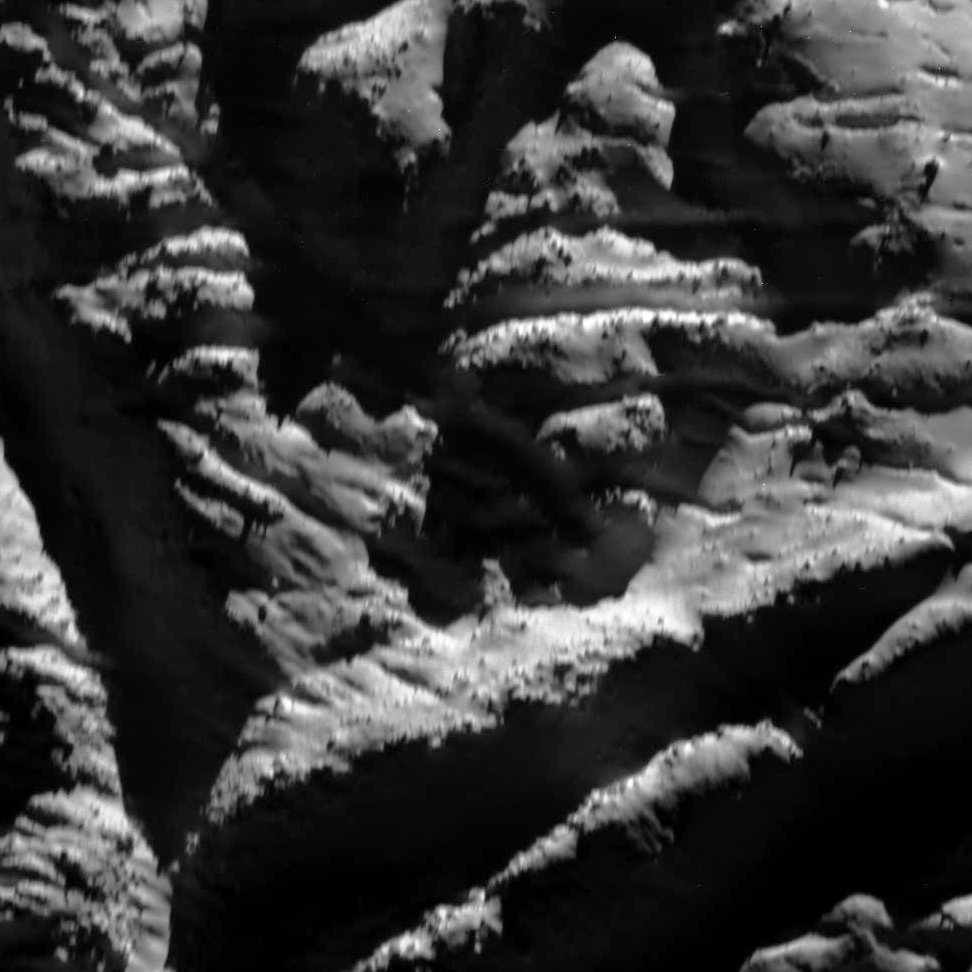
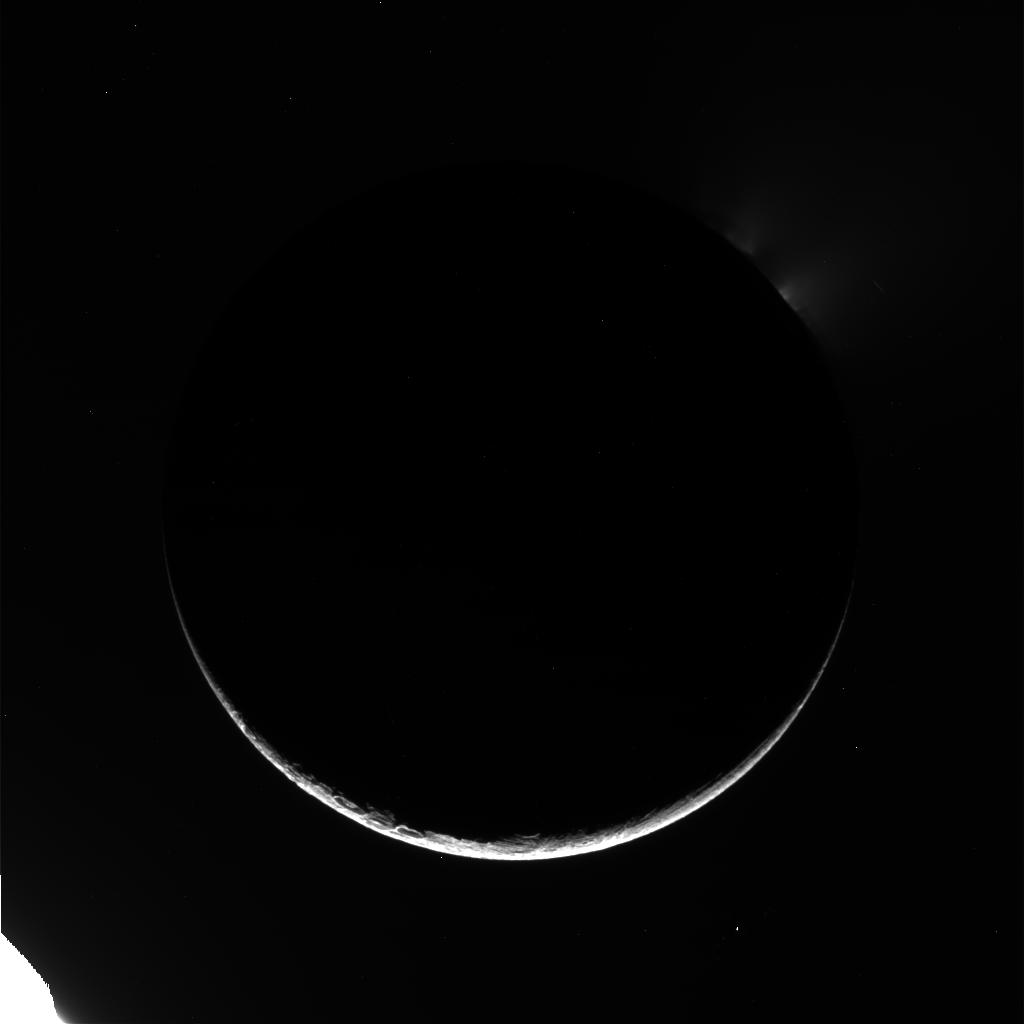
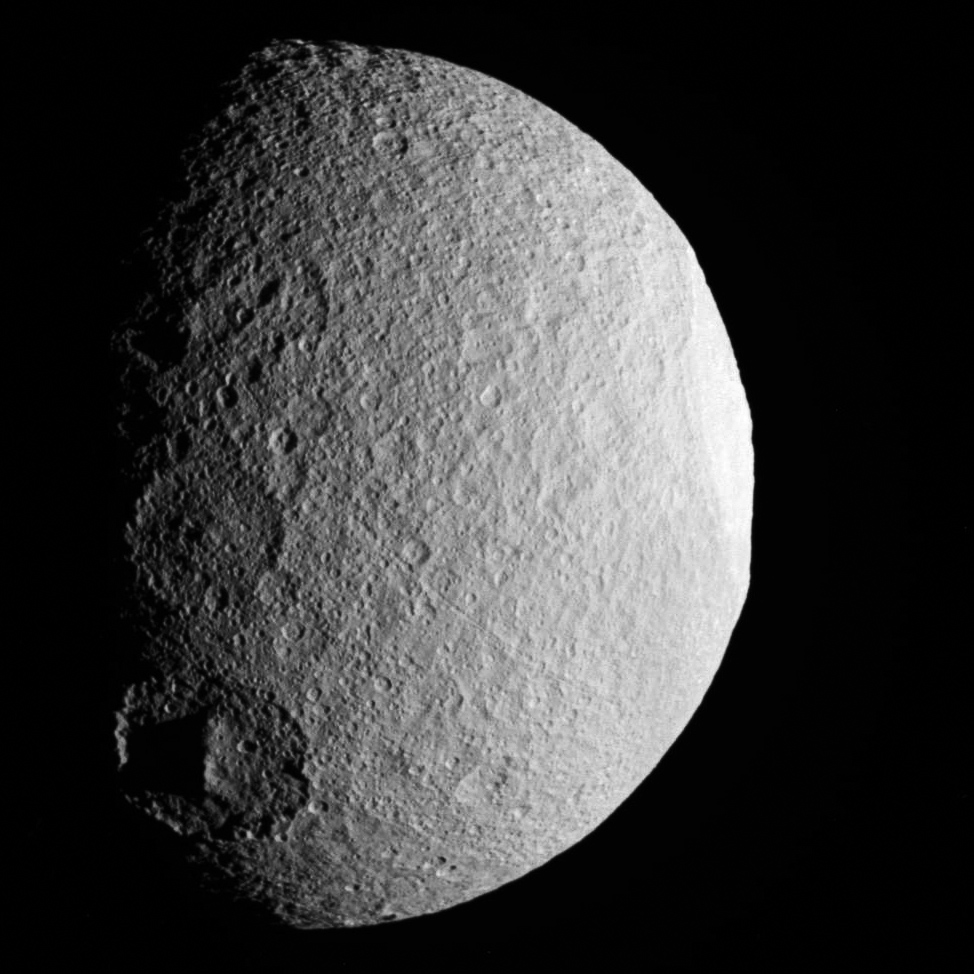
These raw, unprocessed images of Saturn's moons Enceladus and Tethys were taken on April 14, 2012, by NASA's Cassini spacecraft.

[table="head;width=450"]{colsp=2}
Click on images for details​

|

Arc of Enceladus
This image was taken by NASA's Cassini spacecraft on April 14, 2012. The camera was pointing toward Enceladus at approximately 75,067 miles (120,808 kilometers) away.
Image Credit: NASA/JPL/Space Science Institute​
|
Enceladus Terrain
This image was taken by NASA's Cassini spacecraft on April 14, 2012. The camera was pointing toward Enceladus at approximately 115 miles (185 kilometers) away.
Image Credit: NASA/JPL/Space Science Institute​

|

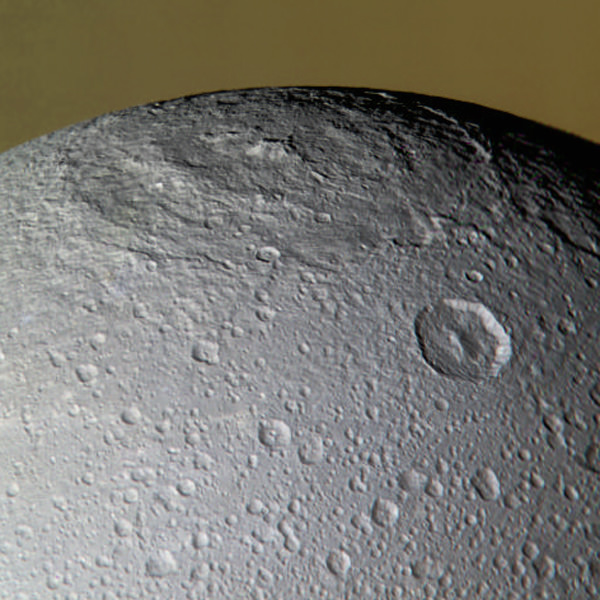
Tethys Portrait
This image was taken by NASA's Cassini spacecraft on April 15, 2012. The camera was pointing toward Tethys at approximately 115,714 miles (186,224 kilometers) away.
Image Credit: NASA/JPL/Space Science Institute​
|
Tethys Surface
This image was taken by NASA's Cassini spacecraft on April 14, 2012. The camera was pointing toward TETHYS at approximately 10,875 miles (17,502 kilometers) away.
Image Credit: NASA/JPL/Space Science Institute​
[/table]​


Cassini flew by Enceladus at an altitude of about 46 miles (74 kilometers). This flyby was designed primarily for the ion and neutral mass spectrometer to analyze, or "taste," the composition of the moon's south polar plume as the spacecraft flew through it. Cassini's path took it along the length of Baghdad Sulcus, one of Enceladus' "tiger stripe" fractures from which jets of water ice, water vapor and organic compounds spray into space. At this time, Baghdad Sulcus is in darkness, but that was not an obstacle for another instrument, the composite infrared spectrometer, which can see features by their surface temperatures and which also took measurements during this flyby.

As soon as daylight passed into the spacecraft's remote sensing instruments' line of sight, Cassini's cameras acquired images of the surface. The wide-angle-camera image included in the new batch, taken from around the time of closest approach, has some smearing from the movement of the spacecraft during the exposure, but still shows the surface in vivid detail.

Cassini's cameras also imaged Enceladus' south polar plume at a high phase angle as the satellite appeared as a thin crescent and the plume was backlit.

After the Enceladus encounter, Cassini passed the moon Tethys with a closest approach distance of about 5,700 miles (9,100 kilometers). This was Cassini's best imaging encounter with Tethys since a targeted encounter in September 2005. The 2005 encounter, with a closest approach distance of about 930 miles (1,500 kilometers), provided the images of Tethys with the best resolution and captured views of the side of Tethys that faces Saturn in its orbit. This new encounter examined the opposite side of Tethys, providing some of the highest-resolution images of the side that faces away from Saturn. Cassini acquired a 22-frame mosaic of this side, which features the large impact basin named Odysseus. Scientists will use these new data in conjunction with images from previous encounters to create digital elevation maps of the moon's surface.

{...}
 
Enceladus' southern fissures, the source of its spray.

Amazing ! Those pics of real alien worlds are awesome ! :thumbup:
 
And 2 more (not raw anymore):

The Planetary Society Blog: Pretty pictures from Cassini's weekend flybys of Enceladus and Tethys

[table="width=400"]
enceladus_plumes_fly-in_cassini_raw_20120414.gif


Flying toward Enceladus' plumes
Cassini took this sequence of photos of Enceladus' south polar plumes as it approached for its super close flyby on April 14, 2012.
Credit: NASA / JPL / SSI / animation by Emily Lakdawalla​
 ​

tethys_cassini_color_raw_20040414_lakdawalla_full.jpg


Tethys in color
An enhanced-color (IR-G-UV) view of Tethys from Cassini's April 14, 2012 flyby.
Credit: NASA / JPL / SSI / color composite by Emily Lakdawalla​
[/table]​
 
NASA / NASA JPL:
Cassini Finds Titan Lake is like a Namibia Mudflat

April 19, 2012

A new study analyzing data from NASA's Cassini spacecraft suggests that the lake, known as Ontario Lacus, behaves most similarly to what we call a salt pan on Earth.

A group led by Thomas Cornet of the Université de Nantes, France, a Cassini associate, found evidence for long-standing channels etched into the lake bed within the southern boundary of the depression. This suggests that Ontario Lacus, previously thought to be completely filled with liquid hydrocarbons, could actually be a depression that drains and refills from below, exposing liquid areas ringed by materials like saturated sand or mudflats.

[table="head;width=400"]
Click on image for details​


A recent study finds that the lake known as Ontario Lacus on Saturn's moon Titan (left) bears striking similarity to a salt pan on Earth known as the Etosha Pan (right).
Image credit: NASA/JPL-Caltech and NASA/USGS​
[/table]​


"We conclude that the solid floor of Ontario Lacus is most probably exposed in those areas," said Cornet, whose paper appears in a recent issue of the journal Icarus.

These characteristics make Ontario Lacus very similar to the Etosha salt pan on Earth, which is a lake bed that fills with a shallow layer of water from groundwater levels that rise during the rainy season. This layer then evaporates and leaves sediments like tide marks showing the previous extent of the water.

"Some of the things we see happening in our own backyard are right there on Titan to study and learn from," said Bonnie Buratti, a co-author and Cassini team member based at NASA's Jet Propulsion Laboratory in Pasadena, Calif. "On Earth, salt pans tend to form in deserts where liquids can suddenly accumulate, so it appears the same thing is happening on Titan."

While the liquid on Titan is methane, ethane and propane rather than water, the cycle appears to work in a very similar fashion to the water cycle on Earth. Beyond Earth, Titan is the only other world known to bear stable liquids on its surface. There, the full hydrocarbon cycle is based on hydrogen, carbon and nitrogen, and takes place between the atmosphere, the surface and the subsurface. Titan's lakes are an integral part of this process.

This latest paper is part of an ongoing study of Ontario Lacus, the largest lake in Titan's south polar region. Cassini has been observing the lake with multiple instruments and employing multiple methods of analysis to see if Titan, like Earth, changes with the seasons. During the time Cassini has been exploring the Saturn system, Titan's southern hemisphere has transitioned from summer to fall.

"These results emphasize the importance of comparative planetology in modern planetary sciences: finding familiar geological features on alien worlds like Titan allows us to test the theories explaining their formation," said Nicolas Altobelli, ESA's Cassini-Huygens project scientist.

{...}


ESA: Far-off cousin of part-time African lake found on Titan

[table="head;width=200"]
Click on image to enlarge​


Ontario Lacus is Titan’s largest lake in its southern hemisphere. It is an ephemeral lake that resembles Etosha Pan in Namibia, Africa. On Titan the liquid is made of hydrocarbons, whereas on Earth it is made of water.
Credits: Cassini radar image JPL/NASA. Envisat radar image ESA. Composite image: LPGNantes.​
[/table]​

Universe Today: African Lake Has a Twin on Titan
 
CICLOPS: Rev165: Apr 23 - May 11 '12:
Cassini continues its exploration of the Saturn system with the 17-day Rev165, which begins on April 23 at its farthest distance from the planet. This is also called the orbit's apoapse. At this point, Cassini is 2.37 million kilometers (1.48 million miles) from Saturn's cloud tops. The spacecraft is nearing the end of the first equatorial phase of the Cassini Solstice Mission, a phase which lasts until the Titan flyby in Rev166. During this phase, the spacecraft's orbits lie within the equatorial plane of the planet, providing opportunities to encounter Saturn's numerous moons, image the rings edge-on, and look at Saturn's cloud tops without the rings obscuring the view. Twenty-three ISS observations are planned for Rev165, the vast majority dedicated to Saturn storm monitoring and to encounters with Enceladus and Dione.

ISS begins its observations for Rev165 the day after apoapse on April 24 with a quick observation of Saturn using the wide-angle camera (WAC). This observation is one of the "Storm Watch" observation sequences designed to take advantage of short, two-minute segments when the spacecraft turns the optical remote sensing (ORS) instruments back to Saturn as a waypoint between other experiments' observations. These sequences include blue, clear, two methane band, and one full-frame, continuum band filter images. Six more such observations are planned between April 28 and 30. Also on April 24, ISS will acquire a 14-hour light curve of the outer irregular satellite Erriapus. Cassini will be making its closest pass of the small, 10-kilometer-wide (6-mile-wide) satellite, at a distance of 6.31 million kilometers (3.92 million miles). This is still too far away to resolve the satellite as anything more than a point of light near the Orion Nebula. On April 25, the visual and infrared mapping spectrometer (VIMS) will attempt to observe the transit of a Jupiter-sized planet orbiting the star HD 189733 in the constellation Vulpecula. ISS will acquire images of the starfield surrounding the star every 3 minutes.

On April 28, ISS will take a look at Titan from a distance of 2.87 million kilometers (1.78 million miles). The observation is an effort to look for clouds in the moon's atmosphere as part of the "Titan Monitoring Campaign" (TMC). This observation of a gibbous Titan is designed to monitor clouds over the moon's Senkyo and eastern Aztlan dune fields. ISS also will be taking shorter-wavelength images to study changes in Titan's upper haze layers. Later that day, ISS will acquire an astrometric observation of Saturn's small, inner moons, including Helene, Telesto and Prometheus. Astrometric observations are used to improve our understanding of the orbits of these small satellites, which can be influenced by Saturn's larger icy satellites. On April 30, ISS will take another TMC observation of Titan that will allow for monitoring of cloud features across the Senkyo dune field from a distance of 2.49 million kilometers (1.55 million miles). On May 1, ISS will acquire a nine-hour rotational light curve of the second largest of Saturn's small, irregular, outer satellites, Ymir. The camera system will acquire another light curve observation of Ymir on May 3.

On May 2 at 12:34 UTC, Cassini will reach periapse for Rev165 at an altitude of 135,460 kilometers (84,170 miles) from Saturn. ISS observations during the periapse period will be taken during a targeted encounter of Enceladus and later during a close, non-targeted encounter of Dione.

Cassini will fly by Enceladus (E19) at an altitude of 73.6 kilometers (45.7 miles) at 09:31 UTC on May 2. ISS will image the icy satellite's south polar plume from distances ranging from 416,000 kilometers (259,000 miles) down to 106,000 kilometers (66,000 miles) while the satellite is just a thin crescent. In between, the radio science sub-system (RSS) will perform that team's first of two gravity experiments of the encounter. Next, the composite infrared spectrometer (CIRS) will acquire a series of mid-infrared scans across the night side of Enceladus, with its highest resolution data over the south polar terrain (found in earlier flybys of Enceladus to be a thermal hotspot). During the two hours surrounding closest approach, RSS will be prime, using Cassini's radio signal back to Earth to measure variations in Enceladus' gravity field. Particularly, the RSS team is looking for a mass concentration (or "mascon") at the south pole, indicative of a diapir, or sub-surface intrusion of material, that would explain the geologic activity in the region. Afterward, CIRS will obtain a map of Enceladus sun-lit side using its FP3 channel while ISS takes several images during one of the slow scans across the leading hemisphere.

At 20:13 UTC, Cassini will fly by another of Saturn's icy satellites, Dione, at a close-approach distance of 8,057 kilometers (5,006 miles). First, CIRS will acquire several scans of Dione's night side while ISS will capture a five-frame mosaic covering the sunlit crescent, centered along 70 degrees west longitude. From the time of closest approach until two hours afterward, ISS will acquire six mosaics. The first is a three-frame mosaic taken around closest approach. This mosaic will cover a fracture named Latium Chasma at resolutions near 53 meters (175 feet) per pixel. The next mosaic is a 24-frame mosaic covering much of Dione's northern anti-Saturn hemisphere, focusing particularly on Janiculum Dorsa and the region to the west of this ridge, as far as the ancient impact basin, Latinus. A three-frame mosaic will then be taken of Janiculum Dorsa for stereo imaging. Next, ISS will acquire a six-frame mosaic along the western limb, covering parts of Dione's wispy streak fractures. ISS will then image Dione's eastern limb, acquiring a set of images over Erulus crater. ISS will acquire a nine-frame mosaic across all of the visible terrain, centered over the moon's anti-Saturn hemisphere. Finally, ISS will capture a WAC movie as Dione crosses the face of Saturn.

The rest of ISS' observations for Rev165 are dedicated to a non-targeted encounter of Titan on May 6, when ISS will come within 700,000 kilometers (435,000 miles) of Saturn's largest moon. The first observation is a two-hour TMC sequence on May 5, taken from a distance of 745,630 kilometers (463,310 miles). This observation will cover western and central Xanadu. On May 6, during the distant encounter, ISS will acquire a 14-hour, 45-minute observation of Titan. This observation is broken up into several parts. First, ISS will acquire a four-frame mosaic covering the anti-Saturn hemisphere of Titan from a distance of 709,950 kilometers (441,140 miles). Afterward, ISS will acquire a series of color filters to characterize both the surface and its upper haze layers followed by sets of surface images four and eight hours later for cloud tracking. ISS will then acquire a clear-filter, WAC movie of Titan passing in front of the bright limb of Saturn. The first four frames will be separated by five minutes while the next 24 will be separated by 17 to 60 seconds. In the middle of this movie, ISS will acquire a set of red, green, and blue images with both the narrow-angle camera (NAC) and WAC just as Titan passes over Saturn's bright limb from a distance of 759,160 kilometers (471,720 miles). Next, ISS will acquire a four-frame mosaic of Titan with Saturn in the background. This mosaic is designed to map the anti-Saturn hemisphere of Titan as well as study the upper haze layers of the moon while they are silhouetted by the planet. Finally, ISS will acquire a set of red, green, and blue filter WACs of Titan with Saturn in the background.

On May 7, ISS will perform a TMC observation of Titan from a distance of 897,800 kilometers (557,900 miles). This will allow for monitoring of cloud features across the Adiri region of the moon. On May 11, ISS will acquire another TMC observation of Titan from a distance of 2.57 million kilometers (1.60 million miles), covering the boundary between Senkyo and Belet.

On May 11, Cassini will reach apoapse on this orbit, bringing it to a close and starting Rev166. Rev166 includes a targeted flyby of Titan. The flyby will bring to a close the first equatorial leg of the Cassini Solstice Mission and start the first inclined phase.

{...}

 
NASA / NASA JPL:
Cassini Sees Objects Blazing Trails In Saturn Ring

April 23, 2012

PASADENA, Calif. - Scientists working with images from NASA's Cassini spacecraft have discovered strange half-mile-sized (kilometer-sized) objects punching through parts of Saturn's F ring, leaving glittering trails behind them. These trails in the rings, which scientists are calling "mini-jets," fill in a missing link in our story of the curious behavior of the F ring. The results will be presented tomorrow at the European Geosciences Union meeting in Vienna, Austria.

"I think the F ring is Saturn's weirdest ring, and these latest Cassini results go to show how the F ring is even more dynamic than we ever thought," said Carl Murray, a Cassini imaging team member based at Queen Mary University of London, England. "These findings show us that the F ring region is like a bustling zoo of objects from a half mile [kilometer] to moons like Prometheus a hundred miles [kilometers] in size, creating a spectacular show."

[table="head;width=450"]{colsp=2}
Click on images for details​

|

Images from NASA's Cassini spacecraft
Images from NASA's Cassini spacecraft have revealed half-mile-sized (kilometer-sized) objects punching through parts of Saturn's F ring, leaving glittering trails behind them. These trails in the rings, which scientists are calling "mini-jets," fill in a missing link in our story of the curious behavior of the F ring.
Image credit: NASA/JPL-Caltech/SSI/QMUL​
|
Small Trail at Saturn Orbit Insertion
This image obtained by NASA's Cassini spacecraft around the time it went into orbit around Saturn in 2004 shows a short trail of icy particles dragged out from Saturn's F ring.
Image credit: NASA/JPL-Caltech/SSI/QMUL​

|

Classic Trails or Mini-Jets
This set of six images obtained by NASA's Cassini spacecraft shows trails that were dragged out from Saturn's F ring by objects about a half mile (1 kilometer) in diameter.
Image credit: NASA/JPL-Caltech/SSI/QMUL​
|
Exotic Trails or Mini-Jets
This set of four images obtained by NASA's Cassini spacecraft shows some of the more bizarre trails that were dragged out from Saturn's F ring by objects about a half mile (1 kilometer) in diameter.
Image credit: NASA/JPL-Caltech/SSI/QMUL​

{colsp=2}

{colsp=2}
Wavy, Wiggly Ring
The constant change in Saturn's wavy, wiggly F ring is on display in this set of images obtained by NASA's Cassini spacecraft. The images show a view looking directly down onto the ring with the planet removed from the center.
Image credit: NASA/JPL-Caltech/SSI/QMUL​
[/table]​


New images and movies of the mini-jets and other peculiar F ring behavior are available at http://www.nasa.gov/mission_pages/cassini/whycassini/cassini20120423.html.

Scientists have known that relatively large objects like Prometheus (as long as 92 miles, or 148 kilometers, across) can create channels, ripples and snowballs in the F ring. But scientists didn't know what happened to these snowballs after they were created, Murray said. Some were surely broken up by collisions or tidal forces in their orbit around Saturn, but now scientists have evidence that some of the smaller ones survive, and their differing orbits mean they go on to strike through the F ring on their own.

These small objects appear to collide with the F ring at gentle speeds - something on the order of about 4 mph (2 meters per second). The collisions drag glittering ice particles out of the F ring with them, leaving a trail typically 20 to 110 miles (40 to 180 kilometers) long. Murray's group happened to see a tiny trail in an image from Jan. 30, 2009 and tracked it over eight hours. The long footage confirmed the small object originated in the F ring, so they went back through the Cassini image catalog to see if the phenomenon was frequent.

"The F ring has a circumference of 550,000 miles [881,000 kilometers], and these mini-jets are so tiny they took quite a bit of time and serendipity to find," said Nick Attree, a Cassini imaging associate at Queen Mary. "We combed through 20,000 images and were delighted to find 500 examples of these rogues during just the seven years Cassini has been at Saturn."

In some cases, the objects traveled in packs, creating mini-jets that looked quite exotic, like the barb of a harpoon. Other new images show grand views of the entire F ring, showing the swirls and eddies that ripple around the ring from all the different kinds of objects moving through and around it.

"Beyond just showing us the strange beauty of the F ring, Cassini's studies of this ring help us understand the activity that occurs when solar systems evolve out of dusty disks that are similar to, but obviously much grander than, the disk we see around Saturn," said Linda Spilker, Cassini project scientist based at NASA's Jet Propulsion Laboratory, Pasadena, Calif. "We can't wait to see what else Cassini will show us in Saturn's rings."

{...}


NASA Press Release: RELEASE : 12-128 - Cassini Spacecraft Sees New Objects Blazing Trails in Saturn Ring

CICLOPS:
Universe Today: Glittering ‘Mini-Jets’ Found in Saturn’s Curious F-Ring

ESA: Cassini movie shows blazing trails in Saturn’s F-ring

SPACE.com: Mysterious Objects Punching Holes In Weird Saturn Ring
 
NASA / NASA JPL:
Cassini Investigates Titan's Chemical Factory

April 24, 2012

Saturn's giant moon Titan hides behind a thick, smoggy atmosphere that's well known to scientists as one of the most complex chemical environments in the solar system. It's a productive "factory" cranking out hydrocarbons that rain down on Titan's icy surface and cloak it in soot. With a brutally cold surface temperature of around minus 270 degrees Fahrenheit (minus 170 degrees Celsius), the hydrocarbons form lakes of liquid methane and ethane.

However, the most important raw ingredient in Titan's chemical factory is methane gas. Methane is a molecule made up of one carbon atom joined to four hydrogen atoms. It should not last long because it's being continuously destroyed by sunlight and converted to more complex molecules and particles. New research from NASA-funded scientists attempts to estimate how long this factory has been operating. The results are presented in two papers appearing in the April 20 issue of the Astrophysical Journal.

[table="head;width=675"]{colsp=3}
Click on images to enlarge​

||

Titan's dense atmosphere shrouds the moon beneath a tan haze in this image. Saturn's third-largest moon Dione can be seen through the Titan haze in this view of the two posing before the planet and its rings from NASA's Cassini spacecraft. The rings, viewed nearly edge-on, appear as a horizontal line through the image. The rings cast shadows on Saturn, which appear as dark lines at the bottom of the image. The Cassini spacecraft narrow-angle camera made this image on May 21, 2011 at a distance of approximately 1.4 million miles (2.3 million kilometers) from Titan.​
Credit: NASA/JPL-Caltech/Space Science Institute​
|
This false-color image shows a thin, detached haze layer (purple line) that appears to float above Titan's main atmospheric haze. The Cassini spacecraft narrow-angle camera took the image on July 3, 2004.​
Credit: NASA/JPL/Space Science Institute​
|
This false-color image shows evidence for lakes of liquid hydrocarbons, probably methane or ethane, on Titan's surface. The lakes are represented as dark areas, but are not what the human eye would see, because radar was used to penetrate the thick haze obscuring Titan's surface. The Cassini radar instrument acquired this image on July 22, 2006. The image is centered near 80 degrees north, 35 degrees west and is about 140 kilometers (84 miles) across. The strip of radar imagery is foreshortened to simulate an oblique view of the highest latitude region, seen from a point to its west. Smallest details in this image are about 500 meters (1,640 feet) across.​
Credit: NASA/JPL/USGS​
[/table]​


These papers used data collected by two instruments onboard NASA's Cassini spacecraft in orbit around Saturn and one instrument on the European Space Agency's Huygens probe that landed on Titan's surface in January 2005. All three instruments were built at NASA's Goddard Space Flight Center in Greenbelt, Md. A paper led by Conor Nixon of the University of Maryland, College Park uses infrared signatures (spectra) of methane from Cassini's composite infrared spectrometer to estimate how much "heavy" methane containing rare isotopes is present in Titan's atmosphere.

Isotopes are versions of an element with different weights, or masses. For example, carbon 13 is a heavier (and rare) version of the most common type of carbon, called carbon 12. Occasionally, a carbon-13 atom replaces a carbon-12 atom in a methane molecule. Because methane made with carbon 12 is slightly lighter, the chemical reactions that convert it to more complex hydrocarbons happen a bit faster. This means carbon-12 methane gets used up at a slightly faster rate than heavy carbon-13 methane, so the concentration of heavy methane in Titan's atmosphere increases slowly.

By modeling how the concentration of heavy methane changes over time, the scientists predicted how long Titan's chemical factory has been running.

"Under our baseline model assumptions, the methane age is capped at 1.6 billion years, or about a third the age of Titan itself," said Nixon, who is stationed at Goddard. "However, if methane is also allowed to escape from the top of the atmosphere, as some previous work has suggested, the age must be much shorter -- perhaps only 10 million years -- to be compatible with observations."

Both scenarios assume that methane entered the atmosphere in one burst of outgassing, probably from the restructuring of Titan's interior as heavier materials sank towards the center and lighter ones rose toward the surface.

"However, if the methane has been continuously replenished from a source, then its isotopes would always appear 'fresh' and we can't restrict the age in our model," said Nixon. Possible sources include methane clathrates, basically a methane molecule inside a "cage" or lattice of ice molecules. Methane clathrates are found in the frigid depths of Earth's oceans, and some scientists think there could be an ocean of liquid water mixed with ammonia (acting as antifreeze) beneath Titan's water-ice crust. If this is so, methane might be released from its clathrate cages during the eruptions of proposed 'cryovolcanoes' of water-ammonia slurry, or more simply could slowly seep out through fractures in the crust.

The second Titan paper by Kathleen Mandt of the Southwest Research Institute, San Antonio, and colleagues also models the time-evolution of methane. In this work, the concentration of the heavy methane is determined from measurements by Cassini's ion and neutral mass spectrometer, which counts molecules in the atmosphere of different masses (weights). Measurements made by the Huygens gas chromatograph mass spectrometer, which also counts molecules of different masses, were used to constrain the impact of escape on the heavy methane in the atmosphere.

"We compute that, even if methane has been replenished from the interior over time to match or exceed the amounts fed into the atmospheric chemical factory, the process must have been running for a maximum of one billion years," said Mandt. "If the process had started any earlier, we would see a build-up of methane in the lakes on the surface and in the atmosphere beyond what is observed today."

Together these papers add important new perspectives and constraints on the history of Titan's methane atmosphere, confirming that it must have formed long after Titan itself. Previous work considering the evolution of Titan's interior predicted the last major methane eruption occurred 350 million to 1.35 billion years ago, while crater counting has put the age of the current surface at 200 million to one billion years. (Crater counting works on the principle that an older surface has more craters, just as the longer you're in a paintball game, the more hits you'll get.)

The present work for the first time estimates the methane age from the atmosphere itself, at less than one billion years, considering both papers.

{...}
 
NASA / NASA JPL:
Cassini Finds Saturn Moon has Planet-Like Qualities

April 26, 2012

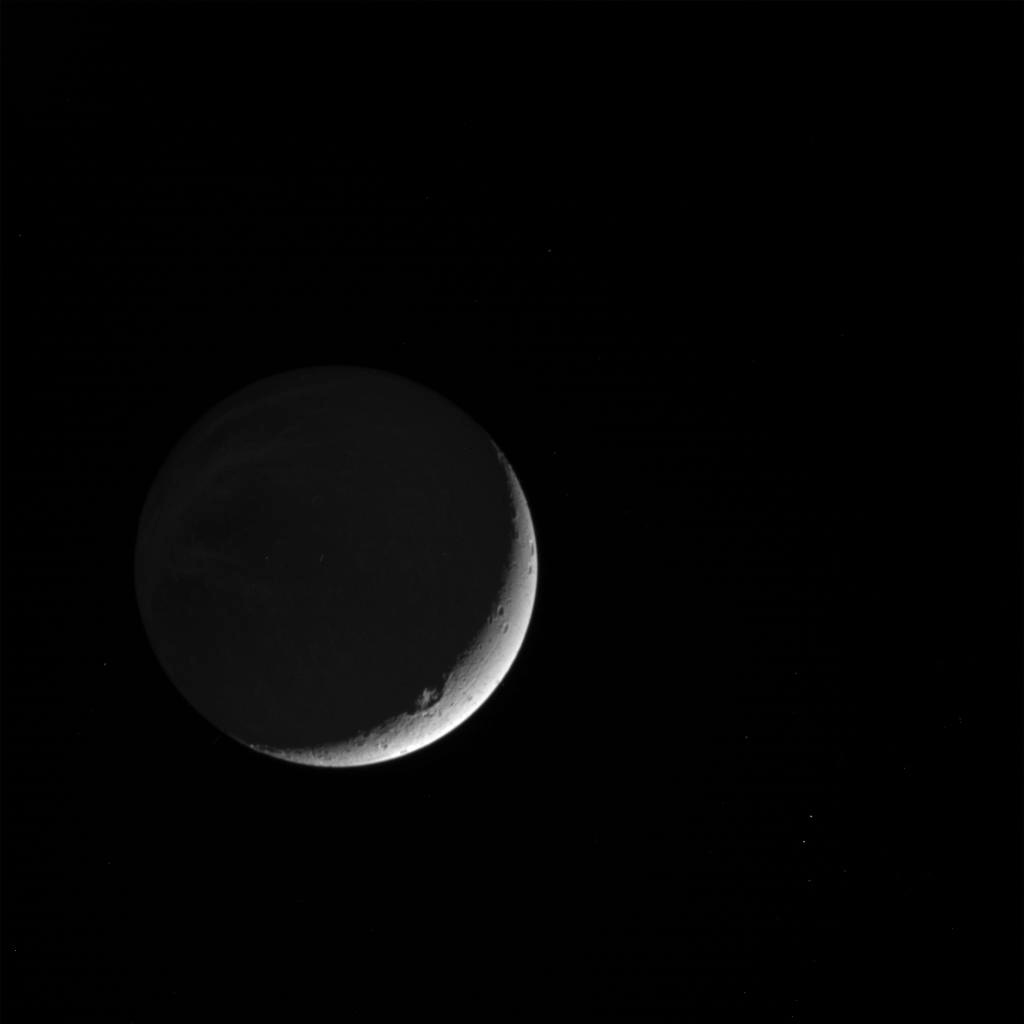
PASADENA, Calif. -- Data from NASA's Cassini mission reveal Saturn's moon Phoebe has more planet-like qualities than previously thought.

Scientists had their first close-up look at Phoebe when Cassini began exploring the Saturn system in 2004. Using data from multiple spacecraft instruments and a computer model of the moon's chemistry, geophysics and geology, scientists found Phoebe was a so-called planetesimal, or remnant planetary building block. The findings appear in the April issue of the Journal Icarus.

[table="head;width=450"]{colsp=2}
Click on images for details​

|

Phoebe's true nature is revealed in startling clarity in this mosaic of two images taken during Cassini's flyby on June 11, 2004.
Image credit: NASA/JPL/Space Science Institute​
|
This panel of images shows the nearly spherical shape of Saturn's moon Phoebe.
Image credit: NASA/JPL-Caltech/SSI/Cornell​
[/table]​


"Unlike primitive bodies such as comets, Phoebe appears to have actively evolved for a time before it stalled out," said Julie Castillo-Rogez, a planetary scientist at NASA's Jet Propulsion Laboratory in Pasadena, Calif. "Objects like Phoebe are thought to have condensed very quickly. Hence, they represent building blocks of planets. They give scientists clues about what conditions were like around the time of the birth of planets and their moons."

Cassini images suggest Phoebe originated in the far-off Kuiper Belt, the region of ancient, icy, rocky bodies beyond Neptune's orbit. Data show Phoebe was spherical and hot early in its history, and has denser rock-rich material concentrated near its center. Its average density is about the same as Pluto, another object in the Kuiper Belt. Phoebe likely was captured by Saturn's gravity when it somehow got close to the giant planet.

Saturn is surrounded by a cloud of irregular moons that circle the planet in orbits tilted from Saturn's orbit around the sun, the so-called equatorial plane. Phoebe is the largest of these irregular moons and also has the distinction of orbiting backward in relation to the other moons. Saturn's large moons appear to have formed from gas and dust orbiting in the planet's equatorial plane. These moons currently orbit Saturn in that same plane.

"By combining Cassini data with modeling techniques previously applied to other solar system bodies, we've been able to go back in time and clarify why it is so different from the rest of the Saturn system," said Jonathan Lunine, a co-author on the study and a Cassini team member at Cornell University, Ithaca, N.Y.

analyses suggest that Phoebe was born within the first 3 million years of the birth of the solar system, which occurred 4.5 billion years ago. The moon may originally have been porous but appears to have collapsed in on itself as it warmed up. Phoebe developed a density 40 percent higher than the average inner Saturnian moon.

Objects of Phoebe's size have long been thought to form as "potato-shaped" bodies and remained that way over their lifetimes. If such an object formed early enough in the solar system's history, it could have harbored the kinds of radioactive material that would produce substantial heat over a short timescale. This would warm the interior and reshape the moon.

"From the shape seen in Cassini images and modeling the likely cratering history, we were able to see that Phoebe started with a nearly spherical shape, rather than being an irregular shape later smoothed into a sphere by impacts," said co-author Peter Thomas, a Cassini team member at Cornell.

Phoebe likely stayed warm for tens of millions of years before freezing up. The study suggests the heat also would have enabled the moon to host liquid water at one time. This could explain the signature of water-rich material on Phoebe's surface previously detected by Cassini.

The new study also is consistent with the idea that several hundred million years after Phoebe cooled, the moon drifted toward the inner solar system in a solar-system-wide rearrangement. Phoebe was large enough to survive this turbulence.

More than 60 moons are known to orbit Saturn, varying drastically in shape, size, surface age and origin. Scientists using both ground-based observatories and Cassini's cameras continue to search for others.

{...}


NASA Press Release: RELEASE : 12-136 - NASA's Cassini Finds Saturn's Moon Phoebe Has Planet-Like Qualities

CICLOPS:
Universe Today: Cassini Exposes Phoebe As More Planet Than Moon
 
NASA / NASA JPL:
Cassini to Probe Enceladus Gravity, Take Pictures

May 01, 2012

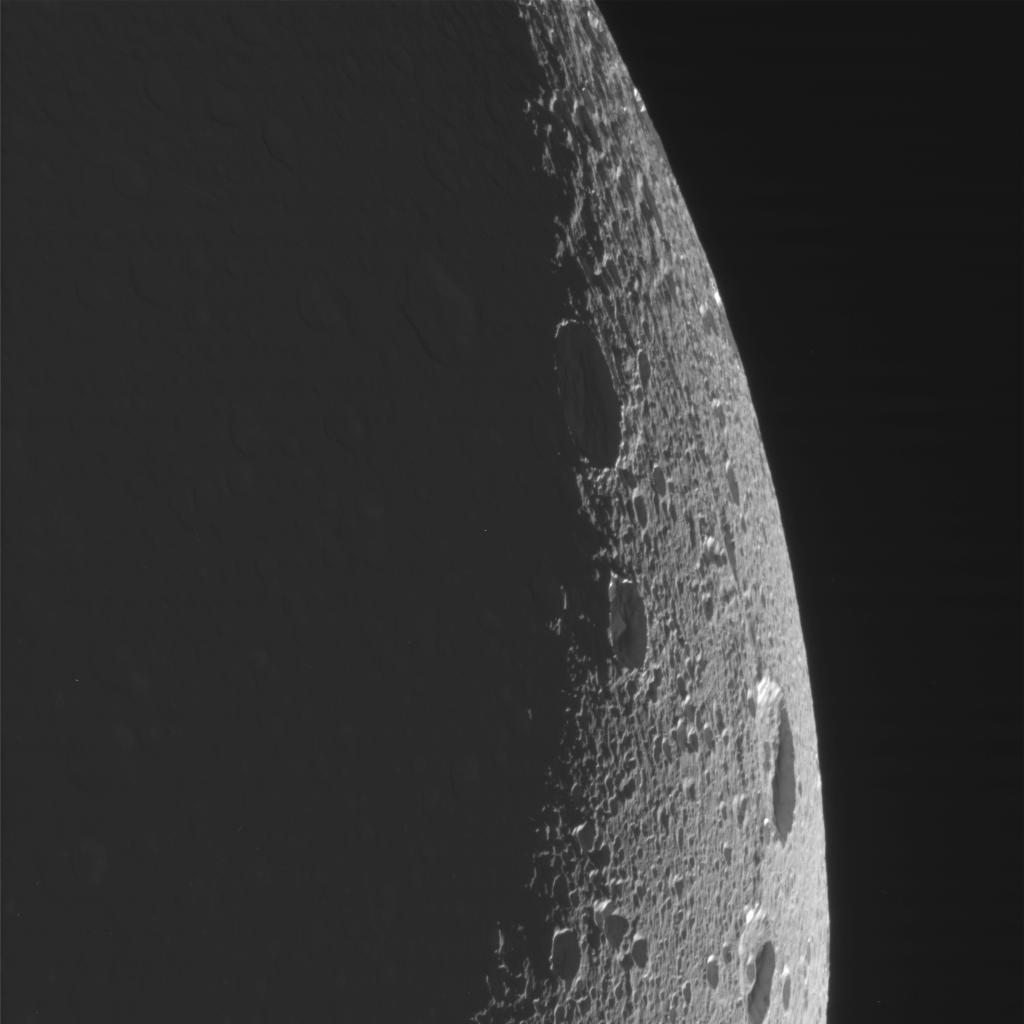
NASA's Cassini spacecraft will be flying within about 46 miles (74 kilometers) of Saturn's moon Enceladus on Wednesday, May 2, aiming primarily to learn more about the moon's internal structure. The flyby is the third part of a trilogy of flybys -- the other two took place on April 28, 2010, and Nov. 30, 2010 -- for Cassini's radio science experiment. The radio science team is particularly interested in learning how mass is distributed under Enceladus' south polar region, which features jets of water ice, water vapor and organic compounds spraying out of long fractures. A concentration of mass in that region could indicate subsurface liquid water or an intrusion of warmer-than-average ice that might explain the unusual plume activity. Cassini's scientists learn about the moon's internal structure by measuring variations in the gravitational pull of Enceladus against the steady radio link to NASA's Deep Space Network on Earth.

Cassini's composite infrared spectrometer instrument will also be observing the side of Enceladus that always faces away from Saturn to monitor for hot spots. The imaging camera team also plans to take images of the plume to look for variability in the jets.

Cassini will also be flying by Dione at a distance of about 5,000 miles (8,000 kilometers), enabling the imaging cameras to create several mosaic images of the icy moon, and the composite infrared spectrometer to monitor heat emission.

{...}


Universe Today: Cassini’s Last Flyby of Enceladus Until 2015
 
NASA / NASA JPL:
Cassini, Saturn Moon Photographer

May 02, 2012

NASA's Cassini spacecraft successfully flew by Saturn's moons Enceladus and Dione during close flybys on May 2, 2012, capturing these raw images. The flybys were the last close encounters of these icy moons that Cassini will make for three years.

Cassini flew by Enceladus at an altitude of about 46 miles (74 kilometers). This flyby was designed primarily for the radio science sub-system to measure variations in Enceladus' gravity field.

On approach to Enceladus, Cassini's cameras imaged the icy satellite's south polar plume, which consists of jets of water ice, water vapor and organic compounds sprayed into space from the moon's famed "tiger stripe" fractures. The plume images were captured at distances ranging from 259,000 miles (416,000 kilometers) down to 66,000 miles (106,000 kilometers) when Enceladus was just a thin crescent and the plume was backlit.

[table="head;width=450"]{colsp=2}
Click on images to enlarge​

|

This raw, unprocessed image was taken by NASA's Cassini spacecraft on May 2, 2012. The camera was pointing toward Enceladus at approximately 239,799 miles (385,919 kilometers) away.
Image credit: NASA/JPL/Space Science Institute​
|
This raw, unprocessed image was taken by NASA's Cassini spacecraft on May 1, 2012. The camera was pointing toward Enceladus at approximately 260,443 miles (419,142 kilometers) away.
Image credit: NASA/JPL/Space Science Institute​
[/table]​


During closest approach, the radio science team looked for a concentration of mass at the south pole that could indicate sub-surface liquid water or an intrusion of warmer-than-average ice that might explain the intriguing geologic activity at the south pole. After the closest approach, the composite infrared spectrometer obtained a map of Enceladus' sun-lit side while Cassini's visible light cameras rode along and captured several images of the moon's leading hemisphere at resolutions of about 1,500 feet (450 meters) per pixel.

Later this month, a close encounter with Titan on May 22 will pitch the spacecraft up out of the equatorial plane and into a nearly three-year-long phase of inclined orbits that will showcase the northern and southern reaches of Saturn. On March 9, 2013, Cassini will make a close pass by Rhea, but the spacecraft won't have another close, targeted encounter with any of Saturn's other icy satellites until June 2015, when it encounters Dione. Cassini will make its next flyby of Enceladus on Oct. 14, 2015.

{...}


CICLOPS:
Universe Today: Enceladus On Display In Newest Images From Cassini

Spaceflight Now: Enceladus gets last visit from Cassini spacecraft until 2015
 
SPACE.com: Amazing Photos of 2 Saturn Moons Snapped by Cassini Probe

Universe Today: Exploration at its Finest: Cassini Visits Dione

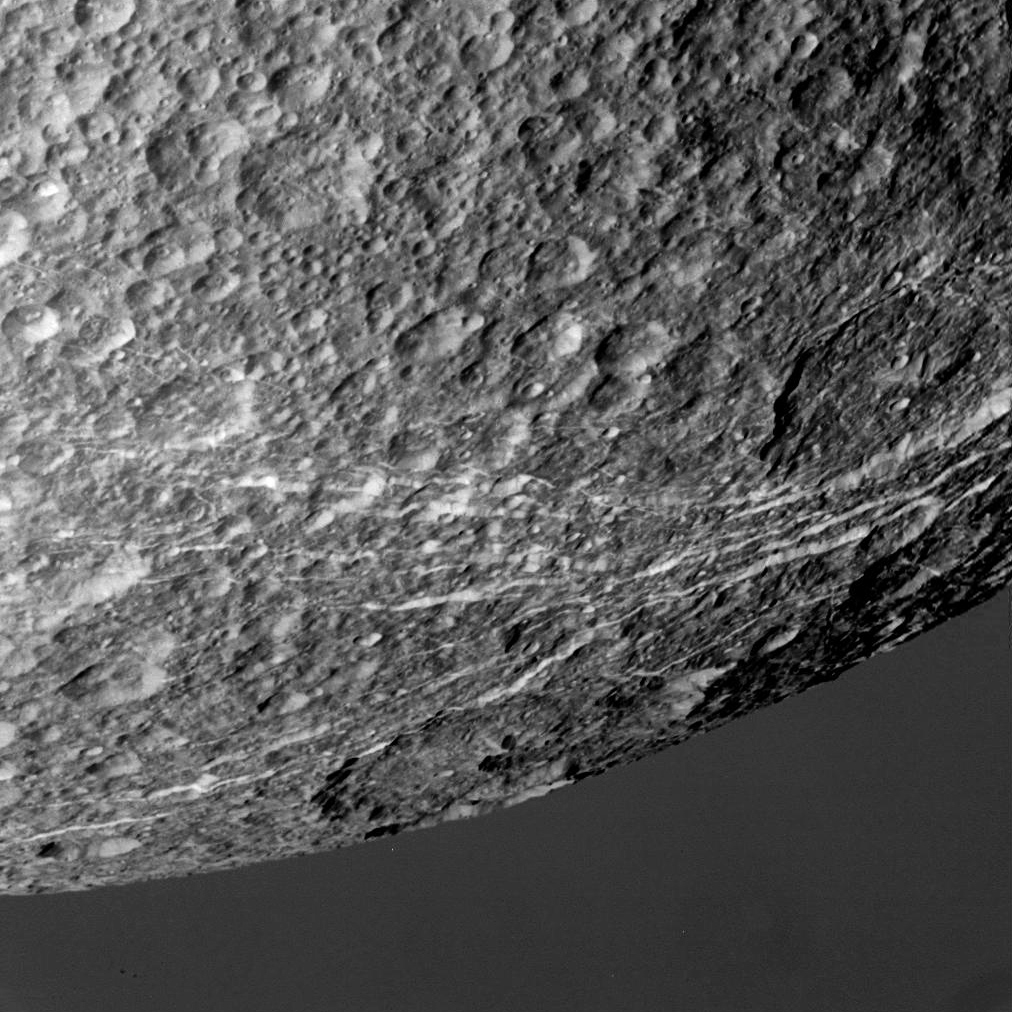
Dione-5-2-12-IR-G-UV.jpg

Color-composite of Dione against Saturn, made from raw images acquired on May 2, 2012 (NASA/JPL/SSI/J. Major)


W00074059.jpg

Crescent-lit Dione, with some reflected light via Saturnshine


W00074064.jpg

A nearly fully-lit Dione, with Saturn's rings in the background


N00186325.jpg

Dione's extensively-cratered limb


N00186448.jpg

Some of Dione's signature "wispy lines", bright icy faces of sheer cliffs now known to be tectonic in origin


Dione-5-2-12b-IR-G-UV.jpg

A color-composite image of an ancient impact crater on the edge of Dione's Saturn-facing side - this could be from the impact that spun the moon 180 degrees. (NASA/JPL/SSI/J. Major)​
 
CICLOPS: Rev166: May 11 - May 28 '12:
Cassini continues its exploration of the Saturn system with the 17-day Rev166, which begins on May 11 at its farthest distance from the planet. This is also called the orbit's apoapse. At this point, Cassini is 2.37 million kilometers (1.47 million miles) from Saturn's cloud tops. This orbit includes a flyby of Saturn's largest moon, Titan. The flyby will push the spacecraft from its current equatorial orbit into a tilted one, beginning the first of two inclined orbit phases during the Cassini Solstice Mission. This phase of the mission, which lasts until March 2015, will allow for polar views of Saturn and Titan as well as better vistas of Saturn's rings than those Cassini has viewed while in the earlier, equatorial phase of the Solstice Mission. Twenty-seven ISS observations are planned for Rev166, the vast majority dedicated to Saturn and Titan storm cloud monitoring, as well as to the Titan flyby.

ISS begins its observations for Rev166 an hour after Cassini passes apoapse on May 11 with an eight-hour light curve of the outer irregular satellite Erriapus. Cassini will be making a relatively close pass of the small, 10-kilometer-wide (6-mile-wide) satellite, at a distance of 7.3 million kilometers (4.5 million miles). On May 12, ISS will take a look at Titan from a distance of 2.90 million kilometers (1.80 million miles). The observation is an effort to look for clouds in the moon's atmosphere as part of the "Titan Monitoring Campaign" (TMC). This observation of a gibbous Titan is designed to monitor clouds over the moon's Senkyo dune field. ISS also will be taking shorter-wavelength images to study changes in Titan's upper haze layers. On May 13, ISS will take another TMC observation of Titan that will allow for monitoring of cloud features across the Senkyo dune field from a distance of 3.13 million kilometers (1.95 million miles). Each day between May 14 and 17, ISS will ride along with the Ultraviolet Imaging Spectrometer (UVIS) in order to take movies, three to six hours in length, of Saturn's aurora australis (southern lights), using the narrow-angle camera (NAC). On May 16 and 17, ISS will take two more TMC observations of Titan. The first, taken from a distance of 3.08 million kilometers (1.91 million miles), will have Saturn's rings in the way, so a set of red, green, and blue filter images will be taken rather than the typical set of infrared surface images. The second, taken from a distance of 2.60 million kilometers (1.61 million miles), will cover the Fensal-Aztlan region of Titan.

On May 20 at 06:26 UTC, Cassini will reach periapse for Rev166 at an altitude of 134,090 kilometers (83,319 miles) from Saturn. ISS observations during the periapse period will be taken during non-targeted encounters with Tethys and the tiny moon Methone. First up is Tethys, as Cassini will fly by the icy satellite at a distance of 53,806 kilometers (33,433 miles). ISS will acquire a global, eight-frame mosaic covering the trailing hemisphere, including a string of unrelated craters: Phemius, Polyphemus, and Ajax. This mosaic will be followed by a long series of clear filter images covering Tethys' sub-Saturn hemisphere, including Ithaca Chasma. After the Tethys encounter, ISS will turn its attention on Methone, a small, 3.2-kilometer-wide (2-mile-wide) moon. At 06:57 UTC, Cassini will pass by the tiny moon at a distance of 1,861 kilometers (1,156 miles), the closest the spacecraft has passed by this moon, or any of the small moons Cassini discovered in 2004 orbiting between Mimas and Enceladus. The best images will be taken 12 minutes after closest approach, from a distance of 4,500 kilometers (2,800 miles). At that distance, the pixel scale will be 26 meters (85 feet) per pixel and Methone will appear 120 pixels across. Two sets of color filter images will be taken, with the first set starting at 07:10 UTC and the second set starting 30 minutes later.

Two days after periapse, Cassini encounters Titan on May 22 at 01:10 UTC for the 84th time. This is the fourth of nine Titan flybys planned for 2012, with the next encounter scheduled for June 7. T81 is a low-altitude flyby with a close-approach distance of 955 kilometers (593 miles). This flyby will allow for imaging of the Adiri region and the anti-Saturn hemisphere of Titan outbound from the encounter. Before the encounter, the Composite Infrared Spectrometer (CIRS) and the Visual and Infrared Mapping Spectrometer (VIMS) will acquire spectral scans and other data of Titan's night side. VIMS will search for specular, or mirror-like, reflections off the northern lakes. CIRS will scan across Titan using its far-infrared channel as well as perform a limb integration. ISS will ride along to acquire images of Titan's upper haze layers, which are more easily visible at high phase angles.

At closest approach, control of spacecraft pointing will switch to the RADAR and the Ion and Neutral Mass Spectrometer (INMS) instruments. RADAR will acquire a SAR swath that will stretch from north of Adiri near 20 degrees north latitude, 210 degrees west longitude; north through a region of small lakes near 80 degrees north latitude, 150 degrees west longitude; across the far northern leading hemisphere; then back south to around 40 degrees north latitude, 20 degrees west longitude. This swath will be used to look for changes in the northern lakes seen during the T16 and T19 flybys in 2006. INMS also will be looking for seasonal changes in atmospheric composition between the northern flybys in 2006 and 2007 and now, as spring progresses. Before closest approach, RADAR will acquire a HiSAR swath around 20 degrees north latitude, 165 degrees west longitude. After the flyby, the instrument will acquire a HiSAR swath to the east of the Menrva impact basin. Inbound and outbound scatterometry, radiometry and altimetry will also be taken by RADAR. Afterward, CIRS will map surface temperatures across the visible disk to look for diurnal and albedo-related differences, while VIMS will monitor the anti-Saturn hemisphere for clouds (with ISS riding along during both observations).

On May 23, ISS will acquire three quick observations of Saturn using the wide-angle camera (WAC). These observations are part of a series of "Storm Watch" observation sequences designed to take advantage of short, two-minute segments when the spacecraft turns the optical remote sensing (ORS) instruments back to Saturn as a waypoint between other experiments' observations. These sequences include blue, clear, two methane band, and one full-frame, continuum band filter images. Three more such observations are planned for May 27. Between the first two storm watch observations, ISS will acquire an astrometric observation of Saturn's small, inner moons, including Calypso, Pandora, Atlas, Anthe, Pan, Janus, and Daphnis. Astrometric observations are used to improve our understanding of the orbits of these small satellites, which can be influenced by Saturn's larger icy satellites. Between the second and third storm watch sequence on May 23, ISS will acquire a pair of movies of Saturn's ring system, its first such movie of the first inclined phase. The first movie, six hours in length, will cover the innermost D ring, while the second, more than 8 hours in length, will cover the outer portion of the A ring, between the Keeler and Encke Gaps. On May 25, ISS will acquire a large set of photometry calibration images of the star Vega, in the constellation Lyra. On May 27, ISS will take a TMC observation of Titan, covering the trailing hemisphere of the large moon from a distance of 2.54 million kilometers (1.58 million miles). Finally, ISS will acquire another astrometric sequence, this time imaging Calypso, Epimetheus, Telesto, and Prometheus.

On May 11, Cassini will reach apoapse on this orbit, bringing it to a close and starting Rev167. Rev167 includes a targeted flyby of Titan and a non-targeted encounter with Mimas.

{...}
 
Back
Top