Updates Cassini Mission News and Updates

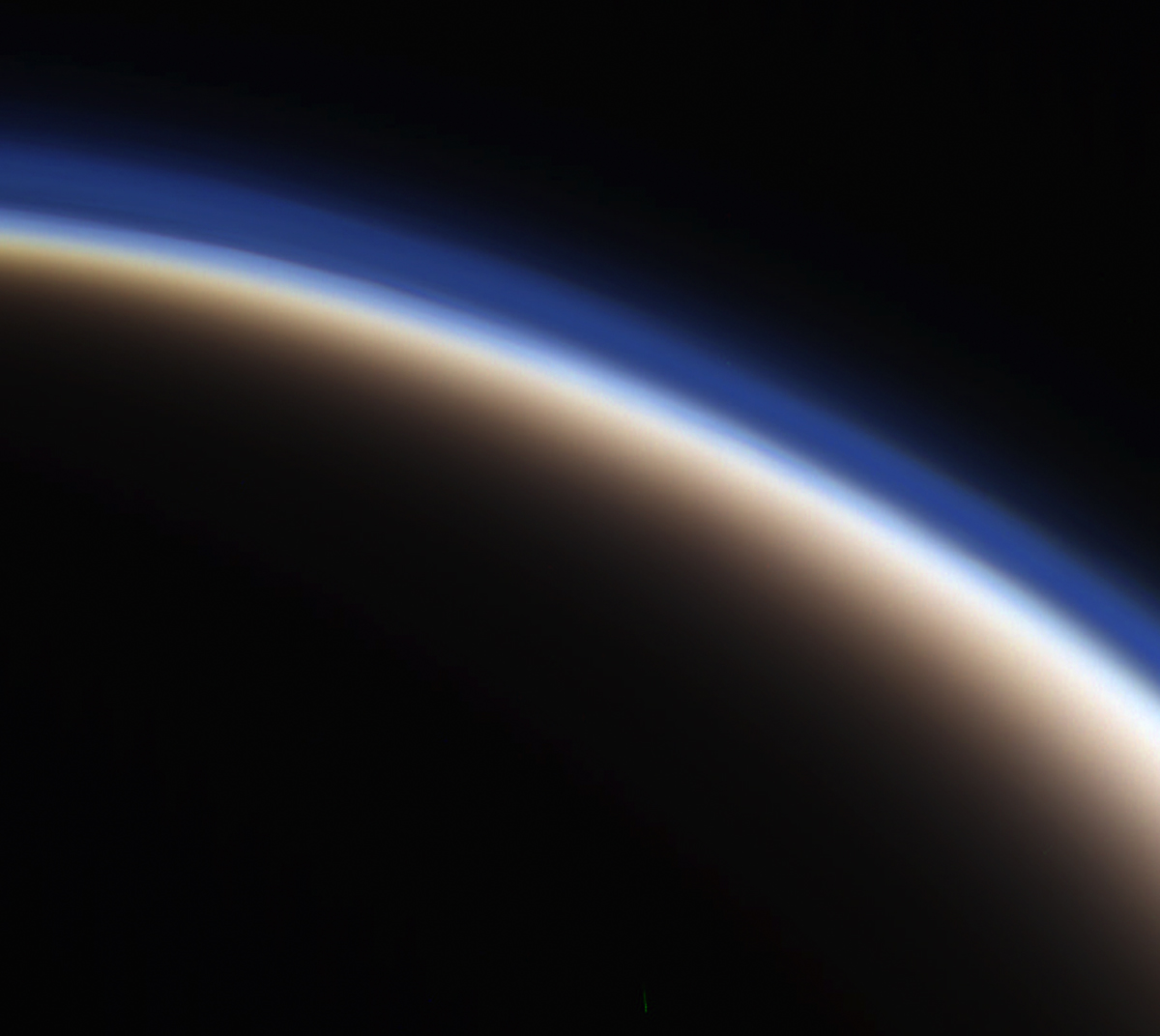
Universe Today: A New Angle on Titan

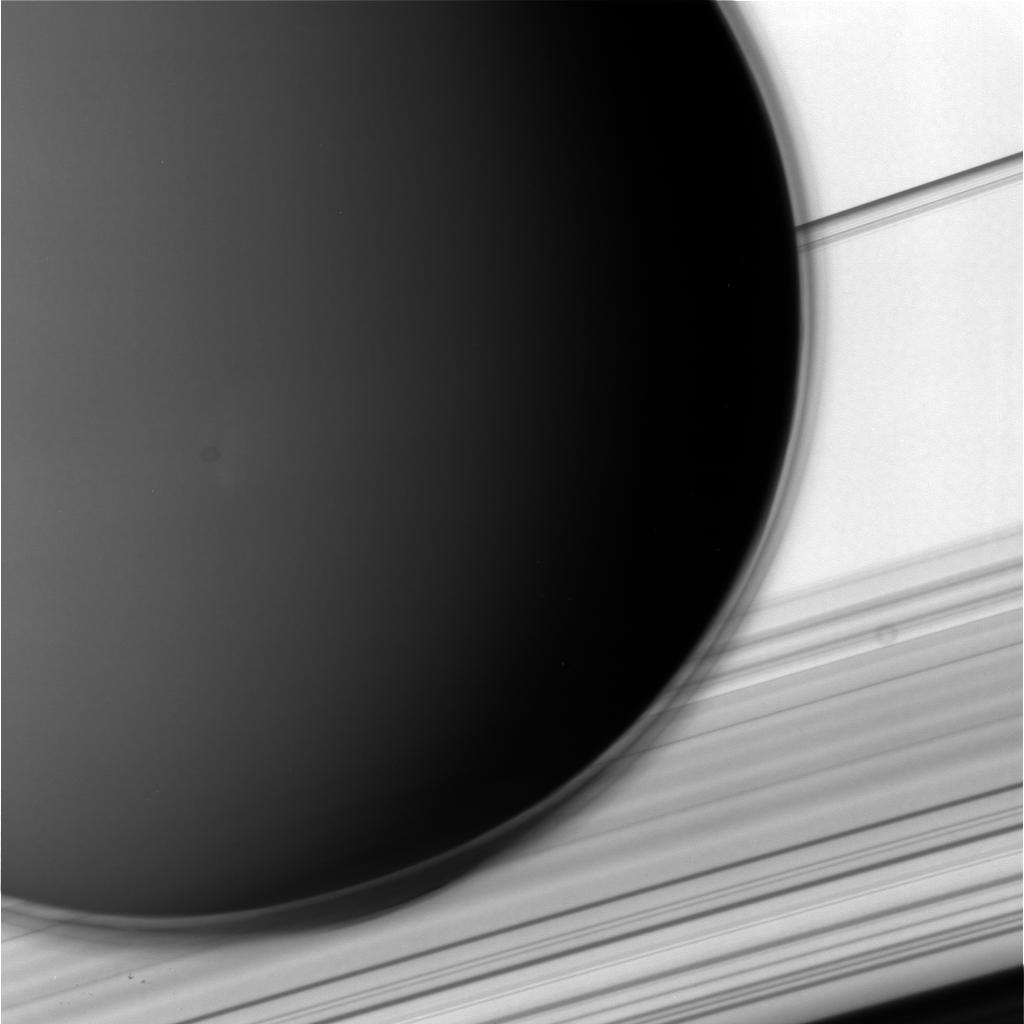
Saturn-5-6-12.jpg

Color-composite image of Titan and Saturn (NASA/JPL/SSI/J. Major)


N00186652.jpg

Titan in blue wavelength against Saturn (NASA/JPL/SSI)​
 
NASA / NASA JPL:
Cassini Spots Tiny Moon, Begins to Tilt Orbit

May 21, 2012

NASA's Cassini spacecraft made its closest approach to Saturn's tiny moon Methone as part of a trajectory that will take it on a close flyby of another of Saturn's moons, Titan. The Titan flyby will put the spacecraft in an orbit around Saturn that is inclined, or tilted, relative to the plane of the planet's equator. The flyby of Methone took place on May 20 at a distance of about 1,200 miles (1,900 kilometers). It was Cassini's closest flyby of the 2-mile-wide (3-kilometer-wide) moon. The best previous Cassini images were taken on June 8, 2005, at a distance of about 140,000 miles (225,000 kilometers), and they barely resolved this object.

Also on May 20, Cassini obtained images of Tethys, a larger Saturnian moon that is 660 miles (1,062 kilometers) across. The spacecraft flew by Tethys at a distance of about 34,000 miles (54,000 kilometers).

[table="head;width=675"]{colsp=3}
Click on images for details​

||

This raw, unprocessed image was taken by NASA's Cassini spacecraft on May 20, 2012. The camera was pointing toward Methone.
Credit: NASA/JPL-Caltech/SSI​
|
This raw, unprocessed image was taken by NASA's Cassini spacecraft on May 20, 2012. The camera was pointing toward Tethys at approximately 81,580 miles (131,290 kilometers) away.
Image Credit: NASA/JPL/Space Science Institute​
|
This raw, unprocessed image was taken by NASA's Cassini spacecraft on May 20, 2012. The camera was pointing toward Tethys at approximately 37,196 miles (59,861 kilometers) away.
Image Credit: NASA/JPL/Space Science Institute​
[/table]​


Cassini's encounter with Titan, Saturn's largest moon, on May 22, is the first of a sequence of flybys that will put the spacecraft into an inclined orbit. At closest approach, Cassini will fly within about 593 miles (955 kilometers) of the surface of the hazy Titan. The flyby will angle Cassini's path around Saturn by about 16 degrees out of the equatorial plane, which is the same plane in which Saturn's rings and most of its moons reside.

Cassini's onboard thrusters don't have the capability to place the spacecraft into orbits so inclined. But mission designers have planned trajectories that take advantage of the gravitational force exerted by Titan to boost Cassini into inclined orbits. Over the next few months, Cassini will use several flybys of Titan to change the angle of its inclination, building one on top of the other until Cassini is orbiting Saturn at around 62 degrees relative to the equatorial plane in 2013. Cassini hasn't flown in orbits this inclined since 2008, when it orbited at an angle of 74 degrees.

This set of inclined orbits is expected to provide spectacular views of the rings and poles of Saturn. Further studies of Saturn's other moons will have to wait until around 2015, when Cassini returns to an equatorial orbit.
"Getting Cassini into these inclined orbits is going to require the same level of navigation accuracy that the team has delivered in the past, because each of these Titan flybys has to stay right on the money," said Robert Mitchell, Cassini program manager at NASA's Jet Propulsion Laboratory, Pasadena, Calif. "However, with nearly eight years of experience to rely on, there's no doubt about their ability to pull this off."
Cassini discovered Methone and two other small moons, Pallene and Anthe, between the orbits of Mimas and Enceladus between 2004 and 2007. The three tiny moons, called the Alkyonides group, are embedded in Saturn's E ring, and their surfaces are sprayed by ice particles originating from the jets of water ice, water vapor and organic compounds emanating from the south polar area of Enceladus.

{...}


CICLOPS:
The Planetary Society Blog: Methone, an egg in Saturn orbit?

Universe Today: Cassini Captures a Rarely-Seen Moon

SPACE.com: Cassini Spacecraft Snaps Saturn Moon Pics, Changes Orbi
 
CICLOPS: Rev167: May 28 - Jun 17 '12:
Cassini continues its exploration of the Saturn system with the 19-day Rev167, which begins on May 28 at its farthest distance from the planet. This is also called the orbit's apoapse. At this point, Cassini is 2.20 million kilometers (1.37 million miles) from Saturn's cloud tops. This orbit includes a flyby of Saturn's largest moon, Titan. The flyby will push the spacecraft into a more inclined orbit, from an inclination of 15.8 degrees to 21.1 degrees, relative to the equatorial plane of the planet. Cassini will end up in a orbit inclined by 61.7 degrees by this time next year. This first inclined phase of the mission, a phase which lasts until March 2015, will allow for polar views of Saturn and Titan as well as better vistas of Saturn's rings than those Cassini has viewed while in the earlier, equatorial phase of the Solstice Mission. Fifty-one ISS observations are planned for Rev167, the vast majority dedicated to Saturn and Titan storm cloud monitoring, as well as to a Titan flyby.

ISS begins its observations for Rev167 on May 29, the day after Cassini passes apoapse, with three quick observations of Saturn using the wide-angle camera (WAC). These observations are part of a series of "Storm Watch" observation sequences designed to take advantage of short, two-minute segments when the spacecraft turns the optical remote sensing (ORS) instruments back to Saturn as a waypoint between other experiments' observations. These sequences include blue, clear, two methane band, and one full-frame, continuum band filter images. Nine more such observations are planned between June 1 and June 3, while 12 more will be taken between June 9 and June 17. Between the first two Storm Watch observations, ISS will take a look at Titan from a distance of 3.09 million kilometers (1.92 million miles). The observation is an effort to look for clouds in the moon's atmosphere as part of the "Titan Monitoring Campaign" (TMC). This observation of a gibbous Titan is designed to monitor clouds over the moon's Senkyo dune field. ISS also will be taking shorter-wavelength images to study changes in Titan's upper haze layers. Between the second and third Storm Watch observations, ISS will acquire an astrometric observation of Saturn's small, inner moons, including Epimetheus, Telesto, Atlas, Calypso, Polydeuces, and Daphnis. Astrometric observations are used to improve our understanding of the orbits of these small satellites, which can be influenced by Saturn's larger icy satellites. After the third Storm Watch observation, ISS will acquire a 10-hour, 30-minute light curve of the outer irregular satellite Ymir. Cassini will be at a distance of 15.1 million kilometers (9.40 million miles) from the 18-kilometer-wide (11.2-mile-wide) satellite.

On June 1, ISS will take a TMC observation of Titan that will allow for monitoring of cloud features across the sub-Saturn hemisphere from a distance of 3.08 million kilometers (1.91 million miles). After another storm watch observation, ISS will acquire an astrometric sequence of Saturn's small inner moons, including Epimetheus, Prometheus, Helene, Pallene, Telesto, and Atlas. On June 2, ISS will take another TMC observation of Titan, covering the Fensal-Aztlan dune fields. The TMC observation will be taken from a distance of 2.83 million kilometers (1.76 million miles). Another astrometric observation will follow, including Helene, Pallene, Janus, Pan, and Polydeuces in this set.

On June 5 at 04:53 UTC, Cassini will reach periapse for Rev167 at an altitude of 126,590 kilometers (78,659 miles) from Saturn. ISS observations during the periapse period will be taken during a non-targeted encounter with Mimas and include a pair of observations of propellers in the A ring. The A ring is host to thousands of these propellers, which are gravitationally-formed voids created by large ring particles. These observations, on June 4 and 5, will search for these propellers in the region between the Encke Gap (itself carved by the small moon Pan) and the Keeler Gap (a narrower gap carved by Daphnis). Of particular importance for this observation is to re-image previously observed propellers to better measure their sizes and orbits. On June 5, ISS will ride along with the Composite Infrared Spectrometer (CIRS) to observe a non-targeted encounter with Mimas. At 05:08 UTC, Cassini will pass Mimas at a distance of 43,563 kilometers (27,069 miles). This encounter will allow for imaging of Mimas's north polar region and northern leading hemisphere.

Two days after periapse, Cassini encounters Titan on June 7 at 00:07 UTC for the 85th time. This is the fifth of nine Titan flybys planned for 2012, with the next encounter scheduled for July 24. T84 is a low-altitude flyby with a close-approach altitude of 959 kilometers (595 miles). This flyby will allow for imaging of the Adiri region and the anti-Saturn hemisphere of Titan outbound from the encounter. Before the encounter, CIRS and the Visual and Infrared Mapping Spectrometer (VIMS) will acquire spectral scans and other data of Titan's night side. VIMS will search for specular, or mirror-like, reflections off the northern lakes. CIRS will scan across Titan using its far-infrared and mid-infrared channels as well as perform a limb integration. In a limb integration CIRS stares at Titan's sunlit limb, or edge of the visible disk, to build up high resolution spectra, or values that vary over along at continuum, of Titan's hazes. ISS will ride along to acquire images of Titan's upper haze layers, which are more easily visible at high phase angles.

At closest approach, control of spacecraft pointing will switch to the RADAR instruments. RADAR will acquire a SAR swath that will stretch from northeast of Fensal near 30 degrees north latitude, 15 degrees west longitude; east-by-northeast through a region not previously seen by RADAR near 50 degrees north latitude, 205 degrees west longitude across the mid-northern trailing hemisphere; then back east-southeast to an area just north of Adiri around 10 degrees north latitude, 20 degrees west longitude. This swath will be used to fill a major gap in the RADAR instrument team's coverage in the northern mid-latitudes in the trailing hemisphere. Previous swaths in the northern mid-latitudes, like the first SAR swath on Ta, revealed bland and difficult to interpret terrain. Before closest approach, RADAR will acquire a HiSAR swath around 60 degrees north latitude, 330 degrees west longitude along the southwestern shore of Kraken Mare. After the flyby, the instrument will acquire a HiSAR swath covering Concordia Regio, an area that saw methane rainfall and possible wide-spread flooding in late 2010. Inbound and outbound scatterometry, radiometry and altimetry will also be taken by RADAR. Afterward, CIRS will map surface temperatures across the visible disk to look for diurnal and albedo-related differences while the Ultraviolet Imaging Spectrometer (UVIS) will scan across Titan's sunlit side with its extreme- and far-ultraviolet channels. ISS will ride along during these three observations, searching for clouds across Adiri and western Shangri-La, including over the Huygens probe's landing site. The next day, June 8, ISS will acquire four sets of observations of Titan at distances between 694,490 and 897,900 kilometers (431,540 and 557,530 miles) in order to search for clouds and monitor their development if they are present. These observations will be centered near the western edge of Adiri and the eastern part of the Belet dune sea.

On June 9, ISS will acquire an astrometric sequence of Saturn's small inner moons, including Calypso, Polydeuces, Pan, Daphnis, Prometheus, and Atlas. On June 11, ISS will acquire a TMC observation of Titan, covering the trailing hemisphere. The TMC observation will be taken from a distance of 2.40 million kilometers (1.49 million miles). Another astrometric observation will follow, including Helene, Prometheus, Atlas, Daphnis, Epimetheus, Anthe, Polydeuces, and Calypso in this set. On June 15, ISS will take a TMC observation of Titan, covering the sub-Saturn hemisphere of the large moon from a distance of 3.92 million kilometers (2.43 million miles). After another storm watch observation, ISS will acquire another astrometric sequence, this time imaging Polydeuces, Pan, Janus, Anthe, Calypso, Pallene, and Pandora. Finally, on June 16, ISS will search for Trojan moons at Titan's L5 LaGrangian point, which lies 60 degrees behind Titan on its orbit.

On June 17, Cassini will reach apoapse on this orbit, bringing it to a close and starting Rev168. Rev168 includes numerous ring observations and a non-targeted encounter with Tethys.

{...}

 
NASA / NASA JPL:
Enceladus Plume is a New Kind of Plasma Laboratory

May 31, 2012

PASADENA, Calif. - Recent findings from NASA's Cassini mission reveal that Saturn's geyser moon Enceladus provides a special laboratory for watching unusual behavior of plasma, or hot ionized gas. In these recent findings, some Cassini scientists think they have observed "dusty plasma," a condition theorized but not previously observed on site, near Enceladus.

Data from Cassini's fields and particles instruments also show that the usual "heavy" and "light" species of charged particles in normal plasma are actually reversed near the plume spraying from the moon's south polar region. The findings are discussed in two recent papers in the Journal of Geophysical Research.

"These are truly exciting discoveries for plasma science," said Tamas Gombosi, Cassini fields and particles interdisciplinary scientist based at the University of Michigan, Ann Arbor. "Cassini is providing us with a new plasma physics laboratory."

Ninety-nine percent of the matter in the universe is thought to be in the form of plasma, so scientists have been using Saturn as a site other than Earth to observe the behavior of this cloud of ions and electrons directly. Scientists want to study the way the sun sends energy into Saturn's plasma environment, since that jolt of energy drives processes such as weather and the behavior of magnetic field lines. They can use these data to understand how Saturn's plasma environment is similar to and different from that of Earth and other planets.

[table="head;width=225"]
Click on image for details​


Cassini imaging scientists used views like this one to help them identify the source locations for individual jets spurting ice particles, water vapor and trace organic compounds from the surface of Saturn's moon Enceladus.
Image credit: NASA/JPL/Space Science Institute​
[/table]​


The small, icy moon Enceladus is a major source of ionized material filling the huge magnetic bubble around Saturn. About 200 pounds (about 100 kilograms) of water vapor per second - about as much as an active comet - spray out from long cracks in the south polar region known as "tiger stripes." The ejected matter forms the Enceladus plume - a complex structure of icy grains and neutral gas that is mainly water vapor. The plume gets converted into charged particles interacting with the plasma that fills Saturn's magnetosphere.

The nature of this unique gas-dust-plasma mixture has been revealed over the course of the mission with data from multiple instruments, including the Cassini plasma spectrometer, magnetometer, magnetospheric imaging instrument, and the radio and plasma wave science instrument. What scientists found most interesting is that the grains range continuously in size from small water clusters (a few water molecules) to thousandths of an inch (100 micrometers). They also saw that a large fraction of these grains trap electrons on their surface. Up to 90 percent of the electrons from the plume appear to be stuck on large, heavy grains.

In this environment, Cassini has now seen positively charged ions become the small, "light" plasma species and the negatively charged grains become the "heavy" component. This is just the opposite of "normal" plasmas, where the negative electrons are thousands of times lighter than the positive ions.

In a paper published in the December issue of the journal, a team of Swedish and U.S. scientists on the Cassini mission examined radio and plasma wave science instrument observations from four flybys of Enceladus during 2008. They found a high plasma density (both ions and electrons) within the Enceladus plume region, although the electron densities are usually much lower than the ion densities in the plumes and in the E ring. The team concluded that dust particles a hundred millionth to a hundred thousandth of an inch (a nanometer to micrometer) in size are sweeping up the negatively charged electrons. The mass of the observed "nanograins" ranges from a few hundred to a few tens of thousands of atomic mass units (proton masses), and must therefore contain tens to thousands of water molecules bound together. At least half of the negatively charged electrons are attached to the dust, and their interaction with the positively charged particles causes the ions to be decelerated. Because the dust is charged and behaves as part of the plasma cloud, this paper distinguishes this state of matter from dust that just happens to be in plasma.

"Such strong coupling indicates the possible presence of so-called 'dusty plasma', rather than the 'dust in a plasma' conditions which are common in interplanetary space," said Michiko Morooka from the Swedish Institute of Space Physics, lead author of the paper and a Cassini radio and plasma wave science co-investigator. "Except for measurements in Earth's upper atmosphere, there have previously been no in-situ observations of dusty plasma in space."

In a dusty plasma, conditions are just right for the dust to also participate in the plasma's collective behavior. This increases the complexity of the plasma, changes its properties and produces totally new collective behavior. Dusty plasma are thought to exist in comet tails and dust rings around the sun, but scientists rarely have the opportunity to fly through the dusty plasma and directly measure its characteristics in place.

A separate analysis, based on data obtained by the Cassini plasma spectrometer, revealed the presence of nanograins having an electric charge corresponding to a single excess electron. "The Cassini plasma spectrometer has enabled us to discover and analyze new classes of charged particles that were wholly unanticipated when the instrument was designed and built in the 1980s and 90s," said Tom Hill, the study's lead author and a co-investigator based at Rice University in Houston.

The nature of the Enceladus plume has been revealed over time due to the synergistic nature of the fields and particles instruments on Cassini, which has been in residence in Saturn's magnetosphere since 2004. Following the original detection of the plume based on magnetometer measurements, Sven Simon from the University of Cologne, Germany, and Hendrik Kriegel from the University of Braunschweig, Germany, found that the observed perturbation of Saturn's magnetic field required the presence of negatively charged dust grains in the plume. These findings were reported in the April and October 2011 issues of Journal of Geophysical Research Space Physics. Previous data obtained by the ion and neutral mass spectrometer revealed the complex composition of the plume gas, and the cosmic dust analyzer revealed that the plume grains were rich in sodium salts. Because this scenario can only arise if the plume originated from liquid water, it provides compelling evidence for a subsurface ocean.

{...}
 
NASA / NASA JPL:
Cassini Plasma Spectrometer Turns Off

June 06, 2012

Cassini Mission Status Report

PASADENA, Calif. - The Cassini plasma spectrometer instrument (CAPS) aboard NASA's Cassini spacecraft was turned off between Friday, June 1 and Saturday, June 2, when a circuit breaker tripped off after the instrument experienced some unexpected voltage shifts.

Engineers are currently investigating this issue, which they believe is due to short circuits in the instrument. In June 2011, the instrument was turned off because of similar problems, but was switched on again in March 2012 once investigators determined that tin plating on electronic components had grown "whiskers" large enough to contact another conducting surface and carry electrical current, resulting in a voltage shift. At that time, it was believed that these "whiskers" were not capable of carrying sufficient current to cause any damage, and the voltage shifts didn't have any effect on normal spacecraft operations because the power subsystem is designed to operate in the presence of such shifts.

More details about whiskers on the CAPS instrument can be found here: http://www.jpl.nasa.gov/news/news.cfm?release=2012-078.

The cause is still under investigation, but engineers will be looking into this issue over the next few months.

{...}
 
Excellent. That awesome pic is premium quality food for our DX11 client developpers :) :thumbup:
 
SPACE.com: Giant Tropical Lake Found on Saturn Moon Titan:
An oasis of liquid methane has unexpectedly been discovered amid the tropical dunes of Saturn's moon Titan, researchers say.

This lake in the otherwise dry tropics of Titan hints that subterranean channels of liquid methane might feed it from below, scientists added.

Titan has clouds, rain and lakes, like Earth, but these are composed of methane rather than water. However, methane lakes were seen only at Titan's poles until now — its tropics around the equator were apparently home to dune fields instead.

Now near-infrared pictures of Titan from the Cassini spacecraft currently orbiting Saturn collected since 2004 suggest a vast methane lake exists on the surface in the moon's tropics, one about 925 square miles (2,400 square kilometers) large and at least three feet (1 meter) deep.

"Titan's tropical lake is roughly the size of the Great Salt Lake in Utah during its lowest recorded level," study lead author Caitlin Griffith, a planetary scientist at the University of Arizona at Tucson, told SPACE.com. "Our work also suggests the existence of a handful of smaller and shallower ponds similar to marshes on Earth with knee- to ankle-level depths."

{...}

NewScientist: Titan's tropical lake hints at hydrocarbon wells

Florida Today: Giant lake detected near equator of Saturn's moon Titan
 
NASA / NASA JPL:
Cassini Sees Tropical Lakes on Saturn Moon

June 13, 2012

PASADENA, Calif. - NASA's Cassini spacecraft has spied long-standing methane lakes, or puddles, in the "tropics" of Saturn's moon Titan. One of the tropical lakes appears to be about half the size of Utah's Great Salt Lake, with a depth of at least 3 feet (1 meter).

[table="head;width=225"]
Click on image for details​


Saturn's rings lie in the distance as the Cassini spacecraft looks toward Titan and its dark region called Shangri-La, east of the landing site of the Huygens Probe.
Image Credit: NASA/JPL-Caltech/Space Science Institute​
[/table]​


The result, which is a new analysis of Cassini data, is unexpected because models had assumed the long-standing bodies of liquid would only exist at the poles. The findings appear in this week's issue of the journal Nature.

Where could the liquid for these lakes come from? "A likely supplier is an underground aquifer," said Caitlin Griffith, the paper's lead author and a Cassini team associate at the University of Arizona, Tucson. "In essence, Titan may have oases."

Understanding how lakes or wetlands form on Titan helps scientists learn about the moon's weather. Like Earth's hydrological cycle, Titan has a "methane" cycle, with methane rather than water circulating. In Titan's atmosphere, ultraviolet light breaks apart methane, initiating a chain of complicated organic chemical reactions. But existing models haven't been able to account for the abundant supply of methane.

"An aquifer could explain one of the puzzling questions about the existence of methane, which is continually depleted," Griffith said. "Methane is a progenitor of Titan's organic chemistry, which likely produces interesting molecules like amino acids, the building blocks of life."

Global circulation models of Titan have theorized that liquid methane in the moon's equatorial region evaporates and is carried by wind to the north and south poles, where cooler temperatures cause methane to condense. When it falls to the surface, it forms the polar lakes. On Earth, water is similarly transported by the circulation, yet the oceans also transport water, thereby countering the atmospheric effects.

The latest results come from Cassini's visual and infrared mapping spectrometer, which detected the dark areas in the tropical region known as Shangri-La, near the spot where the European Space Agency's Huygens probe landed in 2005. When Huygens landed, the heat of the probe's lamp vaporized some methane from the ground, indicating it had landed in a damp area.

Areas appear dark to the visual and infrared mapping spectrometer when liquid ethane or methane are present. Some regions could be shallow, ankle-deep puddles. Cassini's radar mapper has seen lakes in the polar region, but hasn't detected any lakes at low latitudes.

The tropical lakes detected by the visual and infrared mapping spectrometer have remained since 2004. Only once has rain been detected falling and evaporating in the equatorial regions, and only during the recent expected rainy season. Scientists therefore deduce the lakes could not be substantively replenished by rain.

"We had thought that Titan simply had extensive dunes at the equator and lakes at the poles, but now we know that Titan is more complex than we previously thought," said Linda Spilker, the Cassini project scientist based at NASA's Jet Propulsion Laboratory, Pasadena, Calif. "Cassini still has multiple opportunities to fly by this moon going forward, so we can't wait to see how the details of this story fill out."

{...}


Universe Today: Cassini Spies a Possible ‘Oasis’ on Titan

Discovery News: The 'Tropical' Lakes of Saturn's Moon Titan
 
CICLOPS: Rev168: Jun 17 - Jul 10 '12:
Cassini continues its exploration of the Saturn system with the 24-day Rev168, which begins on June 17 at its farthest distance from the planet. This is also called the orbit's apoapse. At this point, Cassini is 2.83 million kilometers (1.76 million miles) from Saturn's cloud tops. This orbit includes non-targeted encounters with Titan and Tethys. Rev168 is near the beginning of the first inclined phase of the Cassini Solstice Mission, a phase which lasts until March 2015. The inclined phase will allow for polar views of Saturn and Titan as well as better vistas of Saturn's rings than those Cassini has viewed while in the earlier, equatorial phase of the Solstice Mission. Thirty-eight ISS observations are planned for Rev168, the vast majority dedicated to monitoring Saturn's storms and observing Saturn's rings.

ISS begins its observations for Rev168 on June 18, the day after Cassini passes apoapse, with a quick observation of Saturn using the wide-angle camera (WAC). These observations are part of a series of "Storm Watch" observation sequences designed to take advantage of short, two-minute segments when the spacecraft turns the optical remote sensing (ORS) instruments back to Saturn as a waypoint between other experiments' observations. These sequences include blue, clear, two methane band, and one full-frame, continuum band filter images. Seven more such observations are planned between June 19 and June 25, while eight more will be taken between July 1 and July 10. After the first Storm Watch observation, ISS will take a look at Titan from a distance of 3.84 million kilometers (2.38 million miles). The observation is an effort to look for clouds in the moon's atmosphere as part of the "Titan Monitoring Campaign" (TMC). This observation of a half-phase Titan is designed to monitor clouds over the moon's Fensal-Aztlan dune field. ISS also will be taking shorter-wavelength images to study changes in Titan's upper haze layers. Between the second and third Storm Watch observations, on June 19, ISS will acquire an astrometric observation of Saturn's small, inner moons, including Atlas, Anthe, Prometheus, Janus, Pan, Pallene, Telesto, Helene, and Calypso. Astrometric observations are used to improve our understanding of the orbits of these small satellites, which can be influenced by Saturn's larger icy satellites.

On June 22 and 23, ISS will acquire a 37-hour light curve of the outer irregular satellite Ymir. Cassini will be at a distance of 15.3 million kilometers (9.49 million miles) from the 18-kilometer-wide (11.2-mile-wide) satellite. On June 24, ISS will use the WAC to observe spokes over the unlit side of the B ring as they enter and exit the shadow of Saturn on the rings. On June 25, ISS will acquire an astrometric sequence of Saturn's small inner satellites, including Prometheus, Pan, Daphnis, Janus, Methone, Polydeuces, Pallene, Telesto, Epimetheus, Atlas, Anthe, Calypso, Helene, and Pandora. After another Saturn storm watch observation, ISS will use its narrow-angle camera (NAC) to image the F ring of Saturn. The camera's field-of-view will be focused near the right ansa, and the various streamer-channels and moonlets associated with the narrow ring will rotate into view. This series of images will allow for the creation a movie of the current state of the F ring, which is quite dynamic due to impacts with small moonlets.

On June 27, Cassini will perform a non-targeted encounter with Titan at distance of 458,662 kilometers (284,999 miles). Cassini will pass over Titan's high southern latitudes with the trailing hemisphere illuminated. ISS and the Composite Infrared Spectrometer (CIRS) will perform a 15-hour observation of Titan during the flyby. At the beginning, ISS will perform a three-frame mosaic of the visible crescent, searching for clouds in the region. Over the next 13 hours, ISS will stare at the sunlit half of Titan, acquiring a set of images of the surface and upper haze layers every hour. CIRS will study the south polar atmospheric vortex and measure nitriles, or organic compounds containing nitrogen, that have been increasing in the region due to the change in season to autumn. At the end of the observation, ISS will acquire a two-frame mosaic covering the now half-phase Titan.

On June 29 at 00:27 UTC, Cassini will reach periapse for Rev168 at an altitude of 245,240 kilometers (152,390 miles) from Saturn. ISS observations during the periapse period will be taken during a non-targeted encounter with Tethys and include a set of rings observations, a limb scan of Saturn's atmosphere, and a distant observation of Titan. Before the Tethys encounter on the 29th, ISS will acquire late on June 27 another movie of the F ring at a much higher phase angle than the one taken two days earlier. ISS will then image the D ring, again at very high phase angles. A few hours later on June 28, ISS will acquire a few images of Saturn's limb while Cassini is in the planet's shadow. This will allow research to study the high-altitude haze layers in the planet's atmosphere. Late on June 28, ISS will ride along with CIRS to observe the non-targeted encounter with Tethys. At 21:09 UTC, Cassini will pass Tethys at a distance of 68,479 kilometers (42,718 miles). This encounter will allow for imaging of Tethys's northern leading hemisphere. Next, ISS will ride along with an Ultraviolet Imaging Spectrometer (UVIS) rings stellar occultation observation. ISS is hoping to catch a pair of F ring occultations of the star Kappa Canis Majoris. Afterward, ISS will search for moonlets in the Cassini Division. Late on June 29, ISS will acquire a TMC observation of Titan, covering the sub-Saturn hemisphere. The TMC observation will be taken from a distance of 2.00 million kilometers (1.24 million miles). Afterward, late on June 29 and into June 30, ISS will acquire a pair of movies of the outer B ring and the D ring.

On July 1, ISS will take a TMC observation of Titan, covering the sub-Saturn hemisphere of the large moon from a distance of 2.77 million kilometers (1.72 million miles). This observation will start out a bit differently than most, since Titan will be just emerging from behind Saturn. Initially, a set of red-green-blue images will be taken, followed by the standard set of surface and short-wavelength images a few minutes later when Saturn has moved out of the field of view. Another TMC will be taken the next day from a distance of 3.07 million kilometers (1.91 million miles), covering the Fensal-Aztlan region. A few hours later, ISS will image the A ring, searching for propellers, which are gravitationally-formed voids created by large ring particles. Of particular importance for this observation is to re-image previously observed propellers to better measure their sizes and orbits. On July 4, 6, and 10, ISS will take three more TMC observations of Titan. The closest of these comes on July 10 when Titan will be 1.75 million kilometers (1.09 million miles) away. This observation will cover the Shangri-La dune field which includes a very dark spot southeast of Mindanao Facula, recently presented by the Visual and Infrared Mapping Spectrometer (VIMS) team, that may or may not be a methane/ethane lake.

On July 10, Cassini will reach apoapse on this orbit, bringing it to a close and starting Rev169. Rev169 includes a targeted flyby of Titan.

{...}
 
The Planetary Society Blog: Pretty picture: Halo on a halo?

titan_cassini_raw_20120606_hi-phase_polar-cap.jpg

Crescent Titan with a cloud cap?
Cassini took this photo of Titan on June 6, 2012, on its way into the "T83" flyby. Cassini sees Titan at very high phase, and the Sun lights up its atmosphere from behind.
NASA / JPL / SSI / Emily Lakdawalla​
 
Discover Magazine - Bad Astronomy: Saturn, raw:
{...}

W00074443.jpg

Image credit: NASA/JPL/Space Science Institute

This astonishing image was taken on June 13, 2012 by the Cassini spacecraft when it was 2.6 million kilometers (1.6 million miles) from the ringed planet — that’s more then six times farther than the Moon is from the Earth. Even then Saturn’s rings span too broad a space to see completely. But artistically, perhaps, it works even better; their vast size is intimated instead of spoken aloud, the thousands of thinner component rings only hinted at. You can see their shadow on the tops of Saturn’s southern clouds thousands of kilometers below, the Sun shining down from the north — to the left as seen in this oddly-angled shot. The clouds themselves are almost featureless, but you can still see some boundaries between oppositely-blowing wind belts, and even the long, snaking remnants of a titanic storm that raged in the north last year. It’s incredible.

Moreover, this image has not been processed in any way: it’s raw, taken right off Cassini’s detectors and sent home to Earth (I shrank it a bit to fit the blog, but otherwise didn’t touch it). The sky behind the planet isn’t entirely dark, there are a handful of hot pixels you can see on the planet, and there are other defects here and there that catch the eye. But even that takes nothing away from the power of this image to me, and in many senses actually adds to it.

{...}
 
NASA / NASA JPL:
Cassini Shows Why Jet Streams Cross-Cut Saturn

June 25, 2012

Turbulent jet streams, regions where winds blow faster than in other places, churn east and west across Saturn. Scientists have been trying to understand for years the mechanism that drives these wavy structures in Saturn's atmosphere and the source from which the jets derive their energy.

In a new study appearing in the June edition of the journal Icarus, scientists used images collected over several years by NASA's Cassini spacecraft to discover that the heat from within the planet powers the jet streams. Condensation of water from Saturn's internal heating led to temperature differences in the atmosphere. The temperature differences created eddies, or disturbances that move air back and forth at the same latitude, and those eddies, in turn, accelerated the jet streams like rotating gears driving a conveyor belt.

A competing theory had assumed that the energy for the temperature differences came from the sun. That is how it works in the Earth's atmosphere.

"We know the atmospheres of planets such as Saturn and Jupiter can get their energy from only two places: the sun or the internal heating. The challenge has been coming up with ways to use the data so that we can tell the difference," said Tony Del Genio of NASA's Goddard Institute for Space Studies, N.Y., the lead author of the paper and a member of the Cassini imaging team.

The new study was possible in part because Cassini has been in orbit around Saturn long enough to obtain the large number of observations required to see subtle patterns emerge from the day-to-day variations in weather. "Understanding what drives the meteorology on Saturn, and in general on gaseous planets, has been one of our cardinal goals since the inception of the Cassini mission," said Carolyn Porco, imaging team lead, based at the Space Science Institute, Boulder, Colo. "It is very gratifying to see that we're finally coming to understand those atmospheric processes that make Earth similar to, and also different from, other planets."

Rather than having a thin atmosphere and solid-and-liquid surface like Earth, Saturn is a gas giant whose deep atmosphere is layered with multiple cloud decks at high altitudes. A series of jet streams slice across the face of Saturn visible to the human eye and also at altitudes detectable to the near-infrared filters of Cassini's cameras. While most blow eastward, some blow westward. Jet streams occur on Saturn in places where the temperature varies significantly from one latitude to another.

[table="head;width=450"]{colsp=2}
Click on images for details​

|

A particularly strong jet stream churns through Saturn's northern hemisphere in this false-color view from NASA's Cassini spacecraft.
Image Credit: NASA/JPL-Caltech/SSI​
|
This figure examines a particularly strong jet stream and the eddies that drive it through the atmosphere of Saturn's northern hemisphere. Data from NASA's Cassini spacecraft were used to create this figure.
Image Credit: NASA/JPL-Caltech/SSI​
[/table]​


Thanks to the filters on Cassini's cameras, which can see near-infrared light reflected to space, scientists now have observed the Saturn jet stream process for the first time at two different, low altitudes. One filtered view shows the upper part of the troposphere, a high layer of the atmosphere where Cassini sees thick, high-altitude hazes and where heating by the sun is strong. Views through another filter capture images deeper down, at the tops of ammonia ice clouds, where solar heating is weak but closer to where weather originates. This is where water condenses and makes clouds and rain.

In the new study, which is a follow-up to results published in 2007, the authors used automated cloud tracking software to analyze the movements and speeds of clouds seen in hundreds of Cassini images from 2005 through 2012.

"With our improved tracking algorithm, we've been able to extract nearly 120,000 wind vectors from 560 images, giving us an unprecedented picture of Saturn's wind flow at two independent altitudes on a global scale," said co-author and imaging team associate John Barbara, also at the Goddard Institute for Space Studies. The team's findings provide an observational test for existing models that scientists use to study the mechanisms that power the jet streams.

By seeing for the first time how these eddies accelerate the jet streams at two different altitudes, scientists found the eddies were weak at the higher altitudes where previous researchers had found that most of the sun's heating occurs. The eddies were stronger deeper in the atmosphere. Thus, the authors could discount heating from the sun and infer instead that the internal heat of the planet is ultimately driving the acceleration of the jet streams, not the sun. The mechanism that best matched the observations would involve internal heat from the planet stirring up water vapor from Saturn's interior. That water vapor condenses in some places as air rises and releases heat as it makes clouds and rain. This heat provides the energy to create the eddies that drive the jet streams.

The condensation of water was not actually observed; most of that process occurs at lower altitudes not visible to Cassini. But the condensation in mid-latitude storms does happen on both Saturn and Earth. Storms on Earth - the low- and high-pressure centers on weather maps - are driven mainly by the sun's heating and do not mainly occur because of the condensation of water, Del Genio said. On Saturn, the condensation heating is the main driver of the storms, and the sun's heating is not important.

Images of one of the strongest jet streams and a figure from the paper can be found at http://www.nasa.gov/cassini, http://saturn.jpl.nasa.gov and http://ciclops.org.

{...}


CICLOPS:
SpaceRef: Jet Streams Cross-Cut Saturn

SPACE.com: Saturn's Jet Streams Powered by Internal Heat

Universe Today: Extremes in the Saturn System
 
NASA / NASA JPL:
Cassini Finds Likely Subsurface Ocean on Saturn Moon

June 28, 2012

PASADENA, Calif. -- Data from NASA's Cassini spacecraft have revealed Saturn's moon Titan likely harbors a layer of liquid water under its ice shell.

Researchers saw a large amount of squeezing and stretching as the moon orbited Saturn. They deduced that if Titan were composed entirely of stiff rock, the gravitational attraction of Saturn would cause bulges, or solid "tides," on the moon only 3 feet (1 meter) in height. Spacecraft data show Saturn creates solid tides approximately 30 feet (10 meters) in height, which suggests Titan is not made entirely of solid rocky material. The finding appears in today's edition of the journal Science.

"Cassini's detection of large tides on Titan leads to the almost inescapable conclusion that there is a hidden ocean at depth," said Luciano Iess, the paper's lead author and a Cassini team member at the Sapienza University of Rome, Italy. "The search for water is an important goal in solar system exploration, and now we've spotted another place where it is abundant."

[table="head;width=450"]{colsp=2}
Click on image for details​

|

This artist's concept shows a possible scenario for the internal structure of Titan, as suggested by data from NASA's Cassini spacecraft. Scientists have been trying to determine what is under Titan's organic-rich atmosphere and icy crust.
Image credit: A. Tavani​
|
The colorful globe of Saturn's largest moon, Titan, passes in front of the planet and its rings in this true color snapshot from NASA's Cassini spacecraft.
Image credit: NASA/JPL-Caltech/Space Science Institute​
[/table]​


Titan takes only 16 days to orbit Saturn, and scientists were able to study the moon's shape at different parts of its orbit. Because Titan is not spherical, but slightly elongated like a football, its long axis grew when it was closer to Saturn. Eight days later, when Titan was farther from Saturn, it became less elongated and more nearly round. Cassini measured the gravitational effect of that squeeze and pull.

Scientists were not sure Cassini would be able to detect the bulges caused by Saturn's pull on Titan. By studying six close flybys of Titan from Feb. 27, 2006, to Feb. 18, 2011, researchers were able to determine the moon's internal structure by measuring variations in the gravitational pull of Titan using data returned to NASA's Deep Space Network (DSN).

"We were making ultrasensitive measurements, and thankfully Cassini and the DSN were able to maintain a very stable link," said Sami Asmar, a Cassini team member at NASA's Jet Propulsion Laboratory in Pasadena, Calif. "The tides on Titan pulled up by Saturn aren't huge compared to the pull the biggest planet, Jupiter, has on some of its moons. But, short of being able to drill on Titan's surface, the gravity measurements provide the best data we have of Titan's internal structure."

An ocean layer does not have to be huge or deep to create these tides. A liquid layer between the external, deformable shell and a solid mantle would enable Titan to bulge and compress as it orbits Saturn. Because Titan's surface is mostly made of water ice, which is abundant in moons of the outer solar system, scientists infer Titan's ocean is likely mostly liquid water.

On Earth, tides result from the gravitational attraction of the moon and sun pulling on our surface oceans. In the open oceans, those can be as high as two feet (60 centimeters). While water is easier to move, the gravitational pulling by the sun and moon also causes Earth's crust to bulge in solid tides of about 20 inches (50 centimeters).

The presence of a subsurface layer of liquid water at Titan is not itself an indicator for life. Scientists think life is more likely to arise when liquid water is in contact with rock, and these measurements cannot tell whether the ocean bottom is made up of rock or ice. The results have a bigger implication for the mystery of methane replenishment on Titan.

"The presence of a liquid water layer in Titan is important because we want to understand how methane is stored in Titan's interior and how it may outgas to the surface," said Jonathan Lunine, a Cassini team member at Cornell University, Ithaca, N.Y. "This is important because everything that is unique about Titan derives from the presence of abundant methane, yet the methane in the atmosphere is unstable and will be destroyed on geologically short timescales."

A liquid water ocean, "salted" with ammonia, could produce buoyant ammonia-water liquids that bubble up through the crust and liberate methane from the ice. Such an ocean could serve also as a deep reservoir for storing methane.

{...}


NASA News Release: RELEASE : 12-218 - NASA'S Cassini Finds Probable Subsurface Ocean on Saturn Moon

ESA: Titan’s tides point to hidden ocean

Universe Today: Titan’s Tides Suggest a Subsurface Sea

SpaceRef: Subsurface Ocean on Titan

Discovery News: Earth-Like Saturn Moon Has Liquid Ocean

NewScientist: Titan's tides reveal hidden ocean that could host life

SPACE.com: Saturn Moon Titan May Hide Underground Ocean

RIA Novosti: Giant Ocean Found on Saturn’s Moon
 
NASA / NASA JPL:
Cassini Finds Likely Subsurface Ocean on Saturn Moon

June 28, 2012

PASADENA, Calif. -- Data from NASA's Cassini spacecraft have revealed Saturn's moon Titan likely harbors a layer of liquid water under its ice shell.

Researchers saw a large amount of squeezing and stretching as the moon orbited Saturn. They deduced that if Titan were composed entirely of stiff rock, the gravitational attraction of Saturn would cause bulges, or solid "tides," on the moon only 3 feet (1 meter) in height. Spacecraft data show Saturn creates solid tides approximately 30 feet (10 meters) in height, which suggests Titan is not made entirely of solid rocky material. The finding appears in today's edition of the journal Science...

Our Solar System seems to be awash with water sub-surface and perhaps also life.


Bob Clark
 
I don't think that this hypotheses will be proven true. It is a conjecture made out of too little data. Yes it can explain the bulge, but we have to consider other explanations for this, just because we are pretty much sure that there is water under Europa and some other moons, doesn't mean that it has to exist on Titan as well. I'm sure that there is other explanations and without radio data confirming it or water jet bursts to expose the inner content, the evidence is anecdotal at best.
 
Back
Top