Updates Cassini Mission News and Updates

NASA / NASA JPL:
NASA's Cassini Makes a New Pass at Enceladus

November 03, 2011

NASA's Cassini spacecraft will acquire the first detailed radar images of Saturn's moon Enceladus during a flyby on Sunday, Nov. 6. These will be the first high-resolution radar observations made of an icy moon other than Titan. The results will provide new information about the surface of Enceladus and enable researchers to compare its geological features as seen by radar with those of Titan.

[table="head;width=225"]
Click on image to enlarge​


Artist's concept of the Nov. 6, 2011, flyby of Saturn's moon Enceladus by NASA's Cassini spacecraft.
Image credit: NASA/JPL-Caltech​
[/table]​

The spacecraft will fly past Enceladus at a distance of about 300 miles (500 kilometers) at its closest point. During the encounter, Cassini's synthetic aperture radar will sweep across a long, narrow swath of the surface just north of the moon's south pole. Cassini will use other radar techniques to map much more of the surface of Enceladus at lower resolutions and determine some of the surface's physical properties as the spacecraft approaches and then speeds away from the icy body.

During this flyby, the mission's visible-light cameras will take images of Enceladus and its famous jets, and the composite infrared spectrometer will make new measurements of hot spots from which the jets emerge. Cassini's ultraviolet imaging spectrograph will also make distant observations of Saturn's moon Dione and its environment.

{...}
 
NASA / NASA JPL:
Cassini Flyby Focuses on Saturn's Moon Enceladus

November 07, 2011

Saturn's moon Enceladus shows its icy face and famous plumes in raw, unprocessed images captured by NASA's Cassini spacecraft during its successful flyby on Nov. 6, 2011.

During this Enceladus encounter, the 16th of Cassini's mission, the spacecraft passed the moon at distance of about 300 miles (500 kilometers) at 10:11 p.m. PDT on Nov. 5 (04:49 UTC on Nov. 6).

[table="head;width=450"]{colsp=2}
Click on images for details​

|

Raw, unprocessed image of Saturn's rings and it's moon Enceladus.
Image credit: NASA/JPL-Caltech/Space Science Institute​
|
Raw, unprocessed image of Saturn's moon Enceladus.
Image credit: NASA/JPL-Caltech/Space Science Institute​
[/table]​


To see the raw images, go to http://saturn.jpl.nasa.gov/photos/raw/ and click on "Search Images."

{...}
 
CICLOPS: Hiding Little Brother:
During a flyby of Saturn's moon Enceladus on Oct. 1, 2011, Cassini snapped this portrait of the moon joined by its sibling Epimetheus and the planet's rings.


Enceladus (504 kilometers, 313 miles across) takes up the center of the image, and its famous south polar jets can faintly be seen at the bottom of the image. See PIA11688 to learn more about those jets.

Epimetheus (113 kilometers, 70 miles across) peeps into view from beyond the northern reaches of Enceladus. Lit terrain seen on Enceladus is in the area between the leading hemisphere and anti-Saturn side of the moon. North is up. This view looks toward the northern, sunlit side of the rings from just above the ringplane.

Enceladus and Epimetheus have been contrast enhanced and brightened by a factor 1.8 relative to the rings. Enceladus is closest to the spacecraft here.

The image was taken in visible light with the Cassini spacecraft narrow-angle camera. The view was obtained at a distance of approximately 175,000 kilometers (109,000 miles) from Enceladus and at a Sun-Enceladus-spacecraft, or phase, angle of 151 degrees. Image scale is 1 kilometer (3,433 feet) per pixel on Enceladus.

{...}
 
NASA JPL / NASA:
Cassini Chronicles the Life and Times of Saturn's Giant Storm

November 17, 2011

New images and animated movies from NASA's Cassini spacecraft chronicle the birth and evolution of the colossal storm that ravaged the northern face of Saturn for nearly a year.

These new full-color mosaics and animations show the storm from its emergence as a tiny spot in a single image almost one year ago, on Dec. 5, 2010, through its subsequent growth into a storm so large it completely encircled the planet by late January 2011.

[table="head;width=675"]{colsp=3}
Click on images for details​

||

This false-color mosaic from NASA's Cassini spacecraft shows the tail of Saturn's huge northern storm.
Image credit: NASA/JPL-Caltech/Space Science Institute​
|
This series of images from NASA's Cassini spacecraft shows the development of the largest storm seen on the planet since 1990.
Image credit: NASA/JPL-Caltech/Space Science Institute​
|
These two false-color views from NASA's Cassini spacecraft show detailed patterns that change during one Saturn day within the huge storm in the planet's northern hemisphere.
Image credit: NASA/JPL-Caltech/Space Science Institute​
[/table]​


The monster tempest, which extended north-south approximately 9,000 miles (15,000 kilometers), is the largest seen on Saturn in the past two decades and is the largest by far ever observed on the planet from an interplanetary spacecraft. On the same day that Cassini's high-resolution cameras captured the first images of the storm, Cassini's radio and plasma wave instrument detected the storm's electrical activity, revealing it to be a convective thunderstorm. The storm's active convecting phase ended in late June, but the turbulent clouds it created linger in the atmosphere today.

The storm's 200-day active period also makes it the longest-lasting planet-encircling storm ever seen on Saturn. The previous record holder was an outburst sighted in 1903, which lingered for 150 days. The large disturbance imaged 21 years ago by NASA's Hubble Space Telescope and comparable in size to the current storm lasted for only 55 days.

The collected images and movies from Cassini's imaging team can be seen at http://www.nasa.gov/cassini and http://saturn.jpl.nasa.gov and http://ciclops.org . They include mosaics of dozens of images stitched together and presented in true and false colors.

"The Saturn storm is more like a volcano than a terrestrial weather system," said Andrew Ingersoll, a Cassini imaging team member at the California Institute of Technology in Pasadena. "The pressure builds up for many years before the storm erupts. The mystery is that there's no rock to resist the pressure – to delay the eruption for so many years."

Cassini has taken hundreds of images of this storm as part of the imaging team's "Saturn Storm Watch" campaign. During this effort, Cassini takes quick looks at the storm in between other scheduled observations of either Saturn or its rings and moons. The new images, together with other high-quality images collected by Cassini since 2004, allow scientists to trace back the subtle changes on the planet that preceded the storm's formation and have revealed insights into the storm's development, its wind speeds and the altitudes at which its changes occur.

The storm first appeared at approximately 35 degrees north latitude on Saturn and eventually wrapped itself around the entire planet to cover approximately 2 billion square miles (5 billion square kilometers). The biggest disturbance Cassini had previously witnessed on Saturn occurred in a latitude band in the southern hemisphere called "Storm Alley" because of the prevalence of thunderstorms in this region. That storm lasted several months, from 2009 into 2010. That disturbance was actually a cluster of thunderstorms, each of which lasted up to five days or so and affected only the local weather. The recent northern disturbance is a single thunderstorm that raged continuously for more than 200 days and impacted almost one-fifth of the entire northern hemisphere.

"This new storm is a completely different kind of beast compared to anything we saw on Saturn previously with Cassini," said Kunio Sayanagi, a Cassini imaging team associate and planetary scientist at the University of California, Los Angeles. "The fact that such outbursts are episodic and keep happening on Saturn every 20 to 30 years or so is telling us something about deep inside the planet, but we have yet to figure out what it is."

Current plans to continue the mission through 2017 will provide opportunities for Cassini to witness further changes in the planet's atmosphere as the seasons progress to northern summer.

"It is the capability of being in orbit and able to turn a scrutinizing eye wherever it is needed that has allowed us to monitor this extraordinary phenomenon," said Carolyn Porco, Cassini imaging team leader at the Space Science Institute in Boulder, Colo. "Seven years of taking advantage of such opportunities have already made Cassini one of the most scientifically productive planetary missions ever flown."

{...}


CICLOPS:
 
NASA / NASA JPL:
What's That Sparkle in Cassini's Eye?

December 01, 2011

The moon Enceladus, one of the jewels of the Saturn system, sparkles peculiarly bright in new images obtained by NASA's Cassini spacecraft. The images of the moon, the first ever taken of Enceladus with Cassini's synthetic aperture radar, reveal new details of some of the grooves in the moon's south polar region and unexpected textures in the ice. These images, obtained on Nov. 6, 2011, are the highest-resolution images of this region obtained so far.

Click on image for details

The area on Enceladus observed by Cassini's radar instrument does not include the famous "tiger stripes," fissures that eject great plumes of ice particles and water vapor, but covers regions just a few hundred miles away from the stripes. Scientists are scrutinizing an area around 63 degrees south latitude and 51 degrees west longitude that appears to be very rough, a texture that shows up as very bright in the radar images.

"It's puzzling why this is some of the brightest stuff Cassini has seen," said Steve Wall, deputy team lead of Cassini's radar team, based at NASA's Jet Propulsion Laboratory, Pasadena, Calif. "One possibility is that the area is studded with rounded ice rocks. But we can't yet explain how that would happen."

Scientists are also intrigued by an area around 65 degrees south latitude and 293 degrees west longitude, which shows a close-up view of grooved, water-ice bedrock. The new images reveal undulations and other intricate patterns that had not been seen previously. They also now have measurements of the heights and depths of the grooves in this area, with the central groove measuring about 2,100 feet (650 meters) deep and 1.2 miles (2 kilometers) wide. It has slopes of about 33 degrees.

These images of Enceladus show some similarity to those obtained of Saturn's largest moon Titan. Titan's large feature Xanadu is also very bright, as are areas surrounding the crater Sinlap. Whether the bright areas seen here are due to the same, or very different, processes will be a subject of discussion as scientists continue to learn more about the moons of Saturn.

{...}


The Planetary Society Blog: First-ever Synthetic Aperture Radar image of Enceladus

Universe Today: Enceladus Gives Cassini Some Radar Love

SPACE.com: Saturn Moon's Icy Secrets Shine Bright in New NASA Images
 
I never thought that an orbital probe could be used to track the planet's position, but yes, that seems pretty obvious ! :lol:

This is nothing more than radar ranging. The technology to do this has been around for 50+ years. Recently it has been refined to high accuracy. And in the years to come it will become even more precise.

We've been able to measure the distance to the moon with an accuracy of a few cm with 60's tech. Why not a big-ass planet billions of miles away with 1990's tech? To EM radiation, it's all the same. And with Cassini having a box full of active electronics on board, it's easier than ever!

---------- Post added at 07:13 AM ---------- Previous post was at 06:24 AM ----------

I never thought that a probe can last so long so far out there, doing so much science all the time. It is a really a masterpiece.

This isn't all that surprising if you think about it. Voyagers have been operating since the 1970's, and they are built with older 60's and 50's technology. As far as the materials used in the construction of the voyager probes are concerned - the space "out there" is the same space as in LEO. Perhaps different particles and radiation counts. But certainly nothing to put "wear and tear" on the vehicle. Unlike driving over potholes in with your car, space probes don't wear out the farther they go.

The notion of Cassini being "so far out there", is a perceptual/relative term to humans and is meaningless to the spacecraft. No space probe wears faster because its farther out. This probe would be performing exactly the same if it was in orbit of the moon, or LV-429.

It is indeed neat that Cassini seemingly goes from target to target with ease. A tribute to the navigation team and the gravity assist flybys, no doubt done on a weekly basis, moon by moon. A veritable gravitational pinball machine!

http://descanso.jpl.nasa.gov/

---------- Post added at 07:15 AM ---------- Previous post was at 07:13 AM ----------

Orb thanks for making this thread a one-stop-shop for cassini/saturn news!
 
Last edited:
CICLOPS: Rev 158: December 3 - December 23, 2011:
Cassini begins the 20-day Rev158 on December 3 at its farthest distance from Saturn, called apoapse. At this point, Cassini is 2.38 million kilometers (1.48 million miles) from Saturn's cloud tops. The spacecraft is in the middle of the first equatorial phase of the Cassini Solstice Mission, which lasts until May 2012. During this phase, the spacecraft's orbits lie within the equatorial plane of the planet, providing opportunities to encounter Saturn's numerous moons, image the rings edge-on, and look at Saturn's cloud tops without the rings obscuring the view. Fifty-three ISS observations are planned for Rev158, the majority dedicated to the two satellite encounters (Titan and Dione) and Saturn storm monitoring.

ISS begins its observations for Rev158 eight hours after apoapse with a quick observation of Saturn and its faded northern hemisphere storm with another planned an hour later. "Storm Watch" observations like this one are designed to take advantage of short, two-minute segments when the spacecraft turns the optical remote sensing (ORS) instruments back to Saturn as a waypoint between other experiments' observations. These sequences include blue, clear, two methane band, and one full-frame, continuum band filter images. Ten more are planned between December 4 and December 10, while seven are planned between December 20 and 22. Between the two storm watch observations for December 3, ISS will acquire an astrometric observation of Saturn's small, inner moons, including Anthe, Pandora (with Epimetheus passing by), Epimetheus, Calypso, and Helene.

On December 7, ISS will image Titan's sub-Saturn hemisphere from a distance of 3.26 million kilometers (2.02 million miles) in an effort to look for clouds in the moon's atmosphere. Following a Saturn storm watch observation tacked on to the end of the Titan observation, ISS will acquire another astrometric observation, this time covering Telesto, Prometheus, Epimetheus, and Helene. After that, ISS will again observe Saturn (this time with Tethys transiting the giant planet). Next, ISS will observe Dione nearly pass behind Rhea's south pole in the first of three mutual events Cassini will observe on December 7. Rhea will be 1.67 million kilometers (1.04 million miles) away, while Dione will be 1.95 million kilometers (1.21 million miles) away. Later in the day, after 15 hours of low activity for Cassini, ISS will take a look at Dione as it passes in front of Titan. Dione will be 1.61 million kilometers (1.00 million miles) away, while Titan will be nearly twice as far away from Cassini at a distance of 3.16 million kilometers (1.96 million miles). Afterward, ISS will observe Tethys pass between Saturn's rings and Titan's north pole. Tethys will be 2.19 million kilometers (1.36 million miles) away, while Titan will be 3.14 million kilometers (1.95 million miles) away.

On December 9, ISS will examine Titan's Fensal-Aztlan region, again searching for cloud activity. Titan will be 2.67 million kilometers (1.66 million miles) away at the time. The next day, ISS will acquire two more observations of Titan. During the first, ISS will observe two mutual events involving Titan. During the first, Tethys will pass above Titan's north pole, while during the second Rhea will pass in front of Titan's north pole. Afterward, ISS will observe a crescent Titan, focusing on the moon's hazy atmosphere. During this observation, Titan will be 2.01 million kilometers (1.25 million miles) from Cassini.

On December 12 at 02:00 UTC, Cassini will reach periapse for Rev158 at an altitude of 135,190 kilometers (84,000 miles) from Saturn's cloud tops. During this periapse passage, Cassini will perform a non-targeted encounter of Enceladus followed by a targeted one of Dione. The Enceladus encounter occurs at 04:27 UTC with a close approach altitude of 19,906 kilometers (12,369 miles). During this observation, ISS will acquire a mosaic across Enceladus' leading hemisphere, starting with coverage over the moon's southern hemisphere.

Afterward, Cassini will begin observing Dione as the spacecraft approaches for its third targeted encounter with that moon. The first observation is by the Composite Infrared Spectrometer (CIRS) as it scans the night side of Dione using first its FP3 channel, then its FP1 channel. These observations are designed to measure the thermal inertia of the extensive fractures that cover Dione's trailing hemisphere. ISS will ride along to acquire a set of seven images during the FP1 raster scan across the crescent of Dione. Following the CIRS observation, the Radio Science Subsystem (RSS) takes over so that Cassini can perform a gravity pass of the satellite at closest approach. This allows for a better understanding of Dione's internal mass distribution. In other words, RSS is looking to determine if Dione is differentiated, like Enceladus, or more homogeneous, like Tethys, in its distribution of high density rocky material and low density icy material. Given its much higher silicate content compared to Tethys, which has a density consistent with little to no rocky material, it is thought that Dione is differentiated into an icy mantle surrounding a rocky core. Closest approach occurs at 09:39 UTC at an altitude of 98.8 kilometers (61.4 miles) during the RSS gravity observation. Following the RSS pass, ISS will acquire a 14-frame mosaic of Dione's anti-Saturn hemisphere including a WAC color sequence with Dione near Saturn's bright limb. After the mosaic, ISS will image a series of mutual events as various moons pass behind Dione including Mimas (both ingress and egress), followed by Pandora, Prometheus, and Epimetheus. Being slower moving, Epimetheus will be in frame when the two smaller moons, Pandora and Prometheus, pass behind Dione. Finishing up, ISS will acquire a pair of 2x2 mosaics of Dione.

A day after periapse, Cassini encounters Titan on December 13 at 20:11 UTC for the 80th time. This is the last of six Titan flybys planned for 2011 with the next encounter scheduled for January 2. T79 is a relatively high-altitude flyby with a close-approach distance of 3,585 kilometers (2,227 miles). This flyby will allow for imaging of Belet and Adiri regions of Titan outbound from the encounter. The Composite Infrared Spectrometer (CIRS) will be the primary pointing instrument during the inbound leg of this flyby while Titan is visible as a narrow crescent. The instrument will perform a variety of nadir-pointing, temperature map scans as well as limb scans measuring aerosols over Titan's north pole and mid-southern latitudes. At closest approach, control of spacecraft pointing will switch to the Visual and Infrared Mapping Spectrometer (VIMS). The instrument will acquire high-resolution data covering central Belet, a large dune field straddling Titan's equator between Senkyo and Adiri, and Ching-Tu, a sand-poor, narrow dune field to the southwest of Adiri. Afterward, VIMS will acquire mosaics of Adiri, where changes were seen following last year's Arrow Storm, and Belet. Finally, VIMS and CIRS will finish up the encounter with a global VIMS mosaic and a mid-infrared temperature map of Titan's day side. Over the next two days, ISS will acquire a series of images of Titan designed to monitor clouds in Titan's atmosphere, if any exist at the time of the encounter. On December 15, these observations start out at a distance of 636,000 kilometers (395,000 miles) from Titan and continue until Titan is 1.09 million kilometers (0.68 million miles) away. On December 16, the 15-hour observation starts out at a distance of 1.38 million kilometers (0.86 million miles) and ends when Cassini is 1.69 million kilometers (1.05 million miles) from Titan. On both cases, Cassini's view of Titan will be centered on the dark Belet dune field.

On December 20, ISS will acquire an astrometric observation of Saturn's small, inner moons, including Janus, Polydeuces (with several other moons in the same view), Pandora, Atlas (with Mimas making a cameo appearance), Calypso and Helene. On December 21, ISS will image Titan from a distance of 3.84 million kilometers (2.39 million miles) in an attempt to monitor clouds across the moon's sub-Saturn hemisphere. After a Saturn storm watch observation, ISS will acquire another astrometric observation, this time observing Pallene, Helene, Prometheus, Epimetheus (with Mimas sneaking into frame), and Polydeuces. Finally on December 23, ISS will acquire a lengthy, 15-hour observation of Suttungr. This observation will be taken from a distance of 17.0 million kilometers (10.6 million miles), and when combined with additional observations of this irregular satellite, is designed to measure Suttungr's brightness at different phase angles. This can provide information about the nature of its surface (whether it is rough or smooth for example) even if Cassini never approaches within millions of kilometers of it. This observation can also be used to measure the rotation period of this small moon.

On December 23, Cassini will reach apoapse on this orbit, bringing it to a close and starting Rev159. Rev159 includes a distant, targeted flyby of Titan.

{...}

 
NASA / NASA JPL:
Cassini to Make a Double Play

December 09, 2011

In an action-packed day and a half, NASA's Cassini spacecraft will be making its closest swoop over the surface of Saturn's moon Dione and scrutinizing the atmosphere of Titan, Saturn's largest moon.

The closest approach to Dione, about 61 miles (99 kilometers) above the surface, will take place at about 1:39 a.m. PST (4:39 a.m. EST) on Dec. 12. One of the questions Cassini scientists will be asking during this flyby is whether Dione's surface shows any signs of activity. Understanding Dione's internal structure will help address that question, so Cassini's radio science instrument will learn how highly structured the moon's interior is by measuring variations in the moon's gravitational tug on the spacecraft. The composite infrared spectrometer instrument will also look for heat emissions along fractures on the moon's surface.

[table="head;width=225"]
Click on image for details​


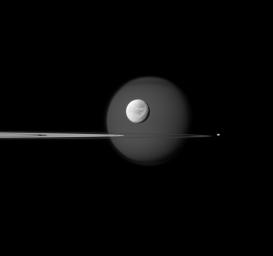
A quartet of Saturn's moons, from tiny to huge, surround and are embedded within the planet's rings in this Cassini composition.
Image credit: NASA/JPL-Caltech/Space Science Institute​
[/table]​


Cassini will also be probing whether Dione, like another Saturnian moon, Rhea, has a tenuous atmosphere. Scientists expect a Dionean atmosphere - if there is one - to be much more ethereal than even Rhea's. Research published in journal Geophysical Research Letters and led by Sven Simon, a Cassini magnetometer team member at the University of Cologne, Germany, found magnetic field disturbances around Dione, hinting at a tenuous atmosphere. But scientists hope to get stronger confirmation by "tasting" the space around the moon with Cassini's ion and neutral mass spectrometer.

On Cassini's journey out from Dione toward Titan, the imaging science subsystem will turn back to look at Dione's distinctive, wispy fractures and a ridge called Janiculum Dorsa.

Cassini will approach within about 2,200 milles (3,600 kilometers) of the Titan surface, at about 12:11 p.m. PST (3:11 PM EST) on Dec. 13. At Titan, the composite infrared spectrometer will be making measurements to understand how the seasonal transition from spring to summer affects wind patterns in the atmosphere near Titan's north pole. It will also search for mist.

The visual and infrared mapping spectrometer and imaging science subsystem will be observing the same equatorial deserts where the imaging science subsystem saw sudden and dramatic surface changes last year, when Titan was experiencing early northern spring. One possibly theory is that rainstorms caused these changes. As Cassini recedes from Titan, the imaging cameras will also continue to observe the moon for another day to monitor any new weather systems.

{...}
 
NASA / NASA JPL:
Portraits of Moons Captured by Cassini

December 12, 2011

NASA's Cassini spacecraft successfully completed its closest-ever pass over Saturn's moon Dione on Monday, Dec. 12, slaloming its way through the Saturn system on its way to tomorrow's close flyby of Titan. Cassini is expected to glide about 2,200 miles (3,600 kilometers) over the Titan surface on Dec. 13.

[table="head;width=675"]{colsp=3}
Click on images for details​

||

NASA's Cassini spacecraft obtained this unprocessed image on Dec. 12, 2011. The camera was pointing toward Saturn's moon Dione from approximately 69,989 miles (112,636 kilometers) away.
Image credit: NASA/JPL-Caltech/SSI​
|
NASA's Cassini spacecraft obtained this unprocessed image on Dec. 12, 2011. The camera was pointing toward Saturn's moon Dione from approximately 48,236 miles (77,682 kilometers) away.
Image credit: NASA/JPL-Caltech/SSI​
|
NASA's Cassini spacecraft obtained this unprocessed image on Dec. 12, 2011. The camera was pointing toward Saturn's moon Dione from approximately 76,344 miles (122,864 kilometers) away.
Image credit: NASA/JPL-Caltech/SSI​
[/table]​


In the selection of the raw images obtained during the Cassini Dione flyby, Dione is sometimes joined by other moons. Mimas appears just beyond the dark side of Dione in one view. In another view, Epimetheus and Pandora appear together, along with Saturn's rings.

This Dione encounter was intended primarily for Cassini's composite infrared spectrometer and radio science subsystem. However, the imaging team did capture views of the distinctive, wispy fractures on the side of Dione that always trails in its orbit around Saturn. It also obtained images of a ridge called Janiculum Dorsa on the hemisphere of Dione that always leads in its orbit around Saturn. While other flybys produced more detailed views of the surface, the best resolved images from this flyby have scales ranging from about 1,100 feet (350 meters) to about 1,600 feet (500 meters) per pixel. Janiculum Dorsa will be imaged by Cassini at higher resolution in May 2012.

All of Cassini's raw images can be seen at http://saturn.jpl.nasa.gov/photos/raw/.

{...}


CICLOPS: Dione Rev 158 Raw Preview

The Planetary Society Blog: Pretty picture: Mimas scuttles behind Dione
 
That Probe is completely awesome ! :hailprobe:
 
CICLOPS: Rev159: Dec 23 '11 - Jan 16 '12:
Cassini finishes up 2011 and starts its new year with the 24-day Rev159, which begins on December 23 at its farthest distance from Saturn. This is also called the orbit's apoapse. At this point, Cassini is 2.84 million kilometers (1.77 million miles) from Saturn's cloud tops. The spacecraft is in the middle of the first equatorial phase of the Cassini Solstice Mission, which lasts until May 2012. During this phase, the spacecraft's orbits lie within the equatorial plane of the planet, providing opportunities to encounter Saturn's numerous moons, image the rings edge-on, and look at Saturn's cloud tops without the rings obscuring the view. Seventy-eight ISS observations are planned for Rev159, the vast majority dedicated to the encounter with Titan and Saturn storm monitoring.

ISS begins its observations for Rev159 seven hours after apoapse on December 24 with a quick observation of Saturn and its faded northern hemisphere storm with another planned an hour later. These "Storm Watch" observation sequences are designed to take advantage of short, two-minute segments when the spacecraft turns the optical remote sensing (ORS) instruments back to Saturn as a waypoint between other experiments' observations. These sequences include blue, clear, two methane band, and one full-frame, continuum band filter images. Sixteen more are planned between December 24 and January 1, while thirty-one are planned between January 6 and 15. Between the two storm watch observations for December 24, ISS will acquire an astrometric observation of Saturn's small, inner moons, including Prometheus, Atlas, Anthe, Methone, Calypso, Polydeuces, and Epimetheus. Astrometric observations are used to improve our understanding of the orbits of these small satellites, which can be influenced by Saturn's larger icy satellites.

On December 25, ISS will image Titan's Fensal-Aztlan region from a distance of 3.94 million kilometers (2.45 million miles) in an effort to look for clouds in the moon's atmosphere. ISS will take a look at Titan again on December 26, this time from a distance of 3.71 million kilometers (2.30 million miles). Following a Saturn storm watch observation tacked on to the end of the Titan observation, ISS will acquire another astrometric observation, this time covering Telesto, Pallene, Janus, Helene, Pandora, Methone, and Calypso, after which ISS will again observe Saturn (this time with Tethys transiting the giant planet). Cassini takes another "Titan Monitoring Campaign" observation on December 30 from a distance of 1.73 million kilometers (1.07 million miles). This observation is designed to study Titan's upper haze layers rather than the moon's surface because the phase angle will be too high to study the surface effectively with ISS. After another Saturn storm watch observation, ISS will acquire another astrometric observation, this time looking at Anthe, Pallene, and Epimetheus.

Two days before periapse, Cassini encounters Titan on January 2 at 15:14 UTC for the 81st time. This is the first of nine Titan flybys planned for 2012 with the next encounter scheduled for January 30. This encounter, called T80, is a high-altitude flyby with a close-approach distance of 29,416 kilometers (18,278 miles). This flyby will allow for imaging of the Senkyo and southern trailing hemisphere regions of Titan outbound from the encounter. The Composite Infrared Spectrometer (CIRS) will be the primary pointing instrument during the inbound leg of this flyby while Titan is visible as a narrow crescent. The instrument will perform a Titan-staring, compositional measurement followed by two temperature map scans and a limb scan measuring aerosols over the night side of the northern hemisphere.

At closest approach, control of spacecraft pointing will switch to ISS with the Visual and Infrared Mapping Spectrometer (VIMS) riding along. This flyby is one of only two flybys during the Solstice Mission where the camera is the "prime" instrument during closest approach of a Titan encounter. The other prime flyby for ISS is T81 coming up at the end of the month. The two optical-remote sensing instruments will focus their attention on the southern trailing hemisphere, taking wide-angle-camera images and VIMS cubes of features like Polaznik Macula. Outbound, RADAR will perform radiometry scans across Titan's southern trailing hemisphere, filling a gap in the instrument's dielectric constant map of Titan. Next, VIMS will acquire stellar occultation observations of Titan's atmosphere using CW Leonis, a near-infrared bright star and R Leonis, a red hypergiant star. Both are in the constellation Leo. Finally, VIMS will finish up the encounter with a global VIMS mosaic.

On January 4 at 13:03 UTC, Cassini will reach periapse for Rev159 at an altitude of 206,330 kilometers (128,210 miles) from Saturn's cloud tops. During this periapse passage, Cassini will acquire a series of observations of Saturn's atmosphere designed to study the dynamics of weather patterns across the planet's northern hemisphere. First up, though, ISS will observe the crescent of Enceladus in order to understand the current state of the south polar plume. By taking observations of the plume at different times, researchers hope to test the hypothesis that the vents for the plume may be opened and closed by tidal forces. These different observations occur when Enceladus is at different points of its orbit, when the pull of Saturn's gravity can produce expanding and contracting forces across the moon's surface. These forces switch from causing expansion to causing contraction depending on orbital phase. Afterward, CIRS will scan along Saturn's limb just south of the ring shadow in order to measure the thermal structure of the planet's stratosphere. Next, the Ultraviolet Imaging Spectrometer (UVIS) will observe an occultation of the Trapezium Cluster in the constellation Orionis by Saturn in order to measure the structure of Saturn's upper haze layers. VIMS will then acquire a high resolution map of Saturn's northern hemisphere, taking VIMS cubes as Saturn rotates underneath the spacecraft. Finally, ISS will observe different latitudes of Saturn's atmosphere at low, moderate, and high emission angles to study again Saturn's upper haze layers and their effects on our ability to observe lower altitude cloud structures.

On January 6, ISS will acquire a lengthy, eight-hour observation of Ymir, the second largest of Saturn's distant, irregular moons. This observation will be taken from a distance of 18 million kilometers (11.2 million miles), and when combined with additional observations of this irregular satellite, is designed to measure Ymir's brightness at different phase angles. This can provide information about the nature of its surface (whether it is rough or smooth for example) even if Cassini never approaches within millions of kilometers of it. In this case, Ymir will be at a very low phase (nearly full), though it will still appear as nothing more than a bright point of light in narrow-angle-camera images. The next day, ISS will conduct another emission angle study of Saturn's atmosphere. On January 8, ISS will take a look at Titan's sub-Saturn hemisphere from a distance of 3.05 million kilometers (1.89 million miles). Following the Titan observation and another set of Saturn storm watch images, ISS will ride along with a 22-hour CIRS observation of Saturn, allowing ISS to map the planet's day side across two Saturn days.

On January 9, ISS will observe Titan's Fensal-Aztlan region, this time from a distance of 3.29 million kilometers (2.05 million miles). Afterward, ISS will begin the first of four Saturn wind measuring observations that will be acquired over the next day and a half. Saturn's winds across different latitude zones are measured by tracking cloud features from one day to the next. These four sequences will cover a period of three Saturn days. Between January 11 and 15, ISS will image Titan each day, searching for clouds across Titan's leading and anti-Saturn hemisphere. During these observations, the closest Cassini comes to Titan is 1.89 million kilometers (1.18 million miles) on January 15. On January 11, ISS will perform a lengthy Saturn storm watch observation acquiring a set of images at the beginning and end of a three-hour sequence, rather than the usual time span of only two minutes.

On January 16, Cassini will reach apoapse on this orbit, bringing it to a close and starting Rev160. Rev160 includes a distant, targeted flyby of Titan similar to the one in this orbit.

{...}
 
The Planetary Society Blog: More radar images of icy moons from Cassini: Iapetus, Enceladus, and Rhea


Iapetus_SAR_simp_8ppd_lg.png

Click to enlarge >
Cassini's SAR image of Iapetus
Cassini trained its RADAR instrument on Iapetus in September, 2007 to capture this Synthetic Aperture Radar (SAR) image of Iapetus' leading hemisphere. The leading hemisphere is Iapetus' dark hemisphere. Credit: NASA / JPL


Iapetus_SAR_blink_lg.gif

Click to enlarge >
Blink animation between SAR and photo observations of Iapetus
Credit: NASA / JPL / SSI / Steve Albers / Jason Perry


BIFQE02N171_D214_R001S01_V02.JPG_lg.jpg

Click to enlarge >
SAR image of Rhea
Cassini acquired this Synthetic Aperture Radar (SAR) image of Saturn's moon Rhea in March, 2010. Credit: NASA / JPL


BIFQE25S324_D207_E001S01_V02.JPG_lg.jpg

Click to enlarge >
SAR image of Enceladus
Cassini acquired this Synthetic Aperture Radar (SAR) image of Saturn's moon Enceladus in November, 2009. Credit: NASA / JPL​
 
NASA JPL / NASA:
NASA's Cassini Delivers Holiday Treats From Saturn

December 22, 2011

PASADENA, Calif. -- No team of reindeer, but radio signals flying clear across the solar system from NASA's Cassini spacecraft have delivered a holiday package of glorious images. The pictures, from Cassini's imaging team, show Saturn's largest, most colorful ornament, Titan, and other icy baubles in orbit around this splendid planet. The release includes images of satellite conjunctions in which one moon passes in front of or behind another. Cassini scientists regularly make these observations to study the ever-changing orbits of the planet's moons. But even in these routine images, the Saturnian system shines. A few of Saturn's stark, airless, icy moons appear to dangle next to the orange orb of Titan, the only moon in the solar system with a substantial atmosphere. Titan's atmosphere is of great interest because of its similarities to the atmosphere believed to exist long ago on the early Earth.

[table="head;width=675"]{colsp=6}
Click on images for details​

{colsp=2}|{colsp=2}|{colsp=2}

{colsp=2}
Titan and Dione

Saturn's third-largest moon Dione can be seen through the haze of its largest moon, Titan, in this view of the two posing before the planet and its rings from NASA's Cassini spacecraft.
Image credit: NASA/JPL-Caltech/SSI​
|{colsp=2}
Titan Upfront

The colorful globe of Saturn's largest moon, Titan, passes in front of the planet and its rings in this true color snapshot from NASA's Cassini spacecraft.
Image credit: NASA/JPL-Caltech/SSI​
|{colsp=2}
Haze Before Ice

Saturn's moon Tethys, with its stark white icy surface, peeps out from behind the larger, hazy, colorful Titan in this Cassini view of the two moons. Saturn's rings lie between the two.
Image credit: NASA/JPL-Caltech/SSI​

{colsp=3}
|{colsp=3}

{colsp=3}
True Colors, Deceptive Sizes

Saturn's largest moon, Titan, appears deceptively small paired here with Dione, Saturn's third-largest moon, in this view from Cassini.
Image credit: NASA/JPL-Caltech/SSI​
|{colsp=3}
Orange and Blue Hazes

These views from Cassini look toward the south polar region of Titan's largest moon, Titan, and show a depression within the moon's orange and blue haze layers near the south pole.
Image credit: NASA/JPL-Caltech/SSI​
[/table]​

The images are online at: http://www.nasa.gov/cassini, http://saturn.jpl.nasa.gov and http://ciclops.org.

While it may be wintry in Earth's northern hemisphere, it is currently northern spring in the Saturnian system and it will remain so for several Earth years. Current plans to extend the Cassini mission through 2017 will supply a continued bounty of scientifically rewarding and majestic views of Saturn and its moons and rings, as spectators are treated to the passage of northern spring and the arrival of summer in May 2017.

"As another year traveling this magnificent sector of our solar system draws to a close, all of us on Cassini wish all of you a very happy and peaceful holiday season, " said Carolyn Porco, Cassini imaging team lead at the Space Science Institute, Boulder, Colo.

{...}


Universe Today: Colorful Holiday Treats from Saturn

The Planetary Society Blog: Pretty pictures from Cassini's recent Dione flyby

SPACE.com: NASA Probe Snaps Amazing Photos of Saturn Moons
 
Nice pictures, but where are the full size ones?
I can only find 1015x1015 ones.
 
When the Universe does art... :blink: :thumbup:

:hailprobe:
 
CICLOPS: Rev160: Jan 16 - Feb 9 '12:
Cassini continues its exploration of the Saturn system with the 24-day Rev160, which begins on January 16 at its farthest distance from the planet. This point is also called the orbit's apoapse. At this point, Cassini will be 2.90 million kilometers (1.80 million miles) from Saturn's cloud tops. The spacecraft is in the middle of the first equatorial phase of the Cassini Solstice Mission, which lasts until May 2012. During this phase, the spacecraft's orbits lie within the equatorial plane of the planet, providing opportunities to encounter Saturn's numerous moons, image the rings edge-on, and look at Saturn's cloud tops without the rings obscuring the view. Sixty ISS observations are planned for Rev160, the vast majority dedicated to an encounter with Titan and Saturn storm monitoring.

ISS begins its observations for Rev160 a day after apoapse on January 17 with a quick observation of Saturn and its faded northern hemisphere storm. Three more such observations are planned that day. These "Storm Watch" observation sequences are designed to take advantage of short, two-minute segments when the spacecraft turns the optical remote sensing (ORS) instruments back to Saturn as a waypoint between other experiments' observations. These sequences include blue, clear, two methane band, and one full-frame, continuum band filter images. Twenty-two more are planned between January 18 and 25, while seven are planned between February 6 and 8. Between the first two storm watch observations on January 17, ISS will image Titan's Fensal-Aztlan region from a distance of 3.94 million kilometers (2.45 million miles) in an effort to look for clouds in the moon's atmosphere as part of the "Titan Monitoring Campaign". ISS will take a look at Titan again on January 18, this time from a distance of 2.23 million kilometers (1.39 million miles). After the Titan observation on January 17, ISS will acquire a pair of Saturn cloud tracking observations. Both last for two hours using sets of images taken 10 minutes apart in order to measure wind speeds in Saturn's atmosphere by tracking clouds. Four more of these will be taken on January 19 and 20, though each of these later Saturn wind observations will last five hours rather than two. Cassini takes another "Titan Monitoring Campaign" observation on January 20 from a distance of 2.87 million kilometers (1.78 million miles), looking for clouds across the moon's trailing hemisphere.

On January 21, ISS will observe different latitudes of Saturn's atmosphere at low, moderate, and high emission angles to study again Saturn's upper haze layers and their effects on our ability to observe lower-altitude cloud structures. A similar observation will be taken on January 26. On January 22, ISS will image Titan's Senkyo, Garotman Terra, Tollan Terra, and Yalaing Terra regions from a distance of 3.20 million kilometers (1.99 million miles) in an effort to look for clouds in the moon's atmosphere. This observation also will be useful to see if the remnant bright spot in Yalaing Terra from the late 2010 "Arrow Storm" remains. A similar observation taken from a distance of 3.06 million kilometers (1.90 million miles) will be taken on January 24 and will cover the sub-Saturn hemisphere. On January 23, the Composite Infrared Spectrometer (CIRS) will observe Saturn for 22 hours while ISS rides along, taking a set of images ever couple of hours. Afterward, ISS will observe Siarnaq for 12 hours in order to pin down the orientation of this small, outer satellite's north pole axis.

On January 28 at 18:30 UTC, Cassini will reach periapse, its closest point to Saturn, for Rev160 at an altitude of 206,310 kilometers (128,200 miles). The only ISS observation planned for this period is a ride along observation with the Visual and Infrared Mapping Spectrometer (VIMS). ISS will acquire a series of narrow-angle-camera images of Saturn's night side to look for lightning.

Two days after periapse, Cassini encounters Titan on January 30 at 13:40 UTC for the 82nd time. This is the second of nine Titan flybys planned for 2012 with the next encounter scheduled for February 19. T81 is a high-altitude flyby with a close-approach distance of 31,131 kilometers (19,343 miles). This flyby will allow for imaging of Adiri and the southern anti-Saturn hemisphere regions of Titan outbound from the encounter. Before the encounter, CIRS and the Ultraviolet Imaging Spectrometer (UVIS) will acquire spectral scans of Titan's night side. First, CIRS will scan across Titan using its far-infrared channel. Next, UVIS will acquire an extreme and far-ultraviolet scan followed by a stare at the bright limb of Titan.

At closest approach, control of spacecraft pointing will switch to ISS with the Visual and Infrared Mapping Spectrometer (VIMS) riding along. This flyby is one of only two flybys during the Solstice Mission where the camera is the "prime" instrument during closest approach of a Titan encounter. The other prime flyby for ISS was T80 earlier this month. The two optical remote sensing instruments will focus their attention on Ontario Lacus, a large hydrocarbon lake near Titan's south pole, during a five-hour observation. Scientists will be interested too see whether lake levels have dropped further since the last time the lake was observed during the T51 flyby in March 2009. This is the last opportunity for these instruments to view Ontario Lacus before the end of the mission because this area is moving into darkness as the seasons progress toward southern winter and northern summer. Afterward, CIRS and VIMS will repeat their observations from the inbound leg of the flyby, this time covering Titan's day side. ISS will ride along with the inbound and outbound CIRS observations. Between February 1 and 4, ISS will acquire three cloud monitoring sequences. Unlike the regular Titan Monitoring Campaign observations, these are much lengthier and are designed not only to monitor for the presence of clouds, but also to track them so their speeds can be measured. These observations will be centered over Belet, eastern Belet, and Hetpet Regio, respectively. A shorter, Titan Monitoring Campain sequence will be taken on February 6 from a distance of 3.58 million kilometers (2.22 million miles) centered on the Senkyo region on Titan.

After another Saturn storm watch sequence, ISS will acquire an astrometric observation of Saturn's small, inner moons, including Janus and Polydeuces. Astrometric observations are used to improve our understanding of the orbits of these small satellites, which can be influenced by Saturn's larger icy satellites. A second astrometric sequence will be taken on February 7, this time covering Epimetheus, Telesto, and Prometheus. Afterward, ISS will search for Trojan satellites near the L5 point on Titan's orbit. Similar co-orbital moons have been found for Tethys and Dione. Finally on February 7, ISS will image Titan once again for 11 hours, tracking clouds across Titan's sub-Saturn hemisphere.

On February 9, Cassini will reach apoapse on this orbit, bringing it to a close and starting Rev161. Rev161 includes a targeted flyby of Titan.

{...}
 
NASA / NASA JPL:
Cassini Testing Part of Its Radio System

January 12, 2012

PASADENA, Calif. -- Engineers with NASA's Cassini mission are conducting diagnostic testing on a part of the spacecraft's radio system after its signal was not detected on Earth during a tracking pass in late December. The spacecraft has been communicating with Earth using a backup part.

The issue occurred with the ultra-stable oscillator, which is used for one type of radio science experiment and also as a means of sending data back to Earth. The spacecraft is currently using an auxiliary oscillator, whose frequency stability is adequate for transmitting data from the spacecraft to Earth. Tests later this month will help mission managers decide whether it will be possible to bring the ultra-stable oscillator back into service.

Some of the data collected for the radio science experiment using the auxiliary oscillator will be of lesser quality than that from the ultra-stable oscillator. Signals used for occultation experiments - where scientists analyze how radio signals are affected as they travel through Saturn's rings or the atmospheres of Saturn and its moons back to Earth - will be of lesser quality. A second kind of radio science investigation using gravity measurements to probe the internal structure of Saturn or its moons will not be affected. Cassini carries 12 science experiments.

The cause is still under investigation, but age may be a factor. The spacecraft launched in 1997 and has orbited Saturn since 2004. Cassini completed its prime mission in 2008 and has had two additional mission extensions. This is the first time its ultra-stable oscillator has had an issue.

{...}
 
NASA / NASA JPL:
Cassini Sees the Two Faces of Titan's Dunes

January 23, 2012

A new analysis of radar data from NASA's Cassini mission, in partnership with the European Space Agency and the Italian Space Agency, has revealed regional variations among sand dunes on Saturn's moon Titan. The result gives new clues about the moon's climatic and geological history.

Dune fields are the second most dominant landform on Titan, after the seemingly uniform plains, so they offer a large-scale insight into the moon's peculiar environment. The dunes cover about 13 percent of the surface, stretching over an area of 4 million square miles (10 million square kilometers). For Earthly comparison, that's about the surface area of the United States.

[table="head;width=225"]
Click on image for details​


Data from NASA's Cassini spacecraft show that the sizes and patterns of dunes on Saturn's moon Titan vary as a function of altitude and latitude.
Image credit: NASA/JPL-Caltech, and NASA/GSFC/METI/ERSDAC/JAROS and U.S./Japan ASTER Science Team​
[/table]​


Though similar in shape to the linear dunes found on Earth in Namibia or the Arabian Peninsula, Titan's dunes are gigantic by our standards. They are on average 0.6 to 1.2 miles (1 to 2 kilometers) wide, hundreds of miles (kilometers) long and around 300 feet (100 meters) high. However, their size and spacing vary across the surface, betraying the environment in which they have formed and evolved.

Using radar data from the Cassini spacecraft, Alice Le Gall, a former postdoctoral fellow at NASA's Jet Propulsion Laboratory, Pasadena, Calif., who is currently at the French research laboratory LATMOS, Paris, and collaborators have discovered that the size of Titan's dunes is controlled by at least two factors: altitude and latitude.

In terms of altitude, the more elevated dunes tend to be thinner and more widely separated. The gaps between the dunes seem to appear to Cassini's radar, indicating a thinner covering of sand. This suggests that the sand needed to build the dunes is mostly found in the lowlands of Titan.

Scientists think the sand on Titan is not made of silicates as on Earth, but of solid hydrocarbons, precipitated out of the atmosphere. These have then aggregated into grains 0.04 inch in size by a still unknown process.

In terms of latitude, the sand dunes on Titan are confined to its equatorial region, in a band between 30 degrees south latitude and 30 degrees north latitude. However, the dunes tend to be less voluminous toward the north. Le Gall and colleagues think that this may be due to Saturn's elliptical orbit.

Titan is in orbit around Saturn, and so the moon's seasons are controlled by Saturn's path around the sun. Because Saturn takes about 30 years to complete an orbit, each season on Titan lasts for about seven years. The slightly elliptical nature of Saturn's orbit means that the southern hemisphere of Titan has shorter but more intense summers. So the southern regions are probably drier, which implies they have less ground moisture. The drier the sand grains, the more easily they can be transported by the winds to make dunes. "As one goes to the north, we believe the soil moisture probably increases, making the sand particles less mobile and, as a consequence, the development of dunes more difficult." says Le Gall.

Backing this hypothesis is the fact that Titan's lakes and seas are not distributed symmetrically by latitude. These reserves of liquid ethane and methane are predominantly found in the northern hemisphere, suggesting again that the soil is moister toward the north and so, again, the sand grains are less easy to transport by the wind.

"Understanding how the dunes form as well as explaining their shape, size and distribution on Titan's surface is of great importance to understanding Titan's climate and geology because the dunes are a significant atmosphere-surface exchange interface", says Nicolas Altobelli, ESA's Cassini-Huygens project scientist. "In particular, as their material is made out of frozen atmospheric hydrocarbon, the dunes might provide us with important clues on the still puzzling methane/ethane cycle on Titan, comparable in many aspects with the water cycle on Earth."

{...}


ESA: The two faces of Titan's dunes
 
Back
Top