Updates Cassini Mission News and Updates

CICLOPS: Rev174: Oct 30 - Nov 19 '12:
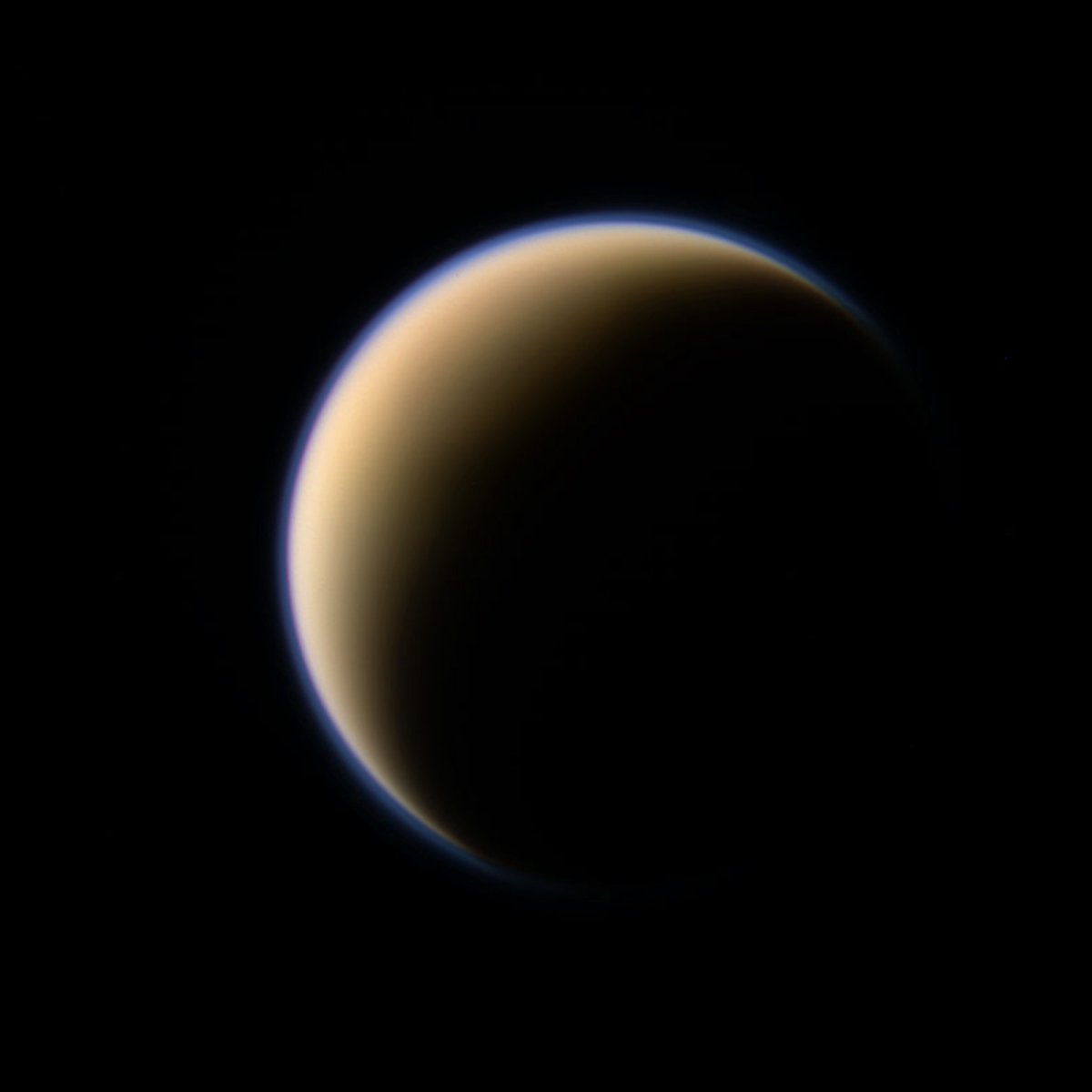
Cassini continues its exploration of the Saturn system with the 20-day Rev174, which begins on October 6 at its farthest distance from the planet. This is also called the orbit's apoapse. At this point, Cassini is 2.67 million kilometers (1.66 million miles) from Saturn's cloud tops. Rev174 occurs six months into the first inclined phase of the Cassini Solstice Mission, a phase which lasts until March 2015. The inclined phase will allow for polar views of Saturn and Titan as well as better vistas of Saturn's rings than those Cassini had while in the earlier, equatorial phase of the Solstice Mission. Thirty-five ISS observations are planned for Rev174, most focused on Saturn's atmosphere and rings as a well as on a Titan flyby on November 13.

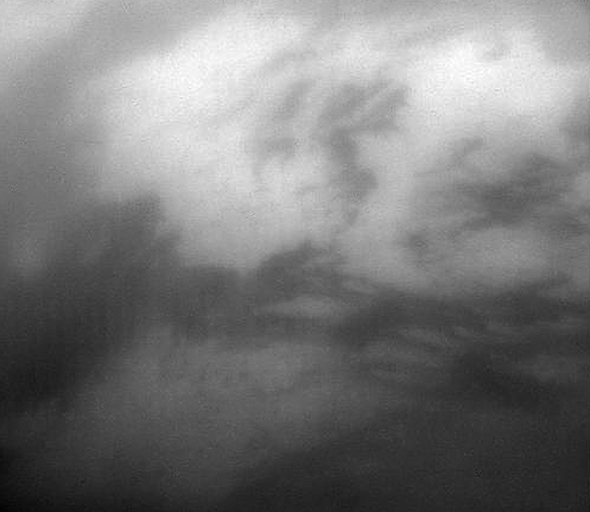
ISS begins its observations for Rev174 the day after apoapse with an observation of a half-phase Titan from a distance of 1.86 million kilometers (1.15 million miles). The observation is an effort to look for clouds in the moon's atmosphere as part of the "Titan Monitoring Campaign"(TMC). This observation is designed to monitor clouds over the moon's southern and trailing hemispheres. ISS will also be taking shorter-wavelength images to study changes in Titan's upper haze layers. ISS will image Titan again on November 2, covering the southern and trailing hemispheres once more. Immediately afterward, ISS will acquire a quick observation of Saturn using the wide-angle camera (WAC). These observations are part of a series of "Storm Watch" observation sequences designed to take advantage of short, two-minute segments when the spacecraft turns the optical remote sensing (ORS) instruments back to Saturn as a waypoint between other experiments' observations. These sequences include blue, clear, two methane band, and one full-frame, continuum band filter images. Eight more such observations are planned between November 2 and 8.

After the first Saturn storm watch observation, ISS will acquire an astrometric observation of Saturn's small, inner moons. Astrometric observations are used to improve our understanding of the orbits of these small satellites, which can be influenced by Saturn's larger icy moons. Another such observation will be taken on November 4. Also on November 2, ISS will acquire a series of images of Saturn rings using the WAC. These images will be tracking spokes -- a ring phenomenon Cassini has monitored throughout the mission -- over the B ring. With Cassini over the unlit side of the rings and with Saturn at a high phase angle, the spokes, if visible, will be brighter than the dark B ring. Additional spoke movies will be taken on November 4 and 7. ISS will observe Titan again on November 4 from a distance of 2.40 million kilometers (1.49 million miles). This observation will focus on the moon's southern and sub-Saturn hemispheres. On November 8, ISS will turn its attention back to Saturn's rings as it acquires a series of narrow-angle-camera (NAC) images of the F ring. These are designed to track changes in various streamers and channels in the ring that are formed by the effects of gravitational pull from the moon Prometheus.

On November 11 at 07:30 UTC, Cassini will reach periapse for Rev174 at an altitude of 414,590 kilometers (257,610 miles) from Saturn. During the periapse period on November 10, ISS will ride along with the Visual and Infrared Mapping Spectrometer (VIMS) as it observes the unlit side of the D and F rings. ISS images will be taken using the WAC. Next, ISS will ride along with VIMS to observe the occultation of the red giant star Alpha Ceti by the F ring. Afterward, ISS will acquire high-resolution images of the D ring followed by a survey of propellers in the outer A ring.

Two days after periapse, Cassini encounters Titan on November 13 at 10:22 UTC for the 88th time. This is the eighth of nine Titan flybys planned for 2012, with the next encounter scheduled for November 29. T87 is a very low-altitude flyby with a close-approach altitude of 973 kilometers (605 miles). This flyby will allow for imaging of the Adiri region and the southern anti-Saturn hemisphere of Titan outbound from the encounter. Before the encounter, the Composite Infrared Spectrometer (CIRS) and VIMS will acquire spectral scans and other data of Titan's night side and narrow crescent. CIRS will scan across Titan in order to map stratospheric temperatures. VIMS will image the north polar region of Titan in order to look for specular reflection from lakes in the region. ISS will ride along to acquire images of Titan's upper haze layers, which are more easily visible at high phase angles.

At closest approach, the Ion and Neutral Mass Spectrometer (INMS) and Navigation teams will be prime. The two teams are collaborating in order to better measure atmospheric density by measuring drag on the spacecraft which results from passing through the moon's upper atmosphere. INMS will be acquiring data at the same time to act as a comparison with the Doppler shift data. Researchers hope to use the information gleaned from this encounter to improve estimates for hydrazine fuel usage during close Titan encounters in the future. As Cassini departs from Titan, CIRS will map surface temperatures across the visible disk to look for diurnal and albedo-related differences while VIMS will perform global mapping at medium resolution. ISS will ride along during these observations, searching for clouds across Adiri and the southern anti-Saturn hemisphere, including over the Huygens landing site.

Late on November 14, ISS will acquire a series of WAC images of Saturn in order to measure wind speeds. A similar set (though only four hours long instead of ten) will be taken on November 17. On November 16 and 18, ISS will ride along with UVIS scans of Saturn.

On November 19, Cassini will reach apoapse on this orbit, bringing it to a close and starting Rev175. Rev175 includes the final Titan flyby for 2012.

{...}
 
NASA / NASA JPL:
Cassini Halloween Treat: Titan Glows in the Dark

October 31, 2012

A literal shot in the dark by imaging cameras on NASA's Cassini spacecraft has yielded an image of a visible glow from Titan, emanating not just from the top of Titan's atmosphere, but also - surprisingly - from deep in the atmosphere through the moon's haze. A person in a balloon in Titan's haze layer wouldn't see the glow because it's too faint - something like a millionth of a watt. Scientists were able to detect it with Cassini because the spacecraft's cameras are able to take long-exposure images.

[table="head;width=225"]
Click on image for details​


This set of images from NASA's Cassini spacecraft shows Saturn's moon Titan glowing in the dark. Titan was behind Saturn at the time, in eclipse from the sun. The image on the left is a calibrated, but unprocessed image from Cassini's imaging camera. The image on the right was processed to exclude reflected light off Saturn and it is clear that even where Titan did not receive any Saturnshine, it is still emitting light. Some light appears to be emanating from high in the atmosphere (noted by the outer dashed line at about 625 miles or 1,000 kilometers in altitude). But more surprisingly, most of it is diffusing up from lower down in the moon's haze, from about 190 miles (300 kilometers) above the surface.
Image credit: NASA/JPL-Caltech/SSI​
[/table]​


"It turns out that Titan glows in the dark - though very dimly," said Robert West, the lead author of a recent study in the journal Geophysical Research Letters and a Cassini imaging team scientist at NASA's Jet Propulsion Laboratory in Pasadena, Calif. "It's a little like a neon sign, where electrons generated by electrical power bang into neon atoms and cause them to glow. Here we're looking at light emitted when charged particles bang into nitrogen molecules in Titan's atmosphere."

Scientists are interested in studying the input of energy from the sun and charged particles into Titan's atmosphere because it is at the heart of the natural organic chemistry factory that exists in Titan's atmosphere.

"Scientists want to know what galvanizes the chemical reactions forming the heavy molecules that develop into Titan's thick haze of organic chemicals," said Linda Spilker, Cassini project scientist, also at JPL. "This kind of work helps us understand what kind of organic chemistry could have existed on an early Earth."

The light, known as airglow, is produced when atoms and molecules are excited by ultraviolet sunlight or electrically charged particles. Cassini scientists have already seen an airglow from Titan's nitrogen molecules caused by X-rays and ultraviolet radiation from the sun when Titan was illuminated by the sun. During 2009, Titan passed through Saturn's shadow, offering a unique opportunity for Cassini instruments to observe any luminescence from Titan while in darkness. Cassini's imaging cameras could see in very dim light by using exposure times of 560 seconds.

Scientists expected to see a glow in the high atmosphere (above 400 miles, or 700 kilometers in altitude) where charged particles from the magnetic bubble around Saturn strip electrons off of atmospheric molecules at Titan. Although an extremely weak emission was seen in that region, they were surprised to see Titan's dark face glow in visible wavelengths of light from deeper in the atmosphere (at about 190 miles or 300 kilometers above the surface), as though illuminated by moonshine from nearby satellites.

The scientists took into account sunlight reflected off Saturn. There was still a glow from the part of Titan that was dark. The luminescence was diffusing up from too deep for charged particles from the sun to be exciting atmospheric particles. The area was also not affected by the shooting of charged particles into the magnetic fields, which is what causes auroras.

Scientists' best guess is that the glow is being caused by deeper-penetrating cosmic rays or by light emitted due to some kind of chemical reaction deep in the atmosphere.

"This is exciting because we've never seen this at Titan before," West said. "It tells us that we don't know all there is to know about Titan and makes it even more mysterious."

Scientists have previously reported that the nightside Venus atmosphere also produces a glow, called the Ashen light. Some have suggested that lightning on Venus is responsible, although that explanation is not universally accepted. While Cassini's radio wave instrument has detected lightning at Saturn, it has not detected lightning at Titan. Scientists plan to keep looking for clues as Cassini continues to make its way around the Saturn system for another season.

{...}


CICLOPS:
Science Daily: Cassini Halloween Treat: Titan Glows in the Dark

SPACE.com: Huge Saturn Moon Titan Glows in the Dark
 
CICLOPS: Rev175: Nov 19 - Dec 3 '12:
Cassini continues its exploration of the Saturn system with the 14-day Rev175, which begins on November 19 at its farthest distance from the planet. This is also called the orbit's apoapse. At this point, Cassini is 1.97 million kilometers (1.22 million miles) from Saturn's cloud tops. Rev175 occurs six months into the first inclined phase of the Cassini Solstice Mission, a phase which lasts until March 2015. The inclined phase will allow for polar views of Saturn and Titan as well as better vistas of Saturn's rings than those Cassini had while in the earlier, equatorial phase of the Solstice Mission. Thirty-five ISS observations are planned for Rev175, the vast majority focused on Saturn's atmosphere as a well as on a Titan flyby on November 29.

ISS begins its observations for Rev175 the day after apoapse with a pair of observation of a gibbous Titan from a distance of 2.53 to 2.61 million kilometers (1.57 to 1.92 million miles). These observations are designed to look for clouds in the moon's atmosphere as part of the "Titan Monitoring Campaign" (TMC). These two observations are designed to monitor clouds over the moon's southern and trailing hemispheres. ISS also will be taking shorter-wavelength images to study changes in Titan's upper haze layers. ISS will image Titan again on November 22 and 23 covering the southern and sub-Saturn hemispheres once more.

On November 20 and 23, ISS will ride along with Ultraviolet Imaging Spectrometer (UVIS) scans of Saturn. The camera system will then acquire a series of WAC images of Saturn in order to measure wind speeds over a period of 5 hours. Similar sets will be taken on November 21, 23, and 24. On November 24, ISS will ride along with a Composite Infrared Spectrometer (CIRS) observation of Saturn's south polar aurora. In addition to making a movie of the planet's aurorae, the images will be used to independently measure the rotation period of Saturn's magnetic field. ISS's observations of the aurora will continue into a pair of Visual and Infrared Mapping Spectrometer (VIMS) observations of the planet's south pole on November 24 and 25.

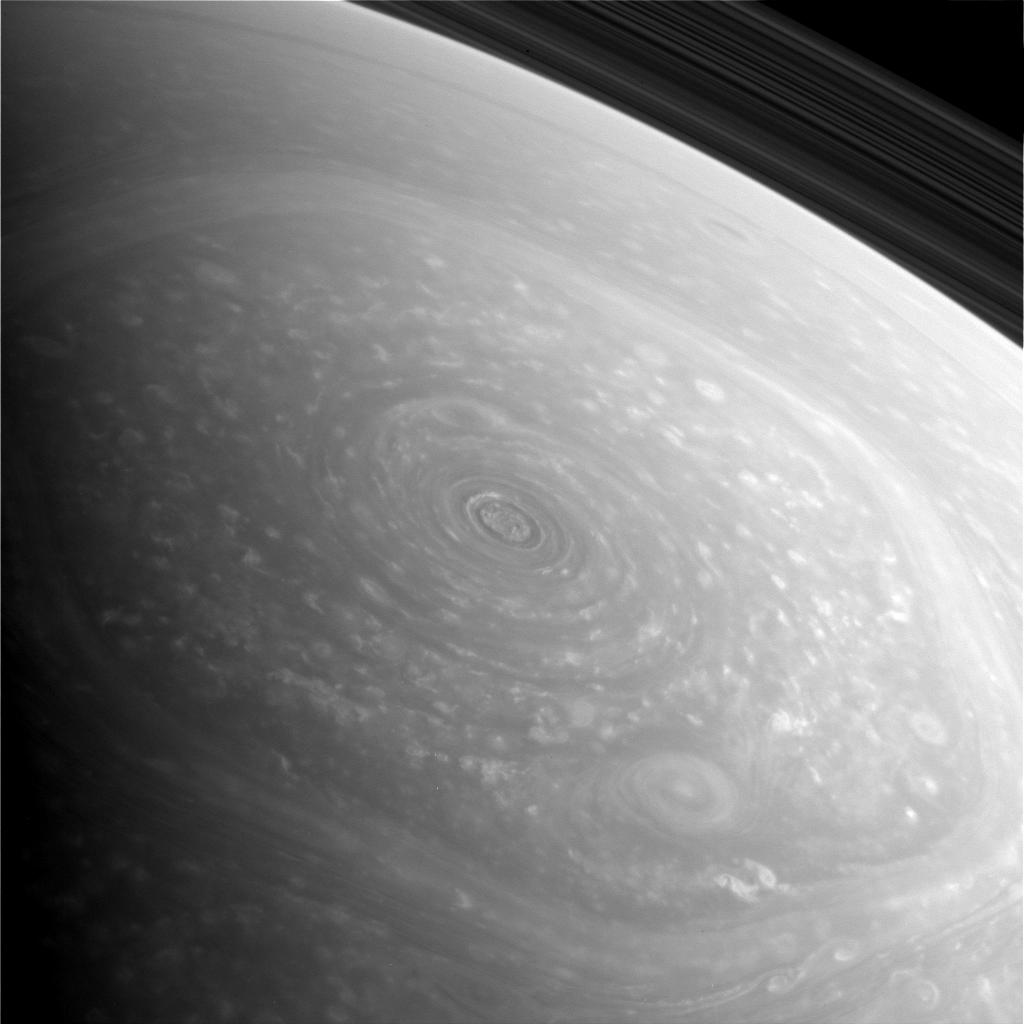
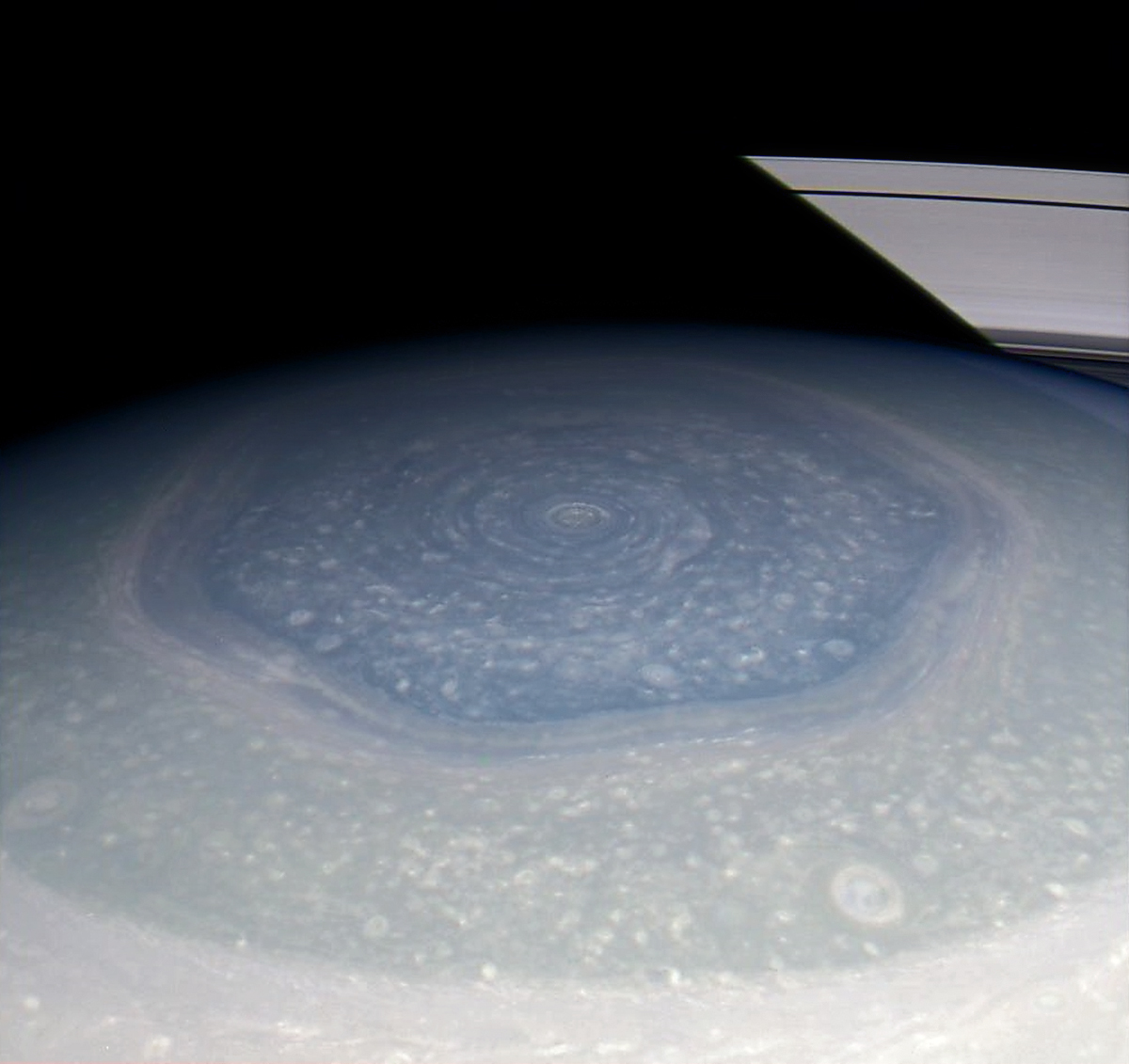
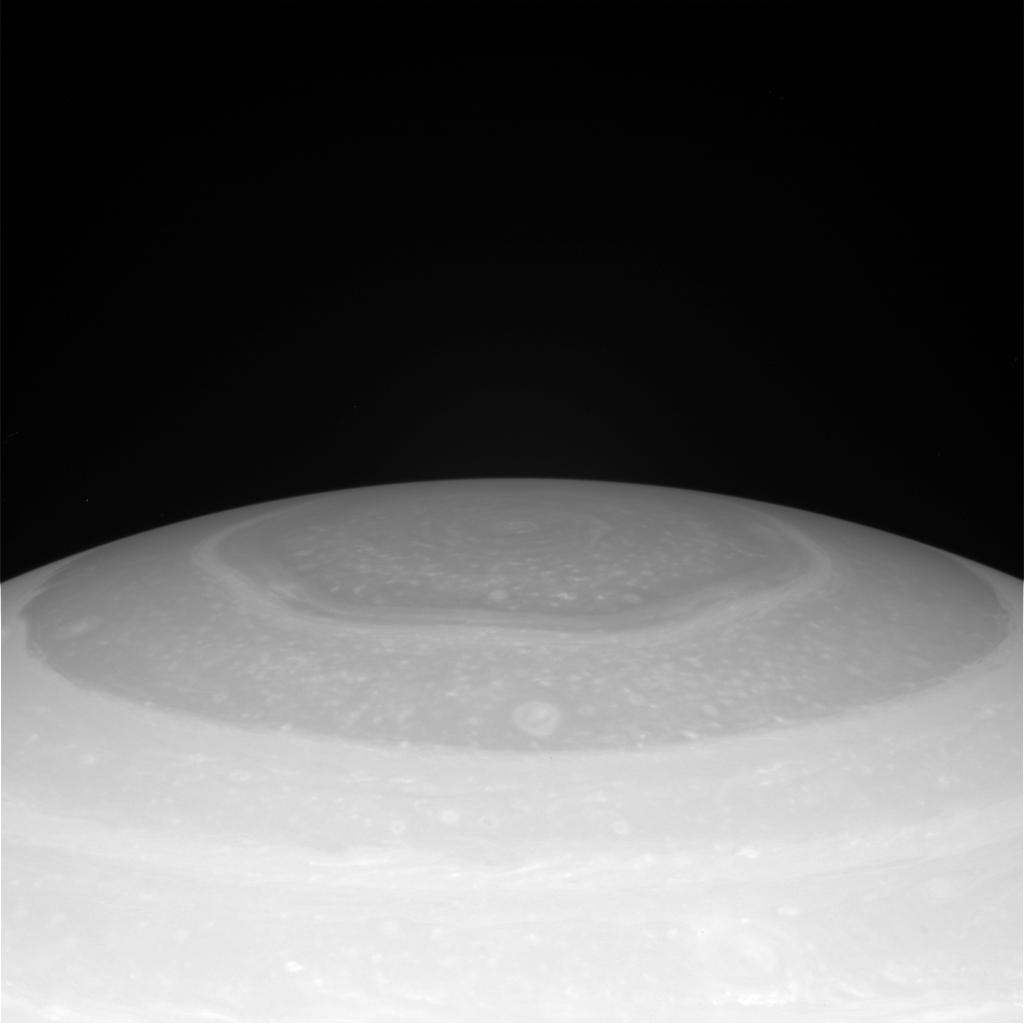
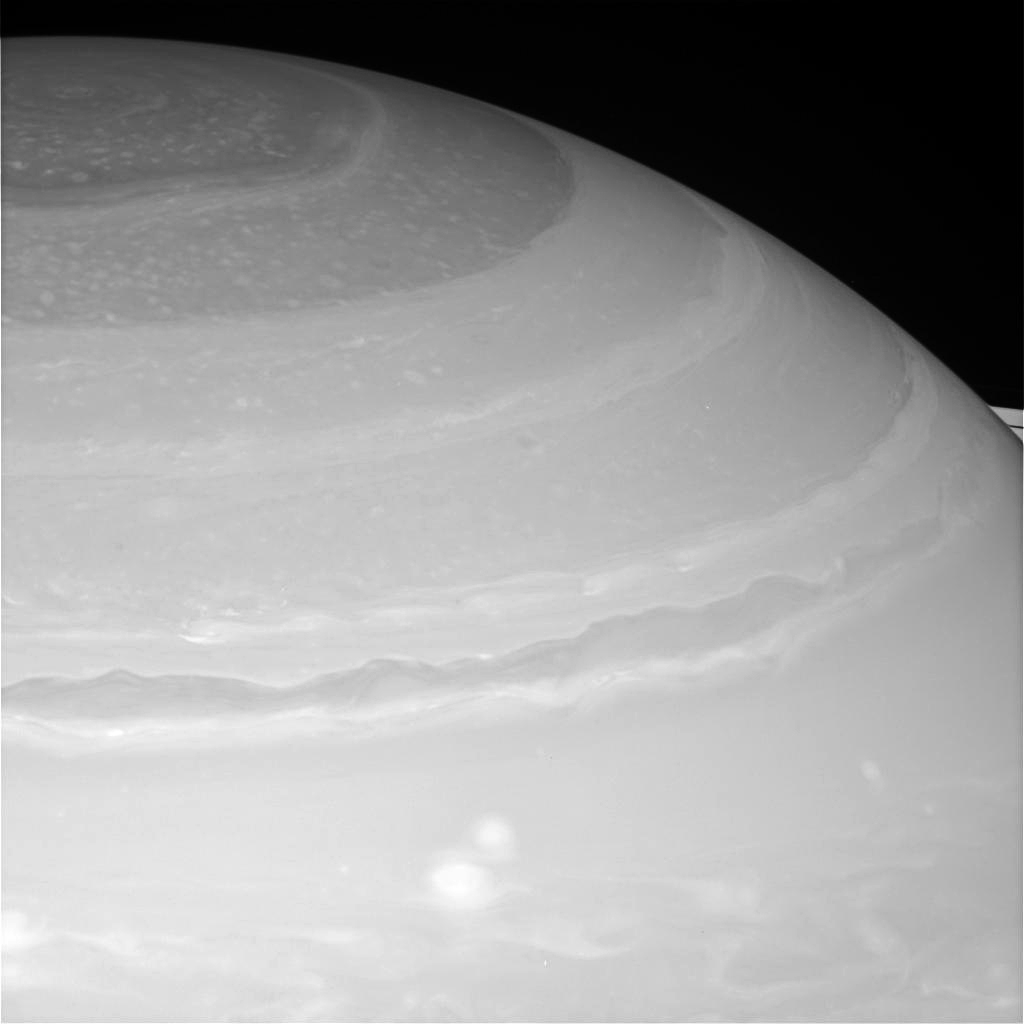
On November 27 at 02:15 UTC, Cassini will reach periapse for Rev175 at an altitude of 355,680 kilometers (221,010 miles) from Saturn. During the periapse period on November 26, ISS will image the limb of Saturn while the Sun is behind the planet. This will provide an excellent opportunity for observing the various haze layers in the planet's upper atmosphere. Early on the 27th, ISS will acquire a short movie of the planet's north polar region. Researchers will be looking to see if there is a north polar vortex to match the one observed at the south pole earlier in the mission. In addition, spring has progressed far enough that the entirety of the hexagonal jet stream that lies near 77 degrees North latitude will be in sunlight. The hexagon should fill the Wide-angle-camera (WAC) images for this observation. Later on the 27th, ISS will ride along with VIMS in order to acquire a WAC mosaic of Saturn's northern hemisphere and north polar region.

Two days after periapse, Cassini encounters Titan on November 29 at 08:57 UTC for the 89th time. This is the final Titan flyby planned for 2012, with the next encounter scheduled for February 17. T88 is a low-altitude flyby with a close-approach altitude of 1014 kilometers (630 miles). This flyby will allow for imaging of the Adiri region and the southern anti-Saturn hemisphere of Titan outbound from the encounter. Before the encounter, CIRS will acquire spectral scans and other data of Titan's night side and narrow crescent. CIRS will scan across Titan in order to map stratospheric temperatures. The instrument will also make scans along the limb of Titan to measure aerosol and chemical abundances at different altitudes above the moon's surface. ISS will ride along to acquire images of Titan's upper haze layers, which are more easily visible at high phase angles.

At closest approach, the VIMS team will be prime. VIMS will acquire image spectral cubes of several surface features as Cassini makes it pass over Titan. It will first image Mackay Lacus, a large lake or marsh land on the leading hemisphere side of the north pole. The lake was first seen by RADAR in July 2006. VIMS's data could be used to determine the depth of liquids within Mackay Lacus. Next, VIMS will look at Tortola Facula, an area of rough terrain in the northwestern part of the Shangri La sand dune sea, and finally will look at Santorini Facula, an impact crater south of Tortola. As Cassini departs from Titan, CIRS will map surface temperatures across the visible disk to look for diurnal and albedo-related differences while VIMS will perform global mapping at high and medium resolution. ISS will ride along during these observations, searching for clouds across Adiri and the southern anti-Saturn hemisphere, including over the Huygens landing site.

On December 2, ISS will acquire four quick observations of Saturn using the wide-angle camera (WAC). These observations are part of a series of "Storm Watch" observation sequences designed to take advantage of short, two-minute segments when the spacecraft turns the optical remote sensing (ORS) instruments back to Saturn as a waypoint between other experiments' observations. These sequences include blue, clear, two methane band, and one full-frame, continuum band filter images. After the second Saturn storm watch observation, ISS will acquire an astrometric observation of Saturn's small, inner moons. Astrometric observations are used to improve our understanding of the orbits of these small satellites, which can be influenced by Saturn's larger icy moons. Also on December 2, ISS will look for propellers within the Saturn's outer A ring.

On December 3, Cassini will reach apoapse on this orbit, bringing it to a close and starting Rev176.

{...}
 
NASA / NASA JPL:
Cassini Finds a Video Gamers' Paradise at Saturn

November 26, 2012

You could call this "Pac-Man, the Sequel." Scientists with NASA's Cassini mission have spotted a second feature shaped like the 1980s video game icon in the Saturn system, this time on the moon Tethys. (The first was found on Mimas in 2010). The pattern appears in thermal data obtained by Cassini's composite infrared spectrometer, with warmer areas making up the Pac-Man shape.

"Finding a second Pac-Man in the Saturn system tells us that the processes creating these Pac-Men are more widespread than previously thought," said Carly Howett, the lead author of a paper recently released online in the journal Icarus. "The Saturn system - and even the Jupiter system - could turn out to be a veritable arcade of these characters."

[table="head;width=600"]
Click on image for details​


Scientists with NASA's Cassini mission have spotted two features shaped like the 1980s video game icon "Pac-Man" on moons of Saturn. One was observed on the moon Mimas in 2010 and the latest was observed on the moon Tethys.
Image credit: NASA/JPL-Caltech/GSFC/SWRI​
[/table]​


Scientists theorize that the Pac-Man thermal shape on the Saturnian moons occurs because of the way high-energy electrons bombard low latitudes on the side of the moon that faces forward as it orbits around Saturn. The bombardment turns that part of the fluffy surface into hard-packed ice. As a result, the altered surface does not heat as rapidly in the sunshine or cool down as quickly at night as the rest of the surface, similar to how a boardwalk at the beach feels cooler during the day but warmer at night than the nearby sand. Finding another Pac-Man on Tethys confirms that high-energy electrons can dramatically alter the surface of an icy moon. Also, because the altered region on Tethys, unlike on Mimas, is also bombarded by icy particles from Enceladus' plumes, it implies the surface alteration is occurring more quickly than its recoating by plume particles.

"Studies at infrared wavelengths give us a tremendous amount of information about the processes that shape planets and moons," said Mike Flasar, the spectrometer's principal investigator at NASA's Goddard Space Flight Center in Greenbelt, Md. "A result like this underscores just how powerful these observations are."

Scientists saw the new Pac-Man on Tethys in data obtained on Sept. 14, 2011, where daytime temperatures inside the mouth of Pac-Man were seen to be cooler than their surroundings by 29 degrees Fahrenheit (15 kelvins). The warmest temperature recorded was a chilly minus 300 degrees Fahrenheit (90 kelvins), which is actually slightly cooler than the warmest temperature at Mimas (about minus 290 degrees Fahrenheit, or 95 kelvins). At Tethys, unlike Mimas, the Pac-Man pattern can also be seen subtly in visible-light images of the surface, as a dark lens-shaped region. This brightness variation was first noticed by NASA's Voyager spacecraft in 1980.

"Finding a new Pac-Man demonstrates the diversity of processes at work in the Saturn system," said Linda Spilker, Cassini project scientist at NASA's Jet Propulsion Laboratory, Pasadena, Calif. "Future Cassini observations may reveal other new phenomena that will surprise us and help us better understand the evolution of moons in the Saturn system and beyond."

{...}


Science Daily: 'Pac-Man' Moons: Cassini Finds a Video Gamers' Paradise at Saturn

Discovery News: Cassini Finds Second 'Pac-Man' Moon

SPACE.com: Saturn's Second 'Pac-Man' Moon Revealed in NASA Photos
 
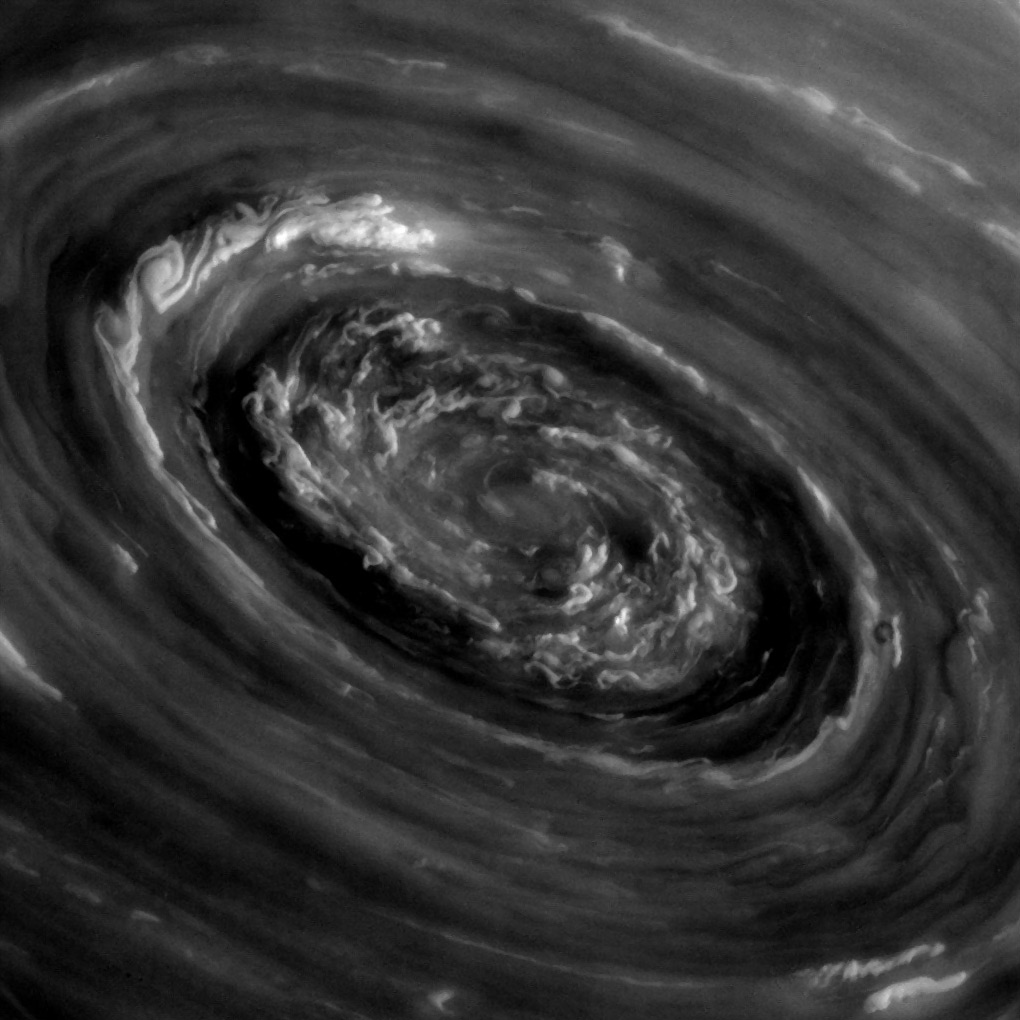
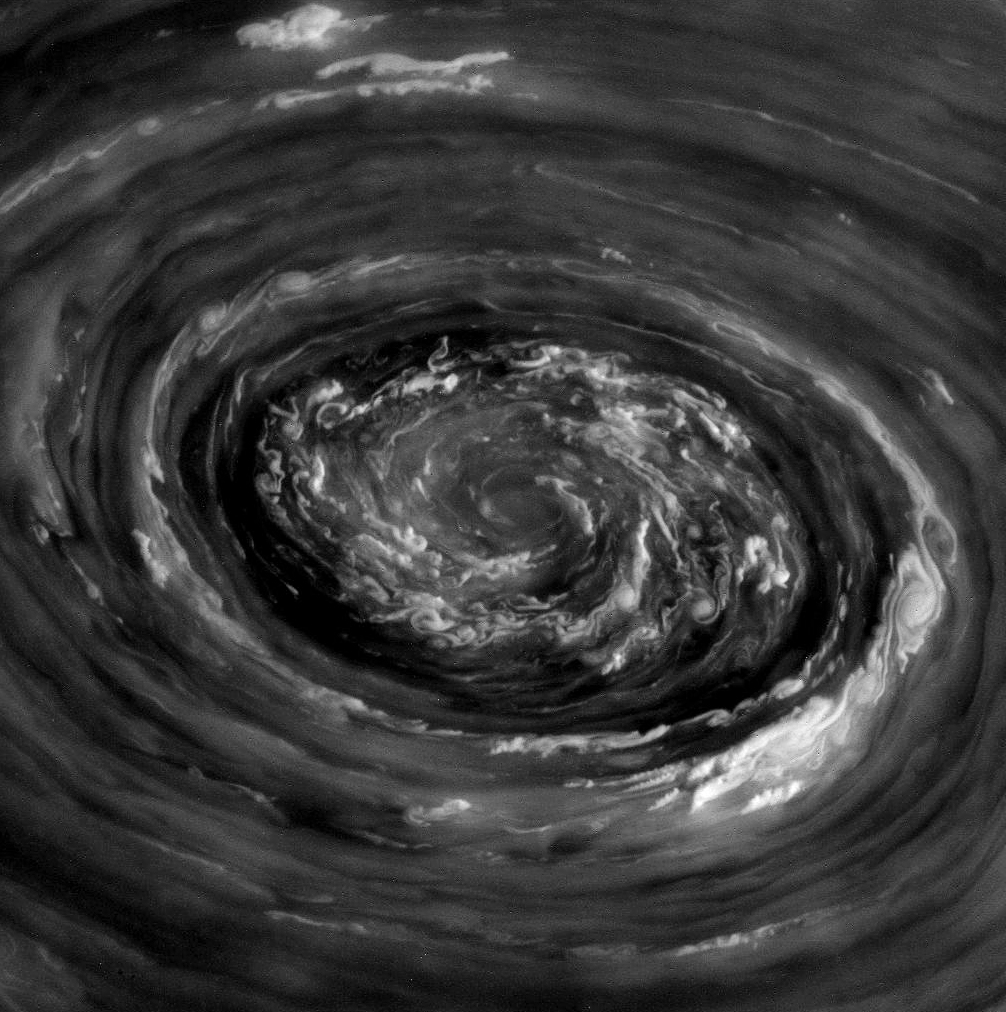
The Planetary Society Blog: Staring into Saturn's baleful eye:

20121127_N00198348_filtered.jpg


20121127_W00077190.jpg


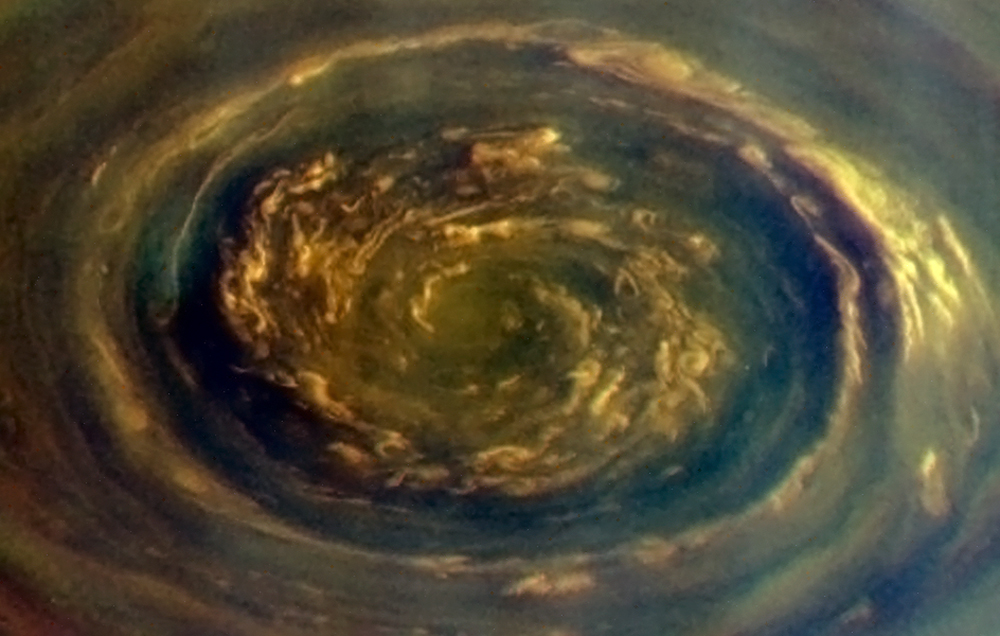
Universe Today: Incredible Raw Image of Saturn’s Swirling North Pole:

N00198376.jpg


Saturn-North-Pole-RGB.jpg


Saturn-Hex-RGB.jpg

Discovery News: Deep Inside Saturn's Stormy Eye: Big Pic
 
Weather must be rather nasty in that storm :shifty:
 
I think thats the most amazing picture of gas giant clouds i've seen, getting down to the actual individual cloud formations. looks scary! i can't even pretend to imagine what it's like inside below the surface!
 
Here comes the storm, moving:

The Planetary Society Blog: That amazing image of Saturn's north pole just got better: now, it moves!

saturn_cassini_npole_stormOriginal.gif

saturn_cassini_npole_stormLocked.gif

NASA / JPL / SSI / Kevin McAbee​


NASA / NASA JPL:
NASA's Cassini Sees Abrupt Turn in Titan's Atmosphere

November 28, 2012

PASADENA, Calif. -Data from NASA's Cassini spacecraft tie a shift in seasonal sunlight to a wholesale reversal, at unexpected altitudes, in the circulation of the atmosphere of Saturn's moon Titan. At the south pole, the data show definitive evidence for sinking air where it was upwelling earlier in the mission. So the key to circulation in the atmosphere of Saturn's moon Titan turned out to be a certain slant of light. The paper was published today in the journal Nature.

"Cassini's up-close observations are likely the only ones we'll have in our lifetime of a transition like this in action," said Nick Teanby, the study's lead author who is based at the University of Bristol, England, and is a Cassini team associate. "It's extremely exciting to see such rapid changes on a body that usually changes so slowly and has a 'year' that is the equivalent of nearly 30 Earth years."

In our solar system, only Earth, Venus, Mars and Titan have both a solid surface and a substantial atmosphere - providing natural laboratories for exploring climate processes. "Understanding Titan's atmosphere gives us clues for understanding our own complex atmosphere," said Scott Edgington, Cassini deputy project scientist at NASA's Jet Propulsion Laboratory, Pasadena, Calif. "Some of the complexity in both places arises from the interplay of atmospheric circulation and chemistry."

[table="head;width=450"]{colsp=2}
Click on images for details​

|

This artist's impression of Saturn's moon Titan shows the change in observed atmospheric effects before, during and after equinox in 2009. The Titan globes also provide an impression of the detached haze layer that extends all around the moon (blue). This image was inspired by data from NASA's Cassini mission.
Image Credit: ESA​
|This true color image captured by NASA'S Cassini spacecraft before a distant flyby of Saturn's moon Titan on June 27, 2012, shows a south polar vortex, or a swirling mass of gas around the pole in the atmosphere.
Image Credit: NASA/JPL-Caltech/Space Science Institute​
[/table]​


The pole on Titan that is experiencing winter is typically pointed away from Earth due to orbital geometry. Because Cassini has been in orbit around Saturn since 2004, it has been able to study the moon from angles impossible from Earth and watch changes develop over time. Models have predicted circulation changes for nearly 20 years, but Cassini has finally directly observed them happening - marking a major milestone in the mission.

Other Cassini instruments recently obtained images of the formation of haze and a vortex over Titan's south pole, but the data from the composite infrared spectrometer (CIRS) is sensitive to much higher altitudes, provides more quantitative information and more directly probes the circulation and chemistry. The CIRS data, which enable scientists to track changes in atmospheric temperature and the distribution of gases like benzene and hydrogen cyanide, also revealed changes in hard-to-detect vertical winds and global circulation.

Besides the evidence for sinking air, Cassini also detected complex chemical production in the atmosphere at up to 400 miles (600 kilometers) above the surface, revealing the atmospheric circulation extends about 60 miles (100 kilometers) higher than previously expected. Compression of this sinking air as it moved to lower altitudes produced a hot spot hovering high above the south pole, the first indication of big changes to come. The scientists were also able to see very rapid changes in the atmosphere and pinpoint the circulation reversal to about six months around the August 2009 equinox, when the sun shone directly over Titan's equator. The circulation change meant that within two years of equinox, some gases had increased in abundance 100-fold - much more extreme than anything seen so far on Titan.

The results also suggest that a detached layer of haze (first detected by NASA's Voyager spacecraft) may not be so detached after all, since complex chemistry and vertical atmospheric movement is occurring above this layer. This layer may instead be the region where small haze particles combine into larger, but more transparent, clumped aggregates that eventually descend deeper into the atmosphere and give Titan its characteristic orange appearance.

"Next, we would expect to see the vortex over the south pole build up," said Mike Flasar, the CIRS principal investigator at NASA's Goddard Space Flight Center in Greenbelt, Md. "As that happens, one question is whether the south winter pole will be the identical twin of the north winter pole, or will it have a distinct personality? The most important thing is to be able to keep watching as these changes happen."

{...}


NASA / NASA JPL:
Swirling Storms on Saturn

November 28, 2012

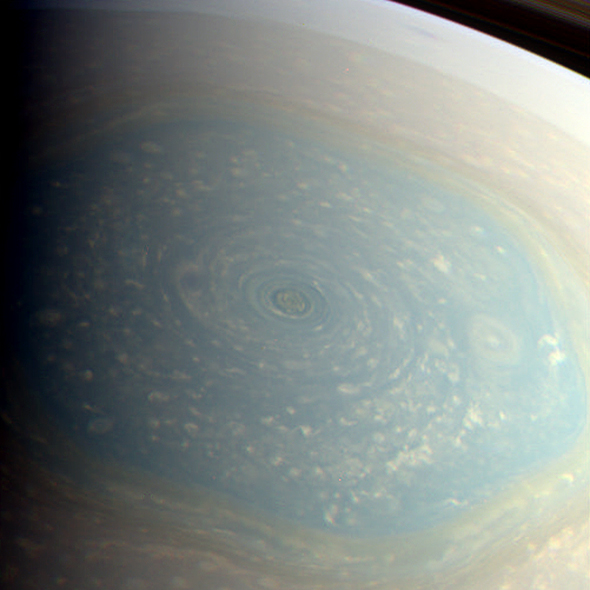
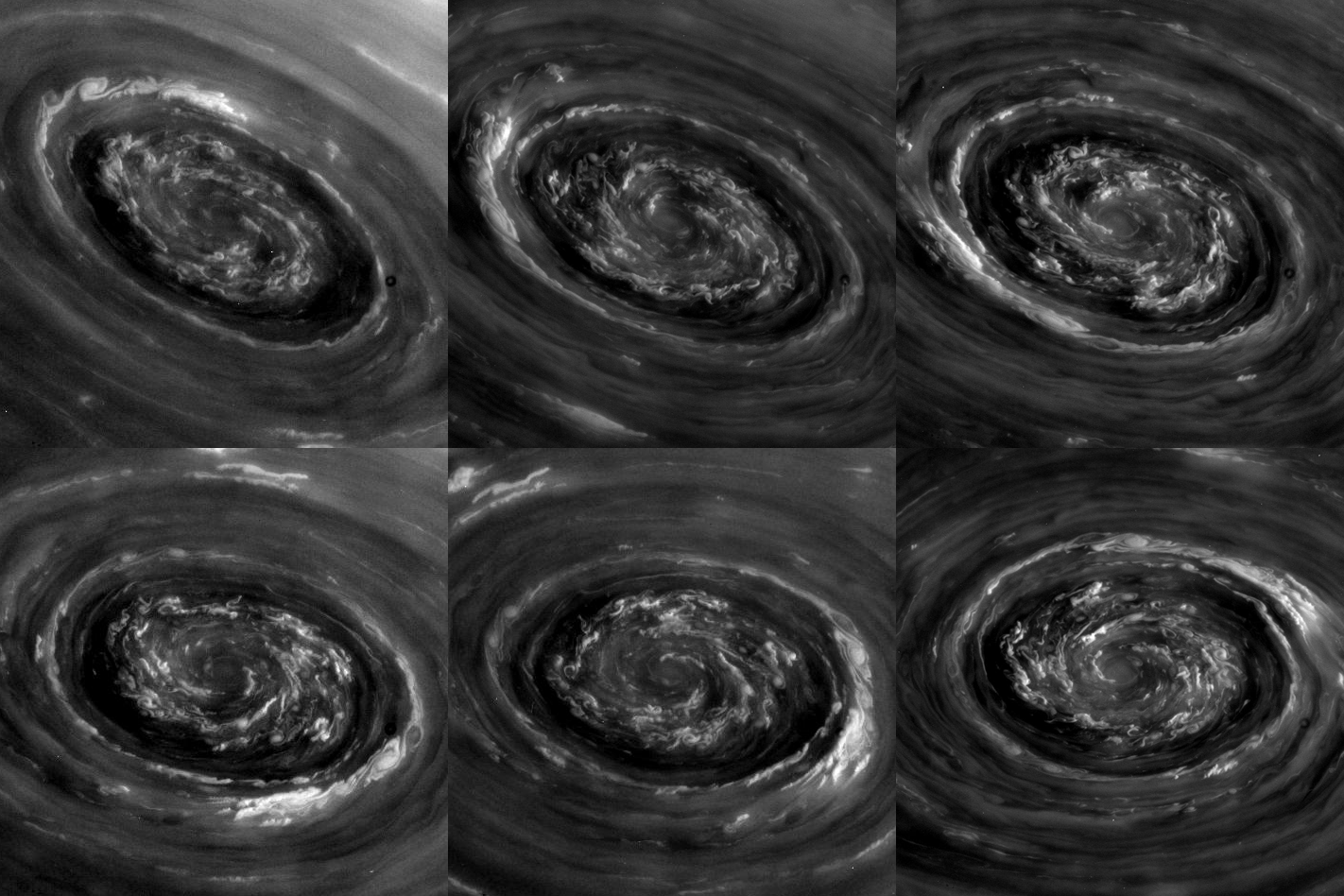
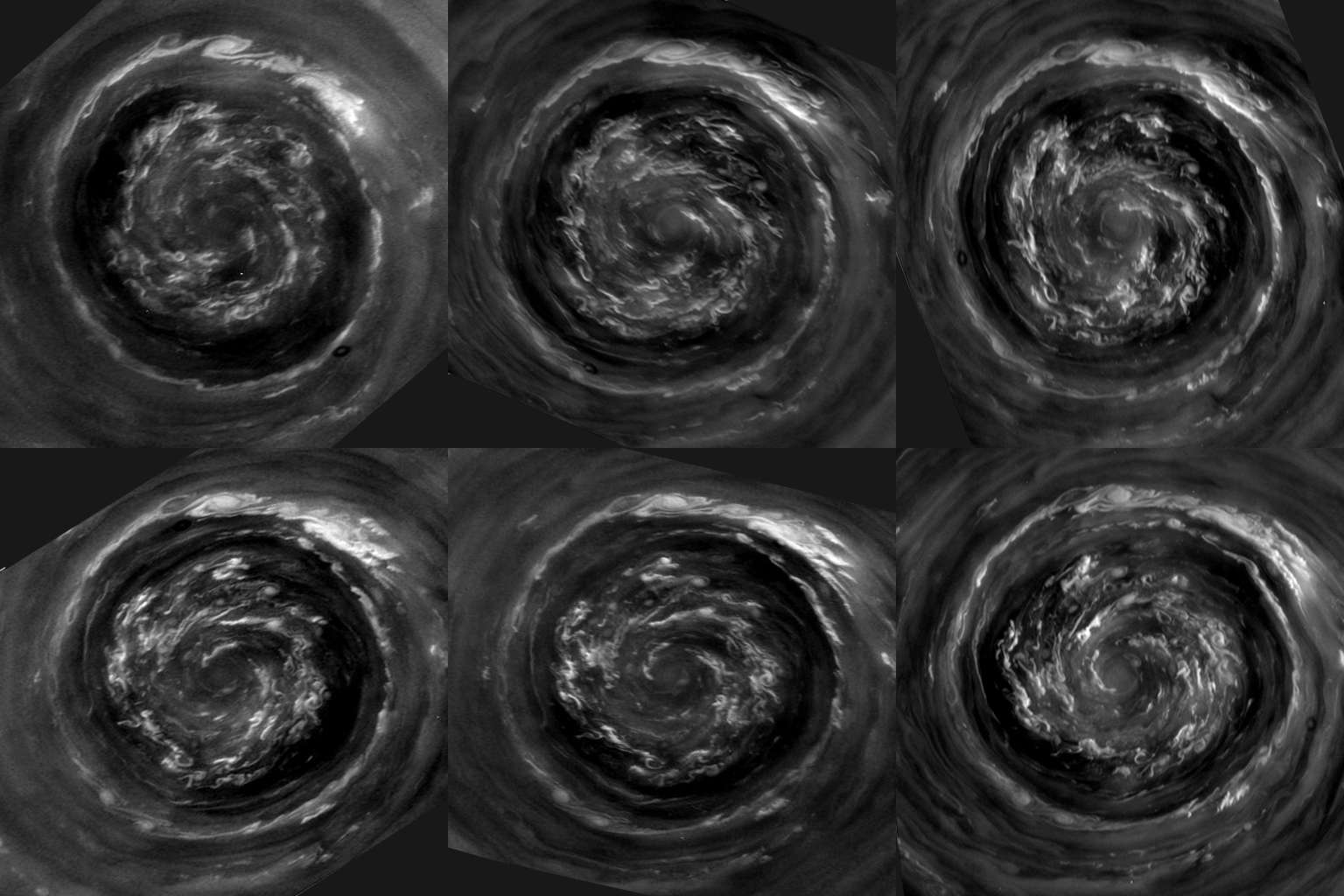
NASA's Cassini spacecraft has been traveling the Saturnian system in a set of inclined, or tilted, orbits that give mission scientists a vertigo-inducing view of Saturn's polar regions. This perspective has yielded images of roiling storm clouds and a swirling vortex at the center of Saturn's famed north polar hexagon.

These phenomena mimic what Cassini found at Saturn's south pole a number of years ago. Cassini has also seen storms circling Saturn's north pole in the past, but only in infrared wavelengths because the north pole was in darkness. (See http://www.jpl.nasa.gov/news/news.php?release=2008-192 .) But, with the change of the Saturnian seasons, the sun has begun to creep over the planet's north pole.

This particular set of raw, unprocessed images was taken on Nov. 27, 2012, from a distance of about 250,000 miles (400,000 kilometers) from Saturn.

More raw images are available at http://saturn.jpl.nasa.gov/photos/raw/index.cfm.

{...}


CICLOPS:
ESA: Titan’s seasons make sharp turn

Slate - Bad Astronomy: The Monstrous Eye at Saturn’s North Pole

SPACE.com:
Spaceflight Now: Cassini watches the seasonal impacts on Saturn's moon

Science Daily: Autumn Sets in Rapidly On Saturn's Giant Moon

EurekAlert: NASA's Cassini sees abrupt turn in Titan's atmosphere

Universe Today: A Colorful and Unexpected Reversal at Titan

AmericaSpace: Cassini Detects Changes in Titan’s Atmosphere
 
Universe Today: Titan Shines in Latest Cassini Shots

Titan-RGB-11-28-12-JMajor.jpg

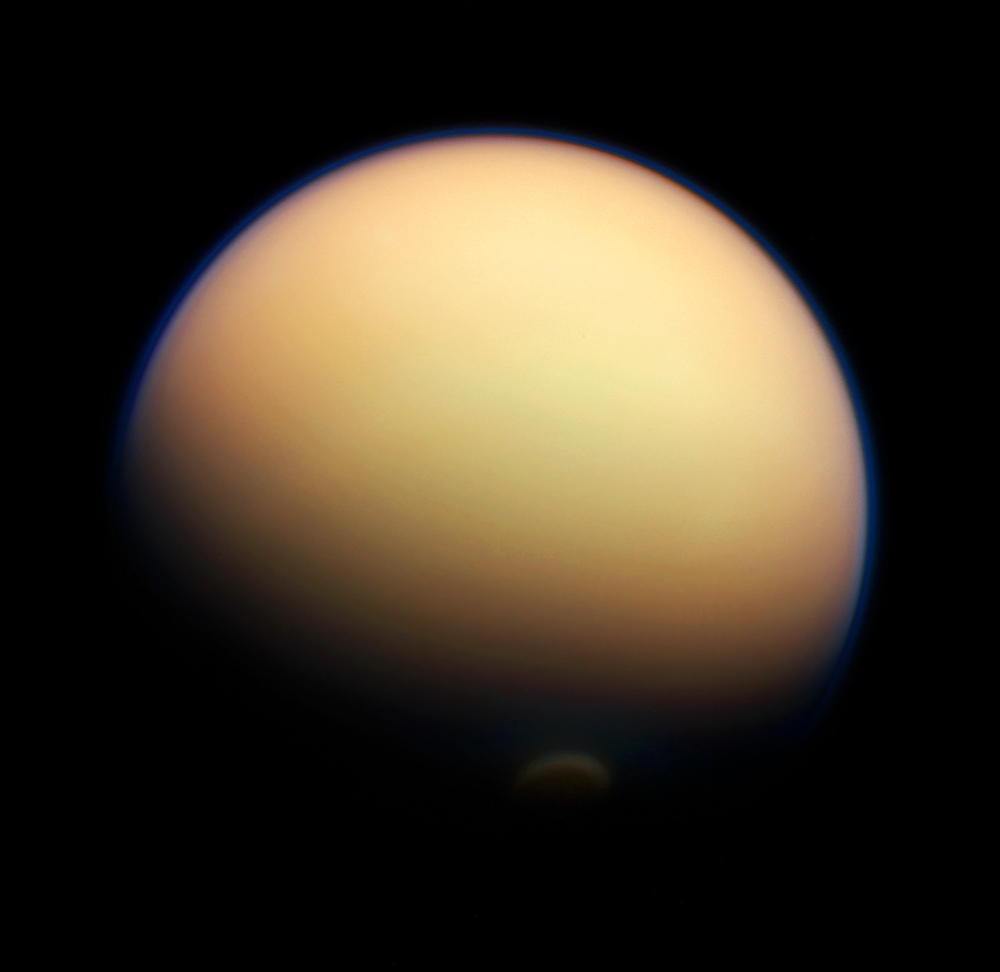
Color-composite raw image of Titan’s southern hemisphere. Note the growing south polar vortex.
(NASA/JPL/SSI/Jason Major)

W00077738.jpg

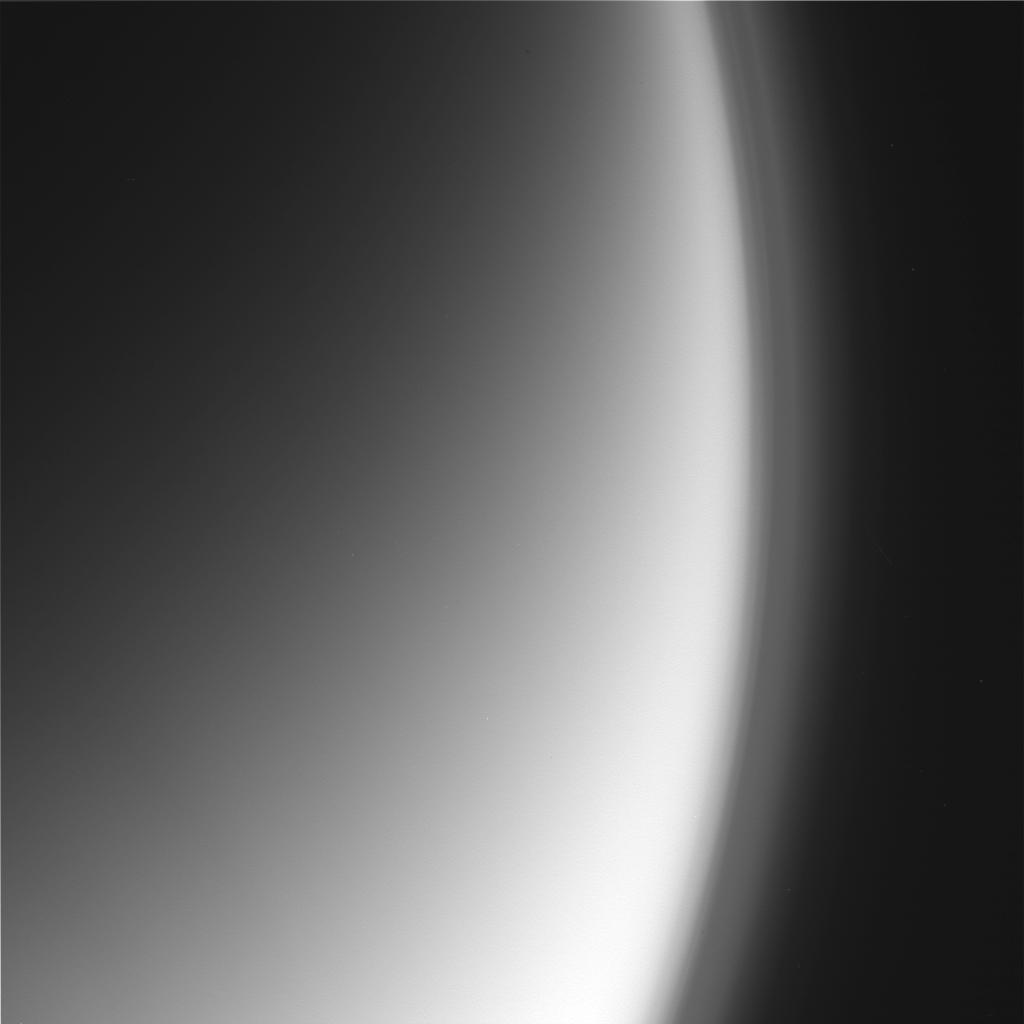
The structure of Titan’s upper-level hazes, which extend ten times the height of Earth’s atmosphere.
(NASA/JPL/SSI)

Titan-RGB-11-28-12.jpg

Cassini captured this view of Titan’s crescent during its approach, from a distance of 193,460 kilometers
(NASA/JPL/SSI/Jason Major)

W000777631.jpg

Cassini’s continuum filter (CB3) allows it to image Titan’s surface. The dark areas are vast fields of hydrocarbon sand dunes
(NASA/JPL/SSI)​


CICLOPS: Rev176: Dec 3 - Dec 16 '12:
Cassini continues its exploration of the Saturn system with the 13-day Rev176, which begins on December 3 at its farthest distance from the planet. This is also called the orbit's apoapse. At this point, Cassini is 1.65 million kilometers (1.03 million miles) from Saturn's cloud tops. Rev 176 occurs seven months into the first inclined phase of the Cassini Solstice Mission, a phase which lasts until March 2015. The inclined phase will allow for polar views of Saturn and Titan as well as better vistas of Saturn's rings than those Cassini had while in the earlier, equatorial phase of the Solstice Mission. Twenty-four ISS observations are planned for Rev 176, the vast majority of which are focused on Saturn's atmosphere.

ISS begins its observations for Rev 176 the day after apoapse with three quick observations of Saturn using the wide-angle camera (WAC). These observations are part of a series of "Storm Watch" observation sequences designed to take advantage of short, two-minute segments when the spacecraft turns the optical remote sensing (ORS) instruments back to Saturn as a waypoint between other experiments' observations. These sequences include blue, clear, two methane band, and one full-frame, continuum band filter images. Six additional sequences will be taken between December 5 and 7. Also on December 4, ISS will acquire a ten-hour light curve observation of the small, distant moon Kiviuq. The spacecraft will take nearly 100 images of Kiviuq over those ten hours in order to improve the estimate for its rotation period and to determine the position of its north pole. Unlike the moons that orbit closer to Saturn, Kiviuq is not tidally locked, having a rotation period of only 21.82 hours, much shorter than its 449-day orbital period. Finally, on December 4, after the second Saturn storm watch observation, ISS will acquire an astrometric observation of Saturn's small, inner moons. Astrometric observations are used to improve our understanding of the orbits of these small satellites, which can be influenced by Saturn's larger icy moons. Another astrometric observation will be taken on December 12.

On December 6, ISS will acquire a movie of the F ring,
observing its various channels and streamers created by the interaction between the ring material and the nearby moon, Prometheus. On December 7 and 8, ISS will ride along with a pair of Ultraviolet Imaging Spectrometer (UVIS) observations of Saturn's south polar aurora. In addition to making a movie of the planet's aurorae, the images will be used to independently measure the rotation period of Saturn's magnetic field. On December 8, ISS will observe a half-phase Titan from a distance of 1.36 million kilometers (0.84 million miles). This observation is designed to look for clouds in the moon's atmosphere as part of the "Titan Monitoring Campaign" (TMC). The observation on December 8 will monitor the clouds over the moon's southern and sub-Saturn hemispheres. ISS also will be taking shorter-wavelength images to study changes in Titan's upper haze layers.

On December 10 at 02:16 UTC, Cassini will reach periapse for Rev 176 at an altitude of 387,780 kilometers (240,960 miles) from Saturn. During the periapse period on December 9, ISS will image the limb of Saturn while the Sun is behind the planet. This will provide an excellent opportunity to observe the various haze layers in the planet's upper atmosphere. Afterward, ISS will monitor the south polar plume of Enceladus from a distance of 700,000 kilometers (435,000 miles). Early on the 10th, ISS will ride along with the Visual and Infrared Mapping Spectrometer (VIMS) to acquire a mosaic of Saturn's north polar region using the Wide-Angle Camera (WAC). Spring has progressed far enough that the entirety of the hexagonal jet stream that lies near 77 degrees North latitude will be in sunlight, as shown in the image at left from Rev175. ISS will be imaging the hexagon with a two-by-two mosaic rather than centering the field-of-view on the north pole like it did during the previous orbit. Later on the 10th, ISS will ride along with VIMS in order to acquire a WAC mosaic of Saturn's mid-northern latitudes, where a major storm raged a couple of years ago. Finally, on December 11, ISS will observe different latitudes of Saturn's atmosphere at low, moderate, and high emission angles to again study Saturn's upper haze layers and their effects on our ability to observe lower altitude cloud structures.

As Cassini recedes from Saturn on December 12, ISS will image the outer A ring, looking at the propellers previously seen in this part of the ring system. Propellers are small voids in Saturn's rings created by the gravitational interaction between large ring particles and the surrounding ring. Following that observation, ISS will observe Methone and the arc of dust that surrounds it for four hours. From late in the day on December 15 to early on December 17, ISS will observe a crescent Titan at a distance of 0.91 to 1.03 million kilometers (564,000 to 638,000 miles). This will last nearly 30 hours, allowing ISS to observe cloud motion and evolution on a long time scale. The field-of-view will also be centered near the south pole, allowing researchers to observe the south polar vortex.

On December 16, Cassini will reach apoapse on this orbit, bringing it to a close and starting Rev177.

{...}
 
NASA / NASA JPL:
Cassini Spots Mini Nile River on Saturn Moon

December 12, 2012

PASADENA, Calif. - Scientists with NASA's Cassini mission have spotted what appears to be a miniature, extraterrestrial likeness of Earth's Nile River: a river valley on Saturn's moon Titan that stretches more than 200 miles (400 kilometers) from its "headwaters" to a large sea. It is the first time images have revealed a river system this vast and in such high resolution anywhere other than Earth.

Scientists deduce that the river, which is in Titan's north polar region, is filled with liquid hydrocarbons because it appears dark along its entire length in the high-resolution radar image, indicating a smooth surface.

[table="head;width=450"]{colsp=2}
Click on images for details​

|

This image from NASA's Cassini spacecraft shows a vast river system on Saturn's moon Titan. It is the first time images from space have revealed a river system so vast and in such high resolution anywhere other than Earth.
Image Credit: NASA/JPL-Caltech/ASI​
|These two gray-scale images from NASA's Space Shuttle show part of the Nile River, near the Fourth Cataract in Sudan. The top photograph was originally taken with color infrared film from Space Shuttle Columbia in November 1995. The radar image at the bottom was acquired by Spaceborne Imaging Radar C/X-Band Synthetic Aperture Radar (SIR-C/X-SAR) aboard Space Shuttle Endeavour in April 1994. The radar image shows clearly the current channel of the Nile as well as an older channel buried in drifting sands.
Image credit: NASA/JPL-Caltech​
[/table]​


"Though there are some short, local meanders, the relative straightness of the river valley suggests it follows the trace of at least one fault, similar to other large rivers running into the southern margin of this same Titan sea," said Jani Radebaugh, a Cassini radar team associate at Brigham Young University, Provo, Utah. "Such faults - fractures in Titan's bedrock -- may not imply plate tectonics, like on Earth, but still lead to the opening of basins and perhaps to the formation of the giant seas themselves."

The new image is available online at: http://www.nasa.gov/mission_pages/cassini/multimedia/pia16197.html.

Titan is the only other world we know of that has stable liquid on its surface. While Earth's hydrologic cycle relies on water, Titan's equivalent cycle involves hydrocarbons such as ethane and methane. In Titan's equatorial regions, images from Cassini's visible-light cameras in late 2010 revealed regions that darkened due to recent rainfall. Cassini's visual and infrared mapping spectrometer confirmed liquid ethane at a lake in Titan's southern hemisphere known as Ontario Lacus in 2008.

"Titan is the only place we've found besides Earth that has a liquid in continuous movement on its surface," said Steve Wall, the radar deputy team lead, based at NASA's Jet Propulsion Laboratory, Pasadena, Calif. "This picture gives us a snapshot of a world in motion. Rain falls, and rivers move that rain to lakes and seas, where evaporation starts the cycle all over again. On Earth, the liquid is water; on Titan, it's methane; but on both it affects most everything that happens."

The radar image here was taken on Sept. 26, 2012. It shows Titan's north polar region, where the river valley flows into Kraken Mare, a sea that is, in terms of size, between the Caspian Sea and the Mediterranean Sea on Earth. The real Nile River stretches about 4,100 miles (6,700 kilometers). The processes that led to the formation of Earth's Nile are complex, but involve faulting in some regions.

{...}


Universe Today: Cry Me a Nile-Like River of Liquid Hydrocarbons on Titan

SPACE.com: Nile-Like River Spotted on Saturn Moon Titan

Discovery News: Titan's 'Nile River' Discovered

Slate - Bad Astronomy: Alien Nile: River of Liquid Methane Seen on Saturn's Moon Titan

AmericaSpace: Cassini Finds Expansive River System on Titan

Saturn Daily: Cassini Spots Mini Nile River on Saturn Moon

Science Daily: Cassini Spots Mini Nile River On Saturn's Moon Titan
 
CICLOPS: Rev177: Dec 16 - Dec 29 '12:
Cassini continues its exploration of the Saturn system with the 13-day Rev177, which begins on December 16 at its farthest distance from the planet. This is also called the orbit's apoapse. At this point, Cassini is 1.65 million kilometers (1.03 million miles) from Saturn's cloud tops. Rev 177 occurs seven months into the first inclined phase of the Cassini Solstice Mission, a phase which lasts until March 2015. The inclined phase will allow for polar views of Saturn and Titan as well as better vistas of Saturn's rings than those Cassini had while in the earlier, equatorial phase of the Solstice Mission. Twenty-four ISS observations are planned for Rev 177, evenly mixed between observations of Saturn's atmosphere, rings, and moons. Rev177 also includes a close, non-targeted flyby of Rhea, the planet's second largest moon.

ISS begins its observations for Rev 177 the day after apoapse with an observation of a half-phase Titan from a distance of 1.10 million kilometers (0.68 million miles). This observation is designed to look for clouds in the moon's atmosphere as part of the "Titan Monitoring Campaign" (TMC). This observation is designed to monitor clouds over the moon's southern and sub-Saturn hemispheres. ISS also will be taking shorter-wavelength images to study changes in Titan's upper haze layers. On December 18, ISS will acquire an astrometric observation of Saturn's small, inner moons. Astrometric observations are used to improve our understanding of the orbits of these small satellites, which can be influenced by Saturn's larger icy moons. Two more astrometric observations will be taken on December 25 and 27. Also on December 18, ISS will ride along with an Ultraviolet Imaging Spectrometer (UVIS) observation of the bright star Vega as the moon Rhea passes in front of it. Afterward, ISS will acquire a movie of the F ring, observing its various channels and streamers created by the interaction between the ring material and the nearby moon Prometheus. A similar movie will be takena week later on December 25. On December 19, ISS will acquire a series of images of Saturn's rings using the WAC. These images will be tracking spokes -- a ring phenomenon Cassini has monitored throughout the mission -- over the B ring. With Cassini over the unlit side of the rings and with Saturn at a high phase angle, the spokes, if visible, will be brighter than the dark B ring.

On December 23 at 08:30 UTC, Cassini will reach periapse for Rev 177 at an altitude of 387,610 kilometers (240,850 miles) from Saturn. The day before, December 22, ISS will acquire a six-hour light curve observation of the small, distant moon Surtur. The spacecraft will take nearly 40 images over those ten hours in order to improve the estimate for its rotation period and to determine the position of its north pole. Also on December 22, at 23:06 UTC, Cassini will pass by Rhea at a distance of 23,650 kilometers (14,695 miles). ISS will acquire three mosaics of the icy satellite covering its trailing hemisphere and north polar region. The 26-image mosaic covering portions of the trailing hemisphere will have a peak resolution of 140 meters (460 feet) per pixel. A seven-image mosaic covering the north polar region will have a resolution of 240 meters (790 feet) per pixel. Afterward, early on December 23, ISS will monitor the south polar plume of Enceladus from a distance of 700,000 kilometers (435,000 miles). Finally, ISS will image Dione's northern hemisphere at a distance of 248,000 kilometers (154,000 miles).

On December 24, ISS will acquire a quick observation of Saturn using the wide-angle camera (WAC). These observations are part of a series of "Storm Watch" observation sequences designed to take advantage of short, two-minute segments when the spacecraft turns the optical remote sensing (ORS) instruments back to Saturn as a waypoint between other experiments' observations. These sequences include blue, clear, two methane band, and one full-frame, continuum band filter images. Six additional sequences will be taken between December 25 and 27. Also on December 24, ISS will acquire another light curve observation of Surtur, this one lasting fourteen hours. On December 25 and 27, ISS will search for clouds on Titan as part of its TMC campaign. These two observations will focus on the Fensal-Aztlan region of the moon and will be taken from a distance of 2.12 million kilometers (1.32 million miles). On December 26, ISS will then look at the faint inner D ring for a ten-hour movie observation. Finally, on December 27, ISS will observe Anthe and the arc of dust that surrounds it for ten hours

On December 29, Cassini will reach apoapse on this orbit, bringing it to a close and starting Rev178.

{...}
 
NASA / NASA JPL:
From Cassini for the Holidays: A Splendor Seldom Seen

December 18, 2012

PASADENA, Calif -- Just in time for the holidays, NASA's Cassini spacecraft, in orbit around Saturn for more than eight years now, has delivered another glorious, backlit view of the planet Saturn and its rings.

On Oct. 17, 2012, during its 174th orbit around the gas giant, Cassini was deliberately positioned within Saturn's shadow, a perfect location from which to look in the direction of the sun and take a backlit view of the rings and the dark side of the planet. Looking back towards the sun is a geometry referred to by planetary scientists as "high solar phase;" near the center of your target's shadow is the highest phase possible. This is a very scientifically advantageous and coveted viewing position, as it can reveal details about both the rings and atmosphere that cannot be seen in lower solar phase.

[table="head;width=600"]
Click on image for details​


NASA's Cassini spacecraft has delivered a glorious view of Saturn, taken while the spacecraft was in Saturn's shadow. The cameras were turned toward Saturn and the sun so that the planet and rings are backlit.
Image Credit: NASA/JPL-Caltech/Space Science Institute​
[/table]​


The last time Cassini had such an unusual perspective on Saturn and its rings, at sufficient distance and with sufficient time to make a full system mosaic, occurred in September 2006, when it captured a mosaic, processed to look like natural color, entitled "In Saturn's Shadow" (http://photojournal.jpl.nasa.gov/catalog/?IDNumber=PIA08329). In that mosaic, planet Earth put in a special appearance, making "In Saturn's Shadow" one of the most popular Cassini images to date.

The mosaic being released today by the mission and the imaging team, in celebration of the 2012 holiday season, does not contain Earth; along with the sun, our planet is hidden behind Saturn. However, it was taken when Cassini was closer to Saturn and therefore shows more detail in the rings than the one taken in 2006.

The new processed mosaic, composed of 60 images taken in the violet, visible and near infrared part of the spectrum, can be found at http://www.nasa.gov/cassini, http://saturn.jpl.nasa.gov and http://ciclops.org.

"Of all the many glorious images we have received from Saturn, none are more strikingly unusual than those taken from Saturn's shadow," said Carolyn Porco, Cassini's imaging team lead based at the Space Science Institute in Boulder, Colo.

{...}


CICLOPS:
NASA JPL - Cassini Solstice Mission: From Cassini for the Holidays: A Splendor Seldom Seen

Universe Today: Gorgeous New Backlit View of Saturn

Discovery News: Cassini's Christmas Gift: In the Shadow of Saturn
 
Awesome photo, if im not wrong you can see titan at bottom left?

Slate - Bad Astronomy: Saturn’s Glorious Dark Side:

  1. Cassini was almost directly behind Saturn when these pictures were taken; that is, Saturn was directly between the spacecraft and the Sun. Cassini was deep in Saturn’s shadow, and the visible half of the planet itself is almost entirely dark. In other words: You’re seeing the night side of Saturn.

  2. The rings are in full sunlight, and we see them from “below”, looking up. The rings at the bottom of the picture are farther away; you can see the disk of Saturn blocking them.

  3. The rings near the top are closer to us, coming around into Saturn’s dark side.

  4. In fact, the shadow of the planet itself cuts across the rings!

  5. The glow on the planet’s dark side (seen as green here) is sunlight reflected from the rings onto the planet’s atmosphere. If you were floating there, above Saturn’s clouds, you’d see the rings off to the side brilliantly illuminated by the Sun; that light is what’s illuminating Saturn. Ringlight! It’s like our own bright Moon lighting up the dark part of the Earth at night.

  6. The dark bands going across the planet are the rings themselves, seen in silhouette. This is the part I had to wrap my brain around, and draw myself some diagrams. The cloudtops of Saturn are lit by the parts of the ring in sunlight (#5), but the arc of rings in Saturn’s shadow block our view of the gently illuminated cloud tops.

  7. The bright arc of teal light (though remember, this is false color) going around the planet is sunlight scattered by Saturn’s clouds. Saturn isn’t solid; it’s a gas giant, and sunlight can get through the thinnest, highest-altitude part of the cloud layer. It gets bent a bit toward Cassini, so we see it. This is the same as a spoon looking bent when it sits in a glass of water; light gets bent, or refracted, when passing from one medium to another, like air to water, or the vacuum of space to an atmosphere.

  8. The outermost ring of Saturn—the E ring—is faint and diffuse, but we can see it here as a fuzzy glow. It’s normally difficult to spot, but with the glare of Saturn so diminished in this picture, it’s far easier to see.

  9. Two moons are visible on Saturn’s left side, too (I put in lines pointing at them): Tethys, lower and to the left, and Enceladus, above and the right.

{...}
 
Back
Top