Flight Question deltaglider's autopilot.

rocketdued

New member
Joined
Dec 10, 2010
Messages
240
Reaction score
0
Points
0
im practiceing the scanrio ksc to iss. but upon liftoff in the delatglider i see in the altitude tape it says ap. now ap is for autopilot. i have the default deltaglider. how do i turn off the autopilot? i think that might be why im having trouble flying the thing. im not fighting the earth im fighting the space craft for control.
 
im practiceing the scanrio ksc to iss. but upon liftoff in the delatglider i see in the altitude tape it says ap. now ap is for autopilot.

:facepalm:

How often do we have to tell you: Spacecraft are no aircraft!

And how often do we have to tell you to check the manual first, because it explains the MFDs...

AP means Apoapsis, it is the highest point of your ballistic trajectory. You can't fly higher than apoapsis in ballistic flight, you need to boost your orbit then.

The MFD also shows PE on the same tape, which means periapsis, it is the lowest point of your trajectory.

That is why all people tell you to post a screen shot of Orbit MFD, because it contains the Periapsis and Apoapsis altitude, together with all other data of your trajectory.

Also, the DG has only the standard autopilot modes that all orbiter spacecraft have (except the primitive atmospheric autopilot for altitudes below 10 km).

  • Kill rotation (KILL ROT)
  • Prograde (in direction of your velocity vector)
  • Retrograde (against your velocity vector)
  • Orbit normal (90° away from the orbit plane)
  • Orbit antinormal (-90° away from the orbit plane)
  • Level horizontal.
  • Hold Altitude (with hover thrusters)

Nothing that keeps you out of control if you simply would read the famous manual!
 
Last edited:
deltaglider's autopilot

ok i think i have the deltaglider in space. now if i understand it roght from what the orbit mfd's manual told me trying to get to the space station my apr and per have to match that of the space statio correct in order to get to it? im still doing oms_2burn to get my speed and altitude up. but im pretty sure i got it in orbit. :)
 
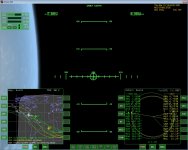
To deactivate the AP, go to the 2D panel view (the one with many buttons to the bottom but not the 3D cockpit view) and keep the down arrow pressed until you can see the buttons in the bottom part. Then see the picture.


Hope this helps!

EDIT: TWO posts before me?! (formatting abuse :))
 
hey yes it does. i new that thing was off but i was messing around with it just to make sure it was indeed off. :thankyou: sir.
 
ok i think i have the deltaglider in space. now if i understand it roght from what the orbit mfd's manual told me trying to get to the space station my apr and per have to match that of the space statio correct in order to get to it? im still doing oms_2burn to get my speed and altitude up. but im pretty sure i got it in orbit. :)

You also have to be in the same plane as the ISS. Deltaglider doesn't have OMS engines.

As I've said to your before, post a screenshot of your Orbit MFD and we can tell you if you are in orbit or in space and going to hit the ground.
 
ok 1 screen shot coming at ya. well im a little higher then the station i think. but im just glad i got it into orbit. :lol:
 

Attachments

  • i think i made it.jpg
    i think i made it.jpg
    288.5 KB · Views: 49
in orbit but you are not at the same plane of the ISS
 
Last edited:
awsome. :thankyou: now if only i can catch up to the space station and dock. lol thats the other hard part. but i hate to touch it now that i git it up there.
 
ok 1 screen shot coming at ya. well im a little higher then the station i think. but im just glad i got it into orbit. :lol:

You are FAR higher than the ISS, also you are behind it, which both is bad - your SMa (Semi-major axis) is bigger, bigger Sma means longer orbit period (T) and that means you fall behind the ISS and it escapes you. You need to end lower than the ISS on the next attempt. Also you are far off plane the ISS (Inclination/Inc and LAN, the longitude of ascending node). For docking, you should be as close to the orbit plane of the ISS (equal Inc and LAN) as possible.

But your periapsis (PeR) is WAY higher than the limits of the atmosphere, so you are in space... orbiting between about 400 km and 1400 km altitude.

if your Sma is smaller than the Sma of the ISS, you can catch up - so try to aim a bit lower next time. The lower you can get actually, above the 250 km minimum altitude, the more fuel you have left for docking.

Sma is the average of PeR and ApR. It is one half of the longest straight line through the orbit ellipse.
 
Last edited:
rocketdued, relax and think that you've just accomplished the easiest among Orbiter's tasks!
:thumbup:
 
oh ok. whats the quickest and easyest way to reduce that. and catch up to the space station? with out loseing my orbit and burning up like a charcoal brick? i know i burned to long i think. but atleast i got into orbit now i just need to fix it up a little

---------- Post added at 05:45 PM ---------- Previous post was at 05:42 PM ----------

:thankyou: ripley. im going to try it again and see if i can get my sma to match that of the space station. i won't burn my engines as long this time.
 
I think that the first to do is to circularizate the orbit then change the inclination and proced to the aproach to iss. Better do another launch
 
oh ok. well im takeing off again for another try. this time how ever i won't burn as long. and i,ll make sure i have a perfect ,atching path with the space station. if not i'll scrap the attempt and try again.
 
oh ok. whats the quickest and easyest way to reduce that. and catch up to the space station? with out loseing my orbit and burning up like a charcoal brick? i know i burned to long i think. but atleast i got into orbit now i just need to fix it up a little

Yes, you have entered space now. ;)

What you should practice now for the beginning, is one of the most basic orbit maneuvers, the Hohmann transfer. You use it for changing PeR and ApR of your orbit in the most fuel effective way.

lets say, you want now into a 300 x 300 km circular orbit from your current orbit.

shortly before you reach Apogee (Ap) (ApT decreasing and between 120 and 150 seconds) you orient retrograde, because as next step, you want to slow down.

Now, you switch DST in orbitMFD so you get read ApA and PeA and wait.

about 10 seconds before passing Apogee (ApT = 10), you fire the main engines until your PeA is a bit higher than 300.0, but not lower. Somewhere between 330 and 310 should be possible for your training. The final corrections are then done by using the forward translation thrusters until you are at 300.0

Now you disable the autopilot again and cruise to perigee (PE). Repeat the process, but replace Ap with Pe. Burn main engines in retrograde direction, until your ApA is less than 320 km. fine tune with RCS.

Forget getting a perfect 300.0 x 300.0 orbit - that is impossible because of sun, moon and Earth. But you can get less than 5 km tolerance.

See here for more information:
https://secure.wikimedia.org/wikipedia/en/wiki/Hohmann_transfer_orbit

 
Last edited:
yes thats how i got into orbit the first time is i hit the progrd and i was able to stay there. but i think i'll wait oin pushing that untill my sma's the sames as the space stations.
 
no sir i havn't not yet. but if i can't get'er this time i'll check it out.
 
ISS rougly orbits at 350 km Alt, so you have to get first to that Alt, too.
Press "DST" on the MFD to change the readout of various parameters ("PeR" changes to "PeA", and so on).

Look at your orbit on the Orbit MFD: the "full" little circle is your Perigee (the lowest point of your orbit), and the "empty" little circle is your Apogee, the highest point of your orbit.
To declutter Orbit MFD a bit you can press "NT" (no target), and then "MOD" until only your orbit is shown, so you can't go wrong.

The principle is that when you are at either Perigee or Apogee (or a little before you reach one of these points), you orient yourself Prograde and burn the engines forward to raise the point on the other "side" of your orbit (at 180° from where you are), or you orient yourself Retrograde and burn the engines forward to lower the point on the other "side" of your orbit.

Also watch "Ecc" (Eccentricity) and try bringing it down to zero.
 
Last edited:
i know another thing i missed. i was watching the numbers for the space station. but the help thing for the mission says kill the thrust at 6.731m i blew past that like a rocket. :lol:
 
Back
Top