Flight Question deltaglider's autopilot.

yes thats how i got into orbit the first time is i hit the progrd and i was able to stay there. but i think i'll wait oin pushing that untill my sma's the sames as the space stations.

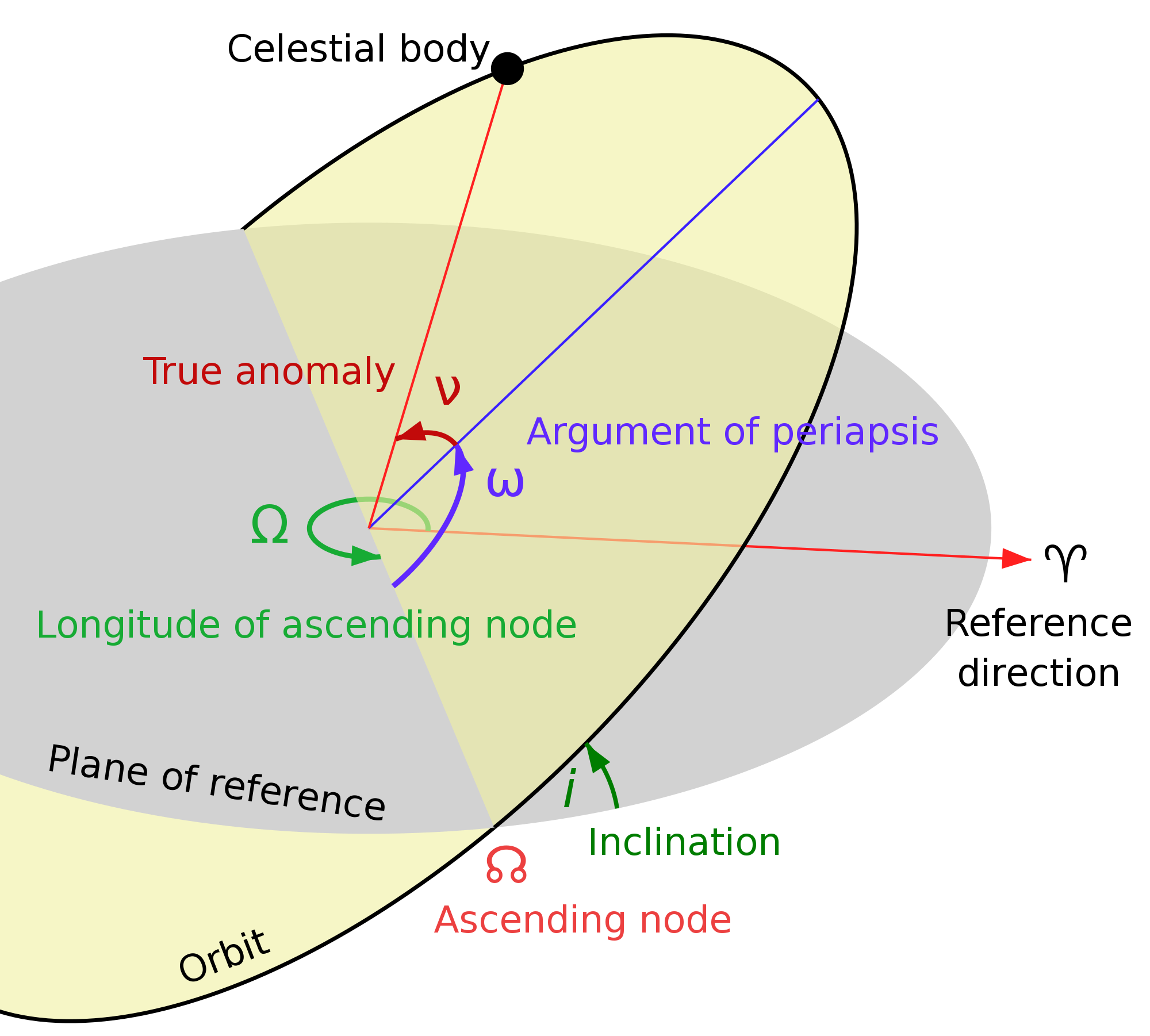
Things don't work like that. Rendezvous is achieved by getting closer in small steps, just Sma alone won't bring you there. Orbits have seven Kepler elements, not just one. and you need to make all seven equal for docking.

https://secure.wikimedia.org/wikipedia/en/wiki/Kepler_orbit

2000px-Orbit1.svg.png
 
ok let me try that. :thankyou: sir

---------- Post added at 06:04 PM ---------- Previous post was at 06:03 PM ----------

:thankyou: i'll try that.

---------- Post added at 06:12 PM ---------- Previous post was at 06:04 PM ----------

ok. right now. my apr is at 6.731. just like it said in the step by step manual for this. so now im waiting to get to the apt point. and i should be ready. cause i have the help menue up while im trying this.
 
yes i did. but im still working on this. and i will till i can get it right the first time every time.
 
And don't rush wanting to dock. It's not easy. Otherwise you'll get frustrated soon again.

Things to be done are:
match your orbit parameters with your target's.
ALIGN PLANES.
SYNC your orbit with ISS's.
DOCK, slowly.
 
Mostly, the biggest first step to come now is to learn to control your orbit. Like being able to select some random orbit parameters and go there as good as possible.

Or bring the Deltaglider into Geostationary orbit, which is also possible.
 
ok. well heres what i have so far. i still don't think im going to make the space station. but im still trying.
 

Attachments

  • i don't think this is right.jpg
    i don't think this is right.jpg
    215.2 KB · Views: 26
ok. well heres what i have so far. i still don't think im going to make the space station. but im still trying.

Yes... your orbit has a tiny bit much of energy. And a bit much eccentricity.

You should learn to circularize it by Hohmann transfers.
 
well i'll continue to keep trying. i was able to get it into space one more time. now i just have to work on my orbits. cause the help page for what im doing says to cut the engines at 6.731m. i did that and must have done it to late cause i blew past.
 
well i'll continue to keep trying. i was able to get it into space one more time. now i just have to work on my orbits. cause the help page for what im doing says to cut the engines at 6.731m. i did that and must have done it to late cause i blew past.

Try to cut when Apoapsis Radius (ApR) is at 6731 km (6.731 Mm or Megameters). at apoapsis, you then increase your orbit energy (SMa) again by firing prograde, until your PeR is near 6731 km as well.

Prograde firing = increase energy and Sma
Retrograde firing = decrease energy and Sma.

Since your current position is ALWAYS part of the new orbit, this means that any change you do affects the opposite side of the orbit. If you are in circular orbit and burn prograde, your apogee will grow on the side opposite of your current position.

And remember the difference between ApR and ApA - ApA is ApR minus the radius of Earth.
 
Last edited:
I recommend Go Play In Space by Bruce Irving; it's an excellent step-by-step tutorial for new pilots that among other things walks you through docking with the ISS. :)
 
I'll try to help you here.

Let's start with the orbit in your latest screenshot. The grey circle is the Earth, the green ellipse is your orbit. It goes too high. So we'll going to make it lower.

Press the mode button until the many parameters appear. Don't be scared of them, you won't need too many. Check out the PeT. That means time to periapsis, how many seconds are left 'till you reach the lowest point in your orbit.

When you get quite close (approximately 200-300 seconds) turn retrograde. The shortcut key is ], or you can use the button on the panel.

Once the ship orients itself to the target, wait until you get close enough to the periapsis so you can make the burn. The more you want to change your orbit, the longer the burn. The longer the burn, the farther away from the periapsis you'll start. This will be quite a long burn, let's start the burn at 20 seconds from periapsis.

When PeT reaches around 20, ignite your engines. Keep them on. You'll see the long, green ellipse becoming more and more like a circle. Keep the engines on until it's quite circular. (By the way, there is one parameter on the Orbit MFD, the Ecc parameter, which tells you how circular the orbit is. The smaller the number, the rounder the orbit. Try to bring it as close to zero as possible.)

Now, if you want to adjust the apoapsis altitude (highest point of your orbit) then watch the ApA parameter. Say you want to bring your apoapsis to 350 km. So you'll put tha ApA at 350 k. It's not that hard, you know :)!

If you don't do it in one burn, don't worry. You'll always come back from the other side!

Hope this helps! If you've got any more questions, don't hesitate to ask!

 
oh ok. that must be what i was doing wrong. cause i was getting to 6.731apr. then fireing prograde. but something was going wrong there to.
 
oh ok. that must be what i was doing wrong. cause i was getting to 6.731apr. then fireing prograde. but something was going wrong there to.

Did you coast to apoapsis before you fired? Remember- the when and where is VERY important in spaceflight. Coast phases are not for cooling the engines.

(In reality, the Space Shuttle main engines for example become so cold right after MECO, that ice forms on them...)
 
ok i will try that tommarow. i have to eat and show and do some other stuffl. i'll try this again tommarow
 
assuming you are in the right plane, the easiest way to approach the station using standard MFDs is to use the "syncOrbit" MFD as lond as you are below the target space station (in this acse, keep ApA and PeA below 350Km and above 200Km)

then just turn prograde and burn untill the DTMin (on the left side) is zero, then just wait as the highlighted orbit line (closest approach) gets to the top, you can also use the diagram.

then use IMFDs "Velocity Match" burn calculator ot do it manually with the docking HUD configured with ISS as the target, aim to reduce your relative velocity to 0 as you get within a few KM away.

then just take it nice and easy, approach the port nice and slow, and dont forget to open the nose cone!
 
Did you coast to apoapsis before you fired? Remember- the when and where is VERY important in spaceflight. Coast phases are not for cooling the engines.

(In reality, the Space Shuttle main engines for example become so cold right after MECO, that ice forms on them...)
Actually that ice is formed right at ignition as result of the hydrogen cooling the nozzle. I have seen it several times and post-MECO with all the thruster activity some of the nozzle ice breaks free.
 
Actually that ice is formed right at ignition as result of the hydrogen cooling the nozzle. I have seen it several times and post-MECO with all the thruster activity some of the nozzle ice breaks free.

AFAIK, the post-MECO ice is formed by the hydrogen flowing through the engine for some fractions of a second after the MOV closed and the combustion stopped.

I am not 100% sure on that, but on 104% RPL the outside temperature of the nozzle heat exchanger should be above zero, since the heat exchanger has not over 80% effectivity. But I would need to look at the engine simulation model for that.
 
ok. umm at what altitude should i begin coasting to apoapsis. now i know this sounds like im still trying to get into to space but i think i can get that part. im just trying to fine tune an orbit now.
 
Back
Top