Entering into orbit around a Callisto using the Oberth Effect (revisited)

Keithth G

New member
Joined
Nov 20, 2014
Messages
272
Reaction score
0
Points
0
For those that have watched David Courtney's Orbiter videos, you will undoubtedly seen his him debate whether or not to take advantage of the Oberth Effect in approaching the Galilean moons - Io, Europa, Ganymede and Callisto. His original premise was that the Oberth Effect was probably a 'good thing' and would allow him to enter a circular orbit about a target moons with less 'delta-v' than a more direct approach where one simply targets the relevant moon and, at moon periapsis, executes a retrograde burn to circularise the orbit about the moon.

In this context, application of the Oberth Effect means a slingshot-like manoeuvre close to Jovian surface where, at periapsis, a breaking burn is executed so as to set the new orbital apoapsis to the orbital radius of the target moon. If the timing (and plane alignment) is right, one could then rendezvous with the target moon and enter a circular orbit. David identified (after consultation) that, for the Jovian moons at least, approaching the Galilean Moons using the Oberth Effect was more costly than a direct approach.

Having thought about this, I believe that there is a way of using the Oberth Effect to reduce delta-v requirements for approaching the Galilean moons. Whereas, the direct moon approach can be regarded as a 1-burn solution (a moon-centric retrograde burn to directly enter circular orbit about that moon) and David's use of the Oberth Effect can be regarded as 2-burn solution (one at Jovian periapsis, and a second at the target moon to enter a circular orbit) there is a 3-burn solution that is cheaper than both the 1-burn and the 2-burn approaches.

In this note, I will focus on Callisto, the outermost of the four Galilean moons. As an addition to this post, I will preset the maths behind it along with a small spreadsheet which people can use if they so wish to identify the optimal strategy.

The 1-burn and 2-burn solutions
First, it is worth noting that if one works through the algebra, one can show that if a spacecraft approaches the Jovian system with a hyperbolic excess speed of less than 11.87 km/s, it is always preferable to enter into a circular orbit around Callisto directly using the 1-burn solution rather than resorting to the 2-burn solution. Since 11.87 km/s is a generally high approach speed for the Jovian system, this would seem to rule out the Oberth Effect as a practical tool for approaching the Jovian moons in most cases. However, it is reasonable to ask the question: is there a 3-burn solution that works better than both the 1-burn solution and 2-burn solution. The answer to that question is: yes, I believe there is.

The 3-burn solution
The general concept of the 3-burn solution is to apply a retrograde burn at Jovian periapsis so that the the spacecraft is 'captured' by Jupiter but rather than setting the apoapsis to the orbital radius of the target Moon (as in the 2-burn case), one sets it to a value that is much higher than that. So, after the first burn, the spacecraft enters a highly eccentric elliptical orbit about Jupiter. At the apoapsis of that eccentric orbit, one that applies a second and prograde burn to raise the orbital periapsis to the orbital radius of the target Moon. Assuming that we are in plane with the target Moon and that we have our timing right, our arrival at periapsis can be made to coincide with the passage of the moon through the same point. At rendezvous with the Moon, we then apply a third and retrograde burn to enter a circular orbit about the Moon. As it turns out, in terms of delta-v at least, this is generally the preferred strategy.

An example
As an example, consider the case where the target moon is Callisto and where the spacecraft approaches the Jovian system with a hyperbolic excess velocity of 6,500 m/s and approaches Jupiter with a periapsis radius of 71,000 km - i.e., just above the Jovian cloud deck. Assume that some plane alignment has been done prior to arrival at Jupiter so that the spacecraft is in plane with Callisto. And finally, for simplicity, assume that Callisto moves in a circular orbit around Jupiter at a radius of 1,882,700 km.

As the craft approaches Jupiter periapsis, and because it isfalling into the Jovian gravity well, its speed relative to Jupiter increases to 60,091 m/s. At Jupiter periapsis, the craft executes a retrograde burn of 459 m/s so that its speed is lowered to 59,632 m/s. This small reduction in speed is sufficient to achieve Jupiter 'capture' and to set the orbital apoapsis to a target (and somewhat arbitrary) 20,000,000 km - i.e., about 11 times the orbital radius of Callisto.

As the craft arrives at orbital apoapsis, it executes a prograde burn of 832 m/s. This raises the periapsis with respect to Jupiter to Callisto's orbital radius of 1,882,700 km. (We assume at that the timing of the burn is set to ensure that spacecrafts arrival at Jovian periapsis coincides with Callisto's passage through the same point.)

As the craft returns to Jovian periapsis (but before the spacecraft enters the sphere of influence of Callisto) the speed of the craft with respect to Jupiter has increased to 11,091 m/s. Callisto is nearby and orbits with a speed of 8,203 m/s. So, with respect to Callisto, the craft now has a hyperbolic excess velocity of 2,888 m/s.

The craft now makes minor course adjustments ensure a Callisto passage periapsis of, say, 20 km above its surface. At Callisto periapsis, the speed of the craft relative to Callisto increases to 3,849 m/s. At periapsis, a third and retrograde burn of 2,049 m/s puts it in a circular orbit around Callisto with an orbital speed of 1,799 m/s.

If we sum across the three burns, we find that the total delta-v requirement for these three manoeuvres is 459 m/s + 832 m/s + 2,049 m/s = 3,340 m/s.

Comparison with the 1-burn solution
OK, so how does this compare with the direct 1-burn solution? We again assume that the spacecraft approaches Jupiter with a hyperbolic excess velocity of 6,500 m/s. It is in plane with Callisto and minor deep space adjustments have set the Jovian periapsis to Callisto's orbital radius of 1,882,700 km. In addition, the crafts arrival at periapsis is timed to match the arrival of Callisto through the same point.

As the craft approaches Jovian periapsis, its speed with respect to Jupiter increases from 6,500 m/s to 13,298 m/s. Callisto lies slightly ahead of the craft and is orbiting Jupiter at 8,203 m/s. As the craft enters Callisto's sphere of influence its velocity relative to Callisto is 5,095 m/s. Again, minor course adjustments set the Callisto orbital periapsis to 20 km above its surface. At Callisto periapsis, the speed of the craft increases to 5,695 m/s. The craft applies a breaking burn of 3,896 m/s and enters a circular orbit with an orbital speed of 1,799 m/s - the same as the 3-burn solution.

In this case, the 1-burn solution 'costs' 3,896 m/s. The 3-burn solution, however, costs just 3,340 m/s - i.e., a delta-v saving of 555 m/s. In this case, application of the Oberth effect has reduced overall fuel requirements. And as the hyperbolic excess velocity increases to, say, 11.87 km/s (the break-even point between the 1-burn and 2-burn solutions), the delta-v savings of the 3-burn solution increase to 2,817 m/s - not an inconsiderable saving.


The downside
Generally speaking, it is always possible to find a 3-burn solution that is cheaper than both the 1-burn and 2-burn solutions. However, this solution may require that one executes a retrograde burn at Jovian periapsis that throws the craft a very, very long way from Jupiter. The cost of this is the additional time taken to achieve orbit about Callisto which may be substantial.

In the example given above, the time of flight from the first burn at Jovian periapsis to final rendezvous with Callisto is 1.70 years (yes, years). Although the 3-burn solution does present a significant delta-v saving of 555 m/s, this comes at the cost of adding an additional 20 months to the journey. Application of this effect is, therefore limited by the amount of time that one is willing to wait to realise those gains. For manned missions, it is unlikely to be the case that the 3-burn solution will offer an attractive option. But for unmanned missions, the trade-off is more finely balanced.

Moreover, in being thrown along way from Jupiter, the craft is likely to become subject to a number or perturbations. Although these perturbations may not add much delta-v 'cost', in orbital planning significant care will be needed to take account of them.

(In an adjunct to this post, I will post the associated algebra.)
 
Last edited:
Thanks for starting this thread Keithth G. There are a lot of misconceptions about the "arrival at a moon" problem, the only way to clear them up is to actually do the math.

The exact same thing applies also to the "departure from a moon" problem, were you can also choose from 3 different strategies (single, double or triple burn departure), each with its own upsides and downsides.

I already have a spreadsheet set up for all the moons in the solar system showing the delta-v requirements for all 3 methods, given the hyperbolic excess velocity relative to the "parent" planet and some additional info (R.Inc to the moon, parking orbit alt, etc). The problem is that it's not so user friendly, I need to do some cleaning before I can share, but it's yours if you want to use it.

I think this post should be moved to the "Tutorials and Challenges" part of the forum, with the addition of the math, spreadsheet and a few practise scenarios, using the default DG. Or perhaps even an Orbiter addon.

I had done some of the footwork a few months back, but never got around to finish it. I am attaching below what I have so far, feel free to use it if you want. (the 3 burns solution is just a drawing for now).
 

Attachments

The SOI of the Jovian moons is really small.

The issue that I have seen is that with some craft you do not have time to make a 2km/s breaking burn without leaving the moon's SOI first.

That is one reason why I prefer the two-burn method. It is "elegant" and it keeps the burn in the moon's SOI as short as possible, usually around 800m/s or so. May cost more delta-V, but you are less likely to have any unpleasant surprises. Missing the moon and having to go around again will cost a lot of delta-V and time.
 
And now for the maths behind the 3-burn solution.

At the outset, I should point out that the equations employed here rely heavily upon 2-body physics. Real planetary bodies are n-body systems and perturbations will have an impact on the calculations. Nonetheless, as with TransX, the 2-body approximation provides a good 'first estimate' of total delta-v requirements for a series of manoeuvres. It will be close estimate - but not exact.

Suppose that a craft is approaching the Jovian system with a hyperbolic excess velocity of [MATH]v_\infty[/MATH]. This is the velocity with which the craft would pass through the Jovian system if the gravitational field of Jupiter (and its moons) were magically removed. TransX reports this as the 'encounter velocity' and IMFD as the 'iV'.

Suppose that in the approach to Jupiter, the craft targets a periapsis radius about Jupiter of [MATH]r_0[/MATH]. Then, the speed of the craft at periapsis, [MATH]v_0[/MATH], is given by the expression:

[MATH]v_0=\sqrt{2\,\frac{\mu _J}{r_0}+v_{\infty }^2}[/MATH]

where [MATH]\mu_J = 126686534\,km^3 s^{-2}[/MATH] is the gravitational parameter for Jupiter. So with a hyperbolic excess velocity of [MATH]v_\infty =6.5\,km/s[/MATH] and a periapsis radius of [MATH]71000\,km[/MATH], the speed at periapsis is [MATH]60.091\,kms/s[/MATH].

Now, at periapsis we wish to execute a retrograde burn to target some apoapsis altitude of [MATH]r_1>r_0[/MATH]. We can readily show that for an elliptical orbit with a periapsis radius of [MATH]r_0[/MATH] and apoapsis radius of [MATH]r_1[/MATH], the speeds at periapsis, [MATH]v_p[/MATH], is given by:

[MATH]v_p = \sqrt{2\,\frac{r_1 \,\mu _J}{r_0 \left(r_0+r_1\right)}}[/MATH]

So, if our periapsis radius is 71000 km and our target apoapsis is, say, 20,000,000 km, we calculate that we need to reduce our speed at periapsis to [MATH]v_p = 59.632 \, km/s[/MATH].

This means that our first burn, [MATH]\Delta v_1[/MATH], a retrograde burn at first Jovian periapsis is just the difference between [MATH]v_0[/MATH] and [MATH]v_p[/MATH], i.e.,

[MATH]\Delta v_1 = v_0 - v_p = \sqrt{2\,\frac{\mu _J}{r_0}+v_{\infty }^2} - \sqrt{2\,\frac{r_1 \,\mu _J}{r_0 \left(r_0+r_1\right)}}[/MATH]

The second burn occurs at apoapsis of the new orbit resulting from the first burn. The goal of the second burn is to raise the periapsis altitude to the orbital radius, [MATH]r_m[/MATH] of the target moon - in this case, Calisto. Here, we shall assume that the target moon moves in a circular orbit about Jupiter. (Nuances of elliptical motion we shall ignore on grounds that this is 'one complication too far'.)

As the craft approaches apoapsis, its speed falls to [MATH]v_a[/MATH] and is given by the expression:

[MATH]v_a = \sqrt{2\,\frac{r_0 \,\mu _J}{r_1 \left(r_0+r_1\right)}}[/MATH]

For our example, at Jovian apoapsis - when it is 20,000,000 km away from Jupiter, this has the craft's speed falling to just 212 m/s. At apoapsis, we now wish to execute a second (and now prograde) burn to raise the orbital periapsis from [MATH]r_p[/MATH] to the orbital radius of the target moon, [MATH]r_m[/MATH]. To do this requires that we increase our speed at apoapsis to [MATH]v_a'[/MATH] such that:

[MATH]v_a' = \sqrt{2\,\frac{r_m \,\mu _J}{r_1 \left(r_m+r_1\right)}}[/MATH]

Now, Callisto's mean orbital radius about Jupiter is 1,882,700 km. This means that we need to increase our apoapsis speed from 212 m/s to 1044 m/s. So, the magnitude of our second burn, [MATH]\Delta v_2[/MATH], must be the difference of these two speeds and, in general, is given by the expression:

[MATH]\Delta v_2 = v_a' - v_a = \sqrt{2\,\frac{r_m \,\mu _J}{r_1 \left(r_m+r_1\right)}} - \sqrt{2\,\frac{r_0 \,\mu _J}{r_1 \left(r_0+r_1\right)}}[/MATH]

For our example, this works out to be 832 m/s.

Following this second burn, the craft is allowed to fall to Jupiter periapsis. This is carefully times to coincide with the target moon's arrival at the same point. In general, this timing should not be hard to achieve. Minor adjustments to target apoapsis, for example, will have a large change in the time of second Jovian periapsis arrival time - but not affect the preceding calculations by much.

If we ignore Callisto for the moment, the speed of the craft at second Jovian periapsis passage, [MATH]v_p'[/MATH] is given by the expression:

[MATH]v_p' = \sqrt{2\,\frac{r_1 \,\mu _J}{r_m \left(r_m+r_1\right)}}[/MATH]

For our example, we calculate that the second periapsis speed is 11.091 km/s. However, Callisto orbits at [MATH]v_c=\sqrt{\frac{\mu _J}{r_m}} = 8.203 \,km/s[/MATH]. So, at second periapsis passage, the craft's velocity relative to Callisto is 2.888 km/s. Although the craft is 'captured' by Jupiter, we can nonetheless think of this speed difference as a hyperbolic excess velocity of the craft relative to the target moon - in this case, Callisto. So, we can define a new hyperbolic excess velocity at second periapsis passage, [MATH]v_\infty'[/MATH], such that:

[MATH]v_\infty'= v_p' - v_c = \sqrt{2\,\frac{r_1 \,\mu _J}{r_m \left(r_m+r_1\right)}} - \sqrt{\frac{\mu _J}{r_m}}[/MATH]

Let's suppose that in its rendezvous with Callisto the craft makes some minor course adjustments so that it achieves a periapsis altitude of [MATH]\delta r[/MATH] above the surface of the target moon, Callisto. At Callisto periapsis, the speed of the craft has increased to [MATH]v_{m,p}[/MATH] such that:

[MATH]v_{m,p} = \sqrt{\frac{2 \mu _m}{\text{$\delta $r}+R}+\left(v_{\infty }'\right){}^2}[/MATH]

where [MATH]R[/MATH] is the radius of the target moon; and [MATH]\mu_m[/MATH] is the gravitational parameter for the target moon. In the case of Callisto, we set [MATH]R = 2410\,km[/MATH] and the target altitude above the moon's surface to [MATH]20\,km[/MATH]. According to Wikipedia (an impeccable source), the Callisto's mass is [MATH]1/17649[/MATH] of Jupiter so that we can set:

[MATH]\mu_m = \mu_J / 17649[/MATH]

with these values, we calculate that the speed of the craft at Caliisto periapsis is 3.774 km/s. But to have a circular orbit about Callisto requires that the orbital speed be just [MATH]\sqrt{\frac{\mu _m}{\delta r+R}} = 1.719 km/s[/MATH]. To achieve this circular orbit, we now require a third Callisto-centric retrograde burn of magnitude [MATH]\Delta v_3[/MATH] such that:

[MATH]\Delta v_3 = \sqrt{\frac{2 \mu _m}{\text{$\delta $r}+R}+\left(v_{\infty }'\right){}^2} - \sqrt{\frac{\mu _m}{\delta r+R}}[/MATH]

For our Callisto example, this means that we need to execute a retrograde burn at Callisto periapsis of 2.055 km/s.

Overall, the 3-burn solution thus yields a total delta-v requirement of:

[MATH]\Delta v_{tot} = \Delta v_1 + \Delta v_2 + \Delta v_3 = 3.346 \,km/s[/MATH]

For, the 1-burn solution, one can show that the delta_v requirement here is given by the expression:

[MATH]\Delta v_{tot}' = \sqrt{\left(\sqrt{\frac{2 \mu _J}{r_m}+v_{\infty }^2}-\sqrt{\frac{\mu _J}{r_m}}\right){}^2+\frac{2 \mu _m}{\delta r+R}}-\sqrt{\frac{\mu _m}{\delta r+R}} = 3.926 \, km/s[/MATH]

In other words, we have achieved a delta-v saving of 580 m/s - a not inconsiderable amount.
 
Last edited:
I haven't done the math, but I don't think plane alignment with the target moon prior to arrival at the planet is a safe assumption, nor is it even necessary.

If you time things such that you will intercept the target moon after burn 2, then it doesn't matter what the moon's plane is. The only thing that matters is that you cross the moon's plane when the moon is there.

This may alter the delta-V required for burn 3 somewhat, but that may be cheaper than burning propellant to align planes. Off the top of my head I don't see how it would affect the delta-V, though.

If you wish to enter orbit around the moon with a specific inclination, say to reach a particular landing site or whatever, that presents a further problem which will affect your approach strategy for burn 3. This seems to be beyond the scope of what you're discussing here, but it should be mentioned if you are reaching for a higher target inclination, a misaligned intercept plane probably works in your favor.
 
To further illustrate the potential delta-v savings (relative to the direct, 1-burn solution) attributable to a 3-burn solution for a Callisto approach, here is a small table of delta-v savings for: various target Jovian apoapsis radii; and various values of the Jovian hyperbolic excess velocity.


1. Hyperbolic excess velocity = 7.5 km/s

[MATH]
\begin{array}{cc}
\text{Apoapsis radius (m km)} & \text{delta-v saving (m/s)} \\
20 & 933 \\
25 & 1039 \\
30 & 1110 \\
35 & 1161 \\
40 & 1199 \\
45 & 1229 \\
50 & 1253 \\
\infty & 1469 \\
\end{array}
[/MATH]


2. Hyperbolic excess velocity = 6.5 km/s

[MATH]
\begin{array}{cc}
\text{Apoapsis radius (m km)} & \text{delta-v saving (m/s)} \\
20 & 580 \\
25 & 686 \\
30 & 757 \\
35 & 807 \\
40 & 845 \\
45 & 875 \\
50 & 899 \\
\infty & 1115 \\
\end{array}
[/MATH]


3. Hyperbolic excess velocity = 5.5 km/s

[MATH]
\begin{array}{cc}
\text{Apoapsis radius (m km)} & \text{delta-v saving (m/s)} \\
20 & 269 \\
25 & 375 \\
30 & 446 \\
35 & 497 \\
40 & 535 \\
45 & 564 \\
50 & 588 \\
\infty & 804 \\
\end{array}
[/MATH]


4. Hyperbolic excess velocity = 4.5 km/s

[MATH]
\begin{array}{cc}
\text{Apoapsis radius (m km)} & \text{delta-v saving (m/s)} \\
20 & 6 \\
25 & 112 \\
30 & 182 \\
35 & 233 \\
40 & 271 \\
45 & 301 \\
50 & 325 \\
\infty & 540 \\
\end{array}
[/MATH]


(For other moons and planetary systems, there is no alternative I'm afraid other than simply work through the maths to calculate the potential savings of cost.)
 
Last edited:
Just to add to previous notes on this topic, a couple of points:

1. Node alignment
Before arrival at the parent planet (in this case Jupiter), it is necessary to adjust one's approach trajectory so that periapsis lies (more or less) on the line of nodes of the orbital plane of the approach trajectory and the target moon.

In TransX, the line of nodes (the white line) should more or less bisect the approach and departure arms of the hyperbolic approach trajectory - see figure below:


This manoeuvre ensures that after the initial low altitude "Oberth Effect" breaking burn around Jupiter, the apoapsis of the resulting elliptical trajectory also places through the line of nodes. At apoapsis, the craft's speed is low and so it is a good time to execute a plane change manoeuvre to align the craft's orbital plane with that of the target moon (in this case, Callisto). Having aligned planes in this fashion, the final encounter velocity is an 'in plane' encounter with the target moon - again, at a point that lies on the line of nodes.


2. Calculating [MATH]v_\infty[/MATH]
The mathematics of earlier posts in this thread have used a quantity called [MATH]v_\infty[/MATH] - the so-called hyperbolic excess velocity. Although the concept of what this is should be reasonably clear - i.e., the speed of the craft when it is a long way from the parent planet how does one calculate it for a real inbound hyperbolic trajectory?

Well, the hyperbolic excess velocity is given by the expression:

[MATH]v_\infty = \sqrt{-\frac{\mu_J }{a}}[/MATH]

where [MATH]a<0[/MATH] is the semi-major axis of the inbound hyperbolic orbit and, again, [MATH]\mu_J = 126686534\,km^3 s^{-2}[/MATH] is Jupiter's gravitational constant. The value of the semi-major axis can be obtained by looking at the output of the Orbit MFD which shows the value of the semi-major axis as one of its standard display parameters. When using this method, it is best to get the value of [MATH]a[/MATH] from Orbit MFD when one is close to periapsis to avoid n-body perturbations disturbing Orbit MFD's 2-body calculations.

As an example, here is a screen shot of Orbit MFD for an inbound hyperbolic trajectory around Jupiter.


In the screen shot, periapsis is 833 seconds a way and the semi-major axis is reported as [MATH]-3,450,000\,km[/MATH]. Using the above equation, we calculate that the hyperbolic excess velocity, [MATH]v_\infty[/MATH], is 6.060 km/s. This value should be used in the ensuing calculations. As a case in point, for the first burn at periapsis, we use the expression:

[math]
\Delta v_1 = v_0 - v_p = \sqrt{2\,\frac{\mu _J}{r_0}+v_{\infty }^2} - \sqrt{2\,\frac{r_1 \,\mu _J}{r_0 \left(r_0+r_1\right)}}
[/math]

to calculate the delta-v of the retrograde burn. From the Orbit MFD screen shot, we note that periapsis radius is 80,170 km and so we find that the we need a retrograde burn of 415.6 m/s if we are targeting an apoapsis of 25 million km.


3. Duration of flight
In previous posts, I have neglected to show how to calculate the duration of the flight from the first periapsis retrograde burn to the encounter with the target moon at second periapsis passage. Using the notation of earlier posts, the time of flight is:

[MATH]\Delta T = 0.0000128556 (\sqrt{\frac{\left(r_0+r_1\right){}^3}{\mu _J}} + \sqrt{\frac{\left(r_0+r_1\right){}^3}{\mu _J}})\, days[/MATH]

For the example given in the preceding screen shots, with a target apoapsis of 25 million km, the time of flight is 302.7 days. If the target apoapsis is reduced to a more reasonable 10 million km, the time of flight is reduced to 83.4 days.

4. Plane alignment at apoapsis.
As mentioned earlier, probably the best time to perform a plane alignment manoeuvre with Callisto is at orbital apoapsis. The speed of the craft at this point is:

[math]
v_a = \sqrt{2\,\frac{r_0 \,\mu _J}{r_1 \left(r_0+r_1\right)}}
[/math]

so that if one has correctly aligned nodes prior to Jupiter approach in the first place, the delta-v cost of performing the plane alignment manoeuvre is:

[MATH]\Delta v_{plane} = 2\,v_a\,\sin \left(\frac{\iota }{2}\right)[/MATH]

where [MATH]\iota[/MATH] is the relative inclination of the craft's orbital plane with that of the target moon. This value can be obtained by using the Align Planes MFD. If, say, the relative inclination at apoapsis is 25 degrees, and at an apoapsis radius of 25 million km, the delta-v requirement for achieving plane alignment with the target moon is 78 m/s. If the apoapsis radius is lower at, say, 10 million km, the plane alignment cost increases to 194 m/s.


4. Practical measures
Although the equations in these notes are correct for pure 2-body physics, perturbations can (and will) significantly affect calculations if the apoapsis radius approaches or exceeds the radius of the parent planet's SOI. Although there are real delta-v gains to be had by throwing the craft into a very high elliptical orbit around the parent planet, in practice these gains will be earned at a substantial increase in the time of flight and at the cost of numerous corse corrections that will be needed to counter the effect of n-body perturbations. In practice, targeting an apoapsis radius of around half the SOI radius of the parent planet is probably reasonable - given the inaccuracies of Orbiter's current suite of trajectory planning tools.
 
Last edited:
One thing that I'd like to add here, is that the plane alignment burn can be combined with the second burn at apoapsis ([math] \Delta v_2[/math] in the example of post #4), in order to minimize the ΔV required.

The ΔV for the combined burn is given by
[math]\Delta v_2' = \sqrt{V_i^2+V_f²^2-2 V_i V_f cos\iota}[/math]
where
[math]\Delta v_2'[/math]= combined burn delta-v
[math]V_i[/math]= initial velocity
[math]V_f[/math]= final velocity
[math]\iota[/math]= relative inclination

Using the numbers from the example of post #4 (Vi = 212 m/s , Vf = 1044 m/s) and a R.Inc = ι = 25° (post #7) we have:
[math]\Delta v_2' = \sqrt{V_i^2+V_f^2-2 V_i V_f cos\iota} = [/math]
[math]\Delta v_2' = \sqrt{212^2+1044^2-2 \cdot 212\cdot 1044\cdot cos(25^{o})} = 856.56 \; \; m/s [/math]

If done separately we'd have:
[math]\Delta v_{plane} = 2\,v_a\,\sin \left(\frac{\iota }{2}\right)=[/math]
[math]\Delta v_{plane} = 2\cdot 212\cdot \sin \left(\frac{25^o }{2}\right)= 91.77 \;\; m/s[/math] for the plane alignment and
[math]
\Delta v_2 = v_a' - v_a = 1044 - 212 = 832 \; m/s[/math] for the second burn, raising the perijove.
832+91.77 = 923.77 m/s

For this example, we get the plane alignment for only 24.56 m/s additional Δv if we combine it, instead of 91.77 m/s if we do it separately.

As for the angle θ relative to the prograde direction which we have to point the spacecraft, we can calculate it with:
[math]\theta=acos\left(\frac{\Delta v_2'^2+V_f^2-V_i^2}{2 \Delta v_2' V_f}\right)+\iota=[/math]

[math]\theta=acos\left(\frac{856.56^2+1044^2-212^2}{2 \cdot 856.56 \cdot 1044}\right)+25^{o}= 6+25 = 31^{o} [/math]
We'd need to point the spacecraft 31° "above" or "below" the prograde direction and burn 856.56 m/s, depending on whether the apojove is at a descending or ascending node respectively. By the end of the burn, we will have our planes aligned and the perijove at the desired distance.
 
Having had the opportunity now to play around with the 'three burn' technique for rendezvous with a target moon, it has become clear that - in its straightforward implementation, at least - the full benefit of the delta-v gains of the manoeuvre can only be realised if the vessel is thrown into a highly elliptical trajectory following the retrograde burn at first perijove passage.

As mentioned in previous posts, the practical limitation of this technique is that one must:

1. limit the eccentricity of the orbit so as to stay within the string SOI of the parent planet; and

2. limit the time taken to implement the rendezvous strategy - if only to avoid sheer boredom.

The question needs to be asked, though, is if this technique is combined with others, can one do better? Or, to put it more simply: can one both have one's cake and eat it?

I suspect that the answer to this question is yes: one can avoid throwing the vessel into such a high elliptical orbit if one also includes one or more 'braking encounters' with the target moon (after first perijove passage and before final orbital insertion). The principle of these braking encounters is to shift the task of delta-v minimisation away from relying entirely on the Oberth effect to one that also uses braking encounters with the target moon in order to shed kinetic energy prior to final orbit insertion.

Of course, as if the three burn solution were not intricate enough, coordinating an even longer sequence of manoeuvres is tough. I still have to work through the mathematical details, but I suspect that the overall moon insertion strategy will provide a workable, robust and low delta-v solution for rendezvous with a target moon - at least for those missions that are delta-v constrained. (In the real world, of course, all missions are highly delta-v constrained.) The overall process, however, will never be simple.
 
Last edited:
Just as short adjunct to this thread:

Earlier, I mused that even greater delta-v efficiency can be obtained if one incorporates a series of ballistic 'braking encounters' with the target moon (e.g., Callisto). I've now tested this idea by working through the maths and taking the resulting ideas for a 'test drive'.

The conclusion is a resounding, yes: ballistic braking encounters do work. However, implementation requires a careful choreography in space and time. In due course, I will write up my notes on this (if only to serve as record of my own thoughts) but a couple of key points immediately emerge:

1. The amount of kinetic energy transferred from the spacecraft to the planet in each encounter is a strong function of the approach speed of the spacecraft relative to the target moon. If the approach speed is too high, very little kinetic energy is transferred; and if the approach speed is too low, then again, very little energy is transferred. For an encounter with Callisto, the optimal approach speed (relative to the moon) is around 1.5 km/s when about 15-20% of the craft's total kinetic energy is transferred to the moon. If the approach speed increases to, say, 3.0 km/s then there is almost no kinetic energy transfer.

2. This low energy transfer efficiency for high speed encounters means that if the initial retrograde burn around Jupiter throws the craft into a very high elliptical orbit, the resulting initial encounter speeds with the target moon, Callisto, are sufficiently high so as to 'shut off' access these braking encounters as an efficient means for reducing delta-v. If braking encounters are thrown into the mix, then a good trade-off between efficiency and time is achieved by throwing the craft into an initial orbit around Jupiter with an apojove of around 12.5 to 17.5 million km - or roughly 6.5 to 9.5 times Callisto's orbital radius. If the initial apojove is 17.5 km, then subsequent encounters with Callisto lower the spacecraft's speed by between 300 m/s and 700 m/s with each passage - depending on both the approach speed and the periapsis radius. It doesn't take many encounters to significantly reduce the craft's speed of approach to Callisto before final orbit insertion.

3. Coordinating these encounters is tricky: timing is everything. Because none of the standard MFDs perform the necessary calculations, and because I can't do them in my head, I've written a small spreadsheet which works out when (and where) the next encounter with the moon will occur. If one doesn't get the timing right, large delta-v course corrections are required after each encounter and before the next. If one does get the timing right, then course corrections add around 30 - 50 m/s of delta-v requirements following each encounter. To adjust the timing, one has only one free variable to play with: the periapsis radius of each passage. The purpose of the spreadsheet, then, is to calculate the optimal periapsis radius for each encounter.

Overall, I was quite pleased with the practical implementation of the mechanism. To be sure, the process is not straightforward - and if one has vessels with very large, powerful engines with a corresponding abundance of fuel, then no-one in their right mind would want to engage in such mathematical sophistry. However, real spacecraft are puny things - as a rule vastly under-powered and under-fueled for the tasks that they are built to perform.

---------- Post added at 03:14 PM ---------- Previous post was at 02:44 AM ----------

Since words and equations often obscure rather than clarify, here is a simple graphic that sketches the basic principle of the 'three burn' orbit insertion method.

picture.php
 
Last edited:
Hi RGClark

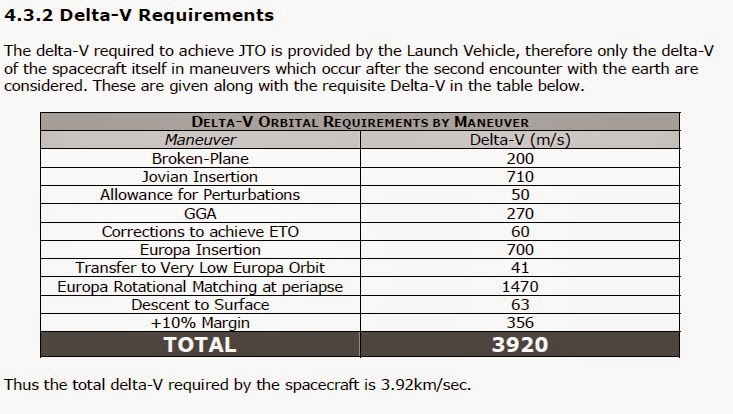
The table that you have shared is for what appears to be a fairly complicated orbital insertion / landing on Europa. Having glanced through the appendix to the linked report, it seems that the approach for entering a low orbit around Europa is:

1. From Earth - drop down to Venus for an accelerating 'gravity assist' slingshot to Jupiter.

2. Upon arrival at the Jovian system, use a a retrograde braking manoeuvre to achieve capture in the Jovian system.

3. Then, use a long, long series - in the figure at the back of the pdf, about seven - of 'braking' gravitational assists around Ganymede to slow the craft down to the point where, it can finally drop down to Europa's orbit.

4. Then, when finally it encounters Europa, a staged series of retrograde burns to enter into low Europa orbit.

This protracted, and laborious sequence has to be undertaken because the direct 'fly to Europa and then stop' strategy is far too expensive in delta-v terms. It is also a lot more complicated than the three-burn strategy that has been the theme of the thread. Nonetheless, I'll run the numbers through the equations and see what the three burn solution on a flight direct from Earth to Jupiter might 'cost'.
 
Last edited:
...OK, here are my numbers for Europa:

Assuming that I haven't made a mistake and that the craft approaches the Jovian system with an excess hyperbolic velocity of 6.05 km/s (as per the Callisto examples given in earlier posts), then:

1. For the standard 1-burn approach to Europa - i.e., approach Europa then applies a single retrograde burn at Europa to enter into a low, 20 km x 20 km orbit - I calculate that the required retrograde burn would be a substantial 6.92 km/s.

2. For the 3-burn solution, and targeting an apojove radius of 17.5 million km, the total cost of Europa orbit insertion would be a comparatively low 5.19 km/s - 1.73 km/s cheaper than the 1-burn approach. This consists of a 0.43 km/s retrograde burn at first periapsis passage around; a 0.67 km/s prograde at apoapsis; and third and final 2.96 km/s retrograde burn to enter into orbit around Europa.

Now, for the Europa mission that RGClark refers to in his post, after stripping out items that clearly do not represent a like-for-like comparison with the 1-burn and 3-burn methods, I estimate the total dV cost is around 3.25 km/s - i.e., roughly 1.94 km/s less than the 3-burn solution.

Why the difference? Primarily the protracted sequence of seven or so ballistic breaking encounters with Ganymede prior to orbit insertion at Europa - or roughly 0.28 km/s per encounter with Ganymede.

Thanks for that calculation. But a likely mission would probably use a Hohmann transfer orbit to get to Jupiter. What would be the delta-v then?

Bob Clark
 
i, RGClark

To tray and answer your question, let's go back to the table that you posted.

The first entry in that table occurs after the "second encounter with Earth". So, by this time, the craft has obtained all of the energy that it needs to reach Jupiter.

The first three manoeuvres in the table are, then:

1. "Brokem-Plane" - which I take to be a plane change to align the craft with Jupiter's orbital plane prior to second Earth enocunter;

2. "Jovian Insertion" - which I take to be a retrograde burn at Ganymede periapsis to achieve capture in Jupiter's gravity well; and

3. "Allowance for perturbations" - which I take to be the 'usual' cost of a series of mid course corrections so as to precisely align the transfer trajectory with rendezvous with Ganymede.

It also follows that what is not included in the table are the mission delta-V costs is a series of delta-V expensive manoeuvres - primarily launch into Low Earth Orbit and escape from Earth. My guess is that these manoeuvres are carried out by some suitable launch system and not part of the delta-V budget of the craft that eventually makes its way to Jupiter.

In truth, I don't know much about the "EVGA" (Earth-Venus Gravity Assist) technique, but it looks as if it includes one gravity assist 'kick' at Venus encounter; and then a second gravity assist 'kick' at second Earth encounter before entering a trans-Jupiter trajectory. I doubt that it is straightforward to understand this process entirely in terms of Hohmann transfers. This is not to say that one cannot work out the total delta-v cost of the Earth-Venus-Earth part of the mission - merely that I can't readily calculate it and would have to expend some considerable effort to try and understand what these manoeuvres require. What I can say, though, is that the once the launch system has injected the craft into an escape trajectory from Earth, the craft (net of the launch system) is on a largely ballistic trajectory (i.e., no delta-V expensive burns) until it reaches Jupiter - aside, that is, from a relatively low-cost (~200 m/s) plane change manoeuvre that takes place prior to second encounter with Earth.
 
Last edited:
Hmm...I don't know how the authors of the paper Bob linked to came up with that Delta-V table, but something seems wrong.
Especially that 710 m/s for the JOI burn at Ganymede. I am willing to give this the best shot there is and compare results.

Since the journey is a VEGA trajectory, meaning the spacecraft will encounter Earth at the second sling after Venus, I will base this calculation on a theoretical perfect Hohmann transfer from Earth to Jupiter, arriving exactly at Jupiter's aphelion to minimize the encounter velocity. For this calculation I will consider Jupiter and Earth in coplanar orbits, (as if we are picking it up after the broken plane maneuver).

At its apoapsis (TrL=194.2° wrt ecliptic) Jupiter has a velocity of 12.44 km/s and is at a distance of 816.3e6 km from the center of the Sun.
When Earth is exactly on the opposite side of the Sun (TrL=194.2°-180°=14.2°), it has a velocity of 29.67 km//s and is at a distance of 149.5e6 km.
A Hohmann trajectory around the Sun with these characteristics (ApD = 816.3e6 km, PeD 149.5e6 km, SMa = 482.9e6 km) has an Aphelion velocity of 7.09 km/s
So the hyperbolic excess velocity at the arrival is 12.44-7.09=5.35 km/s

I will use this ideal V∞ as the basis for the rest of the calculation. I will also make the assumption that Ganymede's orbit around Jupiter is perfectly circular with a radius of 1.07e6 km (constant velocity of 10.88 km/s) and is exactly coplanar with the transfer trajectory.
The source for all the numbers above is Orbiter.

With V∞ = 5.35 km/s and a perijove of 1.07e6 km, we have a perijove velocity of
[math]PeV_j = \sqrt{5.35^2+2\cdot 10.88^2} = 16.29 \;\; km/s[/math] which gives a hyperbolic excess velocity relative to Ganymede equal to 16.29 - 10.88 = 5.41 km/s
Selecting a very low altitude of 10 km for the periapsis at Ganymede (orbital velocity = 1.93 km/s) we have a velocity of [math] PeV_g = \sqrt{5.41^2+2\cdot 1.93^2} = 6.06 \;\; km/s [/math]

The Jovian escape velocity at Ganymede's distance is [math]\sqrt{2} \cdot 10.88 = 15.39 \;\; km/s [/math] giving a hyperbolic excess velocity relative to Ganymede equal to 15.39 - 10.88 = 4.51 km/s and a periapsis velocity at Ganymede: [math] PeV'_g = \sqrt{4.51^2+2\cdot 1.93^2} = 5.27 \;\; km/s [/math]
So in order to get captured by Jupiter, the burn at Ganymede's periapsis needs to be 6.06 - 5.27 = 0.79 m/s

This doesn't seem far off the number they give in the paper, until you consider 2 things. First this is an ideal best case scenario and second the Apojove of this JOI burn is at infinity. Nowhere near the approx. 3.1 times Ganymede's distance which is shown on the pic at page 82.

So let's find out the delta-v required for the JOI burn shown at that pic.
With a perijove at 1.07e6 km and the apojove at 3.1 x 1.07e6 = 3.317e6 km we have a perijove velocity of 13.33 km/s and a hyperbolic excess velocity of 13.33-10.88 = 2.45 km/s
The periapsis velocity at Ganymede is [math] PeV''_g = \sqrt{2.45^2+2\cdot 1.93^2} = 3.67 \;\; km/s [/math] giving a JOI delta-v of 6.06 - 3.67 = 2.39 km/s which is more than 3 times higher the suggested value in the paper (page 12 - Jovian Insertion)

Just in case, I checked the numbers for a higher periapsis altitude at Ganymede, but as expected the delta-v requirement just goes up. For an altitude of 100 km we get the same 0.79 km/s to simply get captured (apojove = ∞) and 2.42 km/s for an apojove of 3.1 times Ganymede's distance.
 
I thought about dgatsoulis' analysis a bit more and it occurred to me that encounter with Ganymede also includes a 'braking' gravitational assist in addition to an 'Oberth Effect' retrograde burn at Ganymede periapsis.

To take into account the gravitational assist component, one really needs to resort to a little bit of velocity vector arithmetic rather than treating velocities as scalar (i.e, one dimensional) quantities. The critical aspect, here is that the craft swings around Ganymede periapsis, and in the Ganymede-centric reference frame, the velocity vector rotates inwards towards Jupiter by around 6 degrees; and after a retrograde burn of 0.71 km/s at Ganymede periapsis, rotates a further 8 degrees or so on the way out from Ganymede. Once one takes into account this deviation in trajectory angle, and using dgastoulis' numbers, one finds that the speed of the craft relative to Jupiter after Ganymede encounter is 15.35 km/s - i.e., below the Jupiter escape velocity of 15.39 km/s at that radius, which in turn means that the craft is captured by Jupiter following its first Ganymede encounter.

The corollary, though, is that the after Ganymede encounter, the craft is only just 'captured' by Jupiter. In turn, this means that the craft is thrown up into a very high Jovian orbit - and not the relatively low eccentricity orbit shown in the pdf to which Bob provided a link. The picture of subsequent Ganymede encounters shown in that pdf I take to be largely schematic.
 
Last edited:
I thought about dgatsoulis' analysis a bit more and it occurred to me that encounter with Ganymede also includes a 'braking' gravitational assist in addition to an 'Oberth Effect' retrograde burn at Ganymede periapsis.
To take into account the gravitational assist component, one really needs to resort to a little bit of velocity vector arithmetic rather than treating velocities as scalar (i.e, one dimensional) quantities. The critical aspect, here is that the craft swings around Ganymede periapsis, and in the Ganymede-centric reference frame, the velocity vector rotates inwards towards Jupiter by around 6 degrees; and after a retrograde burn of 0.71 km/s at Ganymede periapsis, rotates a further 8 degrees or so on the way out from Ganymede. Once one takes into account this deviation in trajectory angle, and using dgastoulis' numbers, one finds that the speed of the craft relative to Jupiter after Ganymede encounter is 15.35 km/s - i.e., below the Jupiter escape velocity of 15.39 km/s at that radius, which in turn means that the craft is captured by Jupiter following its first Ganymede encounter.
The corollary, though, is that the after Ganymede encounter, the craft is only just 'captured' by Jupiter. In turn, this means that the craft is thrown up into a very high Jovian orbit - and not the relatively low eccentricity orbit shown in the pdf to which Bob provided a link. The picture of subsequent Ganymede encounters shown in that pdf I take to be largely schematic.

Thanks for that. Here is another analysis that discusses the Ganymede gravity de-assist:

JEO and the Ganymede Gravity De-assist.
http://ccar.colorado.edu/asen5050/projects/projects_2010/payton/PaytonFinalProject.html

Bob Clark
 
RGClark, many thanks for link to the JEO and the Ganymede Gravity De-assist report.

I'm sorry it has take so long to respond but real life intervened and my attention was diverted elsewhere.

I've read the report and learnt two things. The first is that what I have loosely termed 'a ballistic braking encounter' appears to be called a 'gravity de-assist'. Good to know.

The second thing is somewhat more substantial. The paper raises the possibility, on arrival at the Jovian system, that much of the ~7.5 km/s of the in-bound hyperbolic excess velocity can be shed via a 'gravity de-assist' around Ganymede, the heaviest of the four Galilean moons. Their 2-body calculations suggest as much whereas a 3-body numerical integration suggests otherwise.

Again, you have put forward a paper in which a 'gravity de-assist' around Ganymede - or possibly an 'Oberth burn' at Ganymede periapsis - is the preferred, low delta-v way of approaching orbital insertion around a Galilean moon. Quite possibly, this is so. As for the calculations of the paper for which you have provided a link, I will need to spend some time checking - but at first blush, I would have though that Ganymede has insufficient mass, and the speed of the spacecraft'w encounter with Ganymede would be too high to effect much of a 'gravity de-assist'. But I could be wrong.
 
Last edited:
Hmm...I don't know how the authors of the paper Bob linked to came up with that Delta-V table, but something seems wrong.
Especially that 710 m/s for the JOI burn at Ganymede. I am willing to give this the best shot there is and compare results.

Since the journey is a VEGA trajectory, meaning the spacecraft will encounter Earth at the second sling after Venus, I will base this calculation on a theoretical perfect Hohmann transfer from Earth to Jupiter, arriving exactly at Jupiter's aphelion to minimize the encounter velocity. For this calculation I will consider Jupiter and Earth in coplanar orbits, (as if we are picking it up after the broken plane maneuver).

At its apoapsis (TrL=194.2° wrt ecliptic) Jupiter has a velocity of 12.44 km/s and is at a distance of 816.3e6 km from the center of the Sun.
When Earth is exactly on the opposite side of the Sun (TrL=194.2°-180°=14.2°), it has a velocity of 29.67 km//s and is at a distance of 149.5e6 km.
A Hohmann trajectory around the Sun with these characteristics (ApD = 816.3e6 km, PeD 149.5e6 km, SMa = 482.9e6 km) has an Aphelion velocity of 7.09 km/s
So the hyperbolic excess velocity at the arrival is 12.44-7.09=5.35 km/s

I will use this ideal V∞ as the basis for the rest of the calculation. I will also make the assumption that Ganymede's orbit around Jupiter is perfectly circular with a radius of 1.07e6 km (constant velocity of 10.88 km/s) and is exactly coplanar with the transfer trajectory.
The source for all the numbers above is Orbiter.
With V∞ = 5.35 km/s and a perijove of 1.07e6 km, we have a perijove velocity of
[math]PeV_j = \sqrt{5.35^2+2\cdot 10.88^2} = 16.29 \;\; km/s[/math] which gives a hyperbolic excess velocity relative to Ganymede equal to 16.29 - 10.88 = 5.41 km/s
Selecting a very low altitude of 10 km for the periapsis at Ganymede (orbital velocity = 1.93 km/s) we have a velocity of [math] PeV_g = \sqrt{5.41^2+2\cdot 1.93^2} = 6.06 \;\; km/s [/math]
The Jovian escape velocity at Ganymede's distance is [math]\sqrt{2} \cdot 10.88 = 15.39 \;\; km/s [/math] giving a hyperbolic excess velocity relative to Ganymede equal to 15.39 - 10.88 = 4.51 km/s and a periapsis velocity at Ganymede: [math] PeV'_g = \sqrt{4.51^2+2\cdot 1.93^2} = 5.27 \;\; km/s [/math]
So in order to get captured by Jupiter, the burn at Ganymede's periapsis needs to be 6.06 - 5.27 = 0.79 m/s
This doesn't seem far off the number they give in the paper, until you consider 2 things. First this is an ideal best case scenario and second the Apojove of this JOI burn is at infinity. Nowhere near the approx. 3.1 times Ganymede's distance which is shown on the pic at page 82.
So let's find out the delta-v required for the JOI burn shown at that pic.
With a perijove at 1.07e6 km and the apojove at 3.1 x 1.07e6 = 3.317e6 km we have a perijove velocity of 13.33 km/s and a hyperbolic excess velocity of 13.33-10.88 = 2.45 km/s
The periapsis velocity at Ganymede is [math] PeV''_g = \sqrt{2.45^2+2\cdot 1.93^2} = 3.67 \;\; km/s [/math] giving a JOI delta-v of 6.06 - 3.67 = 2.39 km/s which is more than 3 times higher the suggested value in the paper (page 12 - Jovian Insertion)
Just in case, I checked the numbers for a higher periapsis altitude at Ganymede, but as expected the delta-v requirement just goes up. For an altitude of 100 km we get the same 0.79 km/s to simply get captured (apojove = ∞) and 2.42 km/s for an apojove of 3.1 times Ganymede's distance.

Thanks for those calculations. Could we dispense with the Ganymede gravity assist by going deeper into Jupiter's gravity well? Our objective is to wind up at Europa. Perhaps doing capture burn at Europa's distance then performing circularization burn could give lower total delta-v. I doubt it though. Otherwise they would have done it this way in the first place.

But perhaps we could go a deeper distance in to do the capture burn and then circularize at Europa's orbital distance. Would this result in a lower total delta-v?

Compare to the calculations you made here:

http://www.orbiter-forum.com/showthread.php?p=497439&postcount=20

Bob Clark
 
Last edited:
Hi, RGClark

I'm on vacation at the moment with limited internet capability. If dgatsoulis or others don't respond in the meantime, I'll write a response when I get back in a few weeks.
 
Last edited:
Back
Top