Updates GRAIL mission news and updates

NASA JPL:
NASA to Host Dec. 13 Telecon on Twin Probes' Mission-Ending Moon Impact

December 10, 2012

PASADENA, Calif. -- NASA will host a media teleconference at 10:30 a.m. PST (1:30 p.m. EST) Thursday, Dec. 13, to provide an overview of events leading up to twin spacecraft being commanded to impact the moon's surface on Dec. 17 at approximately 2:28 p.m. PST (5:28 p.m. EST).

NASA's Gravity Recovery and Interior Laboratory (GRAIL) mission, whose two washing machine-sized probes were named Ebb and Flow by elementary school students in Bozeman, Mont., via a nationwide contest, have successfully completed their prime missions and have only days to go on their extended mission science collection. As planned, the duo is running low on fuel. They have been orbiting the moon since New Year's Eve and New Year's Day, respectively, giving scientists unprecedented detail about the moon's internal structure and composition.

Visuals will be available at the start of the event at: http://bit.ly/grail20121213.

Audio and visuals of the event will be streamed live online at:
http://www.nasa.gov/newsaudio and http://www.ustream.tv/nasajpl2.

{...}


SPACE.com: Twin NASA Probes to Crash into Moon Next Week

Universe Today: Herschel Spacecraft Won’t “Bomb” the Moon, But GRAIL Will
 
NASA / NASA JPL:
NASA Probes Prepare for Mission-Ending Moon Impact

December 13, 2012

PASADENA, Calif. -- Twin lunar-orbiting NASA spacecraft that have allowed scientists to learn more about the internal structure and composition of the moon are being prepared for their controlled descent and impact on a mountain near the moon's north pole at about 2:28 p.m. PST (5:28 p.m. EST) Monday, Dec. 17.

Ebb and Flow, the Gravity Recovery and Interior Laboratory (GRAIL) mission probes, are being sent purposely into the lunar surface because their low orbit and low fuel levels preclude further scientific operations. The duo's successful prime and extended science missions generated the highest-resolution gravity field map of any celestial body. The map will provide a better understanding of how Earth and other rocky planets in the solar system formed and evolved.

"It is going to be difficult to say goodbye," said GRAIL principal investigator Maria Zuber of the Massachusetts Institute of Technology in Cambridge. "Our little robotic twins have been exemplary members of the GRAIL family, and planetary science has advanced in a major way because of their contributions."

The mountain where the two spacecraft will make contact is located near a crater named Goldschmidt. Both spacecraft have been flying in formation around the moon since Jan. 1, 2012. They were named by elementary school students in Bozeman, Mont., who won a contest. The first probe to reach the moon, Ebb, also will be the first to go down, at 2:28:40 p.m. PST. Flow will follow Ebb about 20 seconds later.

[table="head;width=450"]{colsp=2}
Click on images for details​

|

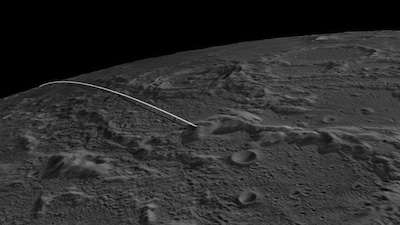
Last Flight for GRAIL's Twin Spacecraft
This still image and animation shows the final flight path for NASA's twin Gravity Recovery and Interior Laboratory (GRAIL) mission spacecraft, which will impact the moon on Dec. 17, 2012, around 2:28 p.m. PST.
Image credit: NASA/JPL-Caltech/GSFC/ASU​
|
GRAIL's Final Resting Spot
These maps of Earth's moon highlight the region where the twin spacecraft of NASA's Gravity Recovery and Interior Laboratory (GRAIL) mission will impact on Dec. 17, marking the end of its successful endeavor to map the moon's gravity.
Image credit: NASA/GSFC​

|

Lunar Heritage Sites and GRAIL's Final Mile
This graphic highlights locations on the moon NASA considers "lunar heritage sites" and the path NASA's Gravity Recovery and Interior Laboratory spacecraft will take on their final flight.
Image credit: NASA/JPL-Caltech​
|These side-by-side, 3-D comparisons depict the unnamed lunar mountain targeted by the NASA's Gravity Recovery and Interior Laboratory (GRAIL) mission for controlled impact of the Ebb and Flow spacecraft.
Image credit: NASA/JPL-Caltech/MIT/GSFC​
[/table]​

Both spacecraft will hit the surface at 3,760 mph (1.7 kilometers per second). No imagery of the impact is expected because the region will be in shadow at the time.

Ebb and Flow will conduct one final experiment before their mission ends. They will fire their main engines until their propellant tanks are empty to determine precisely the amount of fuel remaining in their tanks. This will help NASA engineers validate fuel consumption computer models to improve predictions of fuel needs for future missions.

"Our lunar twins may be in the twilight of their operational lives, but one thing is for sure, they are going down swinging," said GRAIL project manager David Lehman of NASA's Jet Propulsion Laboratory in Pasadena, Calif. "Even during the last half of their last orbit, we are going to do an engineering experiment that could help future missions operate more efficiently."

Because the exact amount of fuel remaining aboard each spacecraft is unknown, mission navigators and engineers designed the depletion burn to allow the probes to descend gradually for several hours and skim the surface of the moon until the elevated terrain of the target mountain gets in their way. The burn that will change the spacecrafts' orbit and ensure the impact is scheduled to take place Friday morning, Dec. 14.

"Such a unique end-of-mission scenario requires extensive and detailed mission planning and navigation," said Lehman. "We've had our share of challenges during this mission and always come through in flying colors, but nobody I know around here has ever flown into a moon mountain before. It'll be a first for us, that's for sure."

During their prime mission, from March through May, Ebb and Flow collected data while orbiting at an average altitude of 34 miles (55 kilometers). Their altitude was lowered to 14 miles (23 kilometers) for their extended mission, which began Aug. 30 and sometimes placed them within a few miles of the moon's tallest surface features.

{...}


NASA News Release: RELEASE : 12-434 - Twin NASA Probes Prepare for Dec. 17 Mission-Ending Moon Impact

Universe Today: One Spacecraft Captures Another in Lunar Orbit

Science Daily: NASA Probes Prepare for Mission-Ending Moon Impact

SPACE.com: Twin NASA Probes Readying for Monday Moon Crash

Discovery News: Kamikaze Probes to Smash into Lunar Mountain

The Planetary Society Blog: How GRAIL will meet its end

Science News: Moon probes set for smashing end

Florida Today: NASA craft aim for crash-landing on moon in GRAIL mission

Universe Today: Endgame: GRAIL Spacecraft to Slam into Lunar Crater Rim on December 17
 
[FONT=VERDANA, ARIAL, HELVETICA, SANS-SERIF][SIZE=+2]Twin GRAIL satellites aim for crash on moon mountain[/SIZE][/FONT]
[FONT=VERDANA, ARIAL, HELVETICA, SANS-SERIF][SIZE=-2][EMAIL="[email protected]"]BY STEPHEN CLARK[/EMAIL]
SPACEFLIGHT NOW

Posted: December 13, 2012[/SIZE][/FONT]

spacer.gif


NASA will send two decommissioned probes to a crash landing on the moon Monday, punctuating a violent end for a mission which mapped the lunar gravity field with more precision than any other object in the solar system.
13grail_400304.jpg

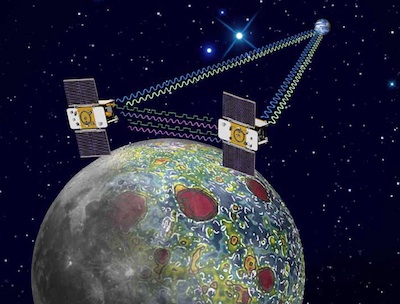
[FONT=Verdana, Arial, Helvetica, sans-serif][SIZE=-2]Artist's concept of the GRAIL satellites at the moon. Credit: NASA[/SIZE][/FONT]

Running low on fuel, the GRAIL satellites will aim for a mountain in the northern hemisphere near Goldschmidt crater. Approaching at a shallow angle of about 1.5 degrees, the nearly identical spacecraft will impact with a velocity of about 3,760 mph.
Because of its low impact angle, the satellites will probably leave features more resembling skid marks than a crater, said Maria Zuber, GRAIL's principal investigator from the Massachusetts Institute of Technology.
One probe will strike the moon at 5:28:40 p.m. EST (2248:40 GMT) Monday, followed about 20 seconds later by impact of the second satellite, according to NASA.

"We have achieved everything we could have possibly hoped for in terms of observations," Zuber said. "Frankly, in my wildest dreams, I could not have imagined this mission would go as well as it has."
The twin GRAIL spacecraft, launched in September 2011, entered orbit around the moon nearly one year ago. The probes started measuring the lunar gravity field in March.

After a mapping the moon from a 34-mile-high orbit in the first half of 2012, the GRAIL probes are now concluding an extended mission to obtain higher-resolution gravity data from an average altitude of 14 miles.
Since Dec. 6, the GRAIL satellites, nicknamed Ebb and Flow, have moved even closer to the moon, flying at a mean altitude of less than 10 miles and buzzing just a few miles above the moon's highest peaks, according to Zuber.

On Friday, thrusters on each satellite will fire to guide the spacecraft toward the unnamed mountain. The maneuver will also ensure the satellites avoid striking landing sites from the Apollo, Surveyor and Soviet space programs. Engineers calculated there was a 1-in-125,000 chance the satellites would hit one of the heritage landing sites, according to David Lehman, GRAIL project manager at NASA's Jet Propulsion Laboratory.
The orbits of the GRAIL satellites are too unstable to keep the spacecraft flying without regular help from rocket thrusters. With the satellites low on propellant, the probes would impact the moon naturally, officials said.
Before impacting the moon Monday, the spacecraft will burn their rocket engines to empty their fuel tanks, an engineering experiment designed to refine techniques to estimate propellant quantities on satellites.
Most satellites have no way of directly measuring how much fuel is left in on-board tanks, and engineers can estimate how much propellant is inside GRAIL's reservoirs by the length of the depletion burn.
map.jpg

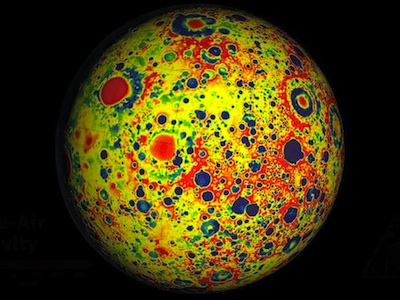
[FONT=Verdana, Arial, Helvetica, sans-serif][SIZE=-2]This image shows the variations in the lunar gravity field as measured by NASA's Gravity Recovery and Interior Laboratory (GRAIL) during the primary mapping mission from March to May 2012. Very precise microwave measurements between two spacecraft, named Ebb and Flow, were used to map gravity with high precision and high spatial resolution. Credit: NASA/JPL-Caltech/GSFC/MIT[/SIZE][/FONT]

GRAIL stands for the the Gravity Recovery and Interior Laboratory mission.
The mission worked by constantly measuring the distance between the two satellites as they orbited the moon. The tug of gravity from a surface or underground mass of rock registers in the range measurements between the spacecraft.

"Conceptually, it's exceedingly simple because we're just measuring the distance between two points," Zuber said.

The satellites measure range by bouncing radio signals between each other. An on-board processor transmits the radiometric data to the ground, where scientists use the information to create gravity maps.
Because variations in the moon's gravity are so small, the GRAIL satellites can detect changes in their range as little as the width of a human hair, according to Sami Asmar, GRAIL project scientist at JPL.

Scientists released the first results from GRAIL's primary mission in early December. The gravity maps show lava-filled dike features buried beneath the lunar soil, evidence the moon expanded in size in its early history.
"There is no record whatsoever of these features at the moon's surface," Zuber said. "If any record existed, it would have been wiped out by these early impacts. These dikes actually provide evidence for early expansion of the moon just after it formed."

GRAIL data also show the lunar crust is thinner than predicted, and its composition supports the theory the moon was created when a Mars-sized object collided with Earth long ago, expelling material which coalesced into the moon.

"We think that the moon formed in a giant impact with the earth, sending debris out into space that collected to form the moon," said Jeff Andrews-Hanna, GRAIL guest scientist from the Colorado School of Mines.
The gravity model also indicates some asteroid and comet impacts pierced the moon's crust and exposed the lunar mantle.
"One of the major results we found is evidence that the lunar crust is much thinner than we had believed before, and a couple of the large impact basins probably excavated the moon's mantle, which is very useful when trying to understand the composition of the moon's mantle," Zuber said.

 
It was a pre-specified mountain named after Sally Ride, IIRC.
 
[FONT=VERDANA, ARIAL, HELVETICA, SANS-SERIF][SIZE=+2]NASA's GRAIL lunar satellites end mission with a bang[/SIZE][/FONT]
[FONT=VERDANA, ARIAL, HELVETICA, SANS-SERIF][SIZE=-2]BY STEPHEN CLARK
SPACEFLIGHT NOW

Posted: December 17, 2012[/SIZE][/FONT]
spacer.gif

http://www.spaceflightnow.com/news/n1212/17grail/#
Engineers guided NASA's twin GRAIL lunar gravity probes into a ridge near the moon's north pole Monday, using the mission's final moments for technical experiments and honoring the legacy of late astronaut Sally Ride.
grail.jpg

[FONT=Verdana, Arial, Helvetica, sans-serif][SIZE=-2]Artist's concept of the GRAIL satellites at the moon. Credit: NASA/JPL-Caltech[/SIZE][/FONT]

The two satellites, each about the size of a washing machine, hit the moon at about 5:29 p.m. EST (2229 GMT). Nicknamed Ebb and Flow, the craft were expected to strike the moon's surface about 30 seconds and one-and-a-half miles apart.

"Impact in 3, 2, 1, 0," a controller said over radio loops. Mission controllers at NASA's Jet Propulsion Laboratory in Pasadena, Calif., and Lockheed Martin's operations center in Denver then lost the radio signal from each GRAIL spacecraft, indicating the satellites had smashed into the moon.
A round of applause broke out as officials confirmed the mission's ending.
Maria Zuber, GRAIL's principal investigator from the Massachusetts Institute of Technology, said NASA has approved naming the impact site for the late astronaut Sally Ride, who led the mission's MoonKam payload, a camera on each spacecraft designed for outreach to middle school students.

"Ebb and Flow have removed a veil from the moon, and removing this veil will enable discoveries about the way the moon formed and evolved for many years to come," Zuber said.
Ride's sister, Rev. Bear Ride, was in the JPL control room for GRAIL's impact. She said she was "appreciative" and "thrilled" the GRAIL team honored her sister.

"It's really cool now to think when you look up at the moon, there's this little corner of the moon named after Sally," Ride said.
Controllers choreographed the impact after GRAIL completed its science mission Friday, when the satellites fired rocket thrusters to aim for a ridge near Goldschmidt crater in the moon's northern hemisphere.
Less than one hour before they hit the moon, the satellites each emptied their fuel tanks with another engine firing, called a burn to depletion. The experiment will provide engineers with data on how much propellant was left aboard the spacecraft.

"We're going to use this data to compare with estimates of what the fuel remaining was," said David Lehman, GRAIL project manager at JPL. "It's very rare for a mission to be able to do a burn to depletion. That tells you exactly how much fuel was remaining."
impact.jpg

[FONT=Verdana, Arial, Helvetica, sans-serif][SIZE=-2]This image shows the final flight path for NASA's twin GRAIL spacecraft. Credit: NASA/JPL-Caltech/GSFC/ASU[/SIZE][/FONT]

Satellites are not equipped with fuel gauges, so engineers must estimate propellant quantities by other means, including pressure readings and the subtraction of burned fuel as it is consumed.
With real engineering data generated by the depletion burns, officials can verify the accuracy of their fuel predictions and maximize the time future missions can continue operating.

The $471 million Gravity Recovery and Interior Laboratory, or GRAIL, mission mapped the moon's gravity field, shedding light on the lunar interior and revealing the moon's crust is thinner than predicted.
GRAIL also found buried dikes underneath the lunar surface. The features - likely composed of ancient solidified lava - indicate the moon's size grew soon after it formed.

The mission's two satellites flew in formation around the moon since January, bouncing Ka-band radio signals between themselves to precisely measure their range. An on-board processor transmitted the radiometric data to the ground, where scientists are using the information to create gravity maps.

The mission worked by constantly measuring the distance between the two satellites as they orbited the moon. The tug of gravity from a surface or underground mass of rock registered in the range measurements between the spacecraft.

Because variations in the moon's gravity are so small, the GRAIL satellites could detect changes in their range as little as the width of a human hair, according to Sami Asmar, GRAIL project scientist at JPL.
"The knowledge of the gravitational field is now so accurate that, in the future, NASA and commercial missions will be able to navigate much more accurately [when] we land or fly over the moon," said Charles Elachi, director of JPL.
 
LROC: Impact!

[table="head;width=300"]
Click on images to enlarge​


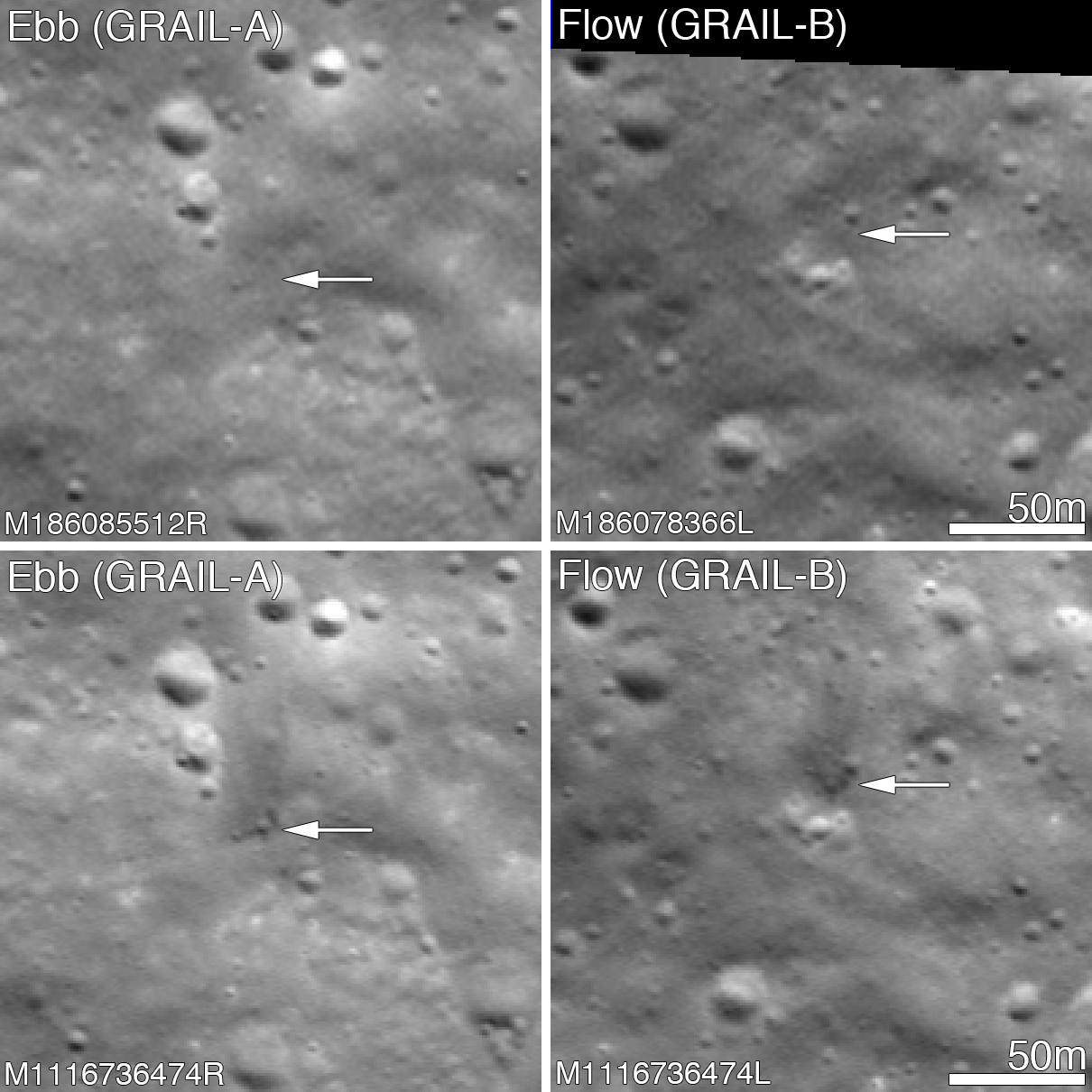
The twin GRAIL spacecraft impacted the Moon on 17 December 2012, LROC was able to image the impact craters on 28 February 2013 showing them both to be about 5 meters in diameter. Upper panels show the area before the impact; lower panels after the impact. Arrows point to crater locations.
NASA/GSFC/Arizona State University​


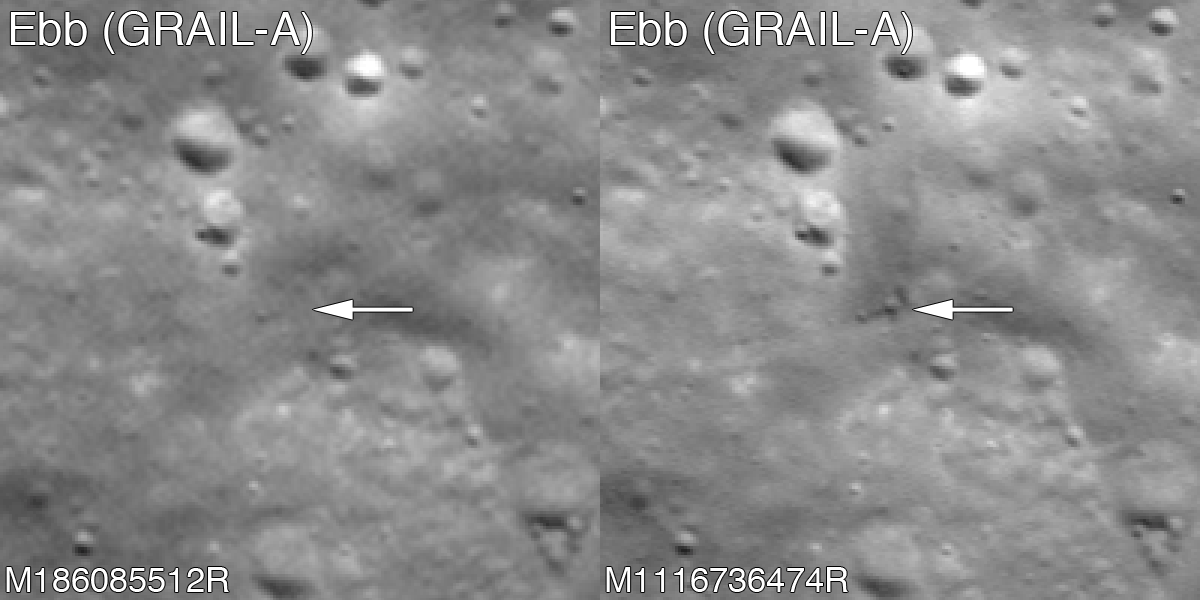
GRAIL A site seen before and after the impact event. Crater center is located at 75.609°N, 333.407°E.
NASA/GSFC/Arizona State University​


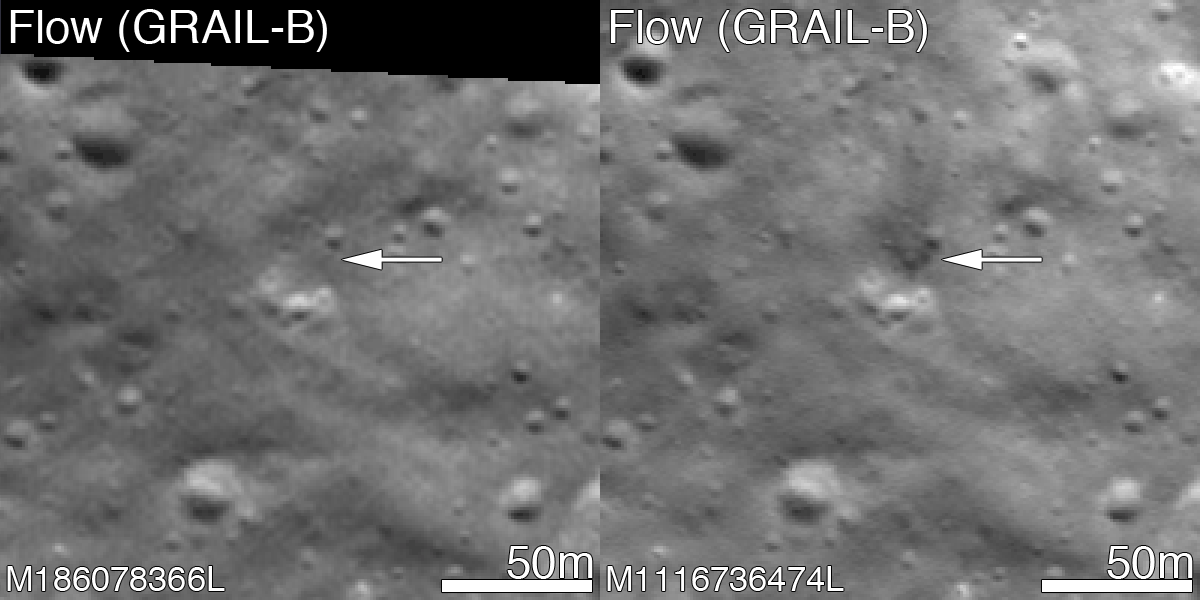
GRAIL B site seen before and after impact event. Crater center is located at 75.651°N, 333.168°E.
NASA/GSFC/Arizona State University​


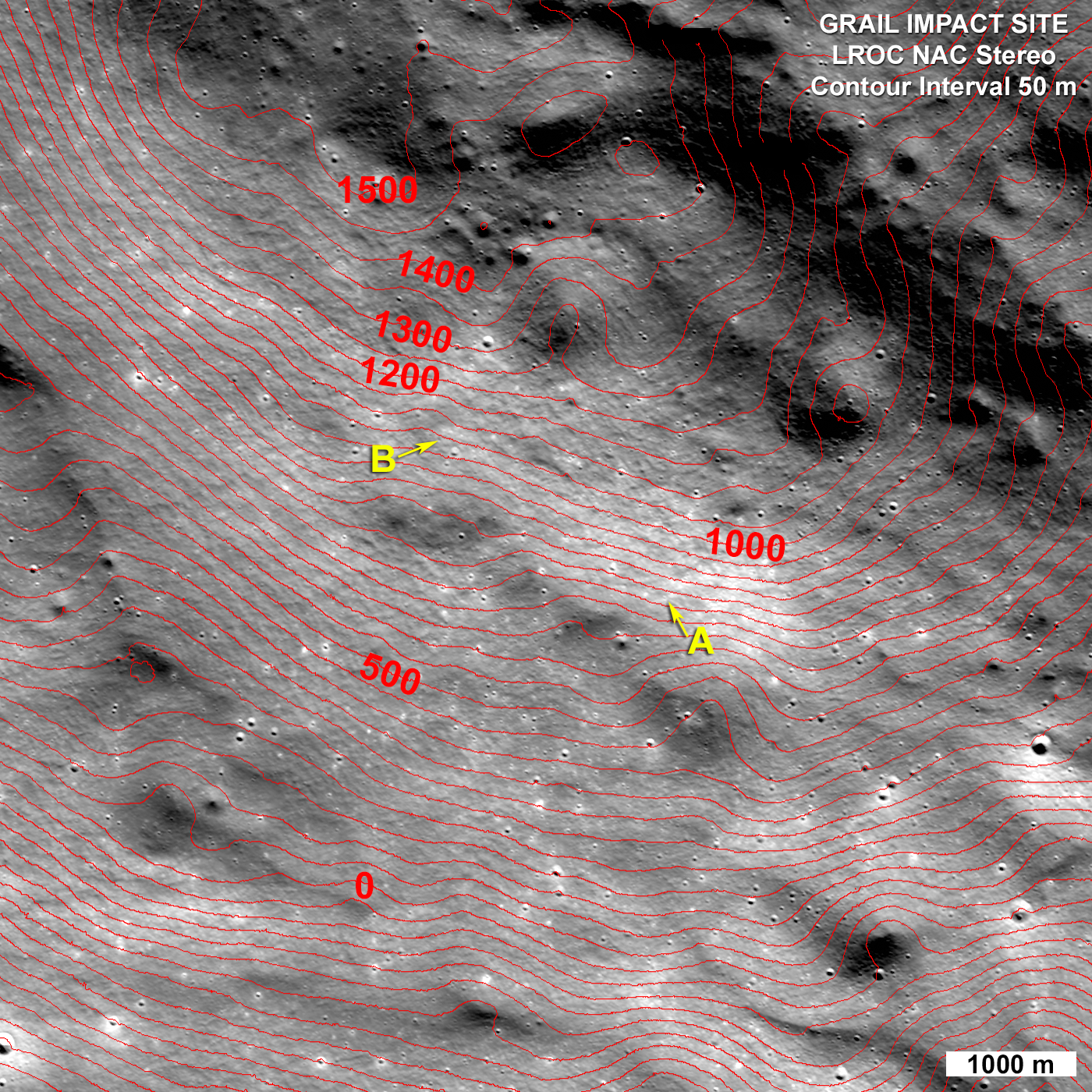
LROC NAC stereo derived topographic map of the GRAIL Impact area, map is 8400 meters wide, north is up.
NASA/GSFC/Arizona State University​
[/table]​
 
Back
Top