Launch News HTV-3 on H-IIB, July 21, 2012

Pretty awesome that they send up an aquarium with the htv3. Can't wait to see the launch of the fish

Yep, fishes in 0g, I'm curious to see that :huh:
 
JAXA Press Release:

July 28, 2012 (JST)
Japan Aerospace Exploration Agency (JAXA)​

The H-II Transfer Vehicle "KOUNOTORI 3" (HTV3) started its final approach to the International Space Station (ISS), and was captured by the ISS robotic arm at 21:23 p.m. on July 27 (Japanese Standard Time, JST). After being maneuvered by the arm, the HTV3 was successfully berthed to the ISS at 2:31 a.m. on July 28 (JST).

Upon berthed to the ISS, the internal and external cargo will be unloaded by the onboard crew.

Reference Link: You can find out more detailed information on the following Web site.
http://iss.jaxa.jp/en/htv/


Comment by JAXA President

Successful berthing of the H-II Transfer Vehicle "KOUNOTORI 3"
(HTV3) to the International Space Station (ISS)


Today, I am delighted to announce that the H-II Transfer Vehicle "KOUNOTORI 3" (HTV3), launched by the H-IIB launch vehicle on July 21, 2012 (Japanese Standard Time) from the JAXA Tanegashima Space Center, was successfully berthed to the International Space Station (ISS) at 2:31 a.m. on July 28, 2012.

We are pleased to report that Astronaut Hoshide, who has recently commenced the long-duration stay at the ISS, participated in this significant task. It was with immense pride and joy to witness the Japanese and American astronauts performing their fruits of the rigorous training to successfully berth the "KOUNOTORI 3 " to the ISS.

This success marks a notable milestone in this mission. We will continue to strive to ensure the transfer of supplies, departure from the ISS, and re-entry into the atmosphere as planned.

July 28, 2012

Keiji Tachikawa
President
Japan Aerospace Exploration Agency (JAXA)​
 
ISS Expedition 32 crew members opened the hatch of KOUNOTORI3 and entered the KOUNOTORI3's Pressurized Logistics Carrier (PLC) at 5:23 p.m., July 28, 2012.
120728_hatch_open_02_l.jpg
 
JAXA Press Release:

September 7, 2012 (JST)
Japan Aerospace Exploration Agency (JAXA)​

Schedules of departure from the International Space Station (ISS) and of re-entry to the atmosphere for the H-II Transfer Vehicle "KOUNOTORI3" (HTV3) are determined as follows.

It is confirmed that there is no obstruction to proceed the departure and re-entry by using primary attitude control thrusters, while the backup thrusters will not be available due to the failure that occurred before berthing to the ISS.


Departure from the ISS:
  • September 13, 2012 / 0:50 a.m.(Japanese Standard Time, JST)*
Re-entry to the atmosphere:
  • September 14, 2012 / 2:24 p.m.(JST)*
* The time may vary according to the actual operation.​


Reference link: For more details, please refer to the following website:
http://iss.jaxa.jp/en/htv/index.html
 
JAXA:
Hatch closed, KOUNOTORI3 is ready for departure tomorrow night

Last Updated: September 11, 2012

Onboard the ISS, trash and waste loading into KOUNOTORI3 (HTV3)'s Pressurized Logistics Carrier (PLC) was completed. The hatch of the PLC, an access door to the International Space Station (ISS), was closed at 10:59 p.m. on September 11, 2012.

Later tonight, KOUNOTORI3 will be unberthed from the ISS with the Space Station Remote Manipulator System (SSRMS).

The next HTV3 mission update will be posted from 8:40 p.m. September 12, with coverage on the unberthing of KOUNOTORI3.

*All times are Japan Standard Time (JST)

{...}
 
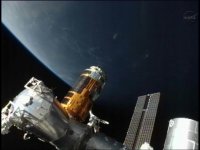
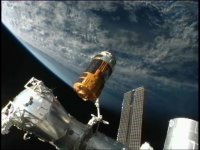
HTV-3 was unberthed from the ISS during last hour:

[table="head"]Before:|After:
HTV-3_unberth-000.jpg|HTV-3_unberth-001.jpg[/table]
 
NASASpaceflight: Japan’s HTV-3 aborts to depart the ISS following resupply mission, article by Orbinaut Pete:
The Japanese H-II Transfer Vehicle-3 (HTV-3) resupply spacecraft has departed – via what sources claim was an abort burn – from the International Space Station (ISS) following a nearly one and a half-month berthed mission. After unberthing from the ISS at around 11:50 AM GMT, release from the station’s robotic arm came at 3:50 PM GMT, following which HTV-3 departed – at speed – via an unconfirmed abort burn.

{...}

Aviation Week: Japan's Third HTV Cargo Capsule Leaves ISS

SPACE.com: Japan's Robotic Cargo Ship Leaves Space Station
 
JAXA Press Release:

September 14, 2012 (JST)
Japan Aerospace Exploration Agency (JAXA)​

Successful re-entry of H-II Transfer Vehicle "KOUNOTORI3" (HTV3) The H-II Transfer Vehicle "KOUNOTORI3" (HTV3) successfully re-entered the atmosphere after the third de-orbit maneuver at 2:00 p.m. on September 14, 2012 (Japanese Standard Time, JST).

The "KOUNOTORI3" has successfully accomplished the main objective of shipping cargo to the International Space Station (ISS), and completed its 56-day mission.

The estimated date/time for the re-entry and waterlanding are as follows (Japanese Standard Time):
Estimated re-entry*: September 14, 2012 / 2:27 p.m.
Estimated waterlanding: September 14, 2012 / 2:38 - 2:59 p.m.
* Altitude at 120 km

Reference link: For more details, please refer to the following website:
http://iss.jaxa.jp/en/htv/


Comment by JAXA President
Completion of the H-II Transfer Vehicle "KOUNOTORI 3"
(HTV3) mission

Today we would like to announce that the H-II Transfer Vehicle "KOUNOTORI3" (HTV3) has successfully completed its mission encompassing a de-orbit maneuver, re-entry into the atmosphere, and safe splashdown to the expected ocean area.

Having successfully berthed to the International Space Station (ISS) on July 28, 2012, the "KOUNOTORI3" remained docked for approximately 45 days, while all of the internal and external cargo were transferred to the ISS. Subsequently, the "KOUNOTORI3" has completed its mission with the re-entry today.

Some components including its main engine and attitude control thruster have shifted from overseas procurement to domestic production. Meanwhile, with three successful missions in a row, the KOUNOTORI has revealed Japanese remarkableness for manufacturing technology of space vehicles and for unique rendezvous flight techniques to the global audiences. There are considerable expectations that KOUNOTORI will help enhance Japan's position world widely by serving as a means of delivering various cargo indispensable for ISS operations such as ISS system spares and exposed equipment.

Continuous KOUNOTORI launch opportunities are contributing to the accumulation of operation techniques for space vehicles and to acquisition of techniques to develop unique manned spacecraft for the future. With a new data collection equipment, the "KOUNOTORI3" has attempted to acquire still image data as well as varied other forms, including the vehicle temperature and velocity upon breakup during re-entry. These data will be reflected in the research and development of return vehicles. They will also be utilized to elucidate the breakup phenomena of vehicle during re-entry and to enhance its safety.

Finally, regarding this "KOUNOTORI3" mission, I would like to express my sincere appreciation to all domestic and overseas organizations, and individuals concerned for their tremendous cooperation and support to date. JAXA will further promote the utilization of the ISS and the Japanese Experiment Module "Kibo", and continue successful cargo transportation using the KOUNOTORI. Your continued support and cooperation will be greatly appreciated.

September 14, 2012

Keiji Tachikawa
President
Japan Aerospace Exploration Agency (JAXA)​
 

Aviation Week: HTV-3 Abort Caused By Friction With Station Arm:
February 25, 2013

PARIS and MADRID — An unplanned abort maneuver performed by the H-II Transfer Vehicle-3 (HTV-3) as it departed the International Space Station (ISS) last September has been traced to friction between the Japanese cargo vessel’s grapple fixture and the space station’s robotic arm, which nudged the vessel off course during release.

NASA spokesman Joshua Byerly says the HTV-3 abort was caused by an interaction between the grapple fixture on the vehicle and the Space Shuttle Remote Manipulator System (SSRMS) “due to the relative positions of the HTV and the ISS.” Byerly says the interaction “created rates on the HTV vehicle that indicated the vehicle would leave its designed departure corridor and thus the vehicle initiated a preplanned abort per our joint safety requirements.”

The Sept. 12 abort, which occurred about a minute before HTV-3’s planned departure, sent the capsule speeding away from the space station at 1.2 meters (4 ft.) per second, rather than the intended 8 ft. per minute planned during the first in a series of departure burns, according to NASA briefing slides presented by ISS Manager Michael Suffredini to the NASA Advisory Council’s human spaceflight and operations committee during a Nov. 14 public meeting.

A spokesman for the Japan Aerospace Exploration Agency (JAXA) said an “unexpected impulse caused by SSRMS was applied during the release and it made HTV take a different trajectory.”

The spokesman said it is possible a similar impulse occurred during one or both of the first two HTV missions to the space station but did not trigger an abort maneuver. He said slight variations in the location, attitude and timing of each HTV vessel visiting the station could result in friction with the SSRMS and ultimately lead to a departure abort.

“We think small differences in the hardware spec and operations have an impact on the interface force,” he said. “Those differences between the flights are very small, and within requirements, and a combination of them might cause a deviation to HTV’s Fault Detection, Isolation & Recovery criteria,” resulting in an abort.

By design, Byerly said, the preprogrammed burns do not put the ISS at risk. He also said NASA has assessed other free-flyer spacecraft, “and this issue is not applicable to them.”

{...}
 
Back
Top