- Joined
- Oct 11, 2009
- Messages
- 3,488
- Reaction score
- 407
- Points
- 123
- Location
- Utrecht
- Website
- www.spaceflightnewsapi.net
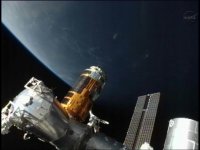
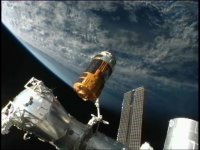
Timelapse of HTV-3 Approach to International Space Station



Pretty awesome that they send up an aquarium with the htv3. Can't wait to see the launch of the fish
The Japanese H-II Transfer Vehicle-3 (HTV-3) resupply spacecraft has departed – via what sources claim was an abort burn – from the International Space Station (ISS) following a nearly one and a half-month berthed mission. After unberthing from the ISS at around 11:50 AM GMT, release from the station’s robotic arm came at 3:50 PM GMT, following which HTV-3 departed – at speed – via an unconfirmed abort burn.
{...}

NASASpaceflight: Japan’s HTV-3 aborts to depart the ISS following resupply mission, article by Orbinaut Pete
February 25, 2013
PARIS and MADRID — An unplanned abort maneuver performed by the H-II Transfer Vehicle-3 (HTV-3) as it departed the International Space Station (ISS) last September has been traced to friction between the Japanese cargo vessel’s grapple fixture and the space station’s robotic arm, which nudged the vessel off course during release.
NASA spokesman Joshua Byerly says the HTV-3 abort was caused by an interaction between the grapple fixture on the vehicle and the Space Shuttle Remote Manipulator System (SSRMS) “due to the relative positions of the HTV and the ISS.” Byerly says the interaction “created rates on the HTV vehicle that indicated the vehicle would leave its designed departure corridor and thus the vehicle initiated a preplanned abort per our joint safety requirements.”
The Sept. 12 abort, which occurred about a minute before HTV-3’s planned departure, sent the capsule speeding away from the space station at 1.2 meters (4 ft.) per second, rather than the intended 8 ft. per minute planned during the first in a series of departure burns, according to NASA briefing slides presented by ISS Manager Michael Suffredini to the NASA Advisory Council’s human spaceflight and operations committee during a Nov. 14 public meeting.
A spokesman for the Japan Aerospace Exploration Agency (JAXA) said an “unexpected impulse caused by SSRMS was applied during the release and it made HTV take a different trajectory.”
The spokesman said it is possible a similar impulse occurred during one or both of the first two HTV missions to the space station but did not trigger an abort maneuver. He said slight variations in the location, attitude and timing of each HTV vessel visiting the station could result in friction with the SSRMS and ultimately lead to a departure abort.
“We think small differences in the hardware spec and operations have an impact on the interface force,” he said. “Those differences between the flights are very small, and within requirements, and a combination of them might cause a deviation to HTV’s Fault Detection, Isolation & Recovery criteria,” resulting in an abort.
By design, Byerly said, the preprogrammed burns do not put the ISS at risk. He also said NASA has assessed other free-flyer spacecraft, “and this issue is not applicable to them.”
{...}