Innovation, the key to future Human Space Exploration

Everything hinges on launch costs, you can't go anywhere or do anything without getting to LEO first, and that remains ludicrously expensive. SpaceX will put a dent in that, but it's still not going to be enough. SSTO is what we really need.

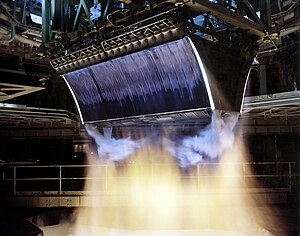
I still don't understand why the aerospike engine was not fully developed. I know all about the X-33's composite tank failures but that had nothing to do with the engine itself. It has always seemed that this is a technology thats been completely ignored. Is there any rocket engineer types out there with more info on why aerospikes are not being perused?

300px-Twin_Linear_Aerospike_XRS-2200_Engine.jpg
 
SpaceX will put a dent in that, but it's still not going to be enough. SSTO is what we really need.

Well 50 million per launch (Falcon 9) is nice price. SSTO is beyond our reach now. Maybe 20 or 30 years from now.
I think about massive unmanned and relatively simple launch vechicles (maybe based on SRBs or something like that) to lower cost.
 
I still don't understand why the aerospike engine was not fully developed. I know all about the X-33's composite tank failures but that had nothing to do with the engine itself. It has always seemed that this is a technology thats been completely ignored. Is there any rocket engineer types out there with more info on why aerospikes are not being perused?

linear aerospikes are an integral part of the launcher structure, which means you need to develop a aerospike around a spacecraft. Also the RS-2000 testing got canceled for freeing resources for the Ares program AFAIR.

---------- Post added at 12:02 AM ---------- Previous post was at 12:01 AM ----------

Well 50 million per launch (Falcon 9) is nice price.

It would be nice if this is really the price tag. But since the Falcon 9 did never launch yet, we can't tell that for sure. if the Falcon 9 launch price exceeds just 75 million, it is not cheaper than the Ariane 5 anymore.
 
Well 50 million per launch (Falcon 9) is nice price. SSTO is beyond our reach now. Maybe 20 or 30 years from now.
I think about massive unmanned and relatively simple launch vechicles (maybe based on SRBs or something like that) to lower cost.

IMO, until real SSTO is developed, we need to run a combination of small crewed vehicles like the Falcon 9, and big dumb boosters that are built cheap and take advantage of the economies of scale. One of the few things Constellation did right was to divorce the crew launches from the heavy lifting. Since man-rating is a hugely expensive process, avoiding it for heavy launches saves money.

http://en.wikipedia.org/wiki/Big_dumb_booster

The PDF in the reference section of that article is full of good stuff, I used it on a research project last year.
 
Worse: MTV.

At least in your teenage years, you got to see actual music on MTV. All that was gone by the time I was a teenager, and now that I'm 21 (nearly), all the music is gone from MTV2, the channel they created because MTV didn't have any music. :shrug:
 
It would be nice if this is really the price tag. But since the Falcon 9 did never launch yet, we can't tell that for sure. if the Falcon 9 launch price exceeds just 75 million, it is not cheaper than the Ariane 5 anymore.
I belive in this project and I think it is going to be major breaktrough in comercial space transport. And it is standing on a platform right now so I don't think launch cost would exeed 60 M$. Time will tell.

The PDF in the reference section of that article is full of good stuff, I used it on a research project last year.

Thanks for the paper. I'll read it as soon as possible. (Probably tomorow).
 

Of course, somebody had to mention it. Regardless how far we progress in technology, brute force will always be considered more economic, despite contradicting research.

Also the Wikipedia article about it would require a "dubious" tag after every sentence. Especially the praise of the low tolerances of the Russian rockets is more belief than fact - the Russian rockets are not cheap because of using less-than-perfect technology (as if the rest of the world would use the best they have all the time), but because of massive and optimized mass production, high production numbers way beyond the break-even and low engineer salaries.

The gap between Russian technology and western technology was never really huge, and it has become tiny lately. people here just like to call things primitive, because they look different.

---------- Post added at 12:49 AM ---------- Previous post was at 12:47 AM ----------

I belive in this project and I think it is going to be major breaktrough in comercial space transport. And it is standing on a platform right now so I don't think launch cost would exeed 60 M$. Time will tell.

:lol: :lol: :lol:

Sorry, but this is wishful thinking.
 
Ya know, even if F9 grows to $75 million a launch at least we would have a man-rated booster for that price which would still be cheaper than any EELV. What would it take for Ariane 5 to be man-rated?
 
Yes, yes, it's all the younger generation's fault, not the baby boomers in leadership positions throughout the government that can't see past the next election cycle. Those damn teenagers and college kids are ruining everything.

If there's one constant throughout history, it's that each generation has believed that the next generation will be the ones to lead humanity into chaos. Somehow, we're still here.
 
What would it take for Ariane 5 to be man-rated?

A few billions and a sledge hammer. The current position of ESA is, that they are not doing any steps to man-rate it.
 
Well, in the defense of the meddling kids, if not for them all those bad guys in the Scooby-Doo cartoons would have gotten away with all those schemes of theirs.
I blame my upbringing on Captain Kangaroo, Captain Kirk, Napolean Solo, Kwai Chang Caine, John Wayne and the entire cast of Gilligan's Island.

One of the barriers for innovation is the current "business model" where a manager only plans to spend 3-5 years in a particular company, then they're off to greener pastures. Not too many companies/managers are thinking in the long term. As already mentioned, they only want to think about the next earnings report.
 
We need people who have an industrial interest in space, and not just a political interest.
 
The article is interesting, but it's a dreamer's musing is all.

There are two problems with all this.

One is that neither he, nor any other space enthusiast, can give a really firm reason why we need all those technologies. Whenever you ask this question, the best answer anyone can give is "man's destiny to explore, blah blah". That's enough to get me to open my wallet, but if I were representing other people in Congress it's not even close. Unless you can tell me something really dire will happen to those I represent if we don't do this, then I don't see a reason. Defending the earth from comet strikes is a good idea, but it doesn't require all this other manned stuff.

The second reason is that spaceflight is still a government monopoly and is centrally planned. That makes it political, which means it will never, ever, ever, ever, be done in an efficient and cost-effective manner. Like the USSR and the 5-year plans for its planned economy that never worked out, NASA has seen project after project started, half-funded, mishandled, fall out of favor, and wind up on the shelf. There is no reason to believe any of this guy's ideas won't suffer the same fate. Lots of money for a few gee-wiz gains is all you can get.

 
Unless access to space is cheap and routine, we're not going to have economic reasons to go anywhere. Mining even one asteroid can be insanely profitable, if only we had launch costs down around $500-$1000/kg. Right now, with essentially nothing below $10,000/kg (or whatever the cheapest launcher is), it's just not going to be cost effective until we're in a painful shortage situation.
 
Last edited:
According to this site:

Here’s something to consider: SKYLON’s development is likely to be roughly $10 billion. How does that affect price-tag for LEO services? If 30 SKYLONs are made and each flies 200 times before replacement, then the development cost divided over all those 6,000 flights is $1.67 million, or $139/kg.

That would mean less than $8500 to launch me into orbit. :P
But, of course, it's pretty optimistic.
 
But, of course, it's pretty optimistic.
Very optimistic, as they have taken the near the upper limit of payload mass and the lower limit of development cost. It also assumes a demand in the order of 3600 t per year just for Skylon launch vehicles. Current demand is about 80 t per year (global).

Even the basic maths is just wrong. If you get 30 Skylons for $10 billion (yeah, right :dry:, that's not much more than you pay for a 747), how are your going to get 300 Skylons for $10 billion?
 
Last edited:
Very optimistic, as they have taken the near the upper limit of payload mass and the lower limit of development cost. It also assumes a demand in the order of 3600 t per year just for Skylon launch vehicles. Current demand is about 80 t per year (global).

At 2-5 times the price. Lower payload costs would really increase the demand, but how much is impossible to tell. If the same money would be spend initially for Skylon flights, you would have up to 400 tons already per year.

Even the basic maths is just wrong. If you get 30 Skylons for $10 billion (yeah, right :dry:, that's not much more than you pay for a 747), how are your going to get 300 Skylons for $10 billion?

The math is right and pretty conservative - you only need to do development once. Production is not included in the 10 billion figure. You have the same R&D costs if you buy 3 or 300 Skylons.

Which is the same reason why big dumb boosters are worse than smaller boosters: The fixed costs of launcher operations are always there. your launch pad needs attention EVERY day. If you launch or not. A Big Dumb Booster would launch years of demand into orbit at once - which means it would maybe just launch once per year or less. The R&D costs will also be distributed over a MUCH lower number, though the total R&D costs will be lower. But not as much lower as the production.

Also, we are no longer in the 1950s. We have mastered docking, and we are getting adept in assembly in space. Who defends monolithic payloads today, is stuck in the past. Large payloads are actually more touchy than smaller ones. What you save on docking system mass, will be added by making the larger structure stiff enough for launch.

In theory, we could even work without docking systems already, we just didn't attempt it yet.
 
A valid point. Your fixed cost per kg is higher with one or two BDB launches per year than if it were spread out over multiple smaller launches. The question, of course, is whether that would end with a smaller net cost per kg.

Orbital construction technology is still kind of limited, however. Docking some prefab modules together in orbit is somewhat different than welding together a complete interplanetary spacecraft, section by section. Eventually you'll run into something, probably in the propulsion and fuel storage areas, that can't be crammed into a payload fairing, and will have to literally be built on site. Monolithic payload capacity means you could launch, say, the entire propulsion rig all at once and spare the risk of assembling it out of two or three sections.
 
Monolithic payload capacity means you could launch, say, the entire propulsion rig all at once and spare the risk of assembling it out of two or three sections.

Yes, but how often would you do this? Once per decade?

Also welding in space is possible, we just don't use it in praxis because the research is still not getting ahead. But there is no reason to assume it is physically impossible. If we could weld tank sections together in space from smaller standard elements, such large, light payloads would already fall away. I doubt even that it would take long then before large rocket engines, like the fusion propulsion concepts could be produced in space.

The question is just, how big the pain must get for having a BDB. Not the other way around though. Most large payloads we transport with ships and trucks today, are mostly very specialized products that are build in too small numbers for justifying local factories.

And now...do we need such propulsion systems on earth or do we need them in space? ;)

A factory in space would be more "intuitive" at first glance than producing the stuff on Earth and bring it into space. But this is also so speculative, that I can't tell any economical figures about this.
 
Back
Top