Updates JAXA Akatsuki (PLANET-C) and IKAROS updates

Looks like that the :probe: was not with them.

:hailprobe: anyway !
 
The Mainichi Daily News: Akatsuki probe began unexpectedly spinning after firing thruster:
Japan's first attempt at a Venus probe, Akatsuki, fell into an unexpected rapid spin soon after beginning the reverse-firing of its thruster, which is thought to have caused it to enter into the "safe-hold mode" that stopped the thruster from reversing and prevented the probe from entering orbit, officials from the Japan Aerospace Exploration Agency (JAXA) announced on Dec. 8.

The unexpected spinning could have been the result of damage to the probe's thruster, a newly-developed "ceramic thruster."

{...}

[table="width=100"]
20101209p2a00m0na005000p_size5.jpg


The Akatsuki probe is thought to have spun in the direction indicated by the white arrows. The cone on the right side is part of the ceramic thruster. Image courtesy of JAXA, with modifications.[/table]​
 
The spinning could also be caused by tiny spiral structures on the inside of the rocket engines, it must not be automatically caused by damage. One loss of the Ariane 5 was caused by such a torque, that became stronger than what the RCS thrusters had been able to compensate.

Does somebody have a photograph of the engine?
 
Does not look like a strong spiral pattern there, but could be one... maybe a fracture of the nozzle is more likely.
 
The Mainichi Daily News: Akatsuki's fuel pressure plunged before failure to enter Venus orbit: JAXA:
An ongoing investigation into the failure to insert the Akatsuki space probe into Venus' orbit has found that the probe's fuel pressure dropped sharply just after it fired its reverse thruster.

The drop in fuel-tank pressure could have been caused by a problem in the pipes or valves of the fuel distribution system, the Japan Aerospace Exploration Agency (JAXA) said on Dec. 10. The sudden pressure loss was uncovered by a JAXA team tasked with tracing the causes of the Akatsuki's failure using the stream of data sent back to Earth by the probe, and drawing up countermeasures.

The team found that the reverse thruster was operating normally for the first two minutes, 32 seconds of the burn. However, the craft then began to go into a spin, and an attitude correction system came online six seconds later. The team believes that at this point a fuel valve shut, cutting off the engine in mid-burn. Three minutes, 37 seconds after that, the probe began emergency maneuvers to abort the orbital insertion. The team does not yet know what caused Akatsuki to begin spinning.

{...}


JAXA - ISAS: AKATSUKI's first shots of Venus taken during health check:
Given the failure of injecting AKATSUKI into the planned Venus orbit, the project team and the special committee of JAXA are now conducting extensive analyses of its cause. Various functionality and health checks of the probe are now underway. As a result of this activity, we obtained images of Venus at 9 am (JST), Dec 9th.

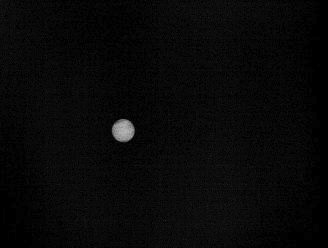
The project team switched on the long wave infrared camera (LIR), ultraviolet imager (UVI), and 1 micron camera (IR1) to take images of Venus at the distance of 0.6 milion km. Venus was pictured with the angular size of about 1.2 deg.

{...}

Long wave infrared camera (LIR) : 10 micron
fig1b.jpg


Ultraviolet imager (UVI): 365 nm
fig2b.png


1 micron camera (IR1) : 0.9 micron
fig3b.png


Comparison of images in the same scale

fig4.png

Images are artificially colored (UVI image - blue; IR1 image - red)​
 
If IKAROS blog in Japanese, or Google translated version makes sense for you, here are links -
JAXA - ISAS: IKAROS Blog - IKAROS Daily Report - Dec. 12, 2010 (Japanese) [Google Translated]. And from what could be understood by me:
{...}

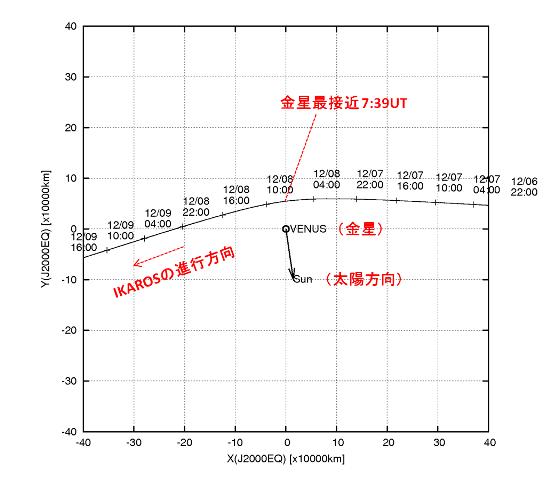
IKAROS during Venus flyby trajectory (see below). Venus closest approach distance was about 80,000 km.

{...}

The flyby increased the velocity of the IKAROS.

{...}

IKAROS is now at the distance over 1,100,000 km from Venus and it's increasing quickly. We rely exclusively on solar sailing in space once again.

{...}

Today's IKAROS (2010-12-10)
Sun Distance: 0.72AU
Earth Distance: 68511958 km, RA = -147.0 deg, Dec = -10.8 deg
Venus Distance: 0.00 AU (258669 km)
Attitude: Spin Rate = 2.0 rpm, Sun Angle = 12.3 deg

Today's IKAROS (2010-12-11)
Sun Distance: 0.72 AU
Earth Distance: 69826621 km, RA = -145.8 deg, Dec = -11.0 deg
Venus Distance: 0.01 AU (848677 km)
Attitude: Spin Rate = 2.1 rpm, Sun Angle = 12.7 deg

Today's IKAROS (2010-12-12)
Sun Distance: 0.72 AU
Earth Distance: 71142242 km, RA = -145.2 deg, Dec = -11.0 deg
Venus Distance: 0.01AU (1140095 km)
Attitude: Spin Rate = 2.0 rpm, Sun Angle = 12.6 deg

Today's IKAROS (2010-12-14)
Sun Distance: 0.72 AU
Earth Distance: 73778110 km, RA = -143.9 deg, Dec = -11.2 deg
Venus Distance: 0.01 AU (1716694 km)
Attitude: Spin Rate = 2.7 rpm, Sun Angle = 12.6 deg​

20101212-ikaros_venus_flyby.jpg
 
Last edited:
AKATSUKI -
The Mainichi Daily News: Japanese space probe most likely overshot Venus due to engine trouble:
TOKYO (Kyodo) -- The space probe Akatsuki most likely failed in its attempt to enter orbit around Venus earlier this month because it was thrust in the wrong direction after engine trouble, the Japan Aerospace Exploration Agency said in a report Friday.

{...}

A nozzle of the engine's thrust system may have broken after overheating due to a glitch in the fuel supply system, according to the report.

{...}


Daily Yomiuri online: Nozzle may have doomed Akatsuki, but could also save it.

SPACE.com: Venus Probe's Problems May Cause Japan to Scale Back .​
 
The Mainichi Daily News: Failure of Venus probe Akatsuki likely due to faulty valve:
The failure of the Akatsuki Venus Climate Orbiter to enter orbit around Venus earlier this month was most likely due to a blockage in the backflow valve installed in the fuel-supply pipes of the engine that was used for reverse engine thrust, a Japan Aerospace Exploration Agency (JAXA) taskforce has concluded.

The valve is structured in a way that it cannot be manipulated from Earth, and whether the space probe can be inserted into Venus's orbit -- at its next chance six years from now -- will not be clear until various experiments are conducted on Earth.

The valve is located inside a high-pressure pipe through which fuel is expelled. The valve disc is put in motion via a spring contraption which automatically blocks up the pipe in the case of backflow.

{...}
 
Murphy was right - anything that can break up, will.
 
The Mainichi Daily News: JAXA may make second try at Akatsuki-Venus rendezvous one year earlier than planned:
The Japan Aerospace Exploration Agency (JAXA) is now considering making a second attempt to insert the Akatsuki probe into Venus' orbit in about five years time -- one year earlier than it was believed possible.

{...}

After the original mission failure, JAXA had calculated that Akatsuki would make 11 trips around the Sun for every 10 Venus made, advancing the planet and the probe's next meeting to sometime in December 2016 or January 2017. Subsequent examination of data from the probe showed engine power had dropped by some 60 percent, possibly caused by a malfunction in the fuel supply system or damage to the engine nozzle, and that prospects for restoring full function were very low.

If the engine nozzle has been weakened, it will be difficult to decelerate the Akatsuki enough for orbital insertion when it again closes with Venus. As such, JAXA is now considering trying to decelerate the craft a little bit at a time, allowing it to make eight orbits around the sun before Venus catches up with it in five years. Making fewer revolutions around the Sun would also mean the probe would be exposed to less risk of damage from solar radiation, lengthening its operational life once it actually makes its rendezvous with Venus.


SPACE.com: Troubled Japanese Venus Probe May Get Early Shot at Redemption.
 
JAXA - Small Solar Power Sail Demonstrator "IKAROS":
IKAROS regular operations completed

January 26, 2011 Updated

[table="width=650"]
The Small Solar Power Sail Demonstrator “IKAROS” has been in its regular operation phase for about six months to verify navigation by the world’s first solar sail device and power generation by the thin-film solar battery. As its missions have been achieved, the IKAROS has completed its regular operations. The demonstrator will be in the post operational phase, which leads to the development of a successor while acquiring basic knowledge of solar power sail technology including a navigation guidance technique.​
Above photo: IKAROS Project Manager Osamu Mori explaining the regular phase completion. Photo below: Venus taken by the IKAROS's monitor camera.​
|
topics_20110126.jpg
[/table]
________________________________________

Science Insider: Japan's IKAROS Solar Sail Mission Extended for a Year:
TOKYO—Success is paying off for Japan's IKAROS solar sail mission: The team behind the spacecraft confirmed today that it flawlessly completed all the performance tests set for it during its planned 6-month life. As a reward, the Japan Aerospace Exploration Agency (JAXA) has extended the mission to March 2012.

"In half a year, we accomplished all the mission objectives," said mission manager Osamu Mori, of JAXA's Institute of Space and Astronautical Science in Sagamihara, near Tokyo. "Now we've set new objectives."

Launched 21 May along with JAXA's ill-fated Akatsuki Venus probe, IKAROS (the Interplanetary Kite-Craft Accelerated by Radiation of the Sun) successfully used centrifugal force to unfurl its 20 meter diagonal, 0.0075 milimeter thick polyimide sail and relied on the pressure of photons streaming from the sun for acceleration. Controllers tweaked the craft's attitude by turning liquid crystal devices on and off to vary the reflectance (and thus the photon pressure) across the sail. All of these accomplishments were spacefaring firsts, Mori says. (Two previous solar sail missions by other countries foundered on rocket failures.)

While sailing, the craft's suite of scientific instruments caught gamma ray bursts, collected data on space dust, and participated in very long baseline interferometry observations of celestial objects.

With the extended lease on life, the team will try new navigational tricks, such as varying the sail's angle toward the sun and changing the craft's trajectory. Mori called these "risky" maneuvers because they are not sure if the sail will remain fully extended. They intend to model the sail's behavior and the craft's response to plan future solar sail missions.

{...}

 
JAXA - Venus Climate Orbiter "AKATSUKI" (PLANET-C):
July 4, 2011 Updated
AKATSUKI set to try and enter orbit of Venus in November 2015

JAXA made the following report at the AKATSUKI’s third investigation meeting for the Space Activities Commission on June 30.

As a result of analysis and verifications of the AKATSUKI’s anomaly cause estimated at the first and second investigation meetings, the highest possibility was found to be damage to the thruster nozzle of the orbit maneuver engine due to closure of the check valve during the orbit injection maneuver.

topics_20110704.jpg

A firing test for Venus orbit injection

We will determine if we can reignite the damaged thruster nozzle through a ground test as well as an emission test of the onboard engine. Based on the results of these tests, we will prepare for an orbit injection maneuver to Venus hoping for the AKATSUKI to meet with Venus in November 2015.
 
JAXA - Venus Climate Orbiter "AKATSUK" (PLANET-C):
September 7, 2011 Updated
AKATSUKI: First test thrust from orbit maneuver engine

JAXA carried out the first test jet thrust(*1) from the orbit maneuver engine (OME) aboard the Venus Climate Orbiter "AKATSUKI" (PLANET-C) as part of studying an orbit change plan for the AKATSUKI to visit Venus.We have confirmed that the OME jetted out thrust at 11:50 a.m. on September 7 (Japan Standard Time.)
We will analyze the acquired telemetry data and prepare for the second test jet thrust(*2) scheduled for Sept. 14 (JST.)

*1: Test thrust aimed at quantitatively understanding postural disturbance (including horizontal thrust.) The planned thrust duration was two seconds.
*2: The second test aims to verify the attitude control logic. The planned thrust duration is 20 seconds.


SPACE.com: After Missing Venus, Japanese Spacecraft Tries for 2nd Chance
 
JAXA - Venus Climate Orbiter "AKATSUK" (PLANET-C):
September 9, 2011 Updated
AKATSUKI: Second orbit maneuver engine test plan changed

JAXA performed the first test jet thrust(*1) from the orbit maneuver engine (OME) aboard the Venus Climate Orbiter “AKATSUKI” (PLANET-C) on Sept. 7 as part of studying an orbit change plan for the AKATSUKI to meet with Venus. Through this test, we found that acceleration by the jet thrust was less than the expected value; therefore, we decided to shorten the time duration of the second test(*2) slated for Sept. 14 to about 5 seconds because the originally expected acceleration value was the baseline for the second test. We will jet the thrust for about five seconds again to reconfirm the thrusting condition of the OME.

The satellite is in good condition after the first test jet thrust.

*1: Test thrust aimed at quantitatively understanding postural disturbance (including horizontal thrust.) The thrust duration was two seconds as planned.
*2: The second test originally aimed to verify the attitude control logic. The planned thrust duration was 20 seconds.
 
Are they going to probe various acceleration profiles and figure out a momentum compensation program for the attitude keeping system, so that the vehicle could "stay still and straight" during a long burn?
 
Back
Top