Updates JAXA Akatsuki (PLANET-C) and IKAROS updates

JAXA - Small Solar Power Sail Demonstrator "IKAROS":
October 18, 2011 Updated
Result of IKAROS 'reverse spin operation'

On Oct. 18, 2011 (Japan Standard Time), JAXA performed a "reverse spin operation" of the IKAROS. As a result of the jet thrust to shift IKAROS's spin direction to the reverse way for about 20 minutes from 7:20 a.m. on the 18th, the membrane successfully spun in the reverse course without being entangled. The IKAROS is in good shape after reversing its spin, and its spin rate at the time of completing this operation was -0.24rpm.
We are currently evaluating if we will continue the mission. For assessing it more in detail, the following information must be acquired.
  1. Attitude related date from the data recorder that accumulated information during the reverse spin.
  2. Data necessary for predicting future attitude change.
    We will announce the detailed evaluation results as soon as we complete data acquisition and analysis.
 
Spaceflight Now: Crippled space probe bound for second chance at Venus:
Japan's Akatsuki probe completed a three-part series of course correction maneuvers Monday, lining up the spacecraft for a second chance to reach Venus in late 2015 after an engine failure curbed plans to orbit the sweltering, cloud-covered planet one year ago.

Flying on a spiraling trajectory through the inner solar system, Akatsuki fired its reaction control system thrusters three times in November to adjust its trajectory, setting up the spacecraft for another chance to enter orbit around Venus in November 2015.

The first two burns occurred Nov. 1 and Nov. 10, and each maneuver lasted almost 10 minutes. The final thruster firing Monday finished the task Monday as Akatsuki reach perihelion, or the closest point to the sun in its orbit.

All three maneuvers went well, according to Seiichi Sakamoto, a mission spokesperson at the Institute of Space and Astronautical Science.

{...}
 
The Planetary Society Blog: Akatsuki to try for Venus orbit in December 2016:
{...}

The closest flyby of Venus will take place in November 2015, and as of last year, JAXA planned to use the attitude control rockets to enter orbit then. However, a new report indicates that the team prefers the next closest opportunity in December 2016. They prefer it because the geometry of that encounter allows Akatsuki to attain an elliptical orbit from which they can recover some science, doing cloud observations, while the orbit achievable from the 2015 encounter would be much less favorable for science.

This assumes that the spacecraft remains healthy. If Akatsuki's systems have deteriorated markedly before the 2015 encounter, then JAXA will consider trying for the earlier opportunity.

{...}
 
The Planetary Society Blog: IKAROS is alive! (Or: oh me of little faith!):
{...}
  • January 6, 2012 was the last time JAXA had contact with IKAROS. They had predicted the loss of contact at about that time due to IKAROS' increasing distance from the Sun and unfavorable solar illumination direction, which resulted in a low power situation that made the spacecraft autonomously enter a hibernation mode

  • JAXA has been attempting to contact IKAROS twice a month from their Usuda communications station since the last contact on January 6.

  • On Thursday, September 6, they detected an "electric wave" -- I suspect that this means the carrier wave -- that could have been IKAROS.

  • On September 8, they attempted contact again, and confirmed that it was, indeed, IKAROS.

  • Other than that, the spacecraft's condition is unknown.
{...}
 
Wow, JAXA's become really good (or lucky) with recovering its spacecraft from problems.
 
It would be better to not have problems in first place...

IIRC, the Japanese really pushes their innovation to the limits on their satellites and probes (e.g. this probe's main engine that failed in 2010 was a completely new design with a ceramic combustion chamber!); unfortunately this also somewhat decreases their reliability.....
 
IMO main reason for Japanese problems with space missions is one simple thing: everything easy was already done by CCCP/Russia and USA. It is hard to get money for something that is just repetition of someone else achievment, even it it would be prudent to do.
 
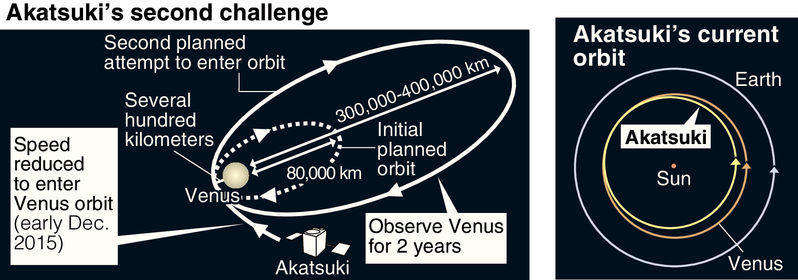
Well probably not many people still remembers Akatsuki, the poor Japanese Venus orbiter that is still stranded around solar orbit. But with Venus Express now dead and no approved future Venus missions worldwide, it is probably the last mission our nearest planet will receive for some time! The current plan is for it to try again entering Venus orbit in late November 2015 with a 20 minute burn of its RCS thrusters. The orbit attained won't be as good as the originally planned one, but will still support some good science of studying Venus' atmosphere. :tiphat:

In the mean time, scientists using one of its instruments found that solar wind is being accelerated drastically at a distance of 5 solar radii!
 
The latest news indicates the spacecraft will try entering a very elliptical Venus orbit in early December now.

The Planetary Society: "Short updates on Akatsuki and Chang'e missions"

On a side note, it appears that someone familiar looking was mentioned by Emily Lakdawalla.

20150106_akatsuki_yomiurishimbun.jpg


And because Japan:
akatsuki_cartoon_ill-be-back.jpg
 
Akatsuki is expected to begin its second orbital insertion attempt very soon.

[eventTimer]2015-12-06 23:51:00[/eventTimer]

(A timeline):
  • Sunday, December 6 (Japan time): Akatsuki turns to orbit insertion attitude.
  • Dec 7 04:30 JST / Dec 6 19:30 UT / Dec 6 11:30 PST: Usuda Deep Space Center begins tracking Akatsuki.
  • Dec 7 08:22 JST / Dec 6 23:22 UT / Dec 6 15:22 PST: Akatsuki enters Venus' penumbra.
  • Dec 7 08:51 JST / Dec 6 23:51 UT / Dec 6 15:51 PST: Akatsuki fires one set of RCS thrusters for about 20 minutes to enter Venus orbit.
  • After the firing, Akatsuki will automatically rotate to prepare for a second attempt at orbit insertion with its opposite set of RCS thrusters. Akatsuki will wait for instruction from Earth to find out if the second attempt is needed.
  • Dec 7 12:00 JST / Dec 7 03:00 UT / Dec 6 19:00 PST: JAXA will hold a press briefing from Sagamihara. At the press briefing, they will only be able to say whether or not the attitude control system functioned as commanded. It will take until December 9 to confirm that the spacecraft successfully entered Venus orbit. Another press briefing is scheduled for that day.
  • December 7, afternoon (Japan time): Canberra Deep Space Network begins tracking Akatsuki.

(Live 3D simulation)

And don't forget, Miku is onboard, too!

miku-space-probe.jpg


Last edited:
Looks like it (finally) worked!!!
Emily Lakdawalla ‏@elakdawalla 1m1 minute ago said:
Emily Lakdawalla Retweeted 大塚実(Minoru OTSUKA)

Applause in the control room!
 
Miku is now orbiting Venus!

Not yet. It will take to the 9th December to confirm that the trajectory is really achieved and the spacecraft entered orbit.
 
Not yet. It will take to the 9th December to confirm that the trajectory is really achieved and the spacecraft entered orbit.
The thrusters worked as intended this time, so it is very likely that it entered orbit; it's just that the exact orbit cannot be determined yet.

This would also make it the first Japanese space probe to orbit another planet.
 
Last edited:
The thrusters worked as intended this time, so it is very likely that it entered orbit; it's just that the exact orbit cannot be determined yet.

This would also make it the first Japanese space probe to orbit another planet.

Wrong. The spacecraft itself reported that the thrusters worked - that is a major difference. Also that the thrusters worked does not mean, that they are working in the correct direction.

This is all pretty important, since the spacecraft can't see itself from outside and does usually not have the sensors to decide if it is operating based on false premises (AFAIR, only the guidance system of Cassini is so sophisticated)
 
Now its confirmed officially: Akatsuki has entered elliptic orbit around Venus.
 
Akatsuki probe relays its first images from Venus orbit

613aa18fa64b9b1843bc58348105932f.jpg

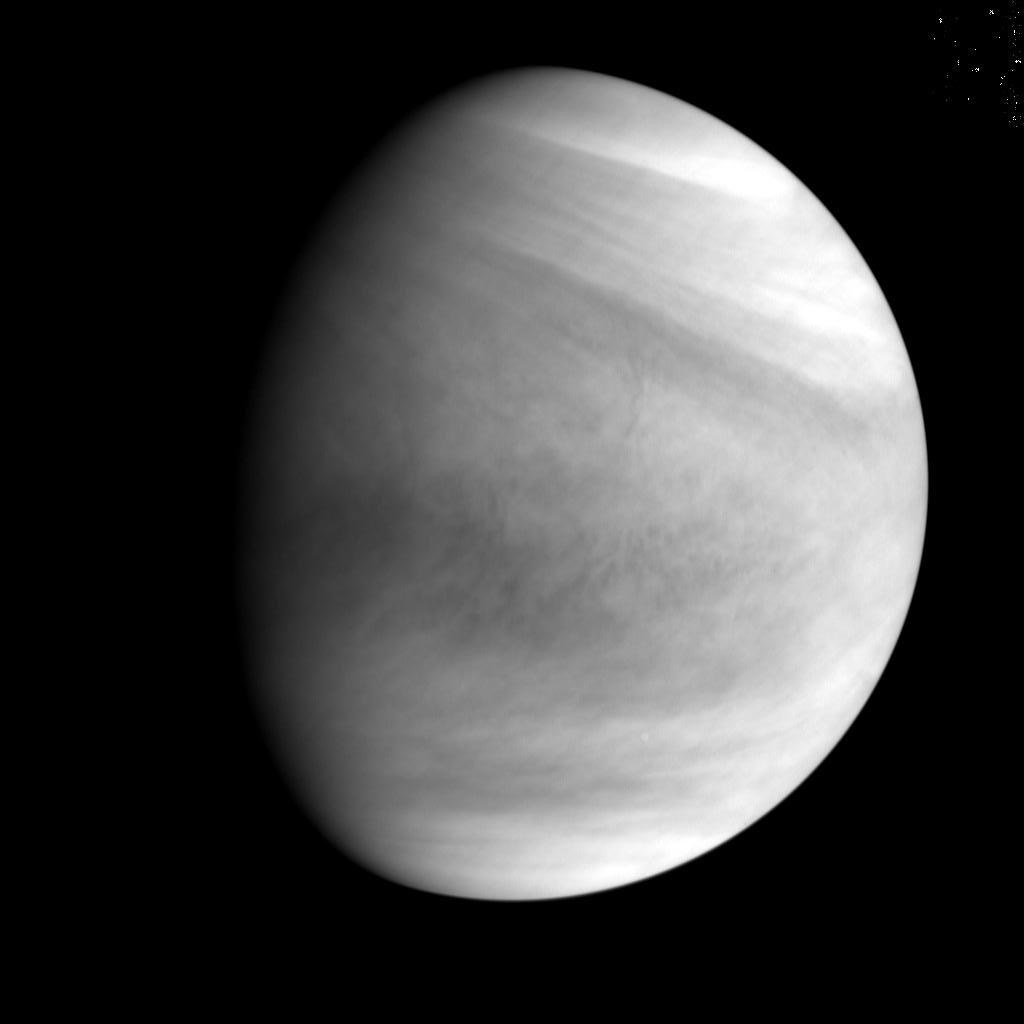
The Akatsuki spacecraft’s ultraviolet camera took this image of Venus at 0519 GMT
(12:19 a.m. EST) on Dec. 7 from a distance of 73,000 kilometers (45,000 miles). Credit: JAXA

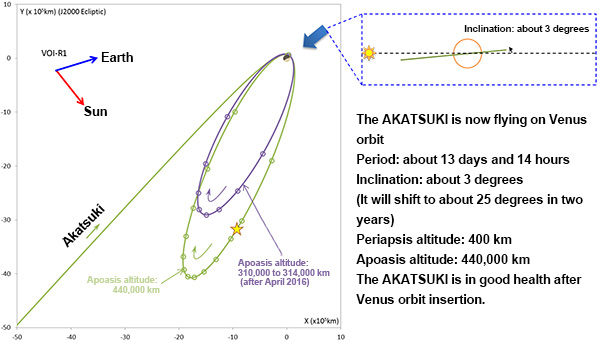
20151209_akatsuki_1.jpg

This diagram shows Akatsuki’s orbital parameters after arriving at Venus. Credit: JAXA
 
Back
Top