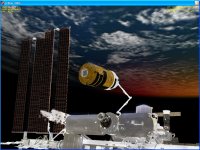
Updates JAXA's HTV-2 "Kounotori 2"

Last edited:
HTV-2 is now hard-mated to the International Space Station. Berthing completed at 14:51 UTC / 9:51 a.m. EST. Ungrappling of the station's robotic arm from the HTV-2 is to begin soon.

The crew will open hatches between Harmony and the HTV-2 and ingress the ship Friday, Jan. 28, at about 12:30 UTC / 7:30 a.m. EST.
 
Some fantastic HTV-2 berthing photos! :thumbup:

5392536197_e32c541a76_o.jpg


5392536169_a8405762a9_o.jpg


5393134256_c485a9a6ea_o.jpg


5393134148_a77253cdbc_o.jpg


NASA TV Video: Japanese Cargo Craft Arrives at ISS.​
Video: HTV-2 Rendezvouz/Grapple/Berthing Timelapse.​
 
From ISS On-Orbit Status Report for 27/01/2011.

At 11:39 AM GMT, JAXA's HTV-2 (H-II Transfer Vehicle-2) "Kounotori" was successfully grappled by FE-5 Paolo Nespoli & FE-6 Cady Coleman, assisted by CDR Scott Kelly, with the SSRMS (Space Station Remote Manipulator System). The SSRMS snares were closed at 11:40 AM and capture was completed at 11:41 AM (fully rigidized). Later, at ~3:00 PM GMT, HTV-2 was successfully berthed to the Nadir port of Node 2.

Prior to grappling HTV-2, Cady, Paolo & Scott worked their way through a number of preparatory steps involving:
  • Setting up the RWS (Robotic Workstation) in the Cupola, complete with CCR (Cupola Crew Restraint) for supporting the capture (later removing CCR again).
  • Verifying PCS (Portable Computer System) commanding plus confirming PROX link data (Paolo).
  • Configuring the Node 2 camcorder for subsequent HTV PCBM (Passive Common Berthing Mechanism) survey (Scott).
  • Performing HTV & SSRMS preps for HTV approach monitoring (Cady, Paolo).
  • Monitoring HTV final approach to 30m & confirming CP hold (Cady, Paolo).
  • Capturing HTV and, if required, maneuvering to the expected HTV capture position (Cady, Paolo).
  • Maneuvering the SSRMS to pre-install position (Cady, Paolo).
Later, the crew:
  • Inspected the HTV PCBM for FOD (Foreign Object Debris), using an internal camcorder out the Node 2 Nadir CBM hatch.
  • Powered up the CBCS (Centerline Berthing Camera System) at the Node 2 Nadir CBM.
  • Berthed & installed the HTV to the Node 2 Nadir CBM (CBM Stage 1 & Stage 2 capture, then fastened & torqued 16 ABOLTS) -- ~3:00 PM GMT.
  • Ungrappled the HTV.
  • Grappled the EP (Exposed Pallet) in the HTV's ULC (Unpressurised Logistics Carrier) with the SSRMS.
  • Cycled the Node 2 Nadir hatch cycle to Latched (Scott).
  • Pressurized and leak-checked the HTV/Node 2 Vestibule (Scott).
  • Opened Node 2 Nadir hatch, removed the CDC (Center Disk Cover) and mated power jumpers (Scott).
  • Inhibited the HCP (Hardware Command Panel) and stowed it in JPM (JEM Pressurized Module) until it is needed again for HTV-2 departure.
  • Uninstalled & relocated the CBCS to the Node 2 Zenith port for the HTV-2 relocation.
  • Powered down the two SSC (Station Support Computer) laptops used for additional monitors at the Lab RWS.
  • Deactivated the RWS video monitor system.
HTV-2 Capture Day Update:
Prior to capture, HTV-2 successfully performed ten nominal burns, per the plan:
  • HAM2 began at 5:21:18 AM GMT and had a delta-V of 1.00 m/s, using the RCS jets.
  • MC5 began at 5:44:42 AM GMT and had a delta-V of 0.08 m/s, using the RCS jets.
  • T1 began at 6:07:10 AM GMT and had a delta-V of 0.87 m/s, using the RCS jets.
  • A1 began at 6:53:26 AM GMT and had a delta-V of 0.02 m/s, using the RCS jets.
  • OOP1 began at 7:16:31 AM GMT and had a delta-V of 0.00 m/s, using the RCS jets.
  • A2 began at 7:39:14 AM GMT and had a delta-V of 0.01 m/s, using the RCS jets.
  • AI began at 8:24:45 AM GMT and had a delta-V of 0.59 m/s, using the RCS jets.
  • MCF1 began at 8:45:09 AM GMT and had a delta-V of 0.01 m/s, using the RCS jets.
  • RI' began at 9:02:14 AM GMT and had a delta-V of 2.05 m/s, using the RCS jets.
  • MCF2 began at 9:17:35 AM GMT and had a delta-V of 0.08 m/s, using the RCS jets.
When ISE commanded the HTV Data Path to "HTV PROX" before the HTV-to-ISS Prox link was established, two enabled "Cygnus" Cautions rang on board and woke up the crew (90 minutes after start of their sleep period). A scrub of other VV (Visiting Vehicle) C&W (Caution & Warning) events revealed two other "Cygnus" events enabled. Ground control inhibited all 4 events, and pressed on with nominal ops. Engineers know now that the two "Cygnus" alarms that rang are mapped to the same bits in CVT memory as nominal HTV data. Investigation why these "Cygnus" Cautions were enabled on board is continuing.
 
The hatches between the ISS and HTV-2 have been opened! :)
 
Nice, flawless mission ! Congratulations to JAXA ! :thumbup:
 
ISS Crew Conclude KOUNOTORI2 Berthing Operations.

All cables between KOUNOTORI2 and Harmony were connected. KOUNOTORI2's berthing operations was completed at 3:34 a.m., January 28, 2011.
 
JAXA Press Release:

January 28, 2011 (JST)
Japan Aerospace Exploration Agency (JAXA)​

The H-II Transfer Vehicle "KOUNOTORI2" (HTV2) was successfully berthed to the International Space Station (ISS) at 3:34 a.m. on January 28 (Japan Standard Time, JST.)
The HTV2 started its final approach to the ISS, and was captured by the ISS robotic arm at 8:41 p.m. on January 27 (JST). After being maneuvered by the arm, the HTV2 was berthed to the ISS at 3:34 a.m. on January 28 (JST).

Upon this successful berthing to the ISS, unloading of internal and external cargo by the onboard crew will begin and continue for several weeks.

Reference Link: You can find out more detailed information on the following Web site.
http://iss.jaxa.jp/htv/

--------------------------------------------------

HTV2 Berthing Successful

The H-II Transfer Vehicle "KOUNOTORI2" (HTV2) Flight, launched by the H-IIB Launch Vehicle No. 2 (H-IIB F2) on January 22, 2011 from the JAXA Tanegashima Space Center, was successfully berthed to the International Space Station (ISS) at 3:34 a.m. today, on January 28 (Japan Standard Time, JST.)
The HTV2 cargo, which is required for the ISS system operations and utilizations are now ready to be unloaded at the ISS.
With the successful berthing to the ISS, the HTV2 overcame the most critical point of the mission. We will do our utmost to successfully complete all the tasks of the mission, including cargo transfer, departure from the ISS, and re-entry to the atmosphere.

January 28, 2011
Keiji Tachikawa
President, JAXA​
________________________________________

The Mainichi Daily News:
 
Here's the latest HTV-2 timeline, compiled from numerous sources.

Feb. 1:
EP extraction from ULC, handoff to JEM RMS, and installation onto JEF.

Feb. 1 to 2:
Kobairo and MSPR transfer to JPM.

Feb. 2 to 4:
SSRMS grapple of SPDM, and SPDM removal of FHRC & CTC-4 from EP.

Feb. 7:
Removal of EP from JEF by JEM RMS, EP handoff from JEM RMS to SSRMS, and EP re-insertion into ULC by SSRMS.

Feb. 18:
HTV-2 relocation to Node 2 Zenith.

Mar. 7:
HTV-2 relocation to Node 2 Nadir.

Mar. 28:
HTV-2 unberthing from Node 2 Nadir.


Here is a view inside HTV-2's PLC through the now open hatches.
110128_hatch_open_01.jpg
 
Last edited:
A view inside the PLC! The new Kobairo rack can be seen in the forward rack bay on the right! :)

5395174039_c4b13f7da8_o.jpg
 
Here's one they missed.
 

Attachments

  • HTVdock.jpg
    HTVdock.jpg
    167.4 KB · Views: 33
A selection of great HTV-2 photos from Dimitri Kondratyev! :thumbup:

The full set of photos is here.

dim_30_01_11.jpg


dim_30_01_1.jpg


dim_30_01_2.jpg


dim_30_01_3.jpg


dim_30_01_4.jpg


dim_30_01_8.jpg

^In the above photo, you can see the external MLI cover from HTV-2's CBM hatch, floating in Columbus.

dim_30_01_9.jpg
 
Last edited:
Video of today's HTV-2 rack transfers is available in today's ISS Update - go to 4:35. In that shot, you can see Kobairo being installed in JPM1F3. MSPR is also visible at JPM1A4. The installation of these two racks marks the beginning of JEM Phase 2 utilisation! :)

 
Last edited:
From ISS On-Orbit Status Report for 31/01/2011.

Preparatory to the transfer of the new JAXA Kobairo ("stork") rack from HTV-2 (H-II Transfer Vehicle-2), CDR Scott Kelly & FE-5 Paolo Nespoli removed rack front stowage in Bay 1 and temporarily stowed it in the HTV-2 endcone.

Later, Scott & FE-6 Cady Coleman had several hours set aside for transferring the Kobairo rack from HTV-2 to the JPM (JEM Pressurized Module) and installing it at location Forward 3 (F3), including removing its protective launch locks.

Cady afterwards completed mating rack umbilicals, connecting them to the F3 Z-Panel, i.e., a UIP (Utility Interface Panel).

In the JPM, Scott activated the RLT (Robotics Laptop Terminal) and set up the DOUG (Dynamic Onboard Ubiquitous Graphics) application for the upcoming HTV-2 EP (Exposed Pallet) extract/insert activities with the SSRMS (Space Station Remote Manipulator System). [Used mostly during Robotics/SSRMS operations, DOUG is a software program on the MSS (Mobile Servicing System) RWS (Robotics Workstation) laptops that provides a graphical birds eye-view image of the up-to-date external station & robot arm configuration on a laptop for study of external ops.]

Later, Cady maneuvered the SSRMS to the EP pre-grapple position on the side of HTV-2, and Scott completed the grapple.

With the video equipment covering the training activity, Paolo & Cady worked with the ROBoT (Robotics On Board Trainer) to simulate/rehearse using the SSRMS for tomorrow's extraction of the EP from the HTV, moving it to the JEF (Japanese Exposed Facility) "veranda" and returning it later to the HTV for insertion. Afterwards, the video hardware was stowed again.

All crewmembers conducted a 15 minute HTV-2 Emergency Procedure Review, intended to familiarize them with the location of HTV hardware used in emergencies, key reminders for HTV emergency response topics and all hatches plus the ability to rapidly clear hatchways in emergencies, paying detailed attention to cables and all other obstructions at hatchways. [The review included verification of the integrity of all hatch rubber seals and availability of foot restraints.]
 
Back
Top