

Unstung
Active member
NASA is focusing on developing the technologies to land the heaviest ever payloads on Mars for obvious reasons. Whether this technology will see use sooner or later is an open question. This thread will be limited to covering the test flight of the LDSD, Low-Density Supersonic Decelerator, because the technology may not have significant press updates for years after this. If that assumption turns out to be incorrect, this thread may be merged with an older LDSD update here.
A concise summary of the test flight is written in the article "NASA's Saucer-Shaped Craft Preps for Flight Test"
A Star-48 engine will rocket the ship to altitude, where the airbags (or supersonic inflatable aerodynamic decelerator) will deploy at four times the speed of sound, increasing the size of the aeroshell and thus providing more drag. The 30 meter parachute will open at over twice the speed of sound.
While the sled test revealed some flaws in the parachute, it remains important to test the rest of the decelerator system in a relevant environment to the Martian atmosphere: Earth's upper atmosphere. With a test in a similar environment, it may be interpreted to bring the system up to a Technology Readiness Level (TRL) of 7, close to the flight proven level of 9.
The LDSD was unable to fly on any planned launch windows between June 3-14 at "the U.S. Navy's Pacific Missile Range in Kauai, Hawaii" due to unacceptable winds. The test has been rescheduled to occur between June 28 and July 3.
A concise summary of the test flight is written in the article "NASA's Saucer-Shaped Craft Preps for Flight Test"
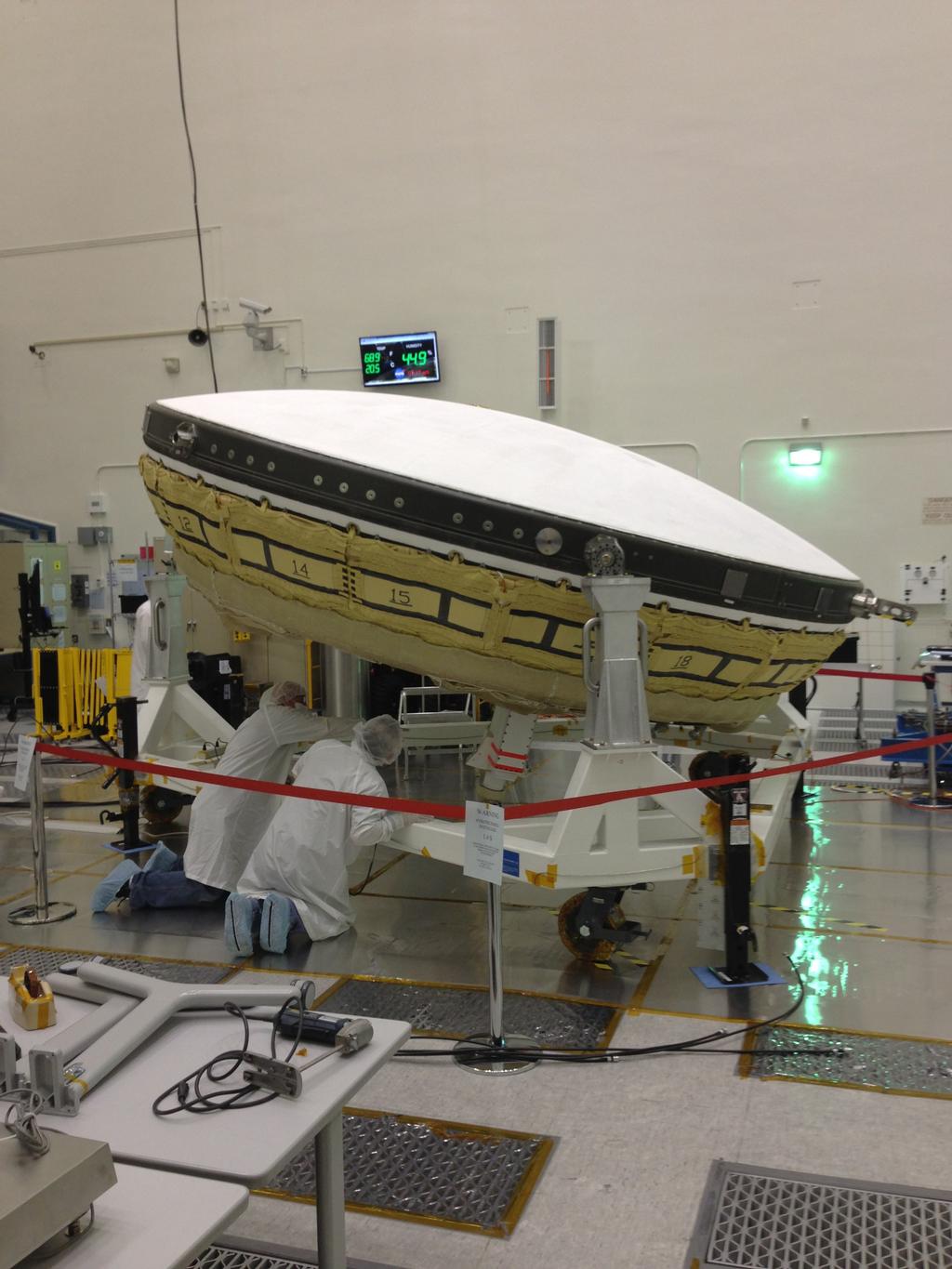
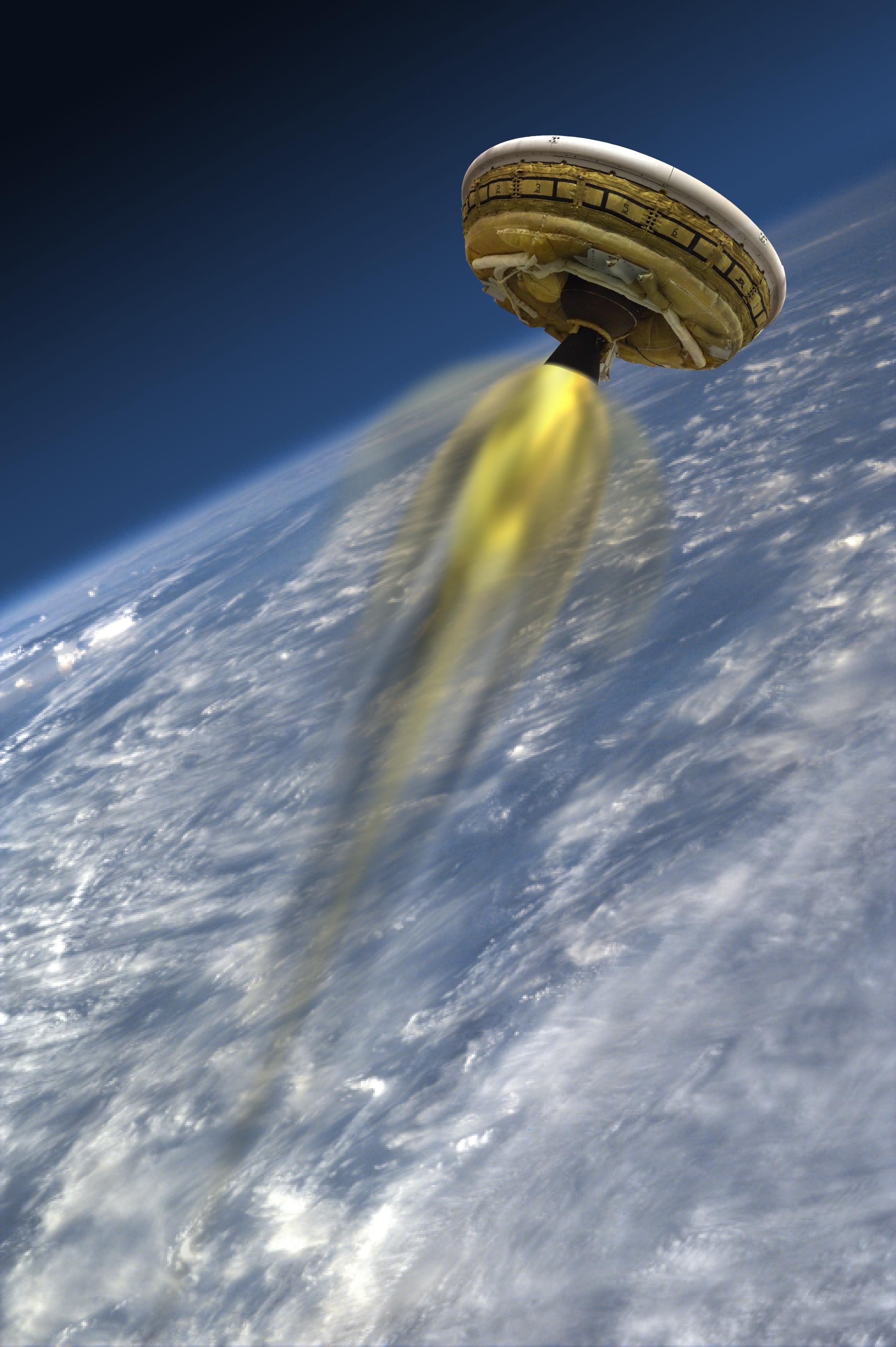
During the June experimental flight test, a balloon will carry the test vehicle from the Hawaii Navy facility to an altitude of about 120,000 feet. There, it will be dropped and its booster rocket will quickly kick in and carry it to 180,000 feet, accelerating to Mach 4. Once in the very rarified air high above the Pacific, the saucer will begin a series of automated tests of two breakthrough technologies.
A Star-48 engine will rocket the ship to altitude, where the airbags (or supersonic inflatable aerodynamic decelerator) will deploy at four times the speed of sound, increasing the size of the aeroshell and thus providing more drag. The 30 meter parachute will open at over twice the speed of sound.
This is what the demonstrator looks like:
 |
|
While the sled test revealed some flaws in the parachute, it remains important to test the rest of the decelerator system in a relevant environment to the Martian atmosphere: Earth's upper atmosphere. With a test in a similar environment, it may be interpreted to bring the system up to a Technology Readiness Level (TRL) of 7, close to the flight proven level of 9.
The LDSD was unable to fly on any planned launch windows between June 3-14 at "the U.S. Navy's Pacific Missile Range in Kauai, Hawaii" due to unacceptable winds. The test has been rescheduled to occur between June 28 and July 3.
Finally, a video about the test:
A recap of where the technology has been:
A recap of where the technology has been:
Last edited:


