News Massive Dreamliner problems caused by Lithium-Ion batteries

Urwumpe

Not funny anymore
Addon Developer
Donator
Joined
Feb 6, 2008
Messages
38,965
Reaction score
3,937
Points
203
Location
Wolfsburg
Preferred Pronouns
Sire
Since there is now a really significant rate of accidents of the same aircraft, I thought it is a good reason to trigger an discussion there. It looks like the problem is caused by the Lithium-Ion batteries, the same kind of power storage used in smart phones and some satellites. These batteries have the tendency to catch fire or explode, when used without control electronics, but are generally safe.

http://www.aviationtoday.com/the-checklist/NTSB-Examines-Dreamliners-Scorched-Battery_78240.html

The Dreamliner is currently the only aircraft that uses LiIon for power storage, because of its higher electrical power consumption. But there are also many accidents with LiIon batteries that had been only transported by cargo aircraft. One was lost in Dubai last year.

The question arises: What causes the accidents really? Is it the lowering of pressure in the aircraft? Poor design of the control electronics?
 
I did read the different discussion threads at Airliners.net, and my impression is that each case has a different origin that resulted in smoking APU batteries and even fire in the electronics bay. Remember that the 787 has a rather radical change in the electronics system.......
 
Ultimately I think someone's cutting corners on safety and design.

Lithium burns in contact with oxygen in air, so it's critical that the case of the battery remains intact. The case can be damaged either through mechanical means or because the battery overheats and its internal pressure increases. Overheating can be caused by pushing too much current through the battery. Lithium batteries have very small internal resistance and their voltage drop-off at high power output is also minimal. Their voltage drop-off as the battery drains is also minimal, so they're capable of high power output for a long time.

Manufacturers of RC lithium polymer batteries always give a C rating on the battery. The C rating indicates how much current a battery can safely give off, but the battery itself is not limited to that current, it's capable of much higher output. There are usually two C ratings, one for continuous output and one for very short time, for example:
40C continuous, 50C for 10 seconds. The maximum safe current can be calculated as capacity * C rating.

You mentioned lower pressure in the aircraft, but at the same time you mentioned satellites. Unless they keep the batteries in the satellites have two casings, one casing that separates the battery and atmosphere at 1 bar and the other that separates the atmosphere and vacuum, they have to cope with quite a bit more pressure difference than on aircraft. Satellite batteries are also subjected to higher temperature variation and quicker charge / discharge cycles.
 
Last edited:
Cost cutting is at an all-time high only going to get worse. But the woes of the 787 are more than that. It is the first aircraft of its size that has this amount of composites and electrics onboard. The first of anything is always a trial and error run. Regardless of how well it is tested at the factory, things will need to be learned from the mechanics and operators and fed back to the factory. Once a mass of practical knowledge is accumulated then the next version will be so much better.

It's this way with everything from toy computers we play orbiter on - to complete aerospace defense systems. Notes from the field are invaluable!
 
Last edited:
Huh? Someone built Li-Ion batteries into the plane? And someone else signed off the safety review? Mere transportation of Li-Ion batteries on planes is restricted for safety reasons!

http://www.ups.com/media/news/en/intl_lithium_battery_regulations.pdf
http://www.bobatkins.com/photography/li_battery_restrictions.html

Yes - actually by special permit. A test with live passengers, if you would say so. UPS is also the reason why the transportation of lithium batteries is restricted, since they lost two planes because of them. ;)

[ame="http://en.wikipedia.org/wiki/UPS_Airlines_Flight_6"]UPS Airlines Flight 6 - Wikipedia, the free encyclopedia[/ame]

http://www.tomshardware.com/news/ntsb-laptopbattery-upsfire,3131.html
 
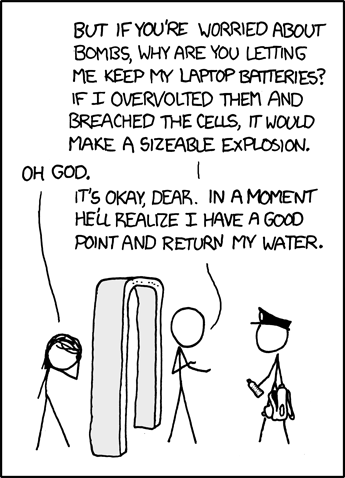
Vaguely related XKCD... :shifty:

bag_check.png


Once a mass of practical knowledge is accumulated then the next version will be so much better.
Sounds a bit like the A380's teething problems that got solved - just a bit more dramatic...
 
Li-Polymer batteries can be quite volatile, as i've seen myself.
The first RC helicopter i made had the control board sitting atop the battery pack. On it's maiden flight it turned upside-down, and slammed into the ground, driving IC pins into the battery.
There was a peculiar smell in the air, 10 seconds later there was smoke, 30 seconds later the thing was very much on fire.
All from a couple of square millimetre holes.

Also, according to the manual shorting that battery for more than 5 seconds would make it a time bomb, as the internal temperature would go above a critical point, and continue to rise in a self-sufficient reaction, until it bursts into flames.

So, damaging these batteries means hot metal fire, overloading them means hot metal fire, and merely overheating them means hot metal fire.

There is another, similar chemistry - lithium iron phosphate (LiFePO), that is much less volatile, probably the least of all lithium types, at cost of somewhat less energy density.

Now, i wonder why did they choose Li-Ion, instead of LiFe-Po, or choose lithium batteries at all?
 
There is another, similar chemistry - lithium iron phosphate (LiFePO), that is much less volatile, probably the least of all lithium types, at cost of somewhat less energy density.

Now, i wonder why did they choose Li-Ion, instead of LiFe-Po, or choose lithium batteries at all?

You said it yourself, less energy density. They must not have much margin with the batteries on board to provide power to satisfy either power budget or FAA requirements and had to go for the Li-Ion ones... Either that or the Li-Ion were cheaper than the tamer alternatives. Or both.
 
You said it yourself, less energy density. They must not have much margin with the batteries on board to provide power to satisfy either power budget or FAA requirements and had to go for the Li-Ion ones... Either that or the Li-Ion were cheaper than the tamer alternatives. Or both.

Probably not cheaper after this! :P (or a lost aircraft)
 
Writing this as an expert on batteries myself; Elon is absolutely correct about thermal stability and runaway.

And furthermore, Boeing has a pride issue here.
 
http://www.gpo.gov/fdsys/pkg/FR-2007-04-30/html/E7-8186.htm

This is the original FAA notice of special conditions for Boeing to put those Li-ion batteries on board. I bet there's some madly intensive analysis going on now in all the electrical suppliers to Boeing, plus Boeing, FAA, NTSB and the Japanese authorities.

Also - for anyone in any doubt how dangerous these batteries can potentially be ... RIP the poor souls on UPS Flight 6 here: [ame="http://en.wikipedia.org/wiki/UPS_Airlines_Flight_6"]http://en.wikipedia.org/wiki/UPS_Airlines_Flight_6[/ame]
 
Last edited:
Funny that they go way back to Cadmium, when the car industry already settled on Lithium-Polymer as technology.
 
aviationweek.com said:
The ultimate irony in this elaborate fix is the 150 lb of the hefty enclosure eliminates much of the weight benefit of using lithium ion batteries in the first place.

Once again, why bother instead of using a more stable chemistry?
 
Back
Top