Updates MESSENGER Mission News

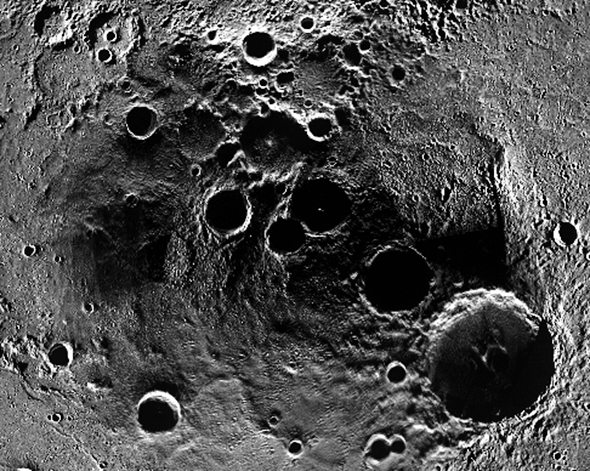
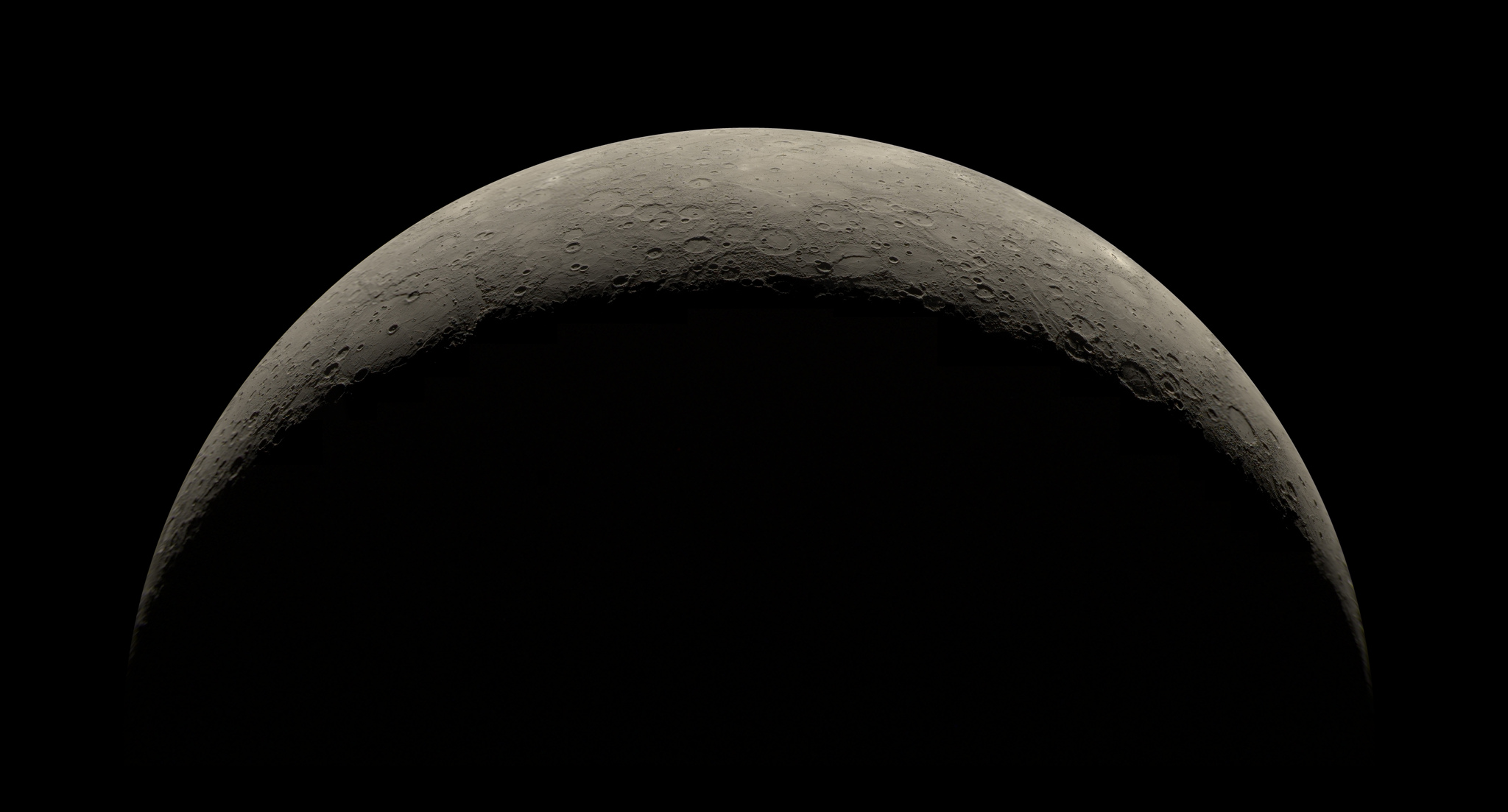
Universe Today: Mercury’s Shadowy North Pole

8224477844_c9ba301271_crop.jpg


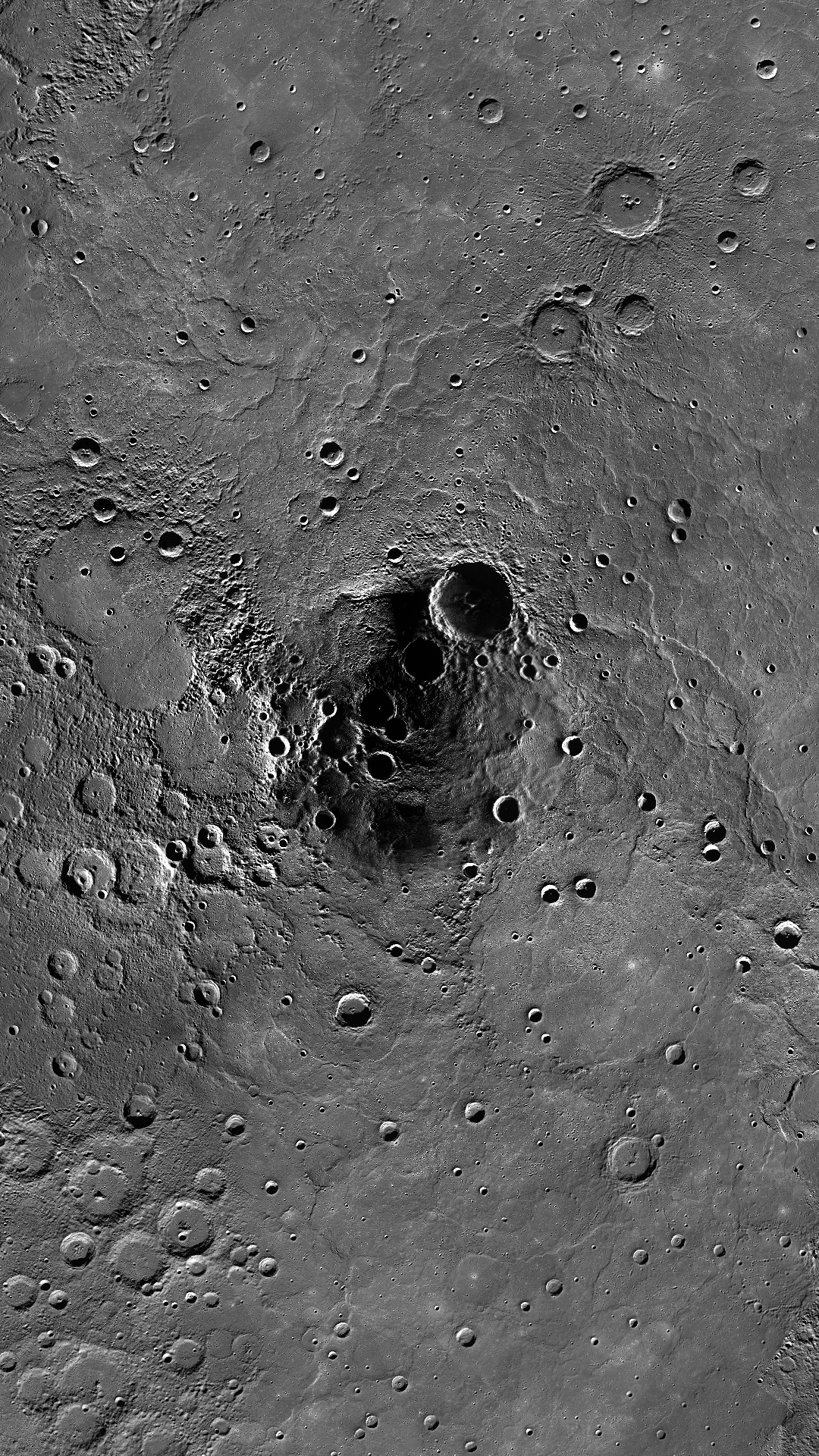
8224477844_c9ba301271_o.jpg
 
JHU APL:
MESSENGER Mission News
November 29, 2012
http://messenger.jhuapl.edu/


MESSENGER Finds New Evidence for Water Ice at Mercury's Poles

New observations by the MESSENGER spacecraft provide compelling support for the long-held hypothesis that Mercury harbors abundant water ice and other frozen volatile materials in its permanently shadowed polar craters.

Three independent lines of evidence support this conclusion: the first measurements of excess hydrogen at Mercury's north pole with MESSENGER's Neutron Spectrometer, the first measurements of the reflectance of Mercury's polar deposits at near-infrared wavelengths with the Mercury Laser Altimeter (MLA), and the first detailed models of the surface and near-surface temperatures of Mercury's north polar regions that utilize the actual topography of Mercury's surface measured by MLA. These findings are presented in three papers published online today in Science Express.

Given its proximity to the Sun, Mercury would seem to be an unlikely place to find ice. But the tilt of Mercury's rotational axis is almost zero -- less than one degree -- so there are pockets at the planet's poles that never see sunlight. Scientists suggested decades ago that there might be water ice and other frozen volatiles trapped at Mercury's poles.

The idea received a boost in 1991, when the Arecibo radio telescope in Puerto Rico detected unusually radar-bright patches at Mercury's poles, spots that reflected radio waves in the way one would expect if there were water ice. Many of these patches corresponded to the location of large impact craters mapped by the Mariner 10 spacecraft in the 1970s. But because Mariner saw less than 50 percent of the planet, planetary scientists lacked a complete diagram of the poles to compare with the images.

MESSENGER's arrival at Mercury last year changed that. Images from the spacecraft's Mercury Dual Imaging System taken in 2011 and earlier this year confirmed that radar-bright features at Mercury's north and south poles are within shadowed regions on Mercury's surface, findings that are consistent with the water-ice hypothesis.

Now the newest data from MESSENGER strongly indicate that water ice is the major constituent of Mercury's north polar deposits, that ice is exposed at the surface in the coldest of those deposits, but that the ice is buried beneath an unusually dark material across most of the deposits, areas where temperatures are a bit too warm for ice to be stable at the surface itself.

MESSENGER uses neutron spectroscopy to measure average hydrogen concentrations within Mercury's radar-bright regions. Water ice concentrations are derived from the hydrogen measurements. "The neutron data indicate that Mercury's radar-bright polar deposits contain, on average, a hydrogen-rich layer more than tens of centimeters thick beneath a surficial layer 10 to 20 centimeters thick that is less rich in hydrogen," writes David Lawrence, a MESSENGER Participating Scientist based at the Johns Hopkins University Applied Physics Laboratory and the lead author of one of the papers. "The buried layer has a hydrogen content consistent with nearly pure water ice."

Data from MESSENGER's Mercury Laser Altimeter (MLA) -- which has fired more than 10 million laser pulses at Mercury to make detailed maps of the planet's topography -- corroborate the radar results and Neutron Spectrometer measurements of Mercury's polar region, writes Gregory Neumann of the NASA Goddard Flight Center. In a second paper, Neumann and his colleagues report that the first MLA measurements of the shadowed north polar regions reveal irregular dark and bright deposits at near-infrared wavelength near Mercury's north pole.

"These reflectance anomalies are concentrated on poleward-facing slopes and are spatially collocated with areas of high radar backscatter postulated to be the result of near-surface water ice," Neumann writes. "Correlation of observed reflectance with modeled temperatures indicates that the optically bright regions are consistent with surface water ice."

The MLA also recorded dark patches with diminished reflectance, consistent with the theory that the ice in those areas is covered by a thermally insulating layer. Neumann suggests that impacts of comets or volatile-rich asteroids could have provided both the dark and bright deposits, a finding corroborated in a third paper led by David Paige of the University of California, Los Angeles.

Paige and his colleagues provided the first detailed models of the surface and near-surface temperatures of Mercury's north polar regions that utilize the actual topography of Mercury's surface measured by MLA. The measurements "show that the spatial distribution of regions of high radar backscatter is well matched by the predicted distribution of thermally stable water ice," he writes.

According to Paige, the dark material is likely a mix of complex organic compounds delivered to Mercury by the impacts of comets and volatile-rich asteroids, the same objects that likely delivered water to the innermost planet. The organic material may have been darkened further by exposure to the harsh radiation at Mercury's surface, even in permanently shadowed areas.

This dark insulating material is a new wrinkle to the story, says Sean Solomon of the Columbia University's Lamont-Doherty Earth Observatory, principal investigator of the MESSENGER mission. "For more than 20 years the jury has been deliberating on whether the planet closest to the Sun hosts abundant water ice in its permanently shadowed polar regions. MESSENGER has now supplied a unanimous affirmative verdict."

"But the new observations have also raised new questions," adds Solomon. "Do the dark materials in the polar deposits consist mostly of organic compounds? What kind of chemical reactions has that material experienced? Are there any regions on or within Mercury that might have both liquid water and organic compounds? Only with the continued exploration of Mercury can we hope to make progress on these new questions."

{...}


JHU APL MESSENGER Gallery:
NASA: MESSENGER Finds New Evidence for Water Ice at Mercury's Poles

NASA News Release: RELEASE : 12-411 - NASA Spacecraft Finds New Evidence for Water Ice on Mercury

NPR: Space Probe Finds Ice In Mercury's Craters

SpaceRef: New Evidence for Water Ice at Mercury's North Pole

Nature: Stores of ice confirmed on Sun-scorched Mercury

NewScientist: Messenger finds hints of ice at Mercury's poles
 
Water would make colony a viable concept but for the near term but there
would have to be an incentive to have an outpost there.

If we discover concetrated regions of important metal elements on Mercury
from orbit, you can bet robotic exploration will be next and you could
even get funding outside NASA for this.

a very small rover (think 1/2 the size of M.E.R) with enough instrumentation,
and a limited abilty to drill a few inches would be enough

A lunar mining is more doable, but it's more of a question of any important
ore's concentration & Rarity & Utility that will determine the which celestial
body gets an industrial venture going.
 
MESSENGER Mission News
December 21, 2012
http://messenger.jhuapl.edu/


Recently Named Mercury Craters Honor Blues Singer and Animation Pioneer

The International Astronomical Union (IAU) recently approved a proposal from the MESSENGER Science Team to assign names to nine impact craters on Mercury. The IAU has been the arbiter of planetary and satellite nomenclature since its inception in 1919. In keeping with the established naming theme for craters on Mercury, all of the newly designated features are named after famous deceased artists, musicians, or authors or other contributors to the humanities. The newly named craters are:

  • Catullus, for Gaius Valerius Catullus (ca. 84 BC – ca. 54 BC), a Latin poet of the Republican period. His surviving works are still read widely and continue to influence poetry and other forms of art.

  • Disney, for Walter Elias "Walt" Disney (1901-1966), an American film maker, actor, and animator who, along with his brother Roy O. Disney, co-founded Walt Disney Productions, which later became one of the best-known motion picture producers in the world.

  • Hopper, for Edward Hopper (1882-1967), a prominent American realist painter and printmaker. Although he was most popularly known for his oil paintings, he was equally proficient as a watercolorist and printmaker in etching.

  • Joplin, for Scott Joplin (1868-1917), an African-American composer and pianist who wrote 44 original ragtime pieces, one ragtime ballet, and two operas. One of his first pieces, the "Maple Leaf Rag," became ragtime's first and most influential hit and has been recognized as the archetypal rag.

  • Kobro, for Katarzyna Kobro (1898-1951), a prominent Polish sculptor who co-founded the AR ("Revolutionary Artists" or "avant-garde Actual"). She is credited with revolutionizing thinking about sculpture. Her work explored the relations between the art object, the audience, and the surrounding space.

  • Komeda, for Krzysztof Komeda (1931-1969), a Polish film music composer and jazz pianist best known for his work in film scores. He wrote the scores for Roman Polanski's films "Rosemary's Baby," "The Fearless Vampire Killers," "Knife in the Water," and "Cul-de-sac." His album "Astigmatic" (1965) is widely regarded as one of the most important European jazz albums.

  • Kyōsai, for Kawanabe Kyōsai (1831-1889), a Japanese artist who attained a reputation as a caricaturist. In addition to his caricatures, Kyōsai painted a large number of pictures and sketches, often choosing subjects from the folklore of his country.

  • Popova, for Lyubov Popova (1889-1924), a Russian painter, graphic artist, theatrical designer, applied artist, and illustrator. She painted in a Cubo-Futurist style and designed fabrics and agitprop books and posters.

  • Waters, for McKinley "Muddy Waters"� Morganfield (1915-1983), an African-American blues musician, generally considered the father of modern "Chicago blues." He was a major inspiration for the British blues explosion in the 1960s and is ranked No. 17 in Rolling Stone magazine's list of the 100 Greatest Artists of All Time.

These nine newly named craters join 86 other craters named since the MESSENGER spacecraft’s first Mercury flyby in January 2008. “Kawanabe Kyōsai, 19th century Japanese artist and now namesake of Kyōsai crater on Mercury, changed the first character of his name from ? (meaning ‘crazy’) to ? (meaning ‘enlightenment’) upon being released from prison,” notes William Vaughan, a Ph.D. student at Brown University who, as a member of MESSENGER Geology Discipline Group, was involved in selecting the names. “I hope that careful study of Kyōsai crater will similarly reward us with enlightenment about Mercury’s enigmatic geology.”

Images of several of the craters can be found in the MESSENGER Science Images Gallery including Cattalus, Disney, and Waters. All of the newly named craters can be explored interactively on a global map of Mercury, with instructions available online at http://messenger.jhuapl.edu/gallery/sciencePhotos/image.php?image_id=1053.

"The MESSENGER team appreciates the timely approval by IAU of the names for this new list of impact craters," adds MESSENGER Principal Investigator Sean Solomon of Columbia University's Lamont-Doherty Earth Observatory. "Because these features are areas of active geological study by our team, the formal names will make it easier to communicate our findings to colleagues in the planetary sciences. More importantly, the naming of these features marks another opportunity to honor those on our planet who have advanced the arts across many eras and cultures."

More information about the names of features on Mercury and the other objects in the Solar System can be found at the U.S. Geological Survey's Planetary Nomenclature Web site: http://planetarynames.wr.usgs.gov/index.html.


MESSENGER Team Member Highlight

Christopher Hash helped create the data processing scheme for MESSENGER's Science Operations Center. Read more about his role on the mission online at http://messenger.jhuapl.edu/who_we_are/member_focus.html.

{...}
 
http://www.bbc.co.uk/news/science-environment-21468172

Scientists working on Nasa's Messenger probe to Mercury have shown off a stunning new colour map of the planet.

It comprises thousands of images acquired by the spacecraft during its first year in orbit.

This is not how we would see Mercury, which would look like a dull, brownish-grey globe to our eyes.

N.
 
http://messenger.jhuapl.edu/

Planetary Data System Releases MESSENGER Data from Third Mercury Solar Day


The Planetary Data System (PDS), which archives and distributes data from all of NASA’s planetary missions, today released data collected during MESSENGER’s thirteenth through eighteenth month in orbit around Mercury. With this release, images and measurements are now available to the public for the third full Mercury solar day of MESSENGER orbital operations.


NASA requires that all of its planetary missions archive data in the PDS, which makes available well-documented, peer-reviewed data to the research community. This ninth delivery of MESSENGER measurements includes raw and calibrated data from all seven of the mission’s science instruments, plus radio science data from the spacecraft telecommunications system, from March 25 to September 17, 2012.


The team has also provided, for the first time in this release, advanced products created with data collected through March 25, 2012, encompassing the first two full Mercury solar days of MESSENGER orbital operations. Those products include the first global mosaics of Mercury to be delivered to PDS.


“The two advanced image products in this release are an eight-color map and a higher-resolution monochrome map,” says Mercury Dual Imaging System (MDIS) Instrument Scientist Nancy Chabot, of the Johns Hopkins University Applied Physics Laboratory (APL). “They are both the products of thousands of images mosaicked together to reveal Mercury's global geology and color characteristics. These mosaics required considerable effort by many on the MESSENGER team, and we are all very proud to make these global maps available.”


Other advanced products include summed gamma-ray spectra and background-subtracted, geolocated neutron counts from the Gamma-Ray and Neutron Spectrometer; time-averaged magnetic field data from the Magnetometer; altimeter profiles, radiometry, and a northern hemisphere digital elevation map produced with data from the Mercury Laser Altimeter (MLA); limb tangent height and surface reflectance spectra from the Mercury Atmospheric and Surface Composition Spectrometer; pitch-angle and measured-flux distributions and energy spectra from the Energetic Particle and Plasma Spectrometer; and occultation data and spherical harmonic gravity and shape models derived from the radio science investigation and the MLA.


“Many in the public have been eagerly awaiting the release of the MESSENGER advanced products, and the MESSENGER team is excited to be able to provide them,” says APL’s Susan Ensor, MESSENGER’s Science Operations Center lead. “Extra analyses and processing are required to generate these products, which in many cases combine data over time and include maps, topography, and other global data. The team has also worked closely with the PDS in planning and documenting these new products to ensure their long-term usefulness to the science community.”


“Mercury is a planet of many mysteries,” adds MESSENGER Principal Investigator Sean Solomon, of Columbia University’s Lamont-Doherty Earth Observatory. “With each increment of data, we have made discoveries that raised new questions. Finding answers to those questions requires further analysis. We hope that this latest release of MESSENGER data will induce more of our colleagues from the broader planetary science community to help us unravel the many stories that Mercury has yet to tell.”


The MESSENGER mission’s ACT-REACT-QuickMap software, developed by Applied Coherent Technology Corporation, allows users to examine global mosaics constructed with high-resolution images from this and previous PDS deliveries. The tool also provides weekly updates of coverage for surface-observing instruments, as well as the status of specially targeted MDIS observations. Future enhancements to QuickMap will include simple data fusion, by which data sets from multiple elements of the payload may be combined.


QuickMap can be accessed via links on the MESSENGER websites at http://messenger.jhuapl.edu/ and http://www.nasa.gov/messenger. The MDIS mosaics can be downloaded from http://messenger.jhuapl.edu/the_mission/mosaics.html.

The data for this release are available online at http://pds.nasa.gov/subscription_service/SS-20130308.html, and all of the MESSENGER data archived at the PDS thus far are available at http://pds.nasa.gov. The team will submit two more data deliveries to PDS at six-month intervals from MESSENGER’s extended mission.


--------------------------------------------------------------------------------


MESSENGER (MErcury Surface, Space ENvironment, GEochemistry, and Ranging) is a NASA-sponsored scientific investigation of the planet Mercury and the first space mission designed to orbit the planet closest to the Sun. The MESSENGER spacecraft launched on August 3, 2004, and entered orbit about Mercury on March 18, 2011 (UTC), to begin its primary mission – a yearlong study of its target planet. MESSENGER’s extended mission began on March 18, 2012. Dr. Sean C. Solomon, the Director of Columbia University's Lamont-Doherty Earth Observatory, leads the mission as Principal Investigator. The Johns Hopkins University Applied Physics Laboratory built and operates the MESSENGER spacecraft and manages this Discovery-class mission for NASA.


--------------------------------------------------------------------------------
 
MESSENGER Mission News
March 18, 2013
http://messenger.jhuapl.edu/


MESSENGER Completes Its First Extended Mission at Mercury

On March 17, 2013, MESSENGER successfully completed its year-long first extended mission in orbit about Mercury, building on the groundbreaking scientific results from its earlier primary mission. Today the team is poised to embark on a second extended mission that promises to provide new observations of Mercury's surface and interior at unprecedented spatial resolution and of the planet's dynamic magnetosphere and exosphere at high time resolution during the peak and declining phase of the current solar cycle.

"NASA is currently considering a second extension to mission operations and until the formal decision is made has asked that we continue to operate the spacecraft and its scientific instruments," says MESSENGER Project Manager Helene Winters of the Johns Hopkins University Applied Physics Laboratory (APL) in Laurel, Maryland.

During its first extended mission, MESSENGER completed 12 specialized measurement campaigns that led to new discoveries about surface volatiles on Mercury, the duration of volcanism, the evolution of long-wavelength topography, the nature of localized regions of enhanced exospheric density, the effect of the solar cycle on Mercury's exosphere, and Mercury's energetic electrons.

Among the most recent results was confirmation of the long-held theory that the planet harbors abundant water ice and other frozen volatile materials within its permanently shadowed polar craters.

If approved by NASA, a second extended mission would seek answers to still further questions, each stimulated by findings from the primary mission and first extended mission, including:
  • What active and recent processes have affected Mercury's surface?

  • How has the state of stress in Mercury's crust evolved over time?

  • How have compositions of volcanic materials on Mercury varied with time?

  • What are the characteristics of volatile sequestration in Mercury's north polar region?

  • What are the consequences of precipitating ions and energetic electrons at Mercury?

  • How do Mercury's exosphere and magnetosphere respond to extreme solar wind conditions near and following solar maximum?

  • What novel insights into Mercury's thermal and crustal evolution can be obtained from high-resolution measurements made at low altitudes?

A possible second extended mission is among the topics MESSENGER team members will be discussing on March 20 in a session at the 44th Lunar and Planetary Science Conference in The Woodlands, Texas.

"Mercury has been revealing its many secrets, but each discovery has led to new puzzles," adds MESSENGER Principal Investigator Sean Solomon, of Columbia University's Lamont-Doherty Earth Observatory. "We now have a healthy spacecraft in orbit around a planet that will not be visited by spacecraft again for more than 10 years. Our scientific plans for a second extended mission build on past discoveries, can be accomplished with planned orbital observations, span an unprecedented phase of the solar cycle, and include extraordinarily low-altitude campaigns that will offer spectacular new views of Mercury's surface and near-surface environment. We hope that NASA will support the continued investigation of the most enigmatic of the inner planets."

{...}


JHU APL: A Tribute to MESSENGER: Video!


Universe Today:
 
http://messenger.jhuapl.edu/

May 24, 2013

MESSENGER Completes Its 2,000th Orbit of Mercury, Provides Data on Solar Magnetic Field

MESSENGER began its 2,000th orbit around Mercury earlier this week, on May 22. The spacecraft completed its primary mission on March 17, 2012, and its first extended mission on March 17, 2013. The team is awaiting word from NASA on a proposal for a second extended mission. In the meantime, instruments aboard the spacecraft continue to gather new data on Mercury and its environment

N.
 
http://messenger.jhuapl.edu/

June 7, 2013

IAU Approves New Names for Ten Major Fault Scarps on Mercury

The International Astronomical Union (IAU) recently approved a proposal from the MESSENGER Science Team to assign names to 10 rupes, the long cliff-like escarpments that formed over major faults along which one large block of crust on Mercury was thrust up and over another. The IAU has been the arbiter of planetary and satellite nomenclature since its inception in 1919. In keeping with the established naming theme for rupes on Mercury, all of the newly designated features are named after ships of discovery. [more]

Terror Rupes, after the HMS Terror. Built in the early 1800s as a British Royal Navy bomb vessel, the ship was involved in the bombardment of Fort McHenry, one of the last battles of the War of 1812. The bombardment provided the inspiration for Francis Scott Key to write the American national anthem "Star Spangled Banner." After being retrofitted for polar exploration, the ship participated in Antarctic exploration

Nice to see that its not been forgotten...

N.
 
Last edited:
MESSENGER to Capture Images of Earth and Moon During Search for Satellites of Mercury


NASA’s Mercury-orbiting MESSENGER spacecraft will capture images of Earth on July 19 and 20. The images will be taken at 7:49 a.m., 8:38 a.m. and 9:41 a.m. EDT on both days. Nearly half of the Earth, including all the Americas, Africa, and Europe, will be illuminated and facing MESSENGER, according to Hari Nair, the Johns Hopkins University Applied Physics Laboratory planetary scientist who designed and is implementing the campaign. The images on the second day will also include pictures of the Moon, where all six of the Apollo landing sites will be illuminated, 44 years to the day after Apollo 11 landed on the Moon’s rocky surface.

http://messenger.jhuapl.edu/news_room/details.php?id=242
 
I think Cassini is going to take an Earth picture tomorrow, too. So, we will have our picture taken from both Mercury and Saturn within hours. Cool!
 
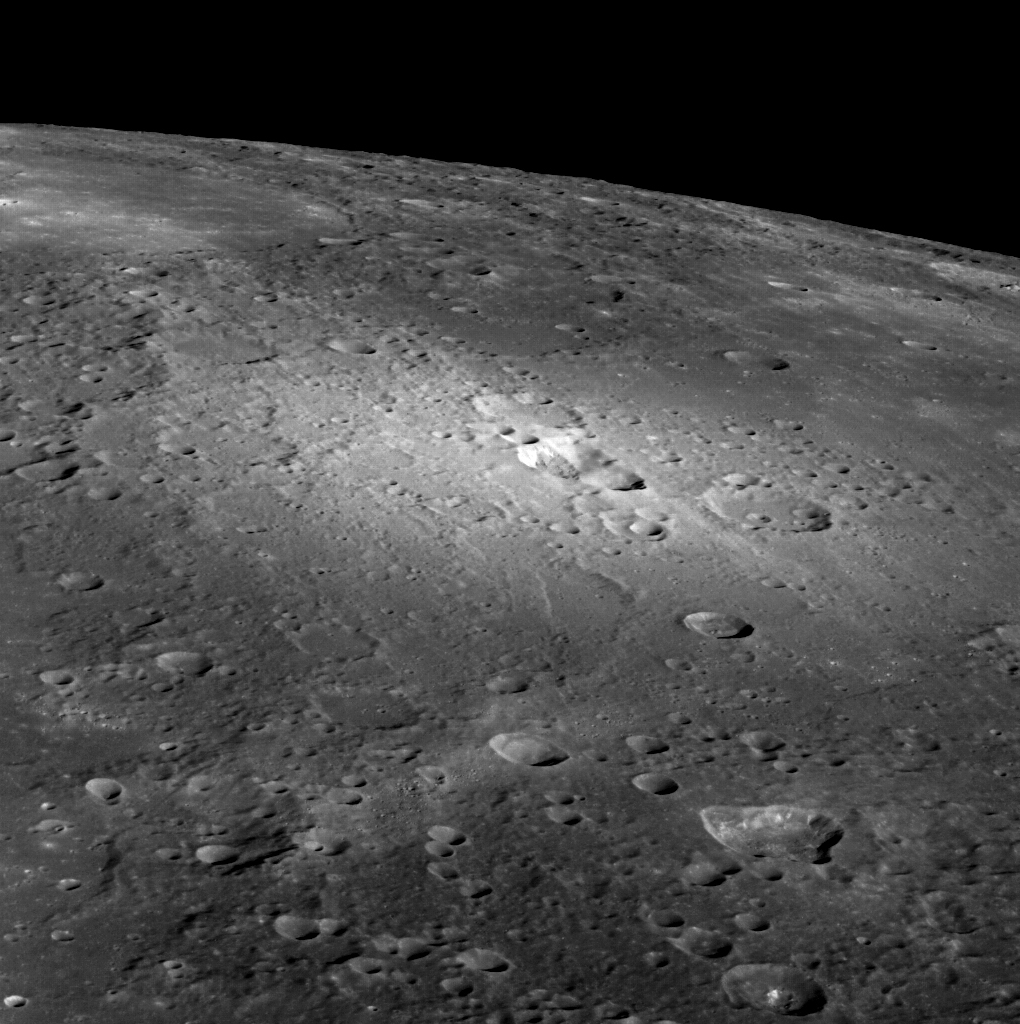
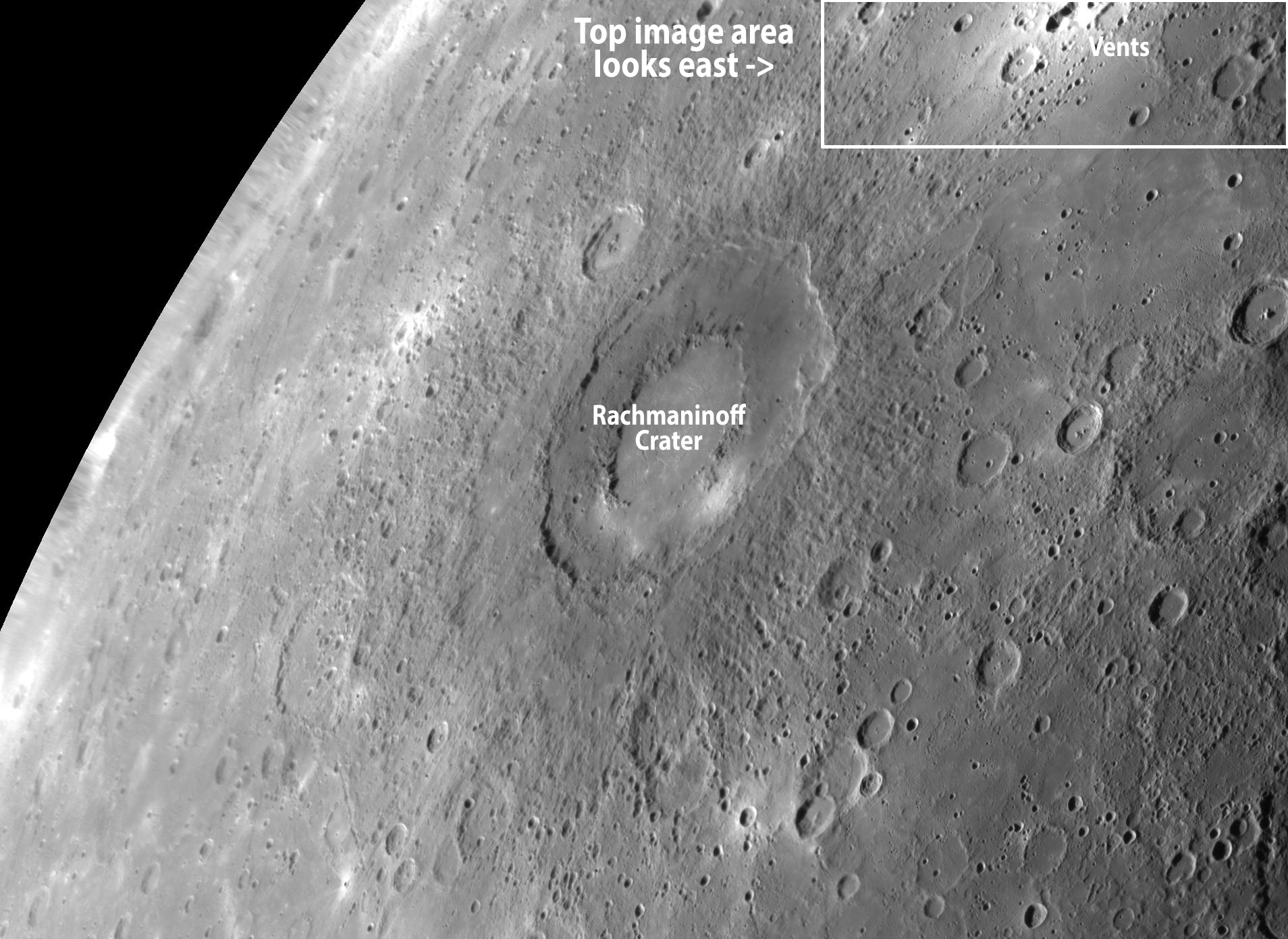
Universe Today: A Volcanic View of Mercury

EW1019543205G.nomap_.jpg

An oblique view of pyroclastic vents on Mercury via MESSENGER


Rachmaninoff.png

MESSENGER image of Rachmaninoff crater obtained in September 2009​
 
Amazing pictures I think?
 
Back
Top