Question Most Realistic Orbiter Spacecraft ?

And to add in the implausibility list: The rear yaw/X axis translation RCS on the DG would shoot exhaust into the vertical stabilisers...
Not only that, but after seeing videos of the Space Shuttle's RCS firing, those nozzles should also damage the upper surface of the wing, even if some sort of hinge moved the vertical stabilisers out of the direct line of fire.
 
Actually, upon close inspection of the XR2's model it's CoL appears to be near the Cargo Bay's aft bulkhead. Based on what we can see of the interior arrangement (and a rough estimate of it's "wet" CoM) that actually sounds about right.

Don't forget that the forward fuselage will also produce lift proportional to the aircraft's AoA.

Assuming that most of the weight is in the engines and propellant tanks (wherever they're hidden) the bird would likely be quite "tail heavy".

Much like its mother...

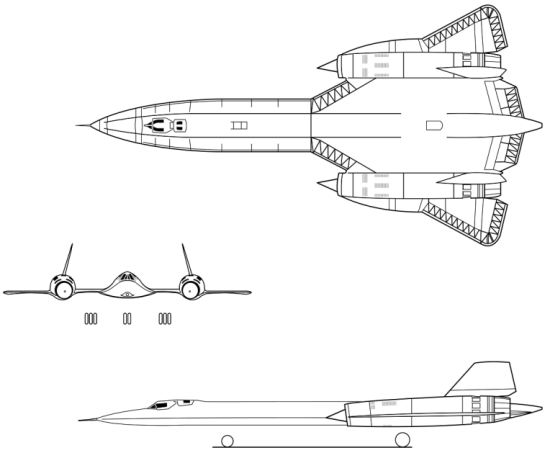
sr71_schem_01.gif


Edit: note that the SR71's engines have a 3* tilt downwards, this is because she was actually designed to spend most of the flight time in a "nose-high" attitude.
 
Last edited:
The abilities of the DG/XR engines are not physically impossible, it's just that concepts that allow that sort of performance come with a whole lot of technical baggage and engineering constraints that these vessels simply don't portray.

As a wise man once said:

A Wise Man said:
for every kilogram of handwavium you remove from a setting, you add about 10 cubic meters of impossible to maintain plumbing.
I'd say it would probably be about 20 cubic meters per kilogram of unobtanium...
 
Interesting - -the aero realms I have asked about here:
http://www.orbiter-forum.com/showthread.php?t=21142

As for the DG series, being it's "all open source", how about a challenge to the developer of those birds - get some folks here who have legit critical observations and set about to make the "ultimate" (or "Ultra") Delta Glider?

Sure, keep the "highly compressed exotic fuel source" and the "hollow quartz deposited thermal shields" for thruster impingement, and "pressurized boundary layer management" for the aero surface "fudges"; maybe even a few other things that are possible but not probable. I have heard a few places that the CG is wrong - so let's lengthen the nose a bit. Hover modes seem too good to be true, well, just scale up the nozzles. Main engines too big for their britches, scale them down and add a few more. Scramjets too anemic - well what about adding some ethanol and MTBE to the fuel; heck it works for the EPA? :)

Also, why don't we instigate a challenge to the X-Plane folks and give them the specs we think would work, and see if we can get a modeler make it fly "over there" - imagine a cross-sim vessel...

This is sooo cool!

 
Actually, upon close inspection of the XR2's model it's CoL appears to be near the Cargo Bay's aft bulkhead. Based on what we can see of the interior arrangement (and a rough estimate of it's "wet" CoM) that actually sounds about right.

Don't forget that the forward fuselage will also produce lift proportional to the aircraft's AoA.

Assuming that most of the weight is in the engines and propellant tanks (wherever they're hidden) the bird would likely be quite "tail heavy".

Much like its mother...

sr71_schem_01.gif


Edit: note that the SR71's engines have a 3* tilt downwards, this is because she was actually designed to spend most of the flight time in a "nose-high" attitude.

This plane was basically a flying gas can with engines. The skin of the plane was literally held the fuel. They would warm up the skin of the plane before it would stop leaking fuel everywhere. Then use a midair refuel to top things off.

There are many planes out today that would not fly if it was not for the flight control systems. Modifying CG is easy (just move some parts around).

The easiest way to to aerodynamic testing on the models is to build one out of foam and make an RC plane out of it.

There's no reason why these models cannot glide. The unrealistic part is the fact that they cram an engine with 2000 ISP (or more) with 640KN of force.
 
The default engine performance of DGIV and XR vessels are similar to what could be expected from nuclear lightbulb engine. Although it is unlikely that such engine could be made small and light enough to be put on something the size and weight of a fighter jet, radiation shield alone would weigh many tons. Such small airframe also woud lack space for propellant

A real deltaglider would probably look like a Skylon spaceplane. Putting the heavy engines on wings, payload bay in the middle and propellant tanks on both ends of airframe would allow easier managment of centre mass and solve the problem of flying tail first when tanks are empty.
 
But Skylon is ugly! It looks like a cross between an SR-71 and an overturned grain silo... :rolleyes:

:lol:
 
Oh, don't say that, I think she's very pretty... :rolleyes:
This coming from someone who prettifies all spacecraft in their eyes, but still. :P

As for the XR2 being nose-heavy, I don't know. I had always imagined that much of fuel was stored in the aft, and the engines (remember that there are also SCRAM engines below) should be reasonably heavy to balance out the weight in the nose. With CoG shift, the design seems stable enough...remember, HOTOL had problems with being tail-heavy, which is why they moved the engines for Skylon.
About building a foam model, remember this? It did fly, apparently, though I don't know how well.

Either way, I think the XR2 airframe looks right, although not from a fuel storage perspective.

This is coming from someone with absolutely no engineering authority on the matter, though, so carry on.
 
Last edited:
Interesting - -the aero realms I have asked about here:
http://www.orbiter-forum.com/showthread.php?t=21142

As for the DG series, being it's "all open source", how about a challenge to the developer of those birds - get some folks here who have legit critical observations and set about to make the "ultimate" (or "Ultra") Delta Glider?

Sure, keep the "highly compressed exotic fuel source" and the "hollow quartz deposited thermal shields" for thruster impingement, and "pressurized boundary layer management" for the aero surface "fudges"; maybe even a few other things that are possible but not probable. I have heard a few places that the CG is wrong - so let's lengthen the nose a bit. Hover modes seem too good to be true, well, just scale up the nozzles. Main engines too big for their britches, scale them down and add a few more. Scramjets too anemic - well what about adding some ethanol and MTBE to the fuel; heck it works for the EPA? :)

Also, why don't we instigate a challenge to the X-Plane folks and give them the specs we think would work, and see if we can get a modeler make it fly "over there" - imagine a cross-sim vessel...

This is sooo cool!
I too would like to see the XR and DG in x-plane. Just to play around with. That would be really cool :thumbup:
 
The XR-2 is great in turns of flexability, being able to just hop in it at the launch window and take off. But the wore off on me very quick. Like you all have said, looking at the thing and seeing that there is no way that thing will be able to have fuel tanks, so I changed the settings to required payload bay tanks. I also know that no way can this thing take off like an airplane and reach space. Not using the mains like that for take off. So I have started using the Energy HLV to get the XR-2 into orbit, and operating it much like the space shuttle. Only the Energy's ET is not really an ET, but has motors of its own, so the XR-2 requires no use of the mains to get into orbit. Although that brings in the stress of hauling the XR-2 dead on the payload connection.

I find the Antares to be a good candidate in my eyes for a flexible more realistic spacecraft, but I have to learn more on editing scenarios to build stacks and program the launch autopilot. At this point in time, I have yet to get the hang of it.

I do like using the XR-2 as sort of a next generation Space Shuttle. I much rather glide in dead stick and land on a runway than just sit in a capsule and crash fall into the ocean. And XR-2 is Ummu compatible and is able to haul UCGO cargo so I can replenish the pantry in my UCGO ISS. I was thinking about how to get it to Mars, and figured I have to figure out a way to launch more fuel into orbit, or get some to the ISS using an unmanned vehicle and store it there, so I can load the payload bay up with oxygen and then have an external tank full of fuel to get me to Mars and back. I really don't like the idea of refuelling at an extra-terrestrial land base.

Anyway, that is my attempt to take a bit of the fantasy out of the XR-2.
 
DG EX seems the most plausible to me. Although, i think it would need a boost stage with current technology. Prolonged hypersonic speeds are awesome...but how to protect against the incredible heat they generate? Better to just go straight up and jett the SRB at a ballistic orbit. Thats how I like to fly her.

It just seems to me that any single stage space plane will be AT LEAST as big as the space shuttle, until some quantum leap in propulsion is discovered.
 
The XR-2's size is one of those things that kind of makes it hard to believe it as near tech, it is so small and so where are all these systems and such supposed to fit. And it is small so functionally it is limited. Not much can fit in that little payload. The mkII seems like it will be bigger, but I think like you, that a lot of these space planes are best used with some sort of launcher to at least get it up out of the thick lower atmosphere, then maybe let the engines take over, but I now need to learn how to velcro some SRBs to the XR2...as of now I tend to launch her on the Energia, which is probably over kill, but oh well.
 
Back
Top