Launch News SpaceX Falcon 9 F3 COTS2+ Updates

Are we back to the stone age again?
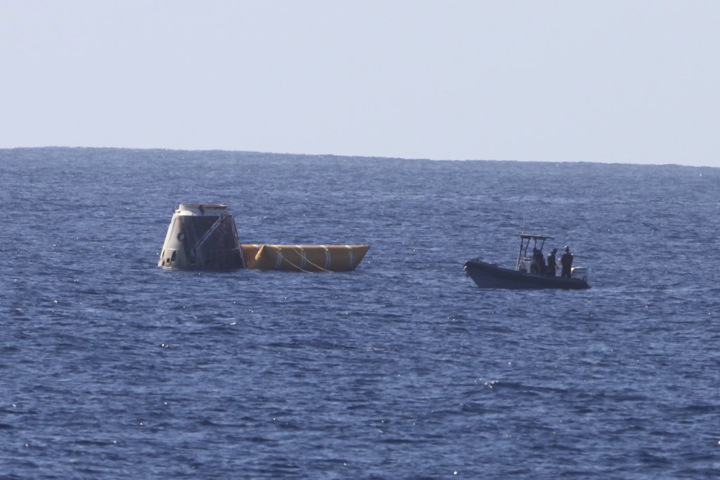
I can't get any news about Dragon status after the splash down.
There are only a few blurry photos.
Or must I just be patient?
I also note that the splashdown was 11:42 a.m. EDT and not 11:44 a.m. EDT as planned.
I know that 2 minutes is a lot in re-entry time.
 
Last edited:
Epic high-res images of Dragon in orbit:

iss031e071075.jpg


iss031e071522.jpg


iss031e069284.jpg


iss031e071143.jpg


iss031e070790.jpg


iss031e071203.jpg


iss031e071199.jpg


iss031e077666.jpg


iss031e077780.jpg


iss031e070969.jpg


http://spaceflight.nasa.gov/gallery/images/station/crew-31/ndxpage35.html
 
So here are the pic we were waiting for :

null.gif


null.gif


oops, sorry, it doesn't work, SpaceX doesn't want those pics to be shared. :(
 
The COTS 1 Dragon has a similar "crack". It's probably nothing.

COTS_1_Dragon_recovery.jpg
 
From C3PO's link:
...Visible are the diagonal channels that held parachute lines during flight, under a layer of thermal protection material.
 
The "crack" is explained under the photo in the link C3PO provided: "Visible are the diagonal channels that held parachute lines during flight, under a layer of thermal protection material."

Edit: Ninja'd by n112vu :)
 
It looks like there are a huge crack on he hull.
But then it would take in water and sunk.
http://www.csmonitor.com/var/ezflow...1-us-latestnews-spacexsplashdown_full_600.jpg

Don't worry. I think it's intentional cracks in the heat shield, caused when the parachutes are deployed. Seems quite normal for Dragon.

Here you can see the ropes of the parachutes covered while Dragon is in orbit:

dragon0pf1qui73s.jpg


And the deployment:

[ame="http://www.youtube.com/watch?v=zq7LgVX-Jdk&feature=related"]SpaceX Testing - Dragon Drop Test (HD) - YouTube[/ame]
 
Last edited:
It's an intentional seperation in the body of the spacecraft. A similar method of suspending the craft on the parachutes existed on the Gemini capsules.

Dragon's parachutes lie in a compartment close to the bottom (heat shield side) of the spacecraft. To ensure that the spacecraft remains in the correct orientation during splashdown, the parachutes must be connected to the spacecraft via this method to ensure that it does not descend to the ocean upside-down.

The Gemini chutes were located in the nose, but were connected to the spacecraft in a way that would keep the astronauts horizontal during descent. This was a call-back to the original Gemini recovery method, which was to use a parawing and glide to a runway.
 
Last edited:
Last edited:
Back
Top