
You are using an out of date browser. It may not display this or other websites correctly.
You should upgrade or use an alternative browser.
You should upgrade or use an alternative browser.
OHM TelescopeMFD 2010
- Thread starter OrbitHangar
- Start date

- Joined
- Jan 7, 2008
- Messages
- 5,814
- Reaction score
- 869
- Points
- 203
- Location
- Earth
- Website
- orbides.org
- Preferred Pronouns
- she/her
It's a new bug. I certainly didn't put it in there, so something in the Orbiter's current handling of camera is causing it.camera shaking


- Joined
- Nov 20, 2007
- Messages
- 11,963
- Reaction score
- 765
- Points
- 188
Just a query, bit off-topic maybe?
This is a screenshot of DG1 at Impact Point, looking back toward Woomera 6A waiting for my F1(Velcro) to come over the horizon.
http://i89.photobucket.com/albums/k207/Notebook_04/11041909-10-01GL-01.jpg
Wondering why there is a relative velocity when both vehicles are still on the ground?
Many thanks, N.
This is a screenshot of DG1 at Impact Point, looking back toward Woomera 6A waiting for my F1(Velcro) to come over the horizon.
http://i89.photobucket.com/albums/k207/Notebook_04/11041909-10-01GL-01.jpg
Wondering why there is a relative velocity when both vehicles are still on the ground?
Many thanks, N.

Rtyh-12
Member
:woohoo: thank you! I've always wanted to try this out.

RobN
Member
- Joined
- Nov 13, 2009
- Messages
- 55
- Reaction score
- 3
- Points
- 8
This is a great add-on indeed. However I have a couple of issues.
When on Mars in daylight I tried to view Earth in close-up, but found the textures messed up. Essentially, what should have been a pink darkside was black, which looked weird against the pink sky. The same thing happened with Venus but not Earth's moon. Our moon looked correct, a pink darkside and light dayside.
Also when zooming in on Mars from Earth orbit I found the phase of Mars was wrong. It was about half-lit, when it can only be full or nearly full from Earth.
Can I post pictures here? I don't know how.
When on Mars in daylight I tried to view Earth in close-up, but found the textures messed up. Essentially, what should have been a pink darkside was black, which looked weird against the pink sky. The same thing happened with Venus but not Earth's moon. Our moon looked correct, a pink darkside and light dayside.
Also when zooming in on Mars from Earth orbit I found the phase of Mars was wrong. It was about half-lit, when it can only be full or nearly full from Earth.
Can I post pictures here? I don't know how.

- Joined
- Feb 8, 2008
- Messages
- 1,649
- Reaction score
- 4
- Points
- 38
- Location
- Hampshire, UK
- Website
- orbiter.quorg.org
Also when zooming in on Mars from Earth orbit I found the phase of Mars was wrong. It was about half-lit, when it can only be full or nearly full from Earth.
Can I post pictures here? I don't know how.
The phases of the planets is wrong in orbiter. You can't tell in the normal sim but this (very well hacked) addon just exasperates the problem. Orbiter calculates the vector from the sun to your current vessel and uses that as a uniform lightsource, rather than having a lightsource from the sun. This is unlikely to get fixed as it's not really important and only evident in this addon. It's a 'feature' of the orbiter renderer, not TelescopeMFD.

Spacethingy
Multitasker
- Joined
- Sep 9, 2010
- Messages
- 1,515
- Reaction score
- 0
- Points
- 36
- Location
- Not the anti-matter universe
- Website
- spacethingy.weebly.com
Can I post pictures here? I don't know how.
I've no idea on your MFD problem, but here's how to do pictures:
While writing a post, click the Image button (green and blue square with a tiny yellow smiley on it). You can then give the address of the image (i.e. from a webpage).
Or, on the forum, you have a dedicated Album space for your own pics. Click on user CP then My Albums.

- Joined
- Oct 30, 2009
- Messages
- 14,019
- Reaction score
- 4
- Points
- 0
You can attach up to 8 pictures directly to the post you're writing, too. Just click on "Manage Attachments" button in "Additional Options" below "Reply to Thread" (so not when you use quick reply option), and in the newly opened window upload your pictures. They will be attached to the post.Or, on the forum, you have a dedicated Album space for your own pics. Click on user CP then My Albums.
RobN
Member
- Joined
- Nov 13, 2009
- Messages
- 55
- Reaction score
- 3
- Points
- 8
These are images taken from Olympus on Mars using Telescope. They are Earth, Earth after more zoom and some F1s, Venus, Jupiter and Saturn. Earth's moon looks okay. I'm using standard Orbiter 2010 textures on everything except Mars itself (level 10).
It may be a video card thing. I have an Nvidia GeForce 7950 GT
It may be a video card thing. I have an Nvidia GeForce 7950 GT
Attachments

Scruce
Ad astra per aspera
- Joined
- Sep 17, 2010
- Messages
- 1,409
- Reaction score
- 0
- Points
- 0
These are images taken from Olympus on Mars using Telescope. They are Earth, Earth after more zoom and some F1s, Venus, Jupiter and Saturn. Earth's moon looks okay. I'm using standard Orbiter 2010 textures on everything except Mars itself (level 10).
It may be a video card thing. I have an Nvidia GeForce 7950 GT
You are viewing all the other planets through Mars atmosphere, any telescope will give that haze. This is not a bug...

superotherguy
New member
Doesn't work on Orbiter 2010's Directx 9 client . Also planets don't render when I zoom in on them. They remain as dots even tho im fully zoomed. I think this is because default orbiter doesn't actually render the 3D model of a planet when your not near it.
. Also planets don't render when I zoom in on them. They remain as dots even tho im fully zoomed. I think this is because default orbiter doesn't actually render the 3D model of a planet when your not near it.Tenmu-101
New member
Have you tried pressing F1 a few times? This sometimes works.
Thanks you very much! that worked!
note: I'm the one who experienced that problem too

Messierhunter
New member
- Joined
- Apr 30, 2008
- Messages
- 488
- Reaction score
- 2
- Points
- 0
Less than 0.1.
O2010P1 uses a different compiler, and i can't find the locations yet. The functions were rewritten or compiler-altered a lot.
---------- Post added at 23:16 ---------- Previous post was at 22:52 ----------
I take that back.
Updated the MFD for O2010P1, no new features, possibly some new bugs related to new camera handling in Orbiter.
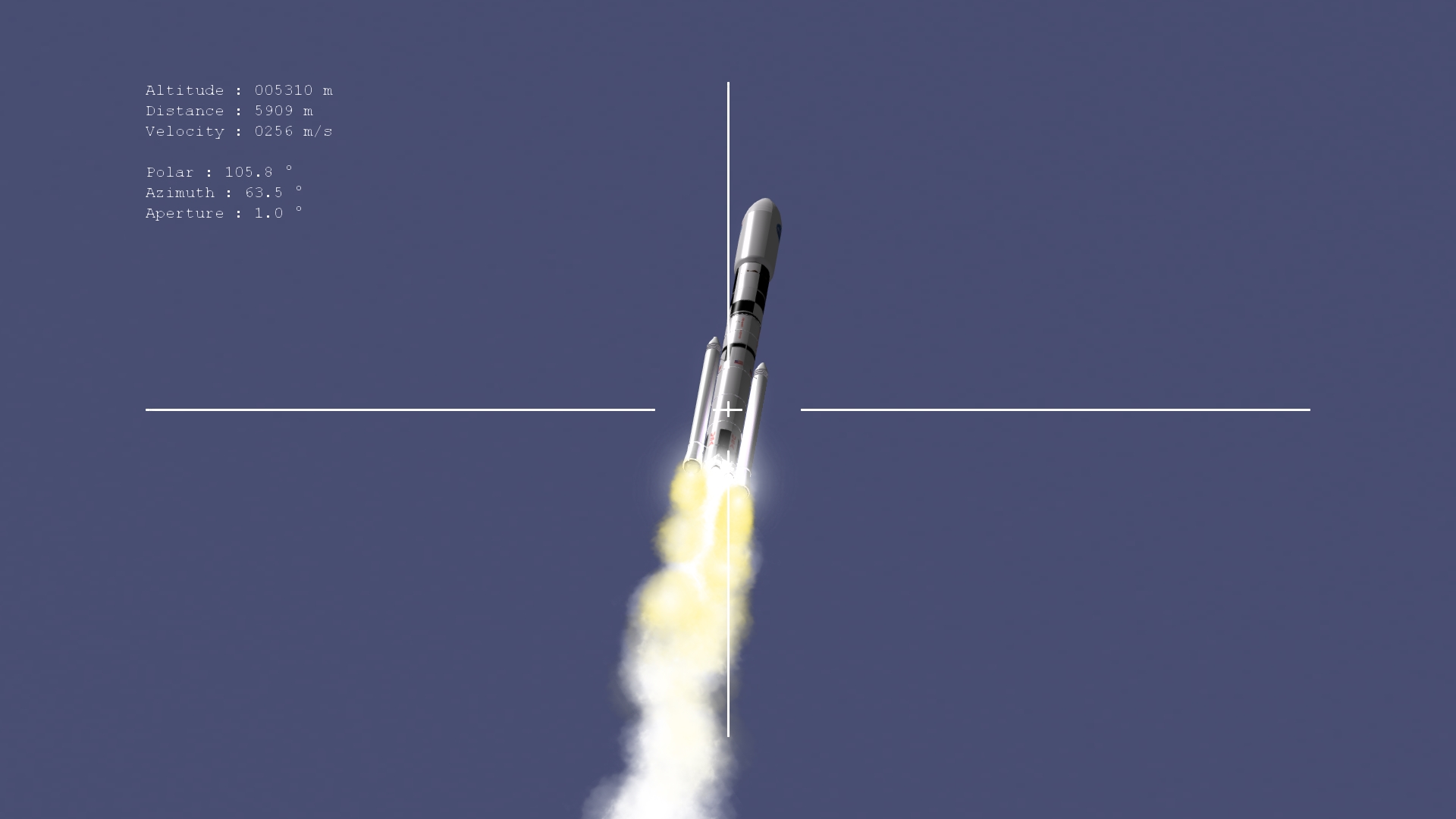
Sorry for the ancient thread necromancy, but I was wondering if I could collaborate with you to expand this mod to get it to pass information on the altitude/azimuth or RA/Dec coordinates of the current 'pointing position' to a log file in regular intervals along with the current date/time in the simulator (maybe say, every 5 seconds).
I'm new to orbiter modding (ie, no idea what I'm doing), but I've developed a program for automatic telescopic tracking of rocket launches using video guidance. It works quite well with my telescope (at least on clear days), but I'd like to use orbiter to improve it by generating a log predicting a rocket's location during a launch so that the program can start tracking based on the prediction and continue tracking based on the predicted location if it goes through a cloud. Right now the best it can do is tracking along the last known vector, but that's not good enough when large clouds block the view of the rocket for more than a second or two.
Knowing nothing about orbiter modding, I don't even know if it's possible for an MFD mod to write to an external text file. Maybe the solution needs to be a custom vessel DLL which writes the coordinates to a scenario file, but I was wondering if it was possible to get the coordinates from your telescope MFD since it already does the job of pointing at a designated target.

barrygolden
Well-known member
hey guys there is a new JWST addon close to release so this or something close my work for that in 2016
- Joined
- Feb 2, 2012
- Messages
- 1,667
- Reaction score
- 115
- Points
- 78
Sorry for the ancient thread necromancy, but I was wondering if I could collaborate with you to expand this mod to get it to pass information on the altitude/azimuth or RA/Dec coordinates of the current 'pointing position' to a log file in regular intervals along with the current date/time in the simulator (maybe say, every 5 seconds).
I'm new to orbiter modding (ie, no idea what I'm doing), but I've developed a program for automatic telescopic tracking of rocket launches using video guidance. It works quite well with my telescope (at least on clear days), but I'd like to use orbiter to improve it by generating a log predicting a rocket's location during a launch so that the program can start tracking based on the prediction and continue tracking based on the predicted location if it goes through a cloud. Right now the best it can do is tracking along the last known vector, but that's not good enough when large clouds block the view of the rocket for more than a second or two.
Knowing nothing about orbiter modding, I don't even know if it's possible for an MFD mod to write to an external text file. Maybe the solution needs to be a custom vessel DLL which writes the coordinates to a scenario file, but I was wondering if it was possible to get the coordinates from your telescope MFD since it already does the job of pointing at a designated target.
Please check the Ms2015 Camera module: it follows rockets during ascent pretty much as you are willing to do.
[ame="http://www.orbithangar.com/searchid.php?ID=7010"]http://www.orbithangar.com/searchid.php?ID=7010[/ame]

boogabooga
Bug Crusher
- Joined
- Apr 16, 2011
- Messages
- 3,010
- Reaction score
- 16
- Points
- 63
but I'd like to use orbiter to improve it by generating a log predicting a rocket's location during a launch so that the program can start tracking based on the prediction and continue tracking based on the predicted location if it goes through a cloud. Right now the best it can do is tracking along the last known vector, but that's not good enough when large clouds block the view of the rocket for more than a second or two.
This has to do with the 'gravity turn' portion of rocket launch. You're making a big assumption here that how an Orbiter add-on rocket behaves is close to how a real-world rocket behaves. Fred18 would be the best expert here IMHO and I recommend that you talk to him as well regarding your goals. (Perhaps BrianJ as well.) It would actually be cool to know how well the real-world 'gravity turn' compares to what is being done in the various Orbiter add-ons.
Edit: :ninja: by fred18. :lol:
Similar threads

- Replies
- 0
- Views
- 5K

- Replies
- 6
- Views
- 2K

- Replies
- 1
- Views
- 9K


- Replies
- 43
- Views
- 16K
- Replies
- 175
- Views
- 40K
