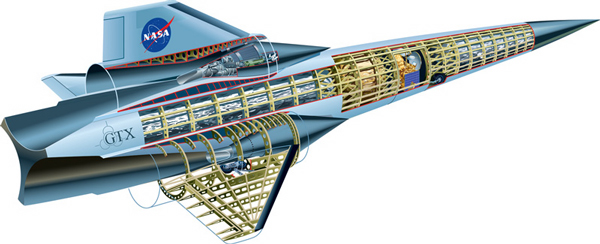
Which is more effective, disposable capsules or reusable spaceplanes?

What about a bullet shaped object... Like a dream chaser with far smaller wings. That should combine the simplicity of a capsule with the aerodynamic control of a spaceplane.

 
What about a bullet shaped object... Like a dream chaser with far smaller wings. That should combine the simplicity of a capsule with the aerodynamic control of a spaceplane.

Gemini_paraglider.JPG


Why not just something like this?
 
- - - Putting on moderator hat for a moment - - -

The topic at hand is essentially winged vehicles v capsule; merits of each.

If anyone wants to discuss the scocioeconomic merits of the astronaut corp (past and present), please start a new topic (preferably in the basement).

Ok then.:)

:hailprobe:

---------- Post added at 07:59 PM ---------- Previous post was at 07:57 PM ----------

I'm not - (not a interest of mine).:P
 
Just to let people know, I made a thread to push the off-topic discussion into the basement, where it hopefully will stay. Enough about that though.

What about a bullet shaped object... Like a dream chaser with far smaller wings. That should combine the simplicity of a capsule with the aerodynamic control of a spaceplane.

As an idea, it doesn't quite add up. Lifting bodies are already the fusion of proper spaceplane and capsule; take away any more wing, and you end up removing stability and control, producing a oddly shaped capsule, perhaps even a terribly unstable capsule. I don't see the point of making it pointy either, since to survive reentry it ought to have a blunt surface to produce a shockwave.

Lifting bodies are compromise vehicles, kinda like flying boats- there are going to be good parts of the compromise, and not so good parts. And there's only so far you can go on the sliding scale before you end up with a actual winged spaceplane or a wingless capsule.
 
fsci123, were you thinking of something like a "biconic" vehicle?

j49HiIG.jpg

([ame="http://en.wikipedia.org/wiki/Blue_Origin_New_Shepard"]Blue Origin New Shepard[/ame])
 
The statistic of 1/6 LOCV for Apollo is real - but it was estimated at the earliest design stages of Apollo, before even the final configuration was decided.

The real LOCV was likely 1:15- 1:20 for Apollo.

I guess the other question is whether that was an estimate for the launch, or an estimate for the entire lunar mission. I have a hard time believing that the risk of LOCV for the Apollo/Saturn launch itself could be greater than that of the Shuttle, or even anywhere near as high as the Shuttle. On the other hand, Apollo 13 was very nearly a LOCV, and a 1/6 risk of LOCV for the lunar landing and ascent might not be far-fetched at all.
 
I guess the other question is whether that was an estimate for the launch, or an estimate for the entire lunar mission. I have a hard time believing that the risk of LOCV for the Apollo/Saturn launch itself could be greater than that of the Shuttle, or even anywhere near as high as the Shuttle. On the other hand, Apollo 13 was very nearly a LOCV, and a 1/6 risk of LOCV for the lunar landing and ascent might not be far-fetched at all.

I think it was a 1/6 risk for the whole mission - it was risky business after all, with almost no safety nets.

The launch reliability of the Saturn V was great for its age, after all, it was designed at a time where the Atlas rockets still exploded, and knowlegde about avoiding problems only lately became introduced into the design process... the Saturn I still had a pretty high failure rate.
 
You have to remember that predictions of LOCV based on statistic aren't going to be accurate. The frequency is far too low for that. The model is supposed to make it possible to compare different design options, and using it to predict the outcome of actual flights is missing the point.

The high prediction is more likely due to the high priority NASA gives to safety now when compared to the time of the space race. If the Apollo flight manual was written to today's standards, every mission would most likely have triggered an abort at some stage. Those early pioneers took risks that were orders of magnitude higher than would be considered acceptable today.

And space flight is still :censored: dangerous.
 
If the Apollo flight manual was written to today's standards, every mission would most likely have triggered an abort at some stage. Those early pioneers took risks that were orders of magnitude higher than would be considered acceptable today.

Yes, but at the same time, far higher risks could be taken with the Saturn V than with the Shuttle. The Shuttle stack is the only launch system that has ever caused a LOCV (there have been other LOCVs, but they were due to problems with the spacecraft itself, not with the launch vehicle). And that happened *twice*, once a straight up launch failure with no escape route for the crew, once involving an incident during launch that damaged the spacecraft so that safe reentry was impossible.

If a compromised thrust chamber had caused an S-IC to disintegrate during launch, the LES would have fired and the capsule would have been carried away from the debris safely. And it was physically impossible for anything falling off the launch vehicle to hit the Apollo heat shield.

I'm not arguing from the statistics of LOCV events here: I'm arguing from the fact that the Shuttle LOCV events demonstrate failure modes that are inherently fatal on a Shuttle-like design, and quite survivable on an Apollo/Saturn-like design. Beyond that, for a tower/capsule stack, I can imagine scenarios in which bad luck could kill the crew in a launch vehicle failure that would normally be survivable, or in which the combination of an otherwise survivable launch vehicle failure and a failure higher up on the stack (such as the failure of the LES to fire) could kill the crew, but I have a hard time imagining a scenario in which the launch vehicle could fail in a way that would kill the crew with near certainty despite a working LES.
 
Like Urwumpe said the NASA models the whole mission and not only the launch and reentry. Every component has a calculated chance of failing, and the model estimates the consequence. Then you calculate the chance of two simultaneous failures etc. Then you add redundancy and recalculate. That's how the model is supposed to help designers.

Apollo had several components that HAD to work or the crew was toast. The LM's ascent engine was especially 'iffy' because it tore itself to pieces so it couldn't be tested before liftoff. The first (and only) time it ran was when it lifted off the Lunar surface.
 
Like Urwumpe said the NASA models the whole mission and not only the launch and reentry. Every component has a calculated chance of failing, and the model estimates the consequence. Then you calculate the chance of two simultaneous failures etc. Then you add redundancy and recalculate. That's how the model is supposed to help designers.

Apollo had several components that HAD to work or the crew was toast. The LM's ascent engine was especially 'iffy' because it tore itself to pieces so it couldn't be tested before liftoff. The first (and only) time it ran was when it lifted off the Lunar surface.

Yes, but when the 1/6 statistic was first mentioned in this thread, it was mentioned in as a LOCV probability for the Saturn V (as opposed to the entire mission), which is preposterous. That the entire course of an Apollo lunar mission might have had a LOCV probability of 1/6 is believable, but that's not relevant to the topic of whether a capsule or a spaceplane is better for LEO operations (you of course aren't going to be dragging your spaceplane along on a lunar mission, even if you use it to get the crew into orbit).
 
Back
Top