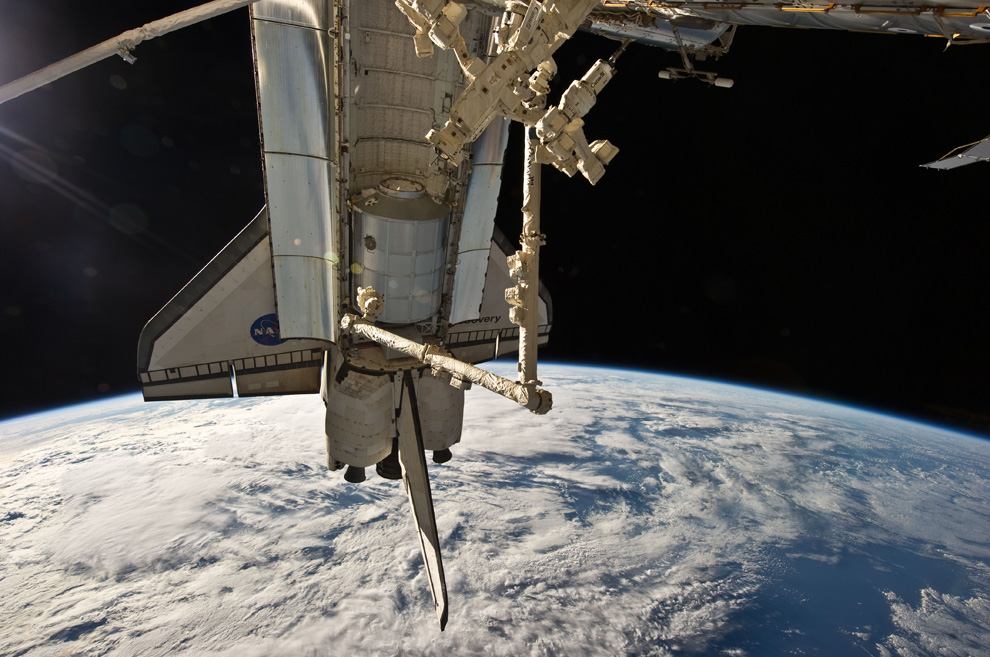
Question Why isn't the PMA straight?

MikeB

Member
Joined
Feb 25, 2009
Messages
186
Reaction score
6
Points
18
Location
Seattle
Why is there a "kink" in the Pressurized Mating Adapters (PMA) of the ISS? I would think a straight tunnel would be easier to use.

Just curious
 
It leaves more room to access the payload bay.
 
It leaves more room to access the payload bay.

Exactly... to explain it with a few more words:

It permits to access the payloads in the docked Space Shuttle better with the robotic arms.
 
i29_1e007048.jpg
 
Because it was born that way and it wants you to respect it's personal choices. Also it's not PMA, it's Susan. :P
 
While its a nice image, it doesn't really demonstrate the effectivness of the kink in the PMA. The payload here, Clearly an MPLM, is in the aft portion of the PLB. and because of the short length of the payload itself, the arm gets nowhere near the PMA.

 
Looking around I am not sure there is a single picture that demonstrates the benefit of how the PMA's shape position the PLB.

The biggest ISS payload carried up by the Shuttle was Kibo, here on STS-124. I quick look did not pull up picks of the grappling, but I at least found one of the rendezvous, so you can see its position in the bay, and just imagine how having the bay's position altered by the shape of the PMA benefits the astronauts in charge of the robotic ops.

And even with the MPLM. Fly a Shuttle mission to the ISS in Orbiter and see how tricky it was to get the MPLM out of the bay and attached to Harmony using the SSRMS.

sts124_orbit.jpg
 
This image with a truss segment shows a more "Full" PLB, more so than the KIBO module.
http://upload.wikimedia.org/wikipedia/commons/b/b8/Shuttle_delivers_ISS_P1_truss.jpg
However this image shows the adjustment the PMA makes for the node. You can see how the offset makes the PLB more accessable.
http://d2lupdnmi5p5au.cloudfront.ne...deee_par368524434f7dae6266158a00606ccf12.jpeg

Cras I think youre right, I have not been able to find a good picture of a payload being off loaded that shows the angle needed to demonstrate this effect.
 
Back
Top