A Return to the Moon by the Apollo 11 50th Anniversary.

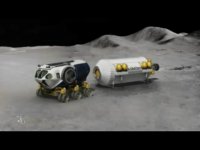
Thanks for that. Masten mentions such a lander could be used also as a lander for asteroid missions, or for Mars or the Martian moons, as indicated in the image from the video. Then developing this at such a minuscule cost would allow us to save on costs for these missions as well.
Masten also mentions engineers at several of the NASA centers have taken an interest in it so NASA is aware of it.
Another image of it this time landing the lunar rover version of [ame="http://en.wikipedia.org/wiki/Space_Exploration_Vehicle"]NASA's Space Exploration Vehicle(SEV)[/ame] attached below.

Bob Clark
 

Attachments

  • image.jpg
    image.jpg
    81.9 KB · Views: 33
Jan. 16, 2014
RELEASE 14-020
NASA Announces Partnership Opportunities for U.S. Commercial Lunar Lander Capabilities.
Building on the progress of NASA's partnerships with the U.S. commercial space industry to develop new spacecraft and rockets capable of delivering cargo, and soon, astronauts to low Earth orbit, the agency is now looking for opportunities to spur commercial cargo transportation capabilities to the surface of the moon.
NASA has released an announcement seeking proposals to partner in the development of reliable and cost-effective commercial robotic lunar lander capabilities that will enable the delivery of payloads to the lunar surface. Such capabilities could support commercial activities on the moon while enabling new science and exploration missions of interest to NASA and the larger scientific and academic communities.
http://www.nasa.gov/press/2014/janu...opportunities-for-us-commercial-lunar-lander/

This is a good start, but I noted NASA in this program is only asking for lunar landers for small cargo. Why? Could it be because they know a lander for large cargo could also be used for a manned lander?

The program should be extended to include possibilities, such as being investigated by Dave Masten, for radically lowered costs for manned landers.


Bob Clark
 
Detailed discussion of the fact that with the higher payload capability of the Falcon 9 v1.1 we can do circumlunar missions on a *single* launch of the Falcon 9 v1.1 + Dragon:

"Golden Spike" circumlunar flights.
http://exoscientist.blogspot.com/2012/12/golden-spike-circumlunar-flights.html

Bob Clark

That blog post used an extra in-space stage to do the translunar injection(TLI).

Elon Musk has said through his Twitter account that the 13 mT payload capability was actually a reduction of the F9 V1.1's true capability due to reusability considerations. Gwynne Shotwell confirmed this on a TheSpaceShow interview on Friday, Mar. 21 at about the 9 minute mark.
She said the quoted payload on their web site for the F9 v1.1 is about 30% less than that of a one-use version.

This would put the expendable version in the range of the 16.6 metric tons to LEO given on NASA's site:

NASA Launch Services Program's
Launch Vehicle Performance Web Site.
http://elvperf.ksc.nasa.gov/elvMap/staticPages/nls1.htm

The point is this would be just about at the payload capability to do translunar with the Dragon using just its onboard Draco, or upgraded SuperDraco, thrusters, no extra in-space stage required. On the "NASA Launch Services Program" site, click the link for the Performance Query Tool and select the Falcon 9 and "elliptical" orbit option. Enter in 36000 km for the altitude corresponding to geosynchronous transfer orbit (GTO) and 28.5 degrees for the orbital inclination corresponding to launch from Cape Canaveral. Then the calculator gives the payload to GTO as 5745 kg.

Wikipedia gives the delta-v to GTO as 2,500 m/s.

Then [ame="http://en.wikipedia.org/wiki/Translunar_injection"]translunar injection[/ame] (TLI) at 3,100 m/s would only require an additional 600 m/s delta-v. The Dragon has a dry mass of 4,200 kg and a propellant mass of 1,290 kg. SpaceX has not released the Isp of the hypergolic thrusters on the Dragon, but they typically are in the 320 s range in vacuum. Then it could carry 1,800 kg payload to the 600 m/s needed to reach TLI:

320*9.81ln(1 + 1290/(4200 + 1800)) = 610 m/s.

Actually that 1,800 kg payload would put the total mass beyond the 5745 kg capacity to GTO. Smaller payload say in the 250 kg range would be doable.


Bob Clark
 
Jan. 16, 2014
RELEASE 14-020
NASA Announces Partnership Opportunities for U.S. Commercial Lunar Lander Capabilities.

http://www.nasa.gov/press/2014/janu...opportunities-for-us-commercial-lunar-lander/

This is a good start, but I noted NASA in this program is only asking for lunar landers for small cargo. Why? Could it be because they know a lander for large cargo could also be used for a manned lander?

The program should be extended to include possibilities, such as being investigated by Dave Masten, for radically lowered costs for manned landers.

I'm glad at least Masten's Xeus lunar lander got recognition by one of these SAA awards through the Lunar CATALYST program, even though they don't provide funding:

XEUS-rendering-Masten-Space-Systems-Inc.png

XEUS-rendering-Masten-Space-Systems-Inc.Masten's XEUS lander.
Credit: NASA/Masten Space Systems, Inc.

http://www.nasa.gov/lunarcatalyst

Perhaps they can get funding from the ESA since the Europeans still want to do a manned lunar mission. This would be like how the ESA is providing funding to Sierra Nevada to develop the Dreamchaser spacecraft.

Actually, there is a variation on the Masten idea that the Europeans might like even better. Masten uses a Centaur upper stage to produce a horizontal lunar lander. However, the ESA has a hydrogen-fueled upper stage that is half-sized to the Centaur in the Ariane H10-3 upper stage. Then you could produce a smaller mission size by using this to form a lander half-size to the Xeus. In fact the mission could be launched by a single Ariane 5, plus a man-rated launcher to carry the crew to LEO.

A reusable lunar lander would have sufficient delta-v to also be used as a Mars lander. Then designing lunar return missions can help with accomplishing a manned Mars mission:

Towards a low cost lander for the Moon - and Mars.
http://exoscientist.blogspot.com/2014/05/towards-low-cost-lander-for-moon-and.html


Bob Clark
 
Last edited:
Nice article here on the Morpheus lunar lander:

Project Morpheus Concludes Successful Flight Test Campaign With Spectacular Night Launch.
By Mike Killian
http://www.americaspace.com/?p=61298&cpage=1


The project leader notes it could be scaled up to be a manned lander. Based on the specifications of the lander I estimate it would need to be scaled up by a factor of three to form a descent stage while using the original sized version for the ascent stage.

Another nice article describes the origin of the idea of the Morpheus and its innovative, low cost approach:

A father-son chat leads to first-of-its-kind NASA spacecraft.
By Thom Patterson, CNN
updated 8:00 AM EDT, Mon May 19, 2014 |
http://www.cnn.com/2014/05/18/tech/big-idea-morpheus-lander/

Based on a $14 million development cost for two prototypes, one scaled up by a factor of three might cost $21 million. So $28 million for both stages.

Or you could combine three of the original size to form the descent stage, with the same development cost of $21 million. This would have an advantage of a quicker time to producing a flight capable prototype. Another problem with the scaled up version of the descent stage is that based on the 12 foot height of the original version I estimate an 18 foot height of the descent stage. That would be a high climb down for the astronauts.

In any case we see again, just as with the Masten Xeus lander, a manned lunar lander can be made for 10′s of millions of dollars rather than the $10 billion of the Altair.

Bob Clark
 
Last edited:
A National Research Council report released last week on how to get to Mars, considered that NASA’s plan of getting to Mars via the asteroid return mission as a stepping-stone might work. However, actually the NRC considers it a bad idea, with plans going to the Moon first being preferred:

NASA could not deliver humans to Mars, says new strategy report.
Published time: June 05, 2014 02:39
Landing humans on Mars is unattainable for NASA if the space agency’s current strategy and level of funding are not modified in the near future, according to a new congressionally-mandated report.

Of the three pathways to Mars that NRC suggested, two were associated with a return to the moon. A lunar landing and habitat would hone technologies that could later be employed on a Mars mission, the report said.
The Obama administration has publicly expressed distaste for continued, expensive moon landings. In outlining US space policy in 2010, President Barack Obama said, “I just have to say pretty bluntly here: We’ve been there before.”
The third option outlined by the report includes the Asteroid Redirect Mission, a plan still in the study phase but currently endorsed by the Obama administration.
Such a mission would send robotic spacecraft to essentially grab and re-orbit an asteroid passing near Earth, allowing astronauts to take samples of the rock.
That mission, though, is not preferred by authors of the report. Safety issues and development of “dead end” technologies render the asteroid mission inferior if NASA wants to reach Mars, it said.
The asteroid option “cannot provide the flight frequency required to maintain competence and safety,” the report posits.

http://rt.com/usa/163736-mars-nasa-funding-strategy/

In point of fact the current NASA idea of dismissing any return to the Moon is making it that much harder for us to understand how to get to Mars.

The only reason for the perception we can’t return to Moon is the idea developing a manned lunar lander would be too expensive. But you need a lander anyway to land on Mars, and by developing a lunar lander you can also use that as a Mars lander. And if you break your mindset out of the box that the lunar lander has to look like the $10 billion Altair lunar lander, you grasp the lander can actually be developed at over a hundred times cheaper than that. Both the Masten XEUS lander and the NASA Morpheus lander can be made into manned landers at only a few 10's of millions of dollars in development cost.

So this self-imposed limitation on their own thinking is making it that we can’t get to Mars either.

Bob Clark
 
http://www.iflscience.com/space/vacation-moon-150-million

Don't know if it's been circulated before. The modified Soyuz idea, although widely proposed, looks a bit shaky in today's geopolical situation. And pit stop at the ISS? wouldn't that require plane changes? Or at least it would severely restrict the number of transfer windows. Also, 17 days? A bit much, IMHO. Maybe going for a Hohmann transfer?
That being said, it would still be cool to see something like this before the 2019. Perhaps even only an unmanned test.
 
http://www.iflscience.com/space/vacation-moon-150-million

Don't know if it's been circulated before. The modified Soyuz idea, although widely proposed, looks a bit shaky in today's geopolical situation. And pit stop at the ISS? wouldn't that require plane changes? Or at least it would severely restrict the number of transfer windows. Also, 17 days? A bit much, IMHO. Maybe going for a Hohmann transfer?
That being said, it would still be cool to see something like this before the 2019. Perhaps even only an unmanned test.

There are two windows/month from the ISS.
 
http://www.iflscience.com/space/vacation-moon-150-million

Don't know if it's been circulated before. The modified Soyuz idea, although widely proposed, looks a bit shaky in today's geopolical situation. And pit stop at the ISS? wouldn't that require plane changes? Or at least it would severely restrict the number of transfer windows. Also, 17 days? A bit much, IMHO. Maybe going for a Hohmann transfer?
That being said, it would still be cool to see something like this before the 2019. Perhaps even only an unmanned test.

The Russian space agency Roscosmos does not seem too keen on the idea though this may be due to the current political tension between the U.S. and Russia:

http://www.parabolicarc.com/2014/06/24/roscosmos-keen-space-adventures-moon-flight/

The Falcon Heavy certainly could do it with the Dragon V2. I estimated the Falcon 9 v1.1 could do it with the Dragon, but that was using the original Dragon dry weight of 4 mT. The human-rated Dragon V2 though has a dry weight of over 6 mT. You would need an additional in-space stage on the F9 v1.1 for this to work.

Bob Clark
 
Nice article by a true astronaut corp insider that shows almost all astronauts want us to return to the Moon:

Where Do We Go From Here?
Posted: 12/23/2013 5:11 pm
Clayton Anderson.
U.S. Astronaut (Ret.); ISS and Space Shuttle spacewalker; Aquanaut and soon-to-be Author.
"While I was still an astronaut, and an astronaut veteran at that, then Associate Administrator for spaceflight Lori Garver came to speak to the Astronaut Corps. A private meeting, just Ms. Garver and an attentive group of type A personalities, I would venture to guess there were about 40-45 of us "space fliers" seated in the room. A bit of a "rah, rah" meeting, touting NASA's work in the world of commercial spaceflight (and I think commercial spaceflight is a good thing, but that's another op-ed!), she asked us all a significant question. After some perfunctory remarks, she asked us to raise our hands if "we thought that Mars should be our next destination?" Three astronauts raised their hands. Next, she offered the question again, but this time replacing the Red Planet with the option of an asteroid as our next destination. No one... that's right, no one, raised a hand. When she finally asked us about our near-neighbor the moon, every astronaut, save the three that voted for Mars, raised their hands.
http://www.huffingtonpost.com/clayton-anderson/where-do-we-go-from-here_3_b_4495029.html

Bob Clark
 
Last edited:
how we dispose of fecal matter (there will be no atmosphere on our interplanetary trajectory into which we can jettison our "poop cans" and have them incinerated through atmospheric friction) and waste.

So, when mankind start BEO missions, the Solar System will get its first asteroid made of... poop.
 
Just one question: Why is this in the "Math & Physics" section?

It seems horribly out of place in a forum dedicated to scientific or technical questions.
 
Excellent points made in this lecture by Jeff Greason of XCOR that commercial space can get us to the Moon and Mars orders of magnitude more cheaply than the NASA estimates.

This is important because supporters of a "Mars first" approach such as Robert Zubrin take that stance because of the idea a lunar return would cost hundreds of billions of dollars. But this is by following the usual governmental financing approach. By following commercial space and not requiring all new "giga"-rockets, it could be done for a fraction of those estimates.

Then all Mars supporters would come on board to support a return to the Moon.

Bob Clark

 
I would like to see a small fire get lit under NASA's rear in regards to getting lunar missions happening again, and I'm even settling for those asteroid redirect missions that will orbit (but not land) on the moon. I also feel that given the more aggressive plans of China we ought to seriously reconsider a 45 year old stance of having "been there and done that". We've explored less that a fraction of a percent of the total surface area on the NEAR side of the moon.

I feel that with new discoveries made with the LRO satellite a whole new dynamic to exploring the moon opened up, and I refer more specifically to the 200 plus mare pits scattered across the surface. In terms of establishing a long term human presence on a body other than earth we need to "colonize" the moon, and I hate using the term colonize as it isn't really the right term. We need to understand what long duration stays on the moon would be like if we are even to attempt such a thing on Mars. The moon would serve as an analog to any operations needed to put humans on Mars, I think it foolish to approach the idea any other way.
 
I would like to see a small fire get lit under NASA's rear in regards to getting lunar missions happening again, and I'm even settling for those asteroid redirect missions that will orbit (but not land) on the moon. I also feel that given the more aggressive plans of China we ought to seriously reconsider a 45 year old stance of having "been there and done that". We've explored less that a fraction of a percent of the total surface area on the NEAR side of the moon.

The only foreseeable way a fire will get lit is if China or one of the commercial-spaceflight companies does a moonshot. We can rule out China due to their dull performance and we can rule out Boeing because of money. That really only leaves SpaceX... Hmm... Maybe we can submit a petition to get them to do their own moonshot.
 
The only foreseeable way a fire will get lit is if China or one of the commercial-spaceflight companies does a moonshot. We can rule out China due to their dull performance and we can rule out Boeing because of money. That really only leaves SpaceX... Hmm... Maybe we can submit a petition to get them to do their own moonshot.

Well, that seems inevitable now.

http://www.space.com/27503-china-mo...pr=17610706465&cmpid=514630_20141022_34195677

And I'm not a fan of SpaceX these days, they seem to be more talk than actual results. People have higher expectations of them then they have for themselves.
 
Back
Top