An SSTO as "God and Robert Heinlein intended".

1st stage;

Dry mass: 53 962 kg

Propellant mass: 730 000 kg

Thrust: 13 100.4 kN (vacuum thrust of 6 SSMEs)

Isp: 428 (I know it calls for vacuum ISP; I tried to give an average throughout the flight).

Propellant residuals: 1%

Restartable upper stage: No.

Payload fairing: 10 000 kg, jettisoning 120 seconds into the flight.

Launch site: Cape Canaveral.

Orbit: 200x200, 28.5 degrees.

Shutdown mode: GCS

By adding two SRBs, capability is boosted to maybe 75 tons to LEO; by adding a stage loosely based on the S-IVB and J-2X, capability goes up to maybe 100 tons.
 
1st stage;
Dry mass: 53 962 kg
Propellant mass: 730 000 kg
Thrust: 13 100.4 kN (vacuum thrust of 6 SSMEs)
Isp: 428 (I know it calls for vacuum ISP; I tried to give an average throughout the flight).
Propellant residuals: 1%
Restartable upper stage: No.
Payload fairing: 10 000 kg, jettisoning 120 seconds into the flight.
Launch site: Cape Canaveral.
Orbit: 200x200, 28.5 degrees.
Shutdown mode: GCS
By adding two SRBs, capability is boosted to maybe 75 tons to LEO; by adding a stage loosely based on the S-IVB and J-2X, capability goes up to maybe 100 tons.

You're numbers look reasonable. Gary Hudson proposed a SSTO based on the shuttle ET also using 6 SSME's. The dry mass for his vehicle he took as 65,000 kg, about 12,000 kg higher than yours, and he got a payload mass of 26,800 kg:

A Single-Stage-to-Orbit Thought Experiment.
Gary C Hudson
http://www.spacefuture.com/archive/a_single_stage_to_orbit_thought_experiment.shtml


Bob Clark
 
Correction. I've been informed by email that I exchanged the booster engine on the Atlas rocket I discuss below with the sustainer engine used on the main stage.
The Astronautix site is down now but this older version of Astronautix has the Atlas rocket:

SLV-3 Atlas / Agena B.
http://www.friends-partners.org/partners/mwade/lvs/slvgenab.htm

The sustainer engine used was the LR-105-5:

LR-105-5.
http://www.friends-partners.org/partners/mwade/engines/lr1055.htm

This engine is 260 kg lighter than the booster engine so from the calculations of the payload to orbit subtract off 260 kg.
The payload possible is still several thousand kg and it is still the case that the payload to dry mass ratio is greater than one, which is better than any rocket that has ever reached orbit.

Bob Clark


It is my contention that the reason why launch costs are so high, the reason why we don't have passenger access to space as routine as say trans-Pacific flights is that the idea has been promulgated that SSTO is impossible. That is not the case. In fact it is easy, IF you do it in the right way. The right way is summarized in that one simple sentence at the end of my sig file.
We all know that to get a good payload to space you want a high efficiency engine. And we all know we want to use lightweight structures so the weight savings can go to increased payload. So you would think it would be obvious to use both these ideas to maximize the payload to orbit, right?
And indeed both have been used together - for upper stages. Yet this fundamentally obvious concept still has not been used for first stages. It is my thesis that if you do this, then what you wind up with will automatically be SSTO capable. This is true for either kerosene fueled or hydrogen fueled stages.
Part of the misinformation that has been promulgated is that the mass ratio for SSTO's is some impossible number. This is false. We've had rocket stages with the required mass ratio's since the 60's, nearly 50 years, both for kerosene and hydrogen fueled. Another part of the misinformation is that it would require some unknown high energy fuel and engine to accomplish. This is false. The required engines have existed since the 70's, nearly 40 years, both for kerosene and hydrogen fueled.
What has NOT been done is to marry the two concepts together for first stages. All you need to do is swap out the low efficiency engines that have been used for the high mass ratio stages and replace them with the high efficiency engines. It really is that simple.
This makes possible small, low cost orbital vehicles that could transport the same number of passengers as the space shuttle, about 7, but would have a comparable cost to a mid-sized business jet, a few tens of millions of dollars.
Then once you have the SSTO's they make your staged vehicles even better because you can carry greater payload when they are used for the individual stages of the multi-staged vehicle.
In disseminating the false dogma that SSTO's are not possible it is sometimes said instead that they are not practical because the payload fraction is so small. Even this is false. And indeed this is just as damaging as making the false statement they are not possible because the statements are often conflated into meaning the same thing. So when those in the industry make the statement they are not "practical", meaning actually they are doable but not economical, this becomes interpreted among many space enthusiasts and even many in the industry as meaning it would require some revolutionary advance to make them possible.
The fact that you can carry significant payload to orbit using SSTO's can be easily confirmed by anyone familiar with the rocket equation. To get a SSTO with significant payload using efficient kerosene engines you need a mass ratio of about 20 to 1. And to get a SSTO with significant payload using efficient hydrogen engines you need a mass ratio of about 10 to 1. Both of these the high mass ratio stages and the high efficiency engines for both kerosene and hydrogen have existed for decades now.
See this list of rocket stages:

Stages Index.
http://www.astronautix.com/stages/index.htm

Among the kerosene-fueled stages you see that several among the Atlas and Delta family have the required mass ratio. However, for the early Atlas stages you have to be aware of the type of staging system they used. They had drop-off booster engines and a main central engine, called the sustainer that continued all the way to orbit. But even when you take this into account you see these highly weight optimized stages had surprisingly high mass ratios.
See for instance the Atlas Agena SLV-3:

Atlas Agena SLV-3 Lox/Kerosene propellant rocket stage. Loaded/empty mass 117,026/2,326 kg. Thrust 386.30 kN. Vacuum specific impulse 316 seconds.
Cost $ : 14.500 million. Semistage: LR89-5. Semistage Thrust (vac): 1,644.960 kN (369,802 lbf). Semistage Thrust (vac): 167,740 kgf. Semistage specific impulse: 290 sec. Semistage Burn time: 120 sec. Semistage specific impulse (sl): 256 sec. Semistage Jettisonable Mass: 3,174 kg (6,997 lb). Semistage- number engines: 2. Semistage: Atlas MA-3.

Status: Out of production.
Gross mass: 117,026 kg (257,998 lb).
Unfuelled mass: 2,326 kg (5,127 lb).
Height: 20.67 m (67.81 ft).
Diameter: 3.05 m (10.00 ft).
Span: 4.90 m (16.00 ft).
Thrust: 386.30 kN (86,844 lbf).
Specific impulse: 316 s.
Specific impulse sea level: 220 s.
Burn time: 265 s.
Number: 140 .
http://www.astronautix.com/stages/atlaslv3.htm

Looking at only the loaded/empty mass you would think this stage had a mass ratio close to 50 to 1. But that is only including the sustainer engine. The more relevant ratio would be when you add in the mass of the booster engines to the dry mass since they are required to lift the vehicle off the pad. These are listed as the jettisonable mass at 3,174 kg. This makes the loaded mass now 117,026 + 3,174 = 120,200 and the dry mass 2,326 + 3,174 = 5,500 kg, for a mass ratio of 21.85.
But this was using the low efficiency engines available in the early 60's. Let's swap these out for the high efficiency NK-33. The sustainer engine used was the LR89-5 at 720 kg. At 1,220 kg the NK-33 weighs 500 kg more. So removing both the sustainer and booster engines to be replaced by the NK-33 our loaded mass becomes 117,526 kg and the dry mass 2,826 kg, and the mass ratio 41.6 (!).
For the trajectory-averaged Isp, notice this is not just the midpoint between the sea level and vacuum value, since most of the flight to orbit is at high altitude at near vacuum conditions. A problem with doing these payload to orbit estimates is the lack of a simple method for getting the average Isp over the flight for an engine, which inhibits people from doing the calculations to realize SSTO is possible and really isn't that hard. I'll use a guesstimate Ed Kyle uses, who is a frequent contributor to NasaSpaceFlight.com and the operator of the Spacelauncereport.com site. Kyle takes the average Isp as lying 2/3rds of the way up from the sea level value to the vacuum value. The sea level value of the Isp for the NK-33 is 297 s, and the vacuum value 331 s. Then from this guesstimate the average Isp is 297 + (2/3)(331 - 297) = 319.667, which I'll round to 320 s.
Using this average Isp and a 8,900 m/s delta-V for a flight to orbit, we can lift 4,200 kg to orbit:

320*9.8ln((117,526+4,200)/(2,826+4,200)) = 8,944 m/s. This is a payload fraction of 3.5%, comparable to that of many multi-stage rockets.
This is just using the engine in its standard configuration, no altitude compensation. However, for a SSTO you definitely would want to use altitude compensation. Dr. Bruce Dunn in his report "Alternate Propellants for SSTO Launchers" estimates an average Isp of 338.3 s for high performance kerosene engines when using altitude compensation. Then we could lift 5,500 kg to orbit:

338.3*9.8ln((117,526+5,500)/(2,826+5,500)) = 8,928 m/s.
But kerosene is not the most energetic hydrocarbon fuel you could use. Dunn in his report estimates an average Isp of 352 s for methylacetyene using altitude compensation. This would allow a payload of 6,500 kg : 352*9.8ln((117,526+6,500)/(2,826+6,500)) = 8,926 m/s.


Bob Clark

---------- Post added 06-26-11 at 01:40 PM ---------- Previous post was 06-25-11 at 04:34 PM ----------

Because SSTO's are controversial I should make the disclaimer that citing the references in the prior post should not be construed as the cited authors endorsing the viewpoint I expressed in that post.

Note also in fact that this SSTO has a very good value for a ratio that I believe should be regarded as a better measure, i.e., figure of merit, than the payload ratio for the efficiency of a orbital vehicle. This is the ratio of the payload to the total dry mass of the vehicle. The reason why this is a good measure is because actually the cost of the propellant is a minor component for the cost of an orbital rocket. The cost is more accurately tracked by the dry mass and the vehicle complexity. Note that SSTO's in not having the complexity of staging are also good on the complexity scale.
For the ratio of the payload to dry mass you see this is greater than 1 for this SSTO. This is important because for every orbital vehicle I looked at, and possibly for every one that has existed, this ratio is going in the other direction: the vehicle dry mass is greater than the payload carried. Often it is much greater. For instance for the space shuttle system, the vehicle dry mass is more than 12 times that of the payload.


Bob Clark

 
Sustainer engine delivers almost no thrust at sea-level.
 
This discussion thread on the SecretProjects forum, showed such
SSTO's were already being proposed in the 60's, as well as ambitious
lunar exploration proposals as exemplified by the lunar bases in the
film, 2001:

ROMBUS, Pegasus, Ithacus .
http://www.secretprojects.co.uk/forum/index.php?topic=4577.0


We didn't have the required high efficiency kerosene or hydrogen
engines in the 60's. But we did in the 70's with the NK-33 for
kerosene and the SSME's for hydrogen.


Bob Clark


Space Travel: The Path to Human Immortality?
Space exploration might just be the key to human beings surviving mass genocide, ecocide or omnicide.
July 24, 2009
On December 31st, 1999, National Public Radio interviewed the futurist and science fiction genius Arthur C. Clarke. Since the author had forecast so many of the 20th Century's most fundamental developments, the NPR correspondent asked Clarke if anything had happened in the preceding 100 years that he never could have anticipated. "Yes, absolutely," Clarke replied, without a moment's hesitation. "The one thing I never would have expected is that, after centuries of wonder and imagination and aspiration, we would have gone to the moon ... and then stopped."
http://www.alternet.org/news/141518/space_travel:_the_path_to_human_immortality/

I remember thinking when I first saw 2001 as a teenager and could appreciate it more, I thought it was way too optimistic. We could never have huge rotating space stations and passenger flights to orbit and Moon bases and nuclear-powered interplanetary ships by then.
That's what I thought and probably most people familiar with the space program thought that. And I think I recall Clarke saying once that the year 2001 was selected as more a rhetorical, artistic flourish rather than being a prediction, 2001 being the year of the turn of the millennium (no, it was NOT in the year 2000.)
However, I've now come to the conclusion those could indeed have been possible by 2001. I don't mean the alien monolith or the intelligent computer, but the spaceflights shown in the film.
It all comes down to SSTO's. As I argued above these could have led and WILL lead to the price to orbit coming down to the $100 per kilo range. The required lightweight stages existed since the 60's and 70's for kerosene with the Atlas and Delta stages, and for hydrogen with the Saturn V upper stages. And the high efficiency engines from sea level to vacuum have existed since the 70's with the NK-33 for kerosene, and with the SSME for hydrogen.
The kerosene SSTO's could be smaller and cheaper and would make possible small orbital craft in the price range of business jets, at a few tens of millions of dollars. These would be able to carry a few number of passengers/crew, say of the size of the Dragon capsule. But in analogy with history of aircraft these would soon be followed by large passenger craft.
However, the NK-33 was of Russian design, while the required lightweight stages were of American design. But the 70's was the time of detente, with the Apollo-Soyuz mission. With both sides realizing that collaboration would lead to routine passenger spaceflight, it is conceivable that they could have come together to make possible commercial spaceflight.
There is also the fact that for the hydrogen fueled SSTO's, the Americans had both the required lightweight stages and high efficiency engines, though these SSTO's would have been larger and more expensive. So it would have been advantageous for the Russians to share their engine if the American's shared their lightweight stages.
For the space station, many have soured on the idea because of the ISS with the huge cost overruns. But Bigelow is planning on "space hotels" derived from NASA's Transhab concept. These provide large living space at lightweight. At $100 per kilo launch costs we could form large space stations from the Transhabs linked together in modular fashion, financed purely from the tourism interests. Remember the low price to orbit allows many average citizens to pay for the cost to LEO.
The Transhab was developed in the late 90's so it might be questionable that the space station could be built from them by 2001. But remember in the film the space station was in the process of being built. Also, with large numbers of passengers traveling to space it seems likely that inflatable modules would have been thought of earlier to house the large number of tourists who might want a longer stay.
For the extensive Moon base, judging from the Apollo missions it might be thought any flight to the Moon would be hugely expensive. However, Robert Heinlein once said: once you get to LEO you're half way to anywhere in the Solar System. This is due to the delta-V requirements for getting out of the Earth's gravitational compared to reaching escape velocity.
It is important to note then SSTO's have the capability once refueled in orbit to travel to the Moon, land, and return to Earth on that one fuel load. Because of this there would be a large market for passenger service to the Moon as well. So there would be a commercial justification for Bigelow's Transhab motels to also be transported to the Moon.
Initially the propellant for the fuel depots would have to be lofted from Earth. But we recently found there was water in the permanently shadowed craters on the Moon. Use of this for propellant would reduce the cost to make the flights from LEO to the Moon since the delta-V needed to bring the propellant to LEO from the lunar surface is so much less than that needed to bring it from the Earth's surface to LEO.
This lunar derived propellant could also be placed in depots in lunar orbit and at the Lagrange points. This would make easier flights to the asteroids and the planets. The flights to the asteroids would be especially important for commercial purposes because it is estimated even a small sized asteroid could have trillions of dollars worth of valuable minerals. The availability of such resources would make it financially profitable to develop large bases on the Moon for the sake of the propellant.
Another possible resource was recently discovered on the Moon: uranium. Though further analysis showed the surface abundance to be much less than in Earth mines, it may be that there are localized concentrations just as there are on Earth. Indeed this appears to be the case with some heavy metals such as silver and possibly gold that appear to be concentrated in some polar craters on the Moon.
So even if the uranium is not as abundant as in Earth mines, it may be sufficient to be used for nuclear-powered spacecraft. Then we wouldn't have the problem of large amounts of nuclear material being lofted on rockets on Earth. The physics and engineering of nuclear powered rockets have been understood since the 60's. The main impediment has been the opposition to launching large amounts of radioactive material from Earth into orbit above Earth. Then we very well could have had nuclear-powered spacecraft launching from the Moon for interplanetary missions, especially when you consider the financial incentive provided by minerals in the asteroids of the asteroid belt.


Bob Clark


---------- Post added at 08:00 PM ---------- Previous post was at 07:19 PM ----------

It would be a truly watershed moment just creating a SSTO even if it doesn't carry much payload. It wouldn't have to be anything extensive like perhaps what Boeing is planning with their X-37B derived SSTO.
A small one could be demonstrated by amateur science or technical organizations, for instance by the British Interplanetary Society, or the Planetary Society.
The Planetary Society is spending about $5.8 million total on their two attempts at solar sail demonstators:


Cosmos 1.
[ame="http://en.wikipedia.org/wiki/Cosmos_1"]Cosmos 1 - Wikipedia, the free encyclopedia[/ame]

LightSail-1.
http://en.wikipedia.org/wiki/LightSail-1#Creation

A small SSTO demonstrator that could carry a few hundred pound payload could be developed for less than this amount and would be far more important for it would show that low cost SSTO's are possible.
In fact the organization developing it could even make money on it because they could use it to launch small scientific payloads.


Bob Clark
 
On the Space Flight news subforum it was discussed that Sierra Nevada is developing the Dream Chaser spacecraft based on the HL-20:

http://www.nasa.gov/topics/technology/features/hl20-recognition.html

http://www.nasa.gov/centers/langley/news/factsheets/HL-20.html

Dream Chaser - Wikipedia, the free encyclopedia

The HL-20 was stated as having a mass of 9,979 kg while the Dream Chaser is listed as having a mass of 9,000 kg. The Dream Chaser is to be of largely composite design. Composite design allows a rocket to have SSTO performance if it is of sufficient size.
Anyone know if that mass of 9,000 kg is the dry mass or gross mass of the Dream Chaser, meaning containing propellant? If it is the dry mass as I'm assuming it is, then filling the entire internal volume with dense, hydrocarbon, propellant would allow you to get a high Mach suborbital vehicle. And scaling it up twice would allow you to get a fully orbital vehicle as is the case with the X-37B.


This page has some dimensions of the HL-20:

HL-20 Spaceplane Simulation.
http://www.aerorocket.com/AeroWindTunnel/IntroToAeroWindTunnel.html

We can calculate the volume of some cross-sectional slices from the x,y, and z dimensions given along the length of the vehicle. Adding these together I estimate an internal volume of 46 m^3.
However, there is a raised central portion where the passenger compartment will be that tends to cause an overestimate of the volume. On the other hand the surface is convex that tends to cause an under estimate of the volume using the flat cross-sectional slices. So I'll take the volume as the 46 m^3. The density of kerolox is about 1,000 kg/m^3, so we have about 46,000 kg propellant.
The Dream Chaser version has a dry mass of 9,000 kg using hybrid engine(s). We want to swap out these for high efficiency liquid fueled engines. To estimate the mass of the hybrid(s) used on the Dream Chaser, we'll use the information on the SpaceShipOne hybrid engine:

SpaceDev Hybrid.
http://web.archive.org/web/20080602055644/http://www.astronautix.com/engines/spaybrid.htm

The mass is estimated as 300 kg. The dry mass of the Dream Chaser is about 9 times that of the SpaceShipOne, so we'll estimate its engines mass as 9 times higher at 2,700 kg. So the mass of the Dream Chaser with the hybrids removed will be 6,300 kg.
The total mass of the engine less vehicle is now 46,000 + 6,300 kg = 52,300 kg. We need tanks to hold the propellant mass. The mass of kerolox propellant tanks is typically about 1/100th that of the propellant. However, with composites we can reduce that to about half that. Call the extra tankage mass 300 kg. This brings the total mass to 52,600 kg.
We need kerosene engines to loft this mass. The engine I suggest using is the RD-0242-HC [1]. This is a kerosene fueled version of a hypergolic engine. There have been cases where hydrocarbon versions were derived from hypergolic fueled engines so this should be doable [2].
What is the performance we can expect from this engine as hydrocarbon fueled? From the high chamber pressure we can conclude this is a high performance engine. Such Russian engines with vacuum optimized nozzles have gotten in the range of 360 s vacuum Isp. This engine though is listed on the Astronautix site as only having an Isp of 312 s. However, this was for its use as a first stage engine, so this is undoubtedly for a version with a nozzle of intermediate length to be used both at sea level and vacuum. As a point of comparison the Merlin 1C [3] engine used for first stages has a vacuum Isp of 304 s. But the vacuum optimized version which only has a longer nozzle has a vacuum Isp of 342 s.
I've also been informed by email that simulations of the RD-0242-HC engine using the engine performance program Propep [4] gave it an Isp in the 370's with a vacuum optimized nozzle. Therefore using altitude compensation I'll take the vacuum Isp as 360 s. For the sea level Isp I'll take the Isp as the 331 s sea level Isp of other high performance Russian engines optimized for sea level use, this time coming though from using altitude compensation.
The increased Isp gives it an increased thrust amounting to about 29,800 lbs at sea level, and 32,400 lbs. in vacuum.
The 52,600 kg mass of the engine-less vehicle is 115,720 lbs. We'll need five of the engines to lift off and have sufficient T/W ratio to not incur too great a gravity loss. At an engine mass of 120 kg, this gives the vehicle a gross mass of 53,200 kg and a dry mass of 7,200 kg.
For the trajectory averaged Isp use the estimate of 338.3 s for high performance kerosene engines using altitude compensation of Dr. Bruce Dunn in his report [5]. Then our delta-V will be 338.3*9.8ln(53,200/7,200) = 6,630 m/s, around Mach 20.
Then as with the X-37B scaling up a high Mach capable suborbital craft by a factor of 2 will result in a fully orbit capable craft.
The payload could be carried in a cannister above the vehicle. Or you could have a small crew capsule within it so as not to take up to much volume from the propellant. Actually this was the original design of the Russian Spiral spacecraft on which the HL-20 was based:

Design of the Spiral Orbiter
http://www.russianspaceweb.com/spiral_orbiter_design.html

Bob Clark


REFERENCES.
1.)RD-0242-HC.
http://web.archive.org/web/20090503093919/http://www.astronautix.com/engines/rd0242.htm#RD-0242-HC

2.)NASA's Apollo lunar module ascent engine roars again.
By Rob Coppinger
DATE:25/07/08
SOURCE: Flight International
http://www.flightglobal.com/article...o-lunar-module-ascent-engine-roars-again.html

3.)Merlin 1C.
http://en.wikipedia.org/wiki/Merlin_(rocket_engine)#Merlin_1C

4.)Propep
http://www.spl.ch/software/index.html

5.)Alternate Propellants for SSTO Launchers.
Dr. Bruce Dunn
Adapted from a Presentation at:
Space Access 96
Phoenix Arizona
April 25 - 27, 1996
http://www.dunnspace.com/alternate_ssto_propellants.htm

---------- Post added 07-23-11 at 04:13 AM ---------- Previous post was 07-22-11 at 05:52 PM ----------

The point of the matter is that the many small spacecraft and suborbital craft of lightweight composite design become high Mach suborbital, a la the X-33, when switched to using high efficiency engines. And moreover if they are scaled up by a factor of 2, then the larger versions become fully orbital vehicles.
This is also true of the X-34 and SpaceShipOne: they become high Mach suborbital, as a single stage, when switched to high efficiency engines. And when scaled up twice as large with the high efficiency engines, they become now fully orbital single stage vehicles.
The case of SpaceShipOne is especially interesting because the twice scaled up vehicle is already built in SpaceShipTwo. Then swapping out the hybrid engines of SpaceShipTwo for high efficiency liquid fueled engines produces a SSTO.


Bob Clark
 
Last edited:
In regards to getting the most economical delivery of payload to orbit. Quite key here is that if you use the principle of using both the most lightweight stages and the most efficient engines at the same time then you can loft even more payload to orbit with your mult-stage launchers. Plus, the individual stages can now be used as SSTO's to loft smaller payloads at a lower cost than using the full multi-stage launchers.
I mentioned before that SpaceX is using weight optimized design for their Falcon 9 launcher. They are getting a 20 to 1 mass ratio for the Falcon 9 first stage. And they expect to achieve a 30 to 1 mass ratio for the side boosters on their Falcon Heavy. If they had used high efficiency engines such as the NK-33 or the RD-180 instead of the Merlins on their Falcons they could loft even more payload to orbit as well as using the first stages or boosters alone as SSTO's to launch smaller payloads.
It is notable that Elon Musk this week announced that SpaceX will be working on a "super efficient" engine which he says will allow reusable launchers that can bring the price to orbit down to $50 to $100 per pound, in the range of what I was saying. The key point is this is doable now with the high efficiency engines already existing and the lightweight stages already existing.

August 03, 2011
Looking at Spacex plans for Making Falcon Rockets Reusable to get to $50 per pound launch costs.
http://nextbigfuture.com/2011/08/looking-at-spacex-plans-for-making.html

August 02, 2011
Elon Musk of Spacex talks about a Reusable Falcon Heavy to get to $50 a pound to space.
Two technology areas Musk didn’t like were lifting bodies/wings and nuclear rockets.
On the former, he said he was a “vertical takeoff, vertical landing” type guy and eschewed wings since they had to be tailored for each planet’s atmosphere and were useless on airless bodies such as the Moon.
Drawbacks to nuclear power included the need for shielding (heavy), water (heavy), and public objections against launching nuclear fuel on a rocket. “It’s a tricky thing getting a reactor up there with a ton of uranium,” Musk said and went on to say while nuclear power would be useful for Mars or lunar operations, he implied that some assembly (i.e., mining and processing fuel off planet) would be required.

http://nextbigfuture.com/2011/08/elon-musk-of-spacex-talks-about.html

c.f.,

SSTO's would have made possible Arthur C. Clarke's vision of 2001.
http://orbiter-forum.com/showthread.php?p=281049&postcount=78

Bob Clark
 
Yeah... good luck getting down to $100/kg. Has anyone done a calculation on the amount of energy expended on a transatlantic trip, and what a transatlantic air-freight cost/kg would be?

Mining and processing fuel off of Earth sounds like nonsense to me, firstly because concentration of uranium on the Moon is low, and secondly because processing isn't just something you do at any old camp site- it requires huge infrastructure, to the point where it just becomes absurd and just shipping a reactor(s) there makes far more sense.

See here.

Forget things like uranium mines or nuclear reactors.

People often go on about rare Earth metals or whatnot on the Moon. Well, if they're there, that's a nice bit of scientific trivia. But what are the actual concentrations? Does nobody bother to give that information?

What is your justification for SSTO? Even I've abandoned SSTO for my addon simply because there was no reason for it.

Are you suggesting single-component architectures are going to offer huge cost savings despite their larger size or more intensive construction? I can maybe see the logic of it... but I don't think it is universally applicable.
 
Last edited:
Yeah... good luck getting down to $100/kg. Has anyone done a calculation on the amount of energy expended on a transatlantic trip, and what a transatlantic air-freight cost/kg would be?
Mining and processing fuel off of Earth sounds like nonsense to me, firstly because concentration of uranium on the Moon is low, and secondly because processing isn't just something you do at any old camp site- it requires huge infrastructure, to the point where it just becomes absurd and just shipping a reactor(s) there makes far more sense.
See here.
People often go on about rare Earth metals or whatnot on the Moon. Well, if they're there, that's a nice bit of scientific trivia. But what are the actual concentrations? Does nobody bother to give that information?
What is your justification for SSTO? Even I've abandoned SSTO for my addon simply because there was no reason for it.
Are you suggesting single-component architectures are going to offer huge cost savings despite their larger size or more intensive construction? I can maybe see the logic of it... but I don't think it is universally applicable.

The amount of fissionable material required for a rocket would be much less than that required to run a nuclear power plant for an entire city. There is also the fact this would not be for making a profit on the power production as with uranium mines but just for producing propellant.
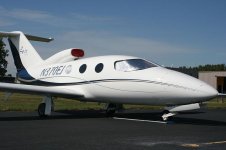
I'll show in an upcoming post you can make a small SSTO using currently existing engines and stages about the size of the smallest of the very light or personal jets:

[ame="http://en.wikipedia.org/wiki/List_of_very_light_jets"]List of very light jets - Wikipedia, the free encyclopedia[/ame]

Except that instead of jet engines it would use rockets and the entire volume aft of the cockpit would be filled with propellant, i.e., no passenger cabin. So they would have the appearance of fighter jets.
A manned orbital vehicle this size would have operational and cost advantages compared to a two-stage system especially for private use.

Bob Clark
 

Attachments

  • 800px-Epic_Victory_N370EJ.jpg
    800px-Epic_Victory_N370EJ.jpg
    50.4 KB · Views: 7
Last edited:
A manned orbital vehicle this size would have operational and cost advantages compared to a two-stage system especially for private use.

Operational advantages maybe, since you can fly alone from ground to space. But otherwise, it will be for a really hefty price tag and sure as hell not fit into a tiny GA sized vehicle. Even if you use the most expensive and most effective ways to push performance, even including that you might want to smash the pilot and his passengers into mangled meat by not limiting acceleration to about 3g, you will eventually have something, that has the cabin size of a Soyuz SA, but body of a Concorde.

Including the need to have specialist technicians for every tiny screw and the inability to fix a small dent in the hull because of a collision on the ground. Such operations are tolerable for government or specialist companies (funded by taxes), but not for the private person.

Also, I can't really follow your argumentation that a twin stage approach is really beyond the operational abilities of a private person. We already do it. And we do it pretty effective and pretty economic.

LKCM_06.jpg


I bet a TSTO would not only really fit into the capabilities of a private person or a club of private persons, but could also be economically handled. Who says that the private person has to own his own first stage? You could have a first stage shared by a club of people. Or a special company providing the first stage launch service to private citizens with a high performance aircraft that can transport maybe even two or three of the smaller second stages.

In your calculations, you would need a very large vehicle (Think of Skylon, which isn't small at all), with very complex and maintenance heavy engines. make the same thing twin staged, and even if you assume a very heavy and complex separation system (though we already know better about how to separate at high Mach numbers), and you could either haul two second stages with a vehicle of the size of the Skylon (and very expensive technology) or a single second stage with more user-friendly hardware
 
The amount of fissionable material required for a rocket would be much less than that required to run a nuclear power plant for an entire city. There is also the fact this would not be for making a profit on the power production as with uranium mines but just for producing propellant.

Except, if you're aiming for a profit, you have to make that profit somehow. If you just add uranium production for nuclear rockets to the chain, it doesn't help- it makes it worse.

It isn't a viable operation. Not nearly. Not even with $100/kg. If you had $100/kg, you'd be better off educating people and just shipping a reactor to the Moon instead!

I'll show in an upcoming post you can make a small SSTO using currently existing engines and stages about the size of the smallest of the very light or personal jets:

Er

One thing I've learnt is that you can't just ascribe maths to everything. Well, technically you can, but you always have to realise the engineering limitations, for example.

And the other thing is that you need to add mass to create a spacecraft. You need seperate power generation systems. You need an RCS. You need thermal control and a TPS for reentry!

You would add literally tons to your vehicle.

You can't have a fighter-jet sized SSTO, even with nuclear propulsion. I realised this when I did ROCS. I knew it was going to be large potentially larger than STS- but I didn't exactly know how large. If I used LH2 as propellant, it would have been absolutely huge.

This is for a spacecraft supposed to carry six people and 4 tons of cargo to LEO. I believe it was somewhere around 70 meters long by the end of it.

In your calculations, you would need a very large vehicle (Think of Skylon, which isn't small at all), with very complex and maintenance heavy engines.

Skylon is large just in dimensional terms because it uses LH2 as fuel. You could make the vehicle a good deal smaller if you used something like methane, but you would of course take a performance hit...

you could either haul two second stages with a vehicle of the size of the Skylon (and very expensive technology) or a single second stage with more user-friendly hardware

Do you really have to slash your performance by half to get 'more user-friendly hardware'?

What is the cutoff point for 'user-friendly'? How user friendly do you have to be? Is it absolutely guaranteed that an SSTO would not be 'user-friendly'?
 
Last edited:
Skylon is large just in dimensional terms because it uses LH2 as fuel. You could make the vehicle a good deal smaller if you used something like methane, but you would of course take a performance hit...

Still, it's lift-off mass is in one league with the 747. Despite Hydrogen being the lightest variant. A kerosene based version would be heavier than a A380 - if it could fly and reach orbit at all.

Do you really have to slash your performance by half to get 'more user-friendly hardware'?

Approximately yes, maybe even more. A small drop in ISP means a big change in vehicle mass for the same trajectory.

What is the cutoff point for 'user-friendly'? How user friendly do you have to be? Is it absolutely guaranteed that an SSTO would not be 'user-friendly'?

Lets define "user-friendly" as such: The pilot/owner/whoever can do the preflight and post-flight checks himself, and only needs specialist knowledge for dealing with the big problems. if you permit some additional mass penalty for example, you could make it possible for a skilled technician to swap a turbopump assembly, without you needing to hire a specialist team, like for example if you would need for replacing a turbopump rotor or bearing.

Current situation in spaceflight is as such: For everything, you need experts, usually in the price class of engineers. You can already do some small maintenance as IVA and EVA, which is about on the skill level for skilled technicians, but it is impossible to fly without. And the problem is not the staging system, but such mundane things like the engines or the propellant utilization system.

Calibrating a IMU isn't that complex, you could do that with adequate accuracy without studying physics. But the subsystem has to be designed for this task.

Swapping a LRU or installing new software would be fairly easy, providing automated test equipment isn't a problem. But could you for example replace a damaged heavy-duty valve? Not that easy without the valve helping you.

Replacing a worn-out bearing on a engine turbopump is really rocket science - not only do you need to deal with complex pneumatics and extreme accuracies, but you also need to do tasks like being able to balance a turbopump shaft afterwards again to prevent destructive vibrations. A high-performance turbopump runs at 250,000 RPM. If you want to be at least effective, you run at 100,000 RPM. if you want it cheap, but bulky, you use just 50,000 RPM and pay a hefty fuel efficiency price. Even for the 50,000 RPM turbopump, you will need to balance the rotor carefully. At 250,000 RPM, you balance in the range of a few hundred nanogram. Special engineers can do that, with special expensive machines. They cost you a few million per rotor then (alone about 400,000 USD for the wages). And you can't make it automatic. You will always need specialists to make sure the machines are not optimizing the rotor away into tiny chips of metal waste. The local optimum for the balance is not always the global optimum that you want.


If a spacecraft owner would need to send his spacecraft to a special company every every flight to check for such expensive problems and do the overhaul because even small checks mean disassembling sensitive parts, it is not user-friendly, the user who paid for it will spend less time with his investment as the technicians to maintain it.

Even if you want to just attract major companies, you need a low-cost approach to maintenance. Especially since you will have to assume that you are not alone in the world and your design might be the first, but not the last to appear. The first in a market is not always the one who makes the biggest profits.
 
Still, it's lift-off mass is in one league with the 747. Despite Hydrogen being the lightest variant. A kerosene based version would be heavier than a A380 - if it could fly and reach orbit at all.

Well yes, but what do you expect? It is a space launch vehicle after all, even if it is an SSTO one, you can't expect it to be the size of a fighter jet.

Even if you built a TSTO vehicle with a similar payload, it would probably end up being quite big as well.

Even the DeltaGlider would need to be larger, if it actually had to carry its propellant mass in liquid hydrogen.

Approximately yes, maybe even more. A small drop in ISP means a big change in vehicle mass for the same trajectory.

That is very understandable, but ISP also does not correlate directly with a certain degree of user-friendliness (though obviously it makes a big difference- the difference between cost of the SSME and RS-68 are an example).

Lets define "user-friendly" as such: The pilot/owner/whoever can do the preflight and post-flight checks himself, and only needs specialist knowledge for dealing with the big problems. if you permit some additional mass penalty for example, you could make it possible for a skilled technician to swap a turbopump assembly, without you needing to hire a specialist team, like for example if you would need for replacing a turbopump rotor or bearing.

Current situation in spaceflight is as such: For everything, you need experts, usually in the price class of engineers. You can already do some small maintenance as IVA and EVA, which is about on the skill level for skilled technicians, but it is impossible to fly without. And the problem is not the staging system, but such mundane things like the engines or the propellant utilization system.

Calibrating a IMU isn't that complex, you could do that with adequate accuracy without studying physics. But the subsystem has to be designed for this task.

Swapping a LRU or installing new software would be fairly easy, providing automated test equipment isn't a problem. But could you for example replace a damaged heavy-duty valve? Not that easy without the valve helping you.

Replacing a worn-out bearing on a engine turbopump is really rocket science - not only do you need to deal with complex pneumatics and extreme accuracies, but you also need to do tasks like being able to balance a turbopump shaft afterwards again to prevent destructive vibrations. A high-performance turbopump runs at 250,000 RPM. If you want to be at least effective, you run at 100,000 RPM. if you want it cheap, but bulky, you use just 50,000 RPM and pay a hefty fuel efficiency price. Even for the 50,000 RPM turbopump, you will need to balance the rotor carefully. At 250,000 RPM, you balance in the range of a few hundred nanogram. Special engineers can do that, with special expensive machines. They cost you a few million per rotor then (alone about 400,000 USD for the wages). And you can't make it automatic. You will always need specialists to make sure the machines are not optimizing the rotor away into tiny chips of metal waste. The local optimum for the balance is not always the global optimum that you want.


If a spacecraft owner would need to send his spacecraft to a special company every every flight to check for such expensive problems and do the overhaul because even small checks mean disassembling sensitive parts, it is not user-friendly, the user who paid for it will spend less time with his investment as the technicians to maintain it.

Even if you want to just attract major companies, you need a low-cost approach to maintenance. Especially since you will have to assume that you are not alone in the world and your design might be the first, but not the last to appear. The first in a market is not always the one who makes the biggest profits.

Do we really need to operate spacecraft as amateurs though? This is what RGClark has stated (or is at least implying), but I can imagine many levels of operation that are not nearly as simple as a very small-scale private operation, that are still much better than the current state(s) of where spaceflight is at.

That said, your super-expensive hyper-intensive maintainance operations and accidental metal-chip production machines will come down in price with time... of course there will always be limits and more intensive systems will always cost more, but the more experience is gained, the better things will become.
 
Do we really need to operate spacecraft as amateurs though? This is what RGClark has stated (or is at least implying), but I can imagine many levels of operation that are not nearly as simple as a very small-scale private operation, that are still much better than the current state(s) of where spaceflight is at.

Well, it is the extreme, isn't it? A platinum coated titanium bullet with diamond heat shield tiles would sure also be possible, but for what?

That said, your super-expensive hyper-intensive maintainance operations and accidental metal-chip production machines will come down in price with time... of course there will always be limits and more intensive systems will always cost more, but the more experience is gained, the better things will become.

Let me tell you an old German fairy tale:

After a senior engineer retired, the machine that this engineer supervised failed. Despite all attempts of the younger engineers and technicians, nothing worked, and the alternative started to become buying a new machine for a few million Euro. The owner of the company saw the proposed solution and was not willed to get deeply in debts without fighting, so he called the retired engineer, if he couldn't do anything there.

The engineer arrived, looked a few minutes at everything, measured a few things, pushed against some parts and then marked a part of the machine with chalk and said "Replace this axle and all will be fine again". The technicians did as told, and suddenly, the machine was running as good as a new one.

The engineer went to his former employer, and produced a bill over 10,000 Euro for his work. The company owner was surprised, after all, he didn't do anything except making a chalk mark. The engineer explained the bill in detail:

Chalk - 1€
Knowing where to put the mark - 9,999€

Now the company owner was enlightened and paid the bill.

Experience and skills together are extremely rare and extremely valuable. And they define their price.

Also, you have to look at the physical aspects there: The more performance you want, the less tolerances for errors you get. Performance is not just brute force alone, but also effectivity. The more effective your spacecraft should get, the more effective have its parts to get. The whole is maybe more than just the sum of all parts, but still you can't use junk parts alone with only junk skills of your engineers.

The math is pretty simple there: The less chamber pressure you have available, the less effective your rocket will be because the exhaust has less energy per kg. At the same time, a higher pressure means a lighter rocket engine for the same thrust. without pumps, you can't get very high chamber pressures, you are limited by the tank pressure and the structural mass.

For anything worth talking as SSTO or TSTO, you will need pumps, simply because the limitations of pressure-fed will be ugly. for pumps, you have the same downsizing: the higher your rotor speed, the smaller and lighter a pump can get for the same pressure change and mass flow. Also, for turbo-pumps, a higher rotor speed means the turbine can run faster and be more effective.

So, you are pretty soon getting in hells kitchen: If you want less good parts, the parts will get heavier or the performance of your spacecraft has to drop. When the parts get heavier, you need more performance from the other parts to compensate or the spacecraft performance will drop.

Now the annoying part starts as well: For a TSTO, you can compensate a performance drop of your second stage by making the first stage better (or the other way around). But there are limits. A SSTO has no such option, it can only try finding a better planet to launch from.

Thus, a first stage, that could for example haul a single low-performance second stage into its launch window, could also maybe carry two higher-performance vehicles with the same payload each. Or you could grow an existing first stage for something obsolete and low-performing into something that can launch two modern second stages. or shrink to become more effective itself.
 
Well, it is the extreme, isn't it? A platinum coated titanium bullet with diamond heat shield tiles would sure also be possible, but for what?

Sounds silly to me. :uhh:

Experience and skills together are extremely rare and extremely valuable. And they define their price.

Also, you have to look at the physical aspects there: The more performance you want, the less tolerances for errors you get. Performance is not just brute force alone, but also effectivity. The more effective your spacecraft should get, the more effective have its parts to get. The whole is maybe more than just the sum of all parts, but still you can't use junk parts alone with only junk skills of your engineers.

The math is pretty simple there: The less chamber pressure you have available, the less effective your rocket will be because the exhaust has less energy per kg. At the same time, a higher pressure means a lighter rocket engine for the same thrust. without pumps, you can't get very high chamber pressures, you are limited by the tank pressure and the structural mass.

For anything worth talking as SSTO or TSTO, you will need pumps, simply because the limitations of pressure-fed will be ugly. for pumps, you have the same downsizing: the higher your rotor speed, the smaller and lighter a pump can get for the same pressure change and mass flow. Also, for turbo-pumps, a higher rotor speed means the turbine can run faster and be more effective.

Well... yes. I'm not arguing with you there. But I mean, what if you tried to build a modern car engine 70 years ago? It would also be far more expensive than building a (perhaps) less demanding engine. And it would probably be more expensive than building a similar engine today.

My point is, I guess, that while the problems never go away, collective technological knowledge, over time, makes it easier to cope with them.

Now the annoying part starts as well: For a TSTO, you can compensate a performance drop of your second stage by making the first stage better (or the other way around). But there are limits. A SSTO has no such option, it can only try finding a better planet to launch from.

But re-engineering the first or second stage doesn't help if it defeats the purpose. If your second stage drops 200 m/s of exhaust velocity so you can instead have cheaper pumps and you want a better first stage, then you would have to increase your performance and thus cost there.

At least it's better juggling those two parts seperately than it is juggling one part at once. It's a pain.

But still, which is ideal? Go for as much performance as possible and get higher costs? Or have a poorly-performing cheaper vehicle?

If I bring my super-ugly, pressure-fed, steel-walled spacecraft onto the scene, that is just as reliable as the Delta IV but has half the price per kilogram, shouldn't it be adopted by any sane customer, over the Delta?

Thus, a first stage, that could for example haul a single low-performance second stage into its launch window, could also maybe carry two higher-performance vehicles with the same payload each. Or you could grow an existing first stage for something obsolete and low-performing into something that can launch two modern second stages. or shrink to become more effective itself.

Yes, but you can't just build things like LEGO. Well, you can... but you could have problems.

That said, if you want to do something different with your SSTO, you would just have to build a new type of SSTO... just like how people build new types of aircraft. Sure, you don't have the same sort of 'growth options' that you might have with another vehicle, but if cost and reliability are acceptable- and better than the competition- why bother?

Though there is of course another path. Strapping a second stage to your SSTO, turning it into a TSTO, and greatly increasing performance. What's wrong with that?
 
Quite key for why reusable SSTO's will make manned space travel routine is the small size and low cost they can be produced. A manned SSTO can be produced using currently existing engines and stages the size of the smallest of the very light, or personal, jets [1], except it would use rocket engines instead of jet engines, and the entire volume aft of the cockpit would be filled with propellant, i.e., no passenger cabin. So it would have the appearance of a fighter jet.

We'll base it on the SpaceX Falcon 1 first stage. According to the Falcon 1 Users Guide on p.8 [2], the first stage has a dry mass of 3,000 lbs, 1,360 kg, and a usable propellant mass of 47,380 lbs, 21,540 kg. We need to swap out the low efficiency Merlin engine for a high efficiency engine. However, SpaceX has not released the mass for the Merlin engine. We'll estimate it from the information here, [3]. From the given T/W ratio and thrust, I'll take the mass as 650 kg.

We'll replace it with the RD-0242-HC, [4]. This is a proposed modification to kerosene fuel of an existing hypergolic engine. This type of modification where an engine has been modified to run on a different fuel has been done before so it should be doable [5], [6]. The engine mass is listed as 120 kg. We'll need two of them to loft the vehicle. So the engine mass is reduced from that of the Merlin engine mass by 410 kg, and the dry mass of the stage is reduced down to 950 kg. Note that the mass ratio now becomes 23.7 to 1.

We need to get the Isp for this case. For a SSTO you want to use altitude compensation. The vacuum Isp of the RD-0242-HC is listed as 312 s. However, this is for first stage use so it's not optimized for vacuum use. Since the RD-0242-HC is a high performance, i.e., high chamber pressure engine, with altitude compensation it should get similar vacuum Isp as other high performance Russian engines such as the RD-0124 [7] in the range of 360 s. As a point of comparison the Merlin Vacuum is a version of the Merlin 1C optimized for vacuum use with a longer nozzle. This increases its vacuum Isp from 304 s to 342 s [8]. I've also been informed by email that engine performance programs such as Propep [9] give the RD-0242-HC an ideal vacuum Isp of 370 s. So a practical vacuum Isp of 360 s should be reachable using altitude compensation.

For the sea level Isp of the RD-0242-HC, again the version of the high performance, high chamber pressure, RD-0124 with a shortened nozzle optimized for sea level operation gets a 331 s Isp. So I'll take the sea level Isp as this value using altitude compensation that allows optimized performance at all altitudes.

To calculate the delta-V achievable I'll follow the suggestion of Mitchell Burnside Clapp who spent many years designing and working on SSTO projects including stints with the DC-X and X-33 programs. He argues that you
should use the vacuum Isp and just use 30,000 feet per second, about 9,150 m/s, as the required delta-V to orbit for dense propellants [10]. The reason for this is that you can just regard the reduction in Isp at sea level and low altitude as a loss and add onto the required delta-V for orbit this particular loss just like you add on the loss for air drag and gravity loss. Then with a 360 s vacuum Isp we get a delta-V of 360*9.8ln(1 + 21,540/950) = 11,160 m/s. So we can add on payload mass: 360*9.8ln(1+21,540/(950 + 790)) = 9,150 m/s, allowing a payload of 790 kg.

To increase the payload we can use different propellant combinations and use lightweight composites. Dr. Bruce Dunn wrote a report showing the payload that could be delivered using high energy density hydrocarbon fuels other than kerosene [11]. For methylacetylene he gives an ideal vacuum Isp of 391.1 s. High performance engines can get get ca. 97% and above of the ideal Isp so I'll take the vacuum Isp value as 384 s. Dunn notes that Methyacetylene/LOX when densified by subcooling gets a density slightly above that of kerolox, so I'll keep the same propellant mass. Then the payload will be 1,120 kg: 384*9.8ln(1 + 21,540/(950 + 1,120)) = 9,160 m/s.

We can get better payload by reducing the stage weight by using lightweight composites. The stage weight aside from the engines is 710 kg. Using composites can reduce the weight of a stage by about 40%. Then adding back on the engine mass this brings the dry mass to 670 kg. So our payload can be 1,400 kg: 384*9.8ln(1 + 21,540/(670 + 1,400)) = 9,160 m/s.
Note this has a very high value for what is now regarded as a key figure of merit for the efficiency of a launch vehicle: the ratio of the payload to the dry mass. The ratio of the payload to the gross mass is now recognized as not being a good figure of merit for launch vehicles. The reason is that payload mass is being compared then to mostly what makes up only a minor proportion of the cost of a launch vehicle, the cost of propellant. By comparing instead to the dry mass you are comparing to the expensive components of the vehicle, the parts that have to be constructed and tested [12].

This vehicle in fact has the payload to dry mass ratio over 2. Every other launch vehicle I looked at, and possibly every other one that has ever existed, has the ratio going in the other direction, i.e., the dry mass is greater than the payload mass. Often it is much greater. For example for the space shuttle system the dry mass is over 12 times that of the payload mass, undoubtedly contributing to the high cost for the payload delivered.

Because of this high value for this key figure of merit, this vehicle would be useful even as a expendable launcher. However, a SSTO is most useful as a reusable vehicle. This will be envisioned as a vertical take-off vehicle. However, it could use either a winged horizontal landing or a powered vertical landing. This page gives the mass either for wings or propellant for landing as about 10% of the dry, landed mass [13]. It also gives the reentry thermal protection mass as 15% of the landed mass. The landing gear mass is given as 3% of the landed mass here [14]. This gives a total of 28% of the landed mass for reentry/landing systems. With lightweight modern materials quite likely this could be reduced to half that.

If you use the vehicle just for a cargo launcher with cargo left in orbit, then the reentry/landing system mass only has to cover the dry vehicle mass so with lightweight materials perhaps less than 100 kg out of the payload mass has to be taken up by the reentry/landing systems. For a manned launcher with the crew cabin being returned, the reentry/landing systems might amount to 300 kg, leaving 1,100 kg for crew cabin and crew. As a mass estimate for the crew cabin, the single man Mercury capsule only weighed 1,100 kg [15 ]. With modern materials this probably can be reduced to half that.

For the cost, the full two stage Falcon 1 launcher is about $10 million. The engines make up the lion share of the cost for launchers. So probably much less than $5 million just for the 1st stage sans engine. Composites will make this more expensive but probably not much more than twice as expensive. For the engine cost, Russian engines are less expensive than American ones. The RD-180 at 1,000,000 lbs vacuum thrust costs about $10 million [16], and the NK-43 at a 400,000 lbs vacuum thrust costs about $4 million [17]. This is in the range of $10 per pound of vacuum thrust. On that basis we might estimate the cost of the RD-0242-HC of about 30,000 lbs vacuum thrust as $300,000. We need two of them for $600,000.

So we can estimate the cost of the reusable version as significantly less than $10,600,000 without the reentry/landing system costs. These systems added on for reusability at a fraction of the dry mass of the vehicle will likely also add on a fraction on to this cost. Keep in mind also that the majority of the development cost for the two stage Falcon 1 went to development of the engines so in actuality the cost of just the first stage without the engine will be significantly less than half the full $10 million cost of the Falcon 1 launcher. The cost of a single man crew cabin is harder to estimate. It is possible it could cost more than the entire launcher. But it's likely to be less than a few 10's of millions of dollars.

REFERENCES.
1.)List of very light jets.
[ame="http://en.wikipedia.org/wiki/List_of_very_light_jets"]List of very light jets - Wikipedia, the free encyclopedia[/ame]

2.)Falcon 1 Users Guide.
http://www.spacex.com/Falcon1UsersGuide.pdf

3.)Merlin (rocket engine)
4 Merlin 1C Engine specifications
http://en.wikipedia.org/wiki/Merlin_(rocket_engine)#Merlin_1C_Engine_specifications

4.)RD-0242-HC.
http://www.astronautix.com/engines/rd0242hc.htm

5.)LR-87.
http://en.wikipedia.org/wiki/LR-87

6.)Pratt and Whitney Rocketdyne's RS-18 Engine Tested With Liquid Methane.
by Staff Writers
Canoga Park CA (SPX) Sep 03, 2008
http://www.space-travel.com/reports...18_Engine_Tested_With_Liquid_Methane_999.html

7.)RD-0124.
http://www.astronautix.com/engines/rd0124.htm

8.)Merlin (rocket engine).
2.5 Merlin Vacuum
http://en.wikipedia.org/wiki/Merlin_(rocket_engine)#Merlin_Vacuum

9.)Propep
http://www.spl.ch/software/index.html

10.)Newsgroups: sci.space.policy
From: Mitchell Burnside Clapp <[email protected]>
Date: 1995/07/19
Subject: Propellant desity, scale, and lightweight structure.
http://groups.google.com/group/sci....thread/3d981607d59684dc/945baea33c95a22?hl=en

11.)Alternate Propellants for SSTO Launchers
Dr. Bruce Dunn
Adapted from a Presentation at:
Space Access 96
Phoenix Arizona
April 25 - 27, 1996
http://www.dunnspace.com/alternate_ssto_propellants.htm

12.)A Comparative Analysis of Single-Stage-To-Orbit Rocket and Air-Breathing Vehicles.
p. 5, 52, and 67.
http://govwin.com/knowledge/comparative-analysis-singlestagetoorbit-rocket-and/15354

13.)Reusable Launch System.
http://en.wikipedia.org/wiki/Reusable_launch_system#Horizontal_landing

14.)Landing gear weight (Gary Hudson; George Herbert; Henry Spencer).
http://yarchive.net/space/launchers/landing_gear_weight.html

15.)Mercury Capsule.
http://www.astronautix.com/craft/merpsule.htm

16.)Wired 9.12: From Russia, With 1 Million Pounds of Thrust.
http://www.wired.com/wired/archive/9.12/rd-180.html

17.)A Study of Air Launch Methods for RLVs.
Marti Sarigul-Klijn, Ph.D. and Nesrin Sarigul-Klijn, Ph.D.
AIAA 2001-4619
p.13
http://mae.ucdavis.edu/faculty/sarigul/aiaa2001-4619.pdf
 
Last edited:
Can you please cease your cargo cult rocket science? I don't know how often we had been explaining you that the Burnside-Clapp hypothesis is wrong and the simulation effect already explained by the known relation between burn time and gravity losses, and not caused by propellant density.

A slowly accelerating rocket which uses liquid depleted Uranium as propellant will NOT have less gravity losses as a faster accelerating hydrogen/oxygen rocket.

I think you should get a blog instead of a forum, because you don't want people to answer you anyway. Or write a book: "How I created another SSTO that will never get build because I screwed up math in Phase I"

Also, your constant arguments by imaginary authority are annoying. If you are not able to support your claims with math, let it be. I don't give a damn about what failed overhyped projects Burnside-Clapp had been involved in. I know his biography and he is not better than millions of other engineers. If engineers would not do stupid errors, we would have a much better world here. But in reality, a diploma from university does not make you a wise person or omnipotent. And as I experience too often: Engineers are having too often absolutely no clue of the theory behind their work. They can use the tools and simulations produced by others, but without somebody competent watching over their work often, they wouldn't even manage to get the definition of aerodynamic mass flux right from their memory.

If your argument only works, because a demigod of Rocket science said so, it is no argument, but a waste of space. And did I mention that I am strong believer in the old role playing game rule that demigods should be cut into tiny stripes and disposed properly?

And citing a wrong source as reference is not making your arguments right. Contrary. You just play in one league with the LHC doomsday proponents then, who cite a paper from 1920 as their reference, despite this paper having been shown to be wrong already in 1922.
 
Last edited:
...
I think you should get a blog instead of a forum, because you don't want people to answer you anyway. Or write a book: "How I created another SSTO that will never get build because I screwed up math in Phase I"
...

If you don't find the topic interesting or believable you are freely encouraged not to read it or respond to it.
However, I severely doubt that other readers of this forum would want you to make that decision for them.

Bob Clark
 
If you don't find the topic interesting or believable you are freely encouraged not to read it or respond to it.
However, I severely doubt that other readers of this forum would want you to make that decision for them.

How many people except me and TNeo do you see in this thread? ;)
 
Can I join?

Oh Dear...
 
Back
Top