It is my contention that the reason why launch costs are so high, the reason why we don't have passenger access to space as routine as say trans-Pacific flights is that the idea has been promulgated that SSTO is impossible. That is not the case. In fact it is easy, IF you do it in the right way. The right way is summarized in that
one simple sentence at the end of my sig file.
We all know that to get a good payload to space you want a high efficiency engine. And we all know we want to use lightweight structures so the weight savings can go to increased payload. So you would think it would be obvious to use both these ideas to maximize the payload to orbit, right?
And indeed both have been used together -
for upper stages. Yet this fundamentally obvious concept still has not been used for
first stages. It is my thesis that if you do this, then what you wind up with will automatically be SSTO capable. This is true for either kerosene fueled or hydrogen fueled stages.
Part of the misinformation that has been promulgated is that the mass ratio for SSTO's is some impossible number. This is false. We've had rocket stages with the required mass ratio's since the 60's, nearly 50 years, both for kerosene and hydrogen fueled. Another part of the misinformation is that it would require some unknown high energy fuel and engine to accomplish. This is false. The required engines have existed since the 70's, nearly 40 years, both for kerosene and hydrogen fueled.
What has NOT been done is to marry the two concepts together for
first stages. All you need to do is swap out the low efficiency engines that have been used for the high mass ratio stages and replace them with the high efficiency engines. It really is that simple.
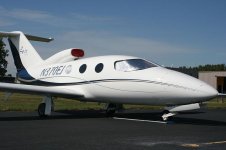
This makes possible small, low cost orbital vehicles that could transport the same number of passengers as the space shuttle, about 7, but would have a comparable cost to a mid-sized business jet, a few tens of millions of dollars.
Then once you have the SSTO's they make your staged vehicles
even better because you can carry greater payload when they are used for the individual stages of the multi-staged vehicle.
In disseminating the false dogma that SSTO's are not possible it is sometimes said instead that they are not practical because the payload fraction is so small. Even this is false. And indeed this is just as damaging as making the false statement they are not possible because the statements are often conflated into meaning the same thing. So when those in the industry make the statement they are not "practical", meaning actually they are doable but not economical, this becomes interpreted among many space enthusiasts and even many in the industry as meaning it would require some revolutionary advance to make them possible.
The fact that you can carry significant payload to orbit using SSTO's can be easily confirmed by anyone familiar with the rocket equation. To get a SSTO with significant payload using efficient kerosene engines you need a mass ratio of about 20 to 1. And to get a SSTO with significant payload using efficient hydrogen engines you need a mass ratio of about 10 to 1. Both of these the high mass ratio stages and the high efficiency engines for both kerosene and hydrogen have existed for decades now.
See this list of rocket stages:
Stages Index.
http://www.astronautix.com/stages/index.htm
Among the kerosene-fueled stages you see that several among the Atlas and Delta family have the required mass ratio. However, for the early Atlas stages you have to be aware of the type of staging system they used. They had drop-off booster engines and a main central engine, called the sustainer that continued all the way to orbit. But even when you take this into account you see these highly weight optimized stages had surprisingly high mass ratios.
See for instance the Atlas Agena SLV-3:
Atlas Agena SLV-3
Lox/Kerosene propellant rocket stage. Loaded/empty mass 117,026/2,326 kg. Thrust 386.30 kN. Vacuum specific impulse 316 seconds.
Cost $ : 14.500 million. Semistage: LR89-5. Semistage Thrust (vac): 1,644.960 kN (369,802 lbf). Semistage Thrust (vac): 167,740 kgf. Semistage specific impulse: 290 sec. Semistage Burn time: 120 sec. Semistage specific impulse (sl): 256 sec. Semistage Jettisonable Mass: 3,174 kg (6,997 lb). Semistage- number engines: 2. Semistage: Atlas MA-3.
Status: Out of production.
Gross mass: 117,026 kg (257,998 lb).
Unfuelled mass: 2,326 kg (5,127 lb).
Height: 20.67 m (67.81 ft).
Diameter: 3.05 m (10.00 ft).
Span: 4.90 m (16.00 ft).
Thrust: 386.30 kN (86,844 lbf).
Specific impulse: 316 s.
Specific impulse sea level: 220 s.
Burn time: 265 s.
Number: 140 .
http://www.astronautix.com/stages/atlaslv3.htm
Looking at only the loaded/empty mass you would think this stage had a mass ratio close to 50 to 1. But that is only including the sustainer engine. The more relevant ratio would be when you add in the mass of the booster engines to the dry mass since they are required to lift the vehicle off the pad. These are listed as the jettisonable mass at 3,174 kg. This makes the loaded mass now 117,026 + 3,174 = 120,200 and the dry mass 2,326 + 3,174 = 5,500 kg, for a mass ratio of 21.85.
But this was using the low efficiency engines available in the early 60's. Let's swap these out for the high efficiency
NK-33. The sustainer engine used was the
LR89-5 at 720 kg. At 1,220 kg the NK-33 weighs 500 kg more. So removing both the sustainer and booster engines to be replaced by the NK-33 our loaded mass becomes 117,526 kg and the dry mass 2,826 kg, and the mass ratio 41.6 (!).
For the trajectory-averaged Isp, notice this is not just the midpoint between the sea level and vacuum value, since most of the flight to orbit is at high altitude at near vacuum conditions. A problem with doing these payload to orbit estimates is the lack of a simple method for getting the average Isp over the flight for an engine, which inhibits people from doing the calculations to realize SSTO is possible and really isn't that hard. I'll use a guesstimate Ed Kyle uses, who is a frequent contributor to NasaSpaceFlight.com and the operator of the Spacelauncereport.com site. Kyle takes the
average Isp as lying 2/3rds of the way up from the sea level value to the vacuum value. The sea level value of the Isp for the NK-33 is 297 s, and the vacuum value 331 s. Then from this guesstimate the average Isp is 297 + (2/3)(331 - 297) = 319.667, which I'll round to 320 s.
Using this average Isp and a 8,900 m/s delta-V for a flight to orbit, we can lift 4,200 kg to orbit:
320*9.8ln((117,526+4,200)/(2,826+4,200)) = 8,944 m/s. This is a payload fraction of 3.5%, comparable to that of many multi-stage rockets.
This is just using the engine in its standard configuration, no altitude compensation. However, for a SSTO you definitely would want to use altitude compensation. Dr. Bruce Dunn in his report "
Alternate Propellants for SSTO Launchers" estimates an average Isp of 338.3 s for high performance kerosene engines when using altitude compensation. Then we could lift 5,500 kg to orbit:
338.3*9.8ln((117,526+5,500)/(2,826+5,500)) = 8,928 m/s.
But kerosene is not the most energetic hydrocarbon fuel you could use. Dunn in his report estimates an average Isp of 352 s for methylacetyene using altitude compensation. This would allow a payload of 6,500 kg : 352*9.8ln((117,526+6,500)/(2,826+6,500)) = 8,926 m/s.
Bob Clark
---------- Post added 06-26-11 at 01:40 PM ---------- Previous post was 06-25-11 at 04:34 PM ----------
Because SSTO's are controversial I should make the disclaimer that citing the references in the prior post should not be construed as the cited authors endorsing the viewpoint I expressed in that post.
Note also in fact that this SSTO has a very good value for a ratio that I believe should be regarded as a better measure, i.e., figure of merit, than the payload ratio for the efficiency of a orbital vehicle. This is the ratio of the payload to the total dry mass of the vehicle. The reason why this is a good measure is because actually the cost of the propellant is a minor component for the cost of an orbital rocket. The cost is more accurately tracked by the dry mass and the vehicle complexity. Note that SSTO's in not having the complexity of staging are also good on the complexity scale.
For the ratio of the payload to dry mass you see this is greater than 1 for this SSTO. This is important because for every orbital vehicle I looked at, and possibly for every one that has existed, this ratio is going in the other direction: the vehicle dry mass is greater than the payload carried. Often it is much greater. For instance for the space shuttle system, the vehicle dry mass is more than 12 times that of the payload.
Bob Clark