Updates Cassini Mission News and Updates

CICLOPS: Rev161: Feb 9 - Mar 1 '12:
Cassini continues its exploration of the Saturn system with the 24-day Rev161, which begins on February 9 at its farthest distance from the planet. This is also called the orbit's apoapse. At this point, Cassini is 2.84 million kilometers (1.77 million miles) from Saturn's cloud tops. The spacecraft is in the middle of the first equatorial phase of the Cassini Solstice Mission, a phase which lasts until May 2012. During this phase, the spacecraft's orbits lie within the equatorial plane of the planet, providing opportunities to encounter Saturn's numerous moons, to image the rings edge-on, and to look at Saturn's cloud tops without the rings obscuring the view. Forty-two ISS observations are planned for Rev161, the vast majority dedicated to an encounter with Titan and Saturn storm monitoring.

ISS begins its observations for Rev161 two days after apoapse on February 11 with a quick observation of Saturn and its faded northern hemisphere storm with a second such observation planned later that day. These "Storm Watch" observation sequences are designed to take advantage of short, two-minute segments when the spacecraft turns the optical remote sensing (ORS) instruments back to Saturn as a waypoint between other experiments' observations. These sequences include blue, clear, two methane band, and one full-frame, continuum band filter images. Eleven more such sequences are planned between February 12 and 18, while four are planned for February 24 and 25. Between the first two storm watch observations on February 11, ISS will acquire an astrometric observation of Saturn's small, inner moons, including Epimetheus, Prometheus, Methone, and Polydeuces. Astrometric observations are used to improve our understanding of the orbits of these small satellites, which can be influenced by Saturn's larger icy satellites. After another Saturn Storm Watch observation, ISS will observe Titan for 11 hours as part of the "Titan Exploration at Apoapse" (TEA) campaign. These lengthy observations are designed to monitor clouds on the satellite as well as to track the clouds' motions. This TEA observation will cover the Fensal-Aztlan region of Titan from a distance of 3.82 million kilometers (2.38 million miles).

On February 14, ISS will take a look at Titan, this time covering eastern Xanadu and northwestern Fensal from a distance of 2.89 million kilometers (1.80 million miles). The observation is an effort to look for clouds in the moon's atmosphere as part of the "Titan Monitoring Campaign" (TMC). These TMC observations are shorter than TEA observations and are simply used to see if clouds are present rather than tracking the clouds' movements. After another Saturn storm watch observation, ISS will acquire an astrometric observation, looking at Janus, Anthe, Telesto, Polydeuces, and Prometheus. On February 16, ISS will observe a crescent Titan in order to examine the moon's upper haze layers, such as the north and south polar hoods. This observation will be taken from a distance of 1.59 million kilometers (0.99 million miles). The next day, the wide-angle camera will be used to examine the vertical structure of the E ring. Researchers will be examining the location of the ring with respect to the planet's equatorial plane to study the effects of solar radiation pressure and Saturn's magnetic field on the eccentricity of the fine particles in the E ring.

Two days before periapse, Cassini encounters Titan on February 19 at 08:43 UTC for the 83rd time. This is the third of nine Titan flybys planned for 2012, and is the last of the first equatorial phase of the mission. The next flyby is scheduled for May 22. T82 is a relatively high-altitude flyby with a close-approach distance of 3,803 kilometers (2,363 miles). This flyby will allow for imaging of Titan's Senkyo region outbound from the encounter and a crescent Titan inbound. For nearly the entire encounter, the Composite Infrared Spectrometer (CIRS) will be the primary pointing instrument, with ISS riding along. Before closest approach, CIRS will acquire a series of nadir and limb temperature and compositional mapping scans using both their far- and mid-infrared channels. ISS also will have a short observation ten hours before encountering Titan. The camera will run through a series of methane, continuum-band, and ultraviolet filters in order to study the moon's upper haze layers.

At closest approach, CIRS will acquire a pair of limb temperature scans using their far-infrared channel. These scans will focus primarily on atmosphere above Titan's mid-southern latitudes. CIRS also will look at the composition of aerosols in the moon's haze layers. For the rest of the encounter, CIRS will acquire another set of nadir and limb temperature and compositional mapping scans, this time covering Titan's sunlit side.

On February 21 at 05:23 UTC, Cassini will reach periapse for Rev161 at an altitude of 134,680 kilometers (83,690 miles) above Saturn's cloud tops. Both of ISS's periapse observations will be taken the day before. First, the narrow-angle camera will ride along with the Ultraviolet Imaging Spectrometer (UVIS) to monitor Saturn's aurora australis. Next, ISS will observe Enceladus' plume, monitoring activity at the south polar jets just five weeks before the next flyby of the moon.

On February 24, ISS will image Titan's sub-Saturn hemisphere from a distance of 2.88 million kilometers (1.79 million miles). ISS will take a look at Titan again on February 29, this time from a distance of 2.81 million kilometers (1.75 million miles) and covering eastern Xanadu and the region around Menrva.

On March 1, Cassini will reach apoapse on this orbit, bringing it to a close and starting Rev162. Rev162 includes a close, non-targeted flyby of Enceladus.

{...}
 
NASA / NASA JPL:
The Many Moods of Titan

February 23, 2012

A set of recent papers, many of which draw on data from NASA's Cassini spacecraft, reveal new details in the emerging picture of how Saturn's moon Titan shifts with the seasons and even throughout the day. The papers, published in the journal Planetary and Space Science in a special issue titled "Titan through Time", show how this largest moon of Saturn is a cousin - though a very peculiar cousin - of Earth.

"As a whole, these papers give us some new pieces in the jigsaw puzzle that is Titan," said Conor Nixon, a Cassini team scientist at the NASA Goddard Space Flight Center, Greenbelt, Md., who co-edited the special issue with Ralph Lorenz, a Cassini team scientist based at the Johns Hopkins University Applied Physics Laboratory, Laurel, Md. "They show us in detail how Titan's atmosphere and surface behave like Earth's - with clouds, rainfall, river valleys and lakes. They show us that the seasons change, too, on Titan, although in unexpected ways."

A paper led by Stephane Le Mouelic, a Cassini team associate at the French National Center for Scientific Research (CNRS) at the University of Nantes, highlights the kind of seasonal changes that occur at Titan with a set of the best looks yet at the vast north polar cloud.

[table="head;width=675"]{colsp=3}
Click on images for details​

||

This series of false-color images obtained by NASA's Cassini spacecraft shows the dissolving cloud cover over the north pole of Saturn's moon Titan.
Image credit: NASA/JPL-Caltech/University of Arizona/CNRS/LPGNantes​
|This series of images obtained by NASA's Cassini spacecraft shows several views of the north polar cloud covering Saturn's moon Titan.
Image credit: NASA/JPL-Caltech/University of Arizona/CNRS/LPGNantes/SSI​
|This artist's concept shows a possible model of Titan's internal structure that incorporates data from NASA's Cassini spacecraft.
Image credit: A. D. Fortes/UCL/STFC​
[/table]​


A newly published selection of images - made from data collected by Cassini's visual and infrared mapping spectrometer over five years - shows how the cloud thinned out and retreated as winter turned to spring in the northern hemisphere.

Cassini first detected the cloud, which scientists think is composed of ethane, shortly after its arrival in the Saturn system in 2004. The first really good opportunity for the spectrometer to observe the half-lit north pole occurred on December 2006. At that time, the cloud appeared to cover the north pole completely down to about 55 degrees north latitude. But in the 2009 images, the cloud cover had so many gaps it unveiled to Cassini's view the hydrocarbon sea known as Kraken Mare and surrounding lakes.

"Snapshot by snapshot, these images give Cassini scientists concrete evidence that Titan's atmosphere changes with the seasons," said Le Mouelic. "We can't wait to see more of the surface, in particular in the northern land of lakes and seas."

In data gathered by Cassini's composite infrared mapping spectrometer to analyze temperatures on Titan's surface, not only did scientists see seasonal change on Titan, but they also saw day-to-night surface temperature changes for the first time. The paper, led by Valeria Cottini, a Cassini associate based at Goddard, used data collected at a wavelength that penetrated through Titan's thick haze to see the moon's surface. Like Earth, the surface temperature of Titan, which is usually in the chilly mid-90 kelvins (around minus 288 degrees Fahrenheit), was significantly warmer in the late afternoon than around dawn.

"While the temperature difference - 1.5 kelvins - is smaller than what we're used to on Earth, the finding still shows that Titan's surface behaves in ways familiar to us earthlings," Cottini said. "We now see how the long Titan day (about 16 Earth days) reveals itself through the clouds."

A third paper by Dominic Fortes, an outside researcher based at University College London, England, addresses the long-standing mystery of the structure of Titan's interior and its relationship to the strikingly Earth-like range of geologic features seen on the surface. Fortes constructed an array of models of Titan's interior and compared these with newly acquired data from Cassini's radio science experiment.

The work shows the moon's interior is partly or possibly even fully differentiated. This means that the core is denser than outer parts of the moon, although less dense than expected. This may be because the core still contains a large amount of ice or because the rocks have reacted with water to form low-density minerals.

Earth and other terrestrial planets are fully differentiated and have a dense iron core. Fortes' model, however, rules out a metallic core inside Titan and agrees with Cassini magnetometer data that suggests a relatively cool and wet rocky interior. The new model also highlights the difficulty in explaining the presence of important gases in Titan's atmosphere, such as methane and argon-40, since they do not appear to be able to escape from the core.

{...}
 
Universe Today: Moons Large and Small

7062_16907_11.jpg

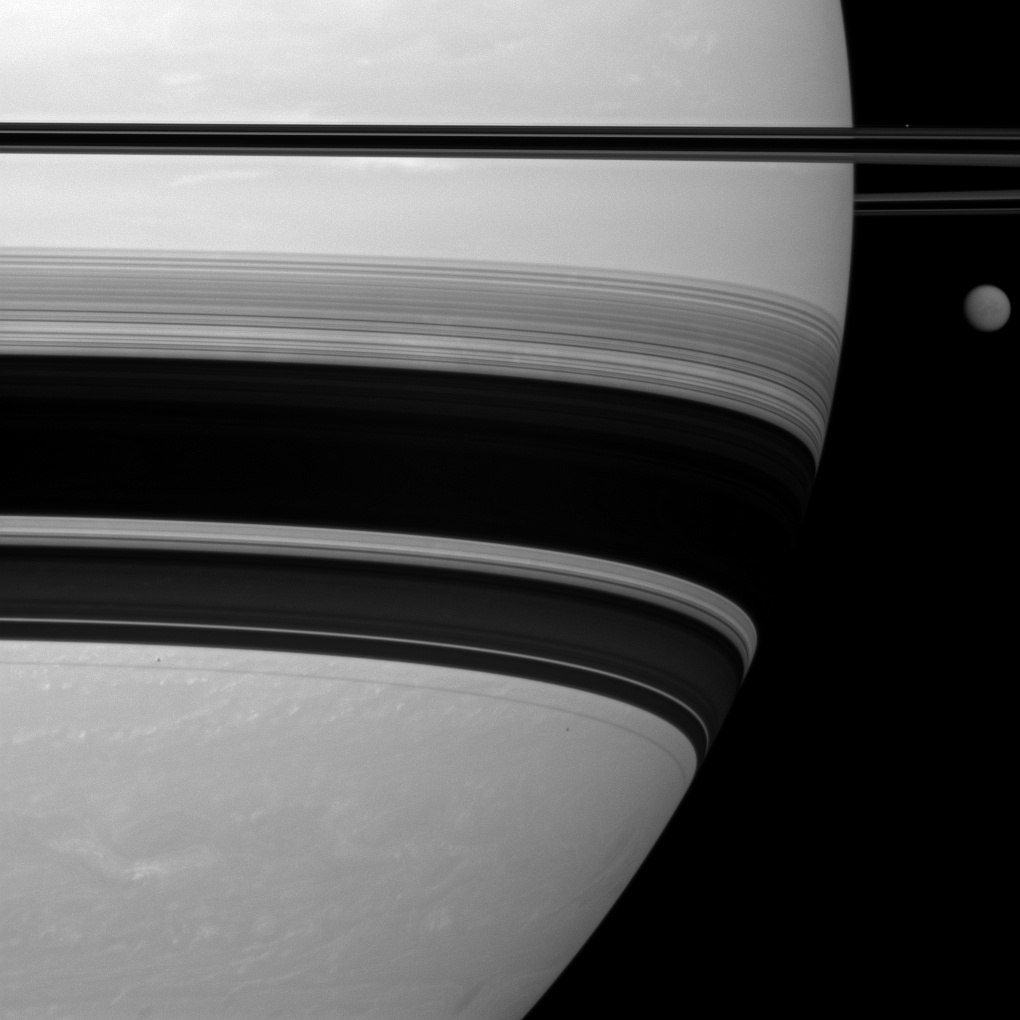
Titan and Prometheus are dwarfed by giant Saturn (NASA/JPL/SSI)​
 
CICLOPS: Rev162: Mar 1 - Mar 18 '12:
Cassini continues its exploration of the Saturn system with the 18-day Rev162, which begins on March 1 at its farthest distance from the planet. This is also called the orbit's apoapse. At this point, Cassini is 2.38 million kilometers (1.48 million miles) from Saturn's cloud tops. The spacecraft is nearing the end of the first equatorial phase of the Cassini Solstice Mission, a phase which lasts until May 2012. During this phase, the spacecraft's orbits lie within the equatorial plane of the planet, providing opportunities to encounter Saturn's numerous moons, image the rings edge-on, and look at Saturn's cloud tops without the rings obscuring the view. Thirty-eight ISS observations are planned for Rev162, the vast majority dedicated to Saturn storm monitoring and to the non-targeted encounters with Rhea and Enceladus.

ISS begins its observations for Rev162 the day after apoapse on March 2 with a look at Titan from a distance of 1.96 million kilometers (1.22 million miles). The observation is an effort to look for clouds in the moon's atmosphere as part of the "Titan Monitoring Campaign" (TMC). This observation, of a crescent Titan, is designed to study changes in Titan's upper haze layers. Later that day, ISS will acquire a lengthy, 18-hour observation of Thrymr, one of Saturn's distant, irregular moons. This observation will be taken from a distance of 9.48 million kilometers (5.89 million miles), and when combined with additional observations of this irregular satellite, is designed to measure Thrymr's rotational period. Similar observations will be taken of two more outer satellites, Jarnsaxa and Mundilfari, on March 8 and 9. On March 5, 6, and 7, ISS will ride along with the Ultraviolet Imaging Spectrometer (UVIS) to monitor Saturn's aurora australis. On March 9, ISS will perform a TMC observation of Titan, this time at much lower phase angles. This will allow for monitoring of cloud features across the sub-Saturn hemisphere of the moon from a distance of 881,000 kilometers (547,000 miles).

On March 10 at 02:13 UTC, Cassini will reach periapse for Rev162 at an altitude of 135,530 kilometers (84,210 miles). ISS observations will be taken during two non-targeted encounters of Saturn's icy satellites, first of Enceladus (albeit seven hours after closest approach) and later of Rhea. Cassini will fly by Enceladus at a distance of 9,176 kilometers (5,701 miles) on March 9. A few hours later, ISS will take a look at Enceladus's leading hemisphere from a distance of 175,000 kilometers (108,000 miles). The camera system will take two sets of color and polarized filter images of the satellite, with the sets separated by an hour. ISS will then image Titan from a distance of 1.54 million kilometers (0.96 million miles).

At 15:03 UTC, Cassini will fly by Saturn's second largest moon, Rhea, at a close-approach distance of 41,858 kilometers (26,009 miles). ISS will acquire three sets of observations during this flyby. First, ISS will ride along with a series of scans of a crescent Rhea by the Composite Infrared Spectrometer (CIRS) about three hours before closest approach. During closest approach, ISS will acquire a 30-frame mosaic of Rhea's leading hemisphere, including the Mamaldi and Tirawa impact basins. Afterward, ISS will search for particles within the Rhea's possible ring system. Particles as small as 5 to 10 meters (16 to 32 feet) could be detected in these images.

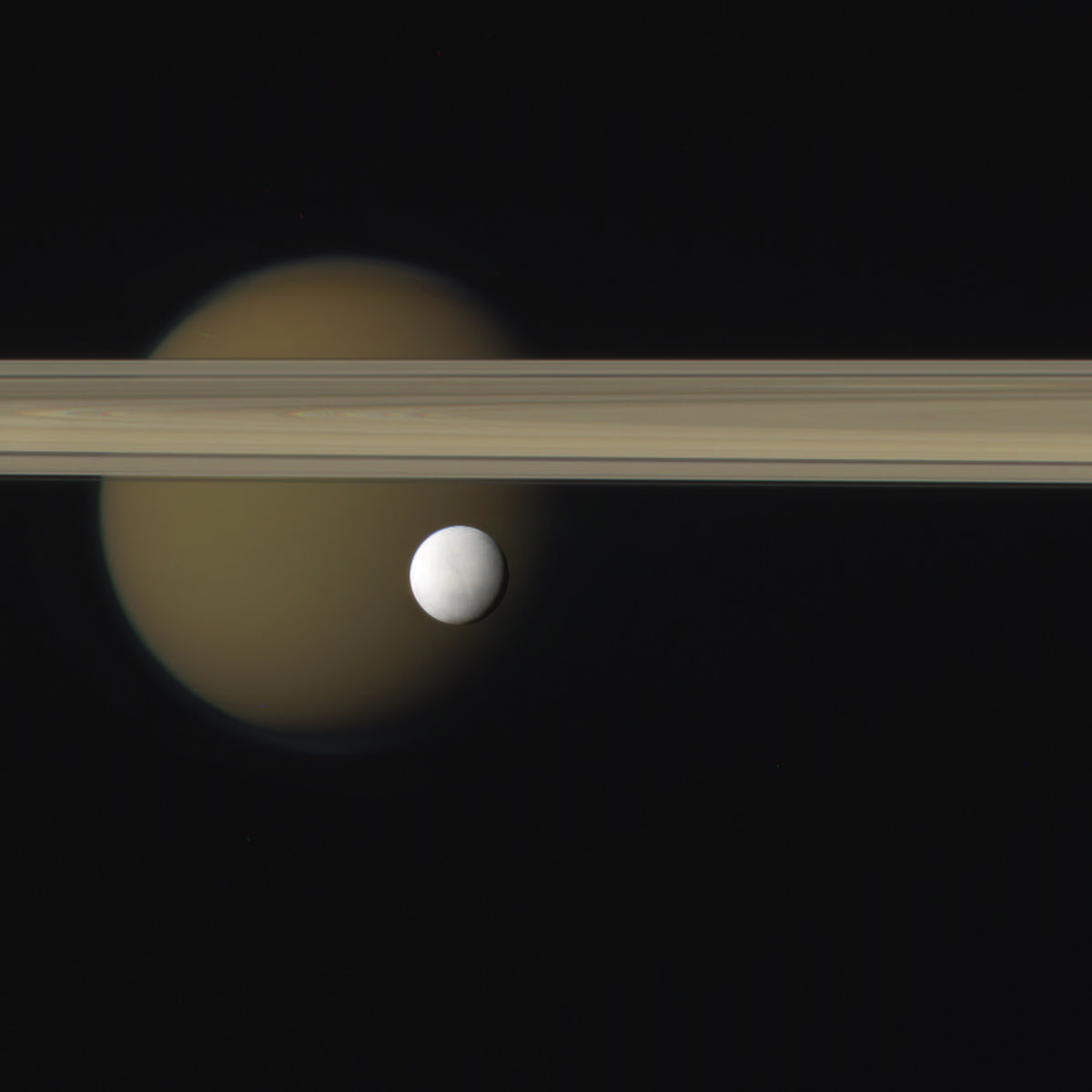
On March 11, ISS will acquire four, quick observations of Saturn and its faded northern hemisphere storm. These "Storm Watch" observation sequences are designed to take advantage of short, two-minute segments when the spacecraft turns the optical remote sensing (ORS) instruments back to Saturn as a waypoint between other experiments' observations. These sequences include blue, clear, two methane band, and one full-frame, continuum band filter images. Thirteen more such observations are planned between March 12 and 18. Also on March 11, ISS will perform a TMC observation of Titan from a distance of 2.45 million kilometers (1.52 million miles). This will allow for monitoring of cloud features across the sub-Saturn hemisphere of the moon. During this image set, portions of Titan will be obscured by Saturn's rings and Janus will transit the moon's north polar region. Immediately afterward, ISS will observe Enceladus as it passes in front of Titan. ISS will take another look at Titan on March 13, from a distance of 2.88 million kilometers (1.79 million miles), this time looking at the Fensal-Aztlan region.

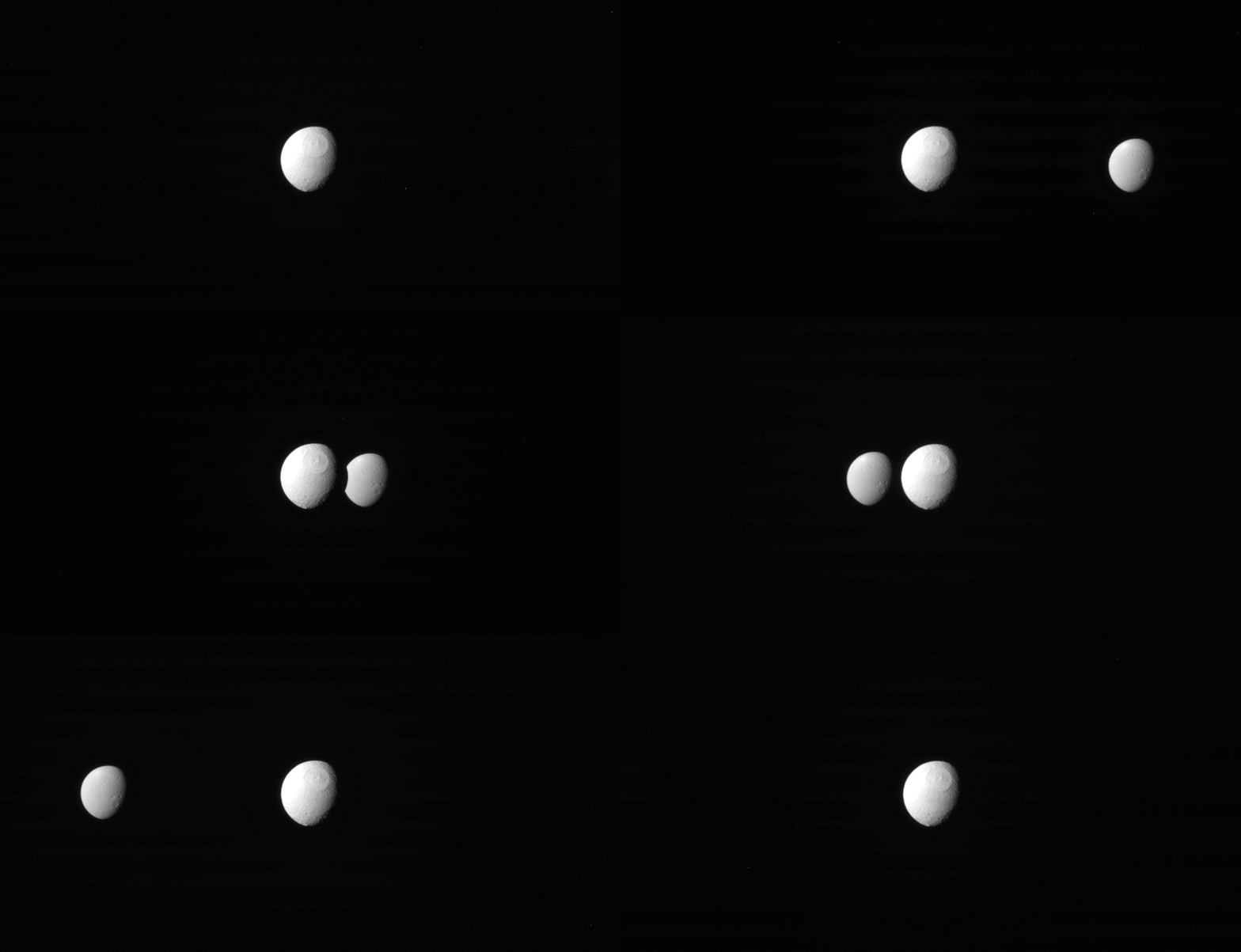
On March 12, ISS will acquire an astrometric observation of Saturn's small, inner moons, including Epimetheus, Helene, Pandora, Telesto, Anthe, and Methone. Astrometric observations are used to improve our understanding of the orbits of these small satellites, which can be influenced by Saturn's larger icy satellites. Additional astrometric observations will be taken on March 13, 15, and 17. On March 14, ISS will observe another satellite mutual event as Tethys passes in front of Dione. Tethys will be 1.69 million kilometers (1.05 million miles) away, while Dione will be 2.20 million kilometers (1.37 million miles) away.

On March 18, Cassini will reach apoapse on this orbit, bringing it to a close and starting Rev163. Rev163 includes a targeted flyby of Enceladus and non-targeted encounters with Dione and Janus.

{...}
 
NASA / NASA JPL:
Cassini Detects Hint of Fresh Air at Dione

March 02, 2012

NASA's Cassini spacecraft has "sniffed" molecular oxygen ions around Saturn's icy moon Dione for the first time, confirming the presence of a very tenuous atmosphere. The oxygen ions are quite sparse - one for every 0.67 cubic inches of space (one for every 11 cubic centimeters of space) or about 2,550 per cubic foot (90,000 per cubic meter) - show that Dione has an extremely thin neutral atmosphere.

[table="head;width=225"]
Click on image for details​


This view highlights tectonic faults and craters on Dione, an icy world that has undoubtedly experienced geologic activity since its formation.
Image credit: NASA/JPL/Space Science Institute​
[/table]​


At the Dione surface, this atmosphere would only be as dense as Earth's atmosphere 300 miles (480 kilometers) above the surface. The detection of this faint atmosphere, known as an exosphere, is described in a recent issue of the journal Geophysical Research Letters.

"We now know that Dione, in addition to Saturn's rings and the moon Rhea, is a source of oxygen molecules," said Robert Tokar, a Cassini team member based at Los Alamos National Laboratory, Los Alamos, N.M., and the lead author of the paper. "This shows that molecular oxygen is actually common in the Saturn system and reinforces that it can come from a process that doesn't involve life."

Dione's oxygen appears to derive from either solar photons or energetic particles from space bombarding the moon's water ice surface and liberating oxygen molecules, Tokar said. But scientists will be looking for other processes, including geological ones, that could also explain the oxygen.

"Scientists weren't even sure Dione would be big enough to hang on to an exosphere, but this new research shows that Dione is even more interesting than we previously thought," said Amanda Hendrix, Cassini deputy project scientist at NASA's Jet Propulsion Laboratory, Pasadena, Calif., who was not directly involved in the study. "Scientists are now digging through Cassini data on Dione to look at this moon in more detail."

Several solid solar system bodies - including Earth, Venus, Mars and Saturn's largest moon Titan - have atmospheres. But they tend to be typically much denser than what has been found around Dione. However, Cassini scientists did detect a thin exosphere around Saturn's moon Rhea in 2010, very similar to Dione. The density of oxygen at the surfaces of Dione and Rhea is around 5 trillion times less dense than that at Earth's surface.

Tokar said scientists suspected molecular oxygen would exist at Dione because NASA's Hubble Space Telescope detected ozone. But they didn't know for sure until Cassini was able to measure ionized molecular oxygen on its second flyby of Dione on April 7, 2010 with the Cassini plasma spectrometer. On that flyby, the spacecraft flew within about 313 miles (503 kilometers) of the moon's surface.

Cassini scientists are also analyzing data from Cassini's ion and neutral mass spectrometer from a very close flyby on Dec. 12, 2011. The ion and neutral mass spectrometer made the detection of Rhea's thin atmosphere, so scientists will be able to compare Cassini data from the two moons and see if there are other molecules in Dione's exosphere.

{...}


SPACE.com: Saturn's Icy Moon Dione Has Oxygen Atmosphere

Universe Today: Saturn’s “Wispy” Moon Has An Oxygen Atmosphere
 
NASA / NASA JPL:
Cassini Captures New Images of Icy Moon

March 12, 2012

These raw, unprocessed images of Saturn's second largest moon, Rhea, were taken on March 10, 2012, by NASA's Cassini spacecraft. This was a relatively distant flyby with a close-approach distance of 26,000 miles (42,000 kilometers), well suited for global geologic mapping.

[table="head;width=450"]{colsp=2}
Click on images for details​

|

Portrait of RheaNASA's Cassini spacecraft took this raw, unprocessed image of Saturn's moon Rhea on March 10, 2012. The camera was pointing toward Rhea at approximately 26,019 miles (41,873 kilometers) away.
Image credit: NASA/JPL-Caltech/SSI​
|
Rhea's SurfaceNASA's Cassini spacecraft took this raw, unprocessed image of Saturn's moon Rhea on March 10, 2012. The camera was pointing toward Rhea at approximately 26,257 miles (42,258 kilometers) away.
Image credit: NASA/JPL-Caltech/SSI​

|

Rhea Close-upNASA's Cassini spacecraft took this raw, unprocessed image of Saturn's moon Rhea on March 10, 2012. The camera was pointing toward Rhea at approximately 26,157 miles (42,096 kilometers) away.
Image credit: NASA/JPL-Caltech/SSI​
|
Shadowed RheaNASA's Cassini spacecraft took this raw, unprocessed image of Saturn's moon Rhea on March 10, 2012. The camera was pointing toward Rhea at approximately 71,495 miles (115,060 kilometers) away.
Image credit: NASA/JPL-Caltech/SSI​
[/table]​


During the flyby, Cassini captured these distinctive views of the moon's cratered surface, creating a 30-frame mosaic of Rhea's leading hemisphere and the side of the moon that faces away from Saturn. The observations included the large Mamaldi (300 miles, or 480 kilometers, across) and Tirawa (220 miles, or 360 kilometers, across) impact basins and the 29-kilometer (47-kilometer) ray crater Inktomi, one of the youngest surface features on Rhea (about 950 miles, or 1,530 kilometers, across).

All of Cassini's raw images can be seen at http://saturn.jpl.nasa.gov/photos/raw/.

{...}


CICLOPS:
 
Again, that probe is absolutely exemplary, the volume of scientific data transmitted to Earth over all those years is awesome ! :thumbup: :hailprobe:
 
NASA / NASA JPL:
Cassini Spies Wave Rattling Jet Stream on Jupiter

March 12, 2012

PASADENA, Calif. -- New movies of Jupiter are the first to catch an invisible wave shaking up one of the giant planet's jet streams, an interaction that also takes place in Earth's atmosphere and influences the weather. The movies, made from images taken by NASA's Cassini spacecraft when it flew by Jupiter in 2000, are part of an in-depth study conducted by a team of scientists and amateur astronomers led by Amy Simon-Miller at NASA's Goddard Space Flight Center in Greenbelt, Md., and published in the April 2012 issue of Icarus.

"This is the first time anyone has actually seen direct wave motion in one of Jupiter's jet streams," says Simon-Miller, the paper's lead author. "And by comparing this type of interaction in Earth's atmosphere to what happens on a planet as radically different as Jupiter, we can learn a lot about both planets."

[table="head;width=225"]
Click on image for details​


Following the path of one of Jupiter's jet streams, a line of V-shaped chevrons travels west to east just above Jupiter's Great Red Spot. Most of the planet is unfolded here in a single, flat map made on December 11 and 12, 2000, when NASA's Cassini spacecraft flew past Jupiter. At the left, the chevrons run into another storm called the South Equatorial Disturbance (SED).
Credit: NASA/JPL/Space Science Institute​
[/table]​


Like Earth, Jupiter has several fast-moving jet streams that circle the globe. Earth's strongest and best known jet streams are those near the north and south poles; as these winds blow west to east, they take the scenic route, wandering north and south. What sets these jet streams on their meandering paths-and sometimes makes them blast Florida and other warm places with frigid air-are their encounters with slow-moving waves in Earth's atmosphere, called Rossby waves.

In contrast, Jupiter's jet streams "have always appeared to be straight and narrow," says co-author John Rogers, who is the Jupiter Section Director of the British Astronomical Association, London, U.K., and one of the amateur astronomers involved in this study.

Rossby waves were identified on Jupiter about 20 years ago, in the northern hemisphere. Even so, the expected meandering winds could not be traced directly, and no evidence of them had been found in the southern hemisphere, which puzzled planetary scientists.

To get a more complete view, the team analyzed images taken by NASA's Voyager spacecraft, NASA's Hubble Space Telescope, and Cassini, as well as a decade's worth of observations made by amateur astronomers and compiled by the JUPOS project.

The movies zoom in on a single jet stream in Jupiter's southern hemisphere. A line of small, dark, v-shaped "chevrons" has formed along one edge of the jet stream and zips along west to east with the wind. Later, the well-ordered line starts to ripple, with each chevron moving up and down (north and south) in turn. And for the first time, it's clear that Jupiter's jet streams, like Earth's, wander off course.

"That's the signature of the Rossby wave," says David Choi, the postdoctoral fellow at NASA Goddard who strung together about a hundred Cassini images to make each time-lapse movie. "The chevrons in the fast-moving jet stream interact with the slower-moving Rossby wave, and that's when we see the chevrons oscillate."

The team's analysis also reveals that the chevrons are tied to a different type of wave in Jupiter's atmosphere, called a gravity inertia wave. Earth also has gravity inertia waves, and under proper conditions, these can be seen in repeating cloud patterns.

"A planet's atmosphere is a lot like the string of an instrument," says co-author Michael D. Allison of the NASA Goddard Institute for Space Studies in New York. "If you pluck the string, it can resonate at different frequencies, which we hear as different notes. In the same way, an atmosphere can resonate with different modes, which is why we find different kinds of waves."

Characterizing these waves should offer important clues to the layering of the deep atmosphere of Jupiter, which has so far been inaccessible to remote sensing, Allison adds.

Crucial to the study was the complementary information that the team was able to retrieve from the detailed spacecraft images and the more complete visual record provided by amateur astronomers. For example, the high resolution of the spacecraft images made it possible to establish the top speed of the jet stream's wind, and then the amateur astronomers involved in the study looked through the ground-based images to find variations in the wind speed.

The team also relied on images that amateur astronomers had been gathering of a large, transient storm called the South Equatorial Disturbance. This visual record dates back to 1999, when members of the community spotted the most recent recurrence of the storm just south of Jupiter's equator. Analysis of these images revealed the dynamics of this storm and its impact on the chevrons. The team now thinks this storm, together with the Great Red Spot, accounts for many of the differences noted between the jet streams and Rossby waves on the two sides of Jupiter's equator.

"We are just starting to investigate the long-term behavior of this alien atmosphere," says co-author Gianluigi Adamoli, an amateur astronomer in Italy. "Understanding the emerging analogies between Earth and Jupiter, as well as the obviously profound differences, helps us learn fundamentally what an atmosphere is and how it can behave."

{...}


Universe Today: Jupiter’s Jet Streams Get Thrown Off Course
 
NASA / NASA JPL:
Cassini Garners Top Honor From Air and Space Museum

March 14, 2012

PASADENA, Calif. - NASA's Cassini mission to Saturn, managed by the Jet Propulsion Laboratory, Pasadena, Calif., has received the top group honor from the Smithsonian's National Air and Space Museum - the Trophy for Current Achievement. Representatives for Cassini will receive the trophy on March 21 at a black-tie dinner in Washington, D.C.

[table="head;width=225"]
Click on image for details​


With giant Saturn hanging in the blackness and sheltering Cassini from the sun's blinding glare, the spacecraft viewed the rings as never before, revealing previously unknown faint rings and even glimpsing its home world.
Image credit: NASA/JPL-Caltech​
[/table]​


"Here we are some 15 years since Cassini launched and it's amazing how well the spacecraft has operated," said Charles Elachi, director of JPL. "Thanks to the superb work of both the development team and the operations team, Cassini has been able to show us the beauty and diversity of the Saturn system and, beyond that, to study what is really a miniature solar system in its own right."

The trophies for current and lifetime achievement are the National Air and Space Museum's most prestigious awards. They recognize outstanding achievements in the fields of aerospace science, technology and their history.

"The National Air and Space Museum Trophy is among the most prestigious awards given by the Smithsonian, it recognizes significant aerospace accomplishments," said National Air and Space Museum Director Jack Dailey. "We are pleased to present it to the Cassini-Huygens Flight Team in the Current Achievement category."

The Cassini-Huygens mission, a cooperative project of NASA, the European Space Agency and the Italian Space Agency, launched in 1997. It performed a dramatic burn in June 2004 to slide into orbit around Saturn and, in December of that year, the spacecraft successfully released ESA's Huygens probe to pass down through the atmosphere of Saturn's largest moon Titan.

Mission highlights include discovering a plume of water ice and organic particles spraying from the icy moon Enceladus and watching signs of seasonal change from northern winter into northern spring, such as the evolution of a monster storm in Saturn's northern hemisphere. Cassini and Huygens have also revealed just how Earth-like Titan is, as the only body in the solar system other than Earth that has stable liquid on the surface. The mission has discovered two new rings around Saturn and four new moons.

The Cassini spacecraft has also been navigating the Saturn system for nearly eight years with accuracies often better than half a mile (kilometer) while 700 to 800 million miles (1.2 to 1.3 billion kilometers) away from Earth. Cassini has also flown within 16 miles (25 kilometers) of the surface of Enceladus and many times through the upper atmosphere of Titan

The project completed its original prime mission in 2008 and has been extended twice. It is now in its solstice mission, which will enable scientists to observe seasonal change in the Saturn system through the northern summer solstice.

"We are very proud of what Cassini has accomplished," said Robert Mitchell, Cassini program manager based at JPL. "But our workhorse spacecraft still has much work left to do. We can't wait to see what Saturn, its rings and photogenic moons will reveal to us next."

{...}
 
CICLOPS: Rev163: Mar 18 - Apr 5 '12:
Cassini continues its exploration of the Saturn system with the 18-day Rev163, which begins on March 18 at its farthest distance from the planet. This is also called the orbit's apoapse. At this point, Cassini is 2.37 million kilometers (1.47 million miles) from Saturn's cloud tops. The spacecraft is nearing the end of the first equatorial phase of the Cassini Solstice Mission, a phase which lasts until May 2012. During this phase, the spacecraft's orbits lie within the equatorial plane of the planet, providing opportunities to encounter Saturn's numerous moons, image the rings edge-on, and look at Saturn's cloud tops without the rings obscuring the view. Thirty-eight ISS observations are planned for Rev163, the vast majority dedicated to Saturn storm monitoring and to encounters with Enceladus, Janus, and Dione.

ISS begins its observations for Rev163 the day after apoapse on March 19 with three, quick observations of Saturn and its faded northern hemisphere storm. These "Storm Watch" observation sequences are designed to take advantage of short, two-minute segments when the spacecraft turns the optical remote sensing (ORS) instruments back to Saturn as a waypoint between other experiments' observations. These sequences include blue, clear, two methane band, and one full-frame, continuum band filter images. Ten more such observations are planned between March 20 and 25, with another five planned between April 1 and 3. Also on March 19, ISS will acquire an astrometric observation of Saturn's small, inner moons, including Calypso, Helene, Methone, Anthe, Epimetheus, and Pandora. Astrometric observations are used to improve our understanding of the orbits of these small satellites, which can be influenced by Saturn's larger icy satellites. Additional astrometric observations will be taken on March 23, 24, and April 3.

On March 20, ISS will take a look at Titan from a distance of 1.32 million kilometers (0.82 million miles). The observation is an effort to look for clouds in the moon's atmosphere as part of the "Titan Monitoring Campaign" (TMC). This observation, of a half-phase Titan, is designed to monitor clouds over the moon's Shangri-La dune field. On March 21, ISS will search for possible satellites at Titan's L4 point, a Lagrangian point that lies 60 degrees ahead of the large moon on its orbit. Similar moons have been found at Dione's and Tethys' L4 points (Helene and Telesto, respectively). An observation covering Titan's L5 point, which lies 60 degrees behind Titan, will be taken on March 26. On March 25, ISS will preform a unique observation of Saturn's shadow on the Phoebe ring. The ring lies along the orbit of the outer moon Phoebe and is likely composed of particles ejected from micrometeorite impacts on the small moon, not unlike the faint dust rings associated with Saturn's inner small moons, such as Anthe or Atlas. The camera system will be pointed at the edge of Saturn's shadow on the ring. On March 26, ISS will perform a TMC observation of Titan that will allow for monitoring of cloud features across the Senkyo dune field from a distance of 1.44 million kilometers (0.89 million miles).

On March 27 at 21:32 UTC, Cassini will reach periapse for Rev163 at an altitude of 135,950 kilometers (84,460 miles) from Saturn. ISS observations during the periapse period will be taken during a targeted encounter of Enceladus and later during non-targeted encounters of Janus and Dione.

Cassini will fly by Enceladus (E17) at an altitude of 74 kilometers (46 miles) at 18:30 UTC on March 27. ISS will image the icy satellite's south polar plume from distances of 335,000 kilometers (208,000 miles) down to 113,500 kilometers (70,500 miles) while the satellite is just a thin crescent. Next, the Composite Infrared Spectrometer (CIRS) will acquire a series of mid-infrared scans across the night side of Enceladus, as well as a pair of scans across the south polar terrain (found in earlier flybys of Enceladus to be a thermal hotspot) as well as a far-infrared raster scan using CIRS's FP1 channel. During the two hours surrounding closest approach, the Ion and Neutral Mass Spectrometer (INMS) will be prime, analyzing the composition of Enceladus' south polar plume as the spacecraft flies through it. The spacecraft's path will take it along the length of Baghdad Sulcus, allowing INMS to resolve individual jets from this "tiger stripe" fracture. Finally, ISS will acquire a nine-frame, clear and UV3 filter mosaic of Enceladus' leading hemisphere terrain as the spacecraft recedes from the moon.

At 21:34 UTC, Cassini will fly by one of Saturn's smaller satellites, Janus, at a close-approach distance of 43,851 kilometers (27,247 miles). ISS will acquire a series of images using many of the narrow-angle camera's filters. All of these images save the final one will be taken with Saturn as a backdrop, though only the second set of images will be against Saturn's day side. A total of 29 images are planned for this observation. At 05:07 UTC on March 28, Cassini will perform a non-targeted encounter of Dione at a distance of 43,997 kilometers (27,338 miles). ISS will acquire a nine-frame mosaic of Dione a couple of hours later, covering the moon's anti-Saturn hemisphere. At the end of the mosaic, the narrow-angle camera will be used to watch as Mimas and Tethys pass behind the limb of Dione.

Later on March 28, ISS will perform a TMC observation of Titan from a distance of 1.88 million kilometers (1.17 million miles). This will allow for monitoring of cloud features across the Fensal-Aztlan region of the moon. Afterward, ISS will search for moons at Rhea's L5 Lagrangian point. Next, ISS will ride along with a CIRS observation of Rhea. ISS will image several mutual events of various moons, including an occultation of Mimas. Finally, ISS will acquire a long series of images of Rhea. These images are designed to improve the photometric calibration of ISS images as well as the camera's shutter offset.

On April 3, ISS will take another look at Titan, this time from a distance of 1.65 million kilometers (1.02 million miles) looking at western Xanadu and eastern Shangri-La. Later that day, ISS will acquire a lengthy, nine-hour observation of Thrymr, one of Saturn's distant, irregular moons. This observation will be taken from a distance of 10.3 million kilometers (6.41 million miles), and when combined with additional observations of this irregular satellite, is designed to measure Thrymr's rotational period. On April 5, ISS will ride along with the Visual and Infrared Mapping Spectrometer to image the G ring.

On April 5, Cassini will reach apoapse on this orbit, bringing it to a close and starting Rev164. Rev164 includes a targeted flyby of Enceladus and close, non-targeted flyby of Tethys.

{...}
 
NASA / NASA JPL:
Cassini Plasma Spectrometer Resumes Operations

March 19, 2012

CASSINI MISSION STATUS REPORT

PASADENA, Calif. -- The Cassini plasma spectrometer instrument (CAPS) aboard NASA's Cassini spacecraft at Saturn has resumed operations. Mission managers received confirmation on Friday, March 16, that it was turned on. They plan to monitor the instrument for any unusual behavior.

Last June, short circuits in the instrument led to unexpected voltage shifts on the spacecraft. As a precaution, mission managers turned off the CAPS instrument while engineers investigated the issue. The investigation led to the conclusion that tin plating on electronics components had grown "whiskers." The whiskers were very small, less than the diameter of a human hair, but they were big enough to contact another conducting surface and carry electrical current. Researchers are still trying to understand why whiskers grow on tin and other metals, but they know now that whiskers can grow in space and on Earth. It is believed that these or additional tin whiskers that may grow on Cassini cannot carry enough current to cause problems, but will burn out on their own like a lightweight fuse.

{...}


SPACE.com: NASA Resurrects Saturn Science Tool on Cassini Spacecraft
 
NASA / NASA JPL:
Cassini Sees Saturn Stressing out Enceladus

March 19, 2012

Images from NASA's Cassini spacecraft have, for the first time, enabled scientists to correlate the spraying of jets of water vapor from fissures on Saturn's moon Enceladus with the way Saturn's gravity stretches and stresses the fissures. The result is among the Cassini findings presented today at the Lunar and Planetary Science Conference at The Woodlands, Texas.

[table="head;width=225"]
Click on image for details​


These images, based on ones obtained by NASA's Cassini spacecraft, show how the pull of Saturn's gravity can deform the surface of Saturn's moon Enceladus in the south polar region crisscrossed by fissures known as "tiger stripes."
Image credit: NASA/JPL-Caltech/SSI/LPI/GSFC​
[/table]​


"This new work gives scientists insight into the mechanics of these picturesque jets at Enceladus and shows that Saturn really stresses Enceladus," said Terry Hurford, a Cassini associate based at NASA Goddard Space Flight Center in Greenbelt, Md.

Enceladus is unique in the Saturn system in having jets of water vapor and organic particles spray from long fissures in its south polar region. The long fissures have been nicknamed the "tiger stripes."

Hurford and colleagues suggested a few years ago that tidal pulls from Saturn's gravity could explain the existence of the jets, but they had not been able to correlate specific jets with calculated stresses until now. They studied the jets emerging from the warmest regions within the tiger stripes Baghdad Sulcus and Damascus Sulcus.

The scientists found that the greatest stresses pulling apart the tiger stripes, occurred right after Enceladus made its closest approach to Saturn in its orbit. The scientists found that Saturn's gravitational pull could also deform the fissure by making one side move relative to the other side. That kind of deformation seemed to occur quite often during Enceladus' orbit around the planet, even when Enceladus was very far away.

The finding suggests that a large reservoir of liquid water - a global or local ocean - would be necessary to allow Enceladus to flex enough to generate stresses great enough to deform the surface, Hurford said. That process would control the timing of the jet eruptions. The finding also suggests that Saturn's tides create an enormous amount of heat in the area.

The conference will also include a talk presenting highlights of the Cassini mission by Linda Spilker, Cassini project scientist at NASA's Jet Propulsion Laboratory, Pasadena, Calif. She will present images showing the evolution of an enormous storm that roiled the northern hemisphere of Saturn, the effect of seasonal rain storms on Saturn's moon Titan, and what Cassini will hope to observe in the next few years of its extended mission.

"Cassini's seven-plus years roaming the Saturn system have shown us how beautifully dynamic and unexpected the Saturn system is over time," Spilker said. "We're looking forward to new discoveries as the seasons turn."

{...}


SPACE.com: Saturn's Gravity Warps Icy Moon's Erupting Jets
 
Universe Today: Two Moons In Passing

Tethys.gif

Animation of Tethys passing in front of Dione from Cassini's point of view.


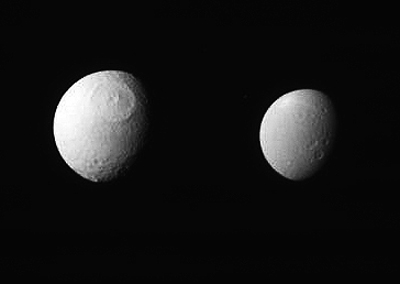
TethysDione.jpg

Tethys and Dione (NASA/JPL/SSI)​
 
NASA / NASA JPL:
Cassini Mission Receives Air and Space Museum Award

March 22, 2012

PASADENA, Calif. -- The Smithsonian's National Air and Space Museum has bestowed its highest group honor, the Trophy for Current Achievement, on NASA's Cassini mission to Saturn. The annual award recognizes outstanding achievements in the fields of aerospace science and technology.

The trophy was presented Wednesday, March 21, during an evening ceremony at the museum in Washington. Established in 1985, the award has been presented to seven NASA planetary mission teams.

[table="head;width=225"]
Click on image for details​


NASA's Cassini-Huygens mission to Saturn was awarded the 2012 National Air and Space Museum Trophy for Current Achievement on March 21 at a black-tie dinner in Washington, D.C. Pictured (from left to right) - Wayne Clough, secretary of the Smithsonian; Robert Mitchell, Cassini program manager based at NASA's Jet Propulsion Laboratory, Pasadena, Calif.; and Gen. Jack Dailey, director of the museum.
Image credit: Smithsonian National Air and Space Museum​
[/table]​


"This joint mission has produced an unprecedented science return," said William Knopf, Cassini program executive at NASA Headquarters in Washington. "Missions like Cassini pave the way for future robotic and human exploration throughout our solar system and beyond."

Launched in 1997, the Cassini spacecraft entered Saturn's orbit in June 2004 with the European Space Agency's (ESA) Huygens probe bolted to its side. In December 2004, the spacecraft successfully released Huygens, which entered the atmosphere of Saturn's largest moon, Titan. Cassini completed its prime mission in 2008 and has been extended twice. It is now in its so-called solstice mission, which will enable scientists to observe seasonal changes in Saturn and its moons during the planet's northern summer solstice. The mission will last through September 2017.

"We look forward to sailing around the Saturn system for several more years to see how our views of the planet and its magnificent moons change as we get into northern summer solstice," said Robert Mitchell, the Cassini program manager at NASA's Jet Propulsion Laboratory in Pasadena, Calif., who accepted the award on behalf of the team.

The Cassini spacecraft carries 12 science instruments and investigations, with an additional six aboard Huygens. Cassini mission highlights to date include the discovery of four new moons and two new rings around Saturn. Cassini observed spraying water vapor and icy particle jets from the moon Enceladus. In Saturn's northern hemisphere, the spacecraft watched the evolution of a monster storm, a sign of seasonal change from northern winter into northern spring.

Cassini and Huygens has also revealed new characteristics about Titan, the only body in the solar system other than Earth with stable liquid on its surface.

{...}


NASA Press Release: RELEASE : 12-092 - NASA'S Cassini Mission Receives Smithsonian National Air and Space Museum's Highest Honor
 
NASA / NASA JPL:
Cassini to Make Closest Pass Yet over Enceladus South Pole

March 26, 2012

NASA's Cassini spacecraft is preparing to make its lowest pass yet over the south polar region of Saturn's moon Enceladus, where icy particles and water vapor spray out in glittering jets. The closest approach, at an altitude of about 46 miles (74 kilometers), will occur around 11:30 a.m. PDT (2:30 p.m. EDT) on March 27.

This flyby is primarily designed for Cassini's ion and neutral mass spectrometer, which will attempt to "taste" particles from the jets. Scientists using this spectrometer will utilize the data to learn more about the composition, density and variability of the plume. The Cassini plasma spectrometer, which team members worked to return to service so it could gather high-priority measurements during this flyby, will also be analyzing Saturn's magnetic and plasma environment near Enceladus and sampling the plume material near closest approach.

[table="head;width=450"]{colsp=2}
Click on images for larger view / details​

|

Artist's concept of the Mar. 27, 2012, flyby of Saturn's moon Enceladus by NASA's Cassini spacecraft.
Image credit: NASA/JPL-Caltech​
|
At least four distinct plumes of water ice spew out from the south polar region of Saturn's moon Enceladus in this dramatically illuminated image.
Image credit: NASA/JPL/Space Science Institute​
[/table]​


In addition, the composite infrared spectrometer will also be looking for hot spots on Enceladus, and the imaging cameras will be snapping pictures.

A flyby in October 2015 will bring Cassini about 16 miles (25 kilometers) closer to the Enceladus surface near the south pole. Cassini's closest approach to any part of Enceladus occurred on Oct. 9, 2008, when it flew within about 16 miles (25 kilometers) of the surface at the equator.

{...}


The Planetary Society Blog: Notes from the Lunar and Planetary Science Conference: Making Cassini's radar images prettier
 
Science@NASA: Is it Snowing Microbes on Enceladus?

Universe Today: “Snowing Microbes” On Saturn’s Moon?:
Enceladus, Saturn’s 318-mile-wide moon that’s become famous for its ice-spraying southern jets, is on astronomers’ short list of places in our own solar system where extraterrestrial life could be hiding — and NASA’s Cassini spacecraft is in just the right place to try and sniff it out.

On March 27, Cassini came within 46 miles (74 km) of Enceladus’ south pole, the region where the moon’s many active water-ice jets originate from. This was Cassini’s closest pass yet over the southern pole, allowing the spacecraft to use its ion and neutral mass spectrometer — as well as its plasma spectrometer, recently returned to service — to taste the icy spray emanating from deep fissures called “tiger stripes” that scar Enceladus’ surface.

{...}
 
CICLOPS:
 
NASA / NASA JPL:
Icy Moons through Cassini's Eyes

March 28, 2012

These raw, unprocessed images of Saturn's moons Enceladus, Janus and Dione were taken on March 27 and 28, 2012, by NASA's Cassini spacecraft.

[table="head;width=675"]{colsp=3}
Click on images for details or larger view​

||

Enceladus Plume
This raw image from NASA's Cassini spacecraft was taken on March 27, 2012. The camera was pointing toward Saturn's moon Enceladus at approximately 144,281 miles (232,197 kilometers) away.
Image Credit: NASA/JPL/Space Science Institute​
|
Enceladus Crescent
This raw image from NASA's Cassini spacecraft was taken on March 27, 2012. The camera was pointing toward Saturn's moon Enceladus at approximately 69,475 miles (111,809 kilometers) away.
Image Credit: NASA/JPL/Space Science Institute​
|
Enceladus Terrain
This raw image from NASA's Cassini spacecraft was taken on March 27, 2012. The camera was pointing toward Saturn's moon Enceladus at approximately 19,810 miles (31,881 kilometers) away.


||

Portrait of Janus
This raw image from NASA's Cassini spacecraft was taken on March 27, 2012. The camera was pointing toward Saturn's moon Janus.
Image Credit: NASA/JPL/Space Science Institute​
|
Icy Dione
This raw image from NASA's Cassini spacecraft was taken on March 28, 2012. The camera was pointing toward Saturn's moon Dione at approximately 49,087 miles (78,998 kilometers) away.
Image Credit: NASA/JPL/Space Science Institute​
|
Dione Close-Up
This raw image from NASA's Cassini spacecraft was taken on March 28, 2012. The camera was pointing toward Saturn's moon Dione at approximately 27,668 miles (44,528 kilometers) away.
[/table]​


Cassini passed Enceladus first on March 27, coming within about 46 miles (74 kilometers) of the moon's surface. The encounter was primarily designed for Cassini's ion and neutral mass spectrometer, which "tasted" the composition of Enceladus' south polar plume. Other instruments, including the Cassini plasma spectrometer and composite infrared spectrometer, also took measurements.

Before the closest approach of this encounter, Cassini's cameras imaged the plume, which is comprised of jets of water ice and vapor, and organic compounds emanating from the south polar region. Later, the cameras captured a nine-frame mosaic of the surface of the moon's leading hemisphere as the spacecraft left the moon.

After the Enceladus encounter, Cassini passed the small moon Janus with a closest approach distance of 27,000 miles (44,000 kilometers). The planet was in the background in some of these views.

Early on March 28, the spacecraft flew by Dione at a distance of 27,000 miles (44,000 kilometers) and collected, among other observations, a nine-frame mosaic depicting the side of the moon that faces away from Saturn in its orbit.

All of Cassini's raw images can be seen at http://saturn.jpl.nasa.gov/photos/raw/.

{...}
 
Back
Top