Updates Cassini Mission News and Updates

NASA / NASA JPL:
Saturn's Rings are Back

July 09, 2012

It's been nearly two years since NASA's Cassini spacecraft has had views like these of Saturn's glorious rings. These views are possible again because Cassini has changed the angle at which it orbits Saturn and regularly passes above and below Saturn's equatorial plane. Steeply inclined orbits around the Saturn system also allow scientists to get better views of the poles and atmosphere of Saturn and its moons.

Cassini's recent return of ring images has started to pay off. A group of scientists has restarted the team's studies of propeller-shaped gaps. These gaps are cleared out by objects that are smaller than known moons but larger than typical ring particles. Cassini scientists haven't seen propellers in two years. Matt Tiscareno, a Cassini imaging team associate at Cornell University, Ithaca, N.Y., and colleagues have been following these objects for several years. Because some of the propellers are exactly where models predicted they would be, scientists believe they are seeing some old friends again.

[table="head;width=450"]{colsp=2}
Click on images for details​

|

These three Cassini images show a propeller-shaped structure created by an unseen moon in Saturn's A ring.
Image credit: NASA/JPL-Caltech/SSI/Cornell.​
|
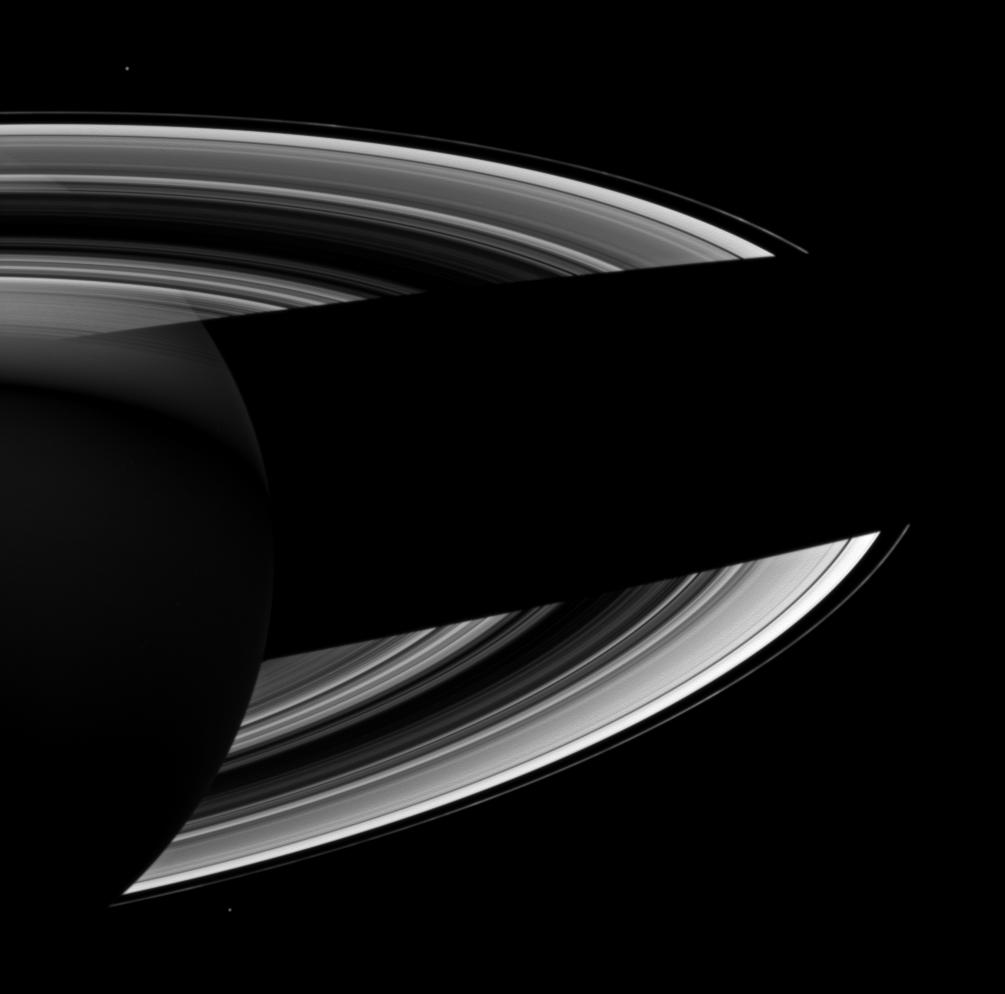
NASA's Cassini spacecraft has recently resumed the kind of orbits that allow for spectacular views of Saturn's rings. This view, from Cassini's imaging camera, shows the outer A ring and the F ring. The wide gap in the image is the Encke gap, where you see not only the embedded moon Pan but also several kinky, dusty ringlets. A wavy pattern on the inner edge of the Encke gap downstream from Pan and aspiral pattern moving inwards from that edge show Pan's gravitational influence. The narrow gap close to the outer edge is the Keeler gap.
Image credit: NASA/JPL-Caltech/SSI​
[/table]​


Scientists are eagerly waiting for the other data that will come from this change in perspective. What's the secret to getting Cassini to orbit at such high angles? Cassini's lead navigator, Duane Roth, explains in a JPL blog post: http://blogs.jpl.nasa.gov/2012/07/a-different-slant/.

{...}


JPL Blog: A Different Slant: Cassini Has a Special View of Saturn These Days - How Did It Get There?

[table="width=300"]
roth.jpg


These graphics show the orbits NASA’s Cassini spacecraft has made and will make around the Saturn system from September 2010 to April 2013. As shown in gray, Cassini orbited within the plane of Saturn’s equator during the first 18 months of its current mission phase, known as the Solstice mission. Then, starting in May 2012, Cassini used the gravity of Saturn’s largest moon, Titan, to tilt its orbit as shown in the magenta loops, reaching a maximum tilt of about 62 degrees in April, 2013. Titan’s orbit is shown in red. The orbits of Saturn’s inner moons are shown in black.
Image credit: NASA/JPL-Caltech​
[/table]​


CICLOPS:
  • Rev169: Jul 10 - Aug 2 '12:
    Cassini continues its exploration of the Saturn system with the 23-day Rev169, which begins on July 10 at its farthest distance from the planet. This is also called the orbit's apoapse. At this point, Cassini is 2.84 million kilometers (1.76 million miles) from Saturn's cloud tops. This orbit includes a targeted encounter with Titan, Cassini's 86th to date. Rev169 is near the beginning of the first inclined phase of the Cassini Solstice Mission, a phase which lasts until March 2015. The inclined phase will allow for polar views of Saturn and Titan as well as better vistas of Saturn's rings than those Cassini had while in the earlier, equatorial phase of the Solstice Mission. Twenty-eight ISS observations are planned for Rev169, the vast majority focused on Titan and Saturn's rings.

    ISS begins its observations for Rev169 on July 11, the day after Cassini passes apoapse, with an eight-hour light curve observation of the outer irregular satellite Ymir. Cassini will be 15.6 million kilometers (9.67 million miles) away from the 18-kilometer-wide (11.2-mile-wide) satellite. On July 13, 15, and 17, ISS will ride along with the Ultraviolet Imaging Spectrometer (UVIS) to acquire a time-lapse movie of Saturn's south polar aurora. These three observations will be taken over a period of between 12 and 17 hours. On July 16, ISS will take a look at Titan from a distance of 3.04 million kilometers (1.89 million miles). The observation is an effort to look for clouds in the moon's atmosphere as part of the "Titan Monitoring Campaign" (TMC). This observation of a gibbous-phase Titan is designed to monitor clouds over the moon's Senkyo dune field. ISS also will be taking shorter-wavelength images to study changes in Titan's upper haze layers. On July 18, ISS will image Titan's sub-Saturn hemisphere again, this time from a distance of 3.03 million kilometers (1.88 million miles).

    On July 22 at 23:03 UTC, Cassini will reach periapse for Rev169 at an altitude of 245,240 kilometers (152,390 miles) from Saturn. ISS observations during the periapse period include a high-phase observation of Saturn's C ring, occultations by the F ring of the stars Sirius and Zeta Canis Majoris, an occultation by Dione of Spica, and a search for moonlets in the Cassini Division. First, ISS will ride along with the Visual and Infrared Mapping Spectrometer to image the C ring at very high phase angles. Portions of this observation will be performed while Cassini is in the shadow of Saturn. Scientists are hoping to catch a few impacts by meteorites in the ring. A few hours later on July 22, ISS will ride along with a pair of UVIS and Visual and Infrared Mapping Spectrometer (VIMS) rings stellar occultation observations. ISS is hoping to catch a pair of F ring occultations of the stars Sirius (which is also called Alpha Canis Majoris) and Zeta Canis Majoris. Next, early on July 23, ISS will ride along with UVIS to observe a stellar occultation of Spica by Dione. The ISS images will provide global color imaging of Dione's leading hemisphere from a distance of 410,000 kilometers (255,000 miles). Afterward, ISS will search for moonlets in the Cassini Division.

    Two days after periapse, Cassini encounters Titan on July 24 at 20:03 UTC for the 86th time. This is the sixth of nine Titan flybys planned for 2012, with the next encounter scheduled for September 26. T85 is a low-altitude flyby with a close-approach altitude of 1,012 kilometers (629 miles). This flyby will allow for imaging of the Adiri region and the anti-Saturn hemisphere of Titan outbound from the encounter. Before the encounter, the Composite Infrared Spectrometer (CIRS) and VIMS will acquire spectral scans and other data of Titan's night side. VIMS will search for specular, or mirror-like, reflections off the northern lakes, particularly at Kivu Lacus. CIRS will scan across Titan using its far-infrared and mid-infrared channels as well as perform a limb integration. In a limb integration, CIRS stares at Titan's sunlit limb, or edge of the visible disk, to build up high resolution spectra, or values that vary along a continuum, of Titan's hazes. ISS will ride along to acquire images of Titan's upper haze layers, which are more easily visible at high phase angles.

    At closest approach, VIMS will control spacecraft pointing. The VIMS team will acquire a number of high-resolution infrared observations of Titan's surface. Right at closest approach, the VIMS team will image Kivu Lacus, a northern lake from which scientists hope to see specular reflection a few hours earlier. Next, VIMS acquire a pushbroom, an image strip over Titan's northern mid-latitudes, again on the anti-Saturn side. Afterward, VIMS will image the crater Selk, image the Huygens probe's landing site, and build up a mosaic of the Adiri region. As Cassini departs from Titan, CIRS will map surface temperatures across the visible disk to look for diurnal and albedo-related differences while VIMS will map the anti-Saturn hemisphere of Titan. ISS will ride along during these four observations, searching for clouds across Adiri and western Shangri-La, including over the Huygens landing site.

    On July 28, ISS will acquire a pair of dark current calibration observations for both the wide-angle and narrow-angle cameras. Dark current is result of electric current within the cameras' detectors that flows even when very few photons are hitting the detector. These calibration images will provide up-to-date dark current files to remove this source of noise during image processing. On August 2, ISS will take a quick observation of Saturn using the wide-angle camera (WAC). These observations are part of a series of "Storm Watch" observation sequences designed to take advantage of short, two-minute segments when the spacecraft turns the optical remote sensing (ORS) instruments back to Saturn as a waypoint between other experiments' observations. These sequences include blue, clear, two methane band, and one full-frame, continuum band filter images. Immediately afterward, ISS will take a TMC observation of Titan, covering the sub-Saturn hemisphere of the large moon from a distance of 3.61 million kilometers (2.24 million miles).

    On August 2, Cassini will reach apoapse on this orbit, bringing it to a close and starting Rev170.

    {...}

  • The Rings Are Back

  • Hello Again

  • Saturn Ring 'Rev 166' Raw Preview #1

  • Cassini Flies High To View Saturn's Rings Again

Universe Today: The Return of the Rings!
 
Universe Today: "Surprising Swirls Above Titan’s South Pole"
Thanks to Cassini’s new vantage point granted by its inclined orbit researchers have gotten a new look at the south pole of Titan, Saturn’s largest moon. What they’ve recently discovered is a swirling vortex of gas forming over the moon’s pole, likely the result of the approach of winter on Titan’s southern hemisphere.
Titan-South-Pole.jpg


SPACE.com: "Saturn's Moon Titan Sports Polar Vortex" (Video)
NASA's Cassini spacecraft captured images of a revolving mass of gas in the atmosphere over Titan's southern pole. This odd cloud group completed a full rotation in 9 hours – quicker that the moon's 16-day rotation period.
 
NASA / NASA JPL:
The Titanian Seasons Turn, Turn, Turn

July 10, 2012

PASADENA, Calif. - Images from NASA's Cassini spacecraft show a concentration of high-altitude haze and a vortex materializing at the south pole of Saturn's moon Titan, signs that the seasons are turning on Saturn's largest moon. "The structure inside the vortex is reminiscent of the open cellular convection that is often seen over Earth's oceans," said Tony Del Genio, a Cassini team member at NASA's Goddard Institute for Space Studies, N.Y. "But unlike on Earth, where such layers are just above the surface, this one is at very high altitude, maybe a response of Titan's stratosphere to seasonal cooling as southern winter approaches. But so soon in the game, we're not sure."

Cassini first saw a "hood" of high-altitude haze and a vortex, which is a mass of swirling gas around the pole in the moon's atmosphere, at Titan's north pole when the spacecraft first arrived in the Saturn system in 2004. At the time, it was northern winter. Multiple instruments have been keeping an eye on the Titan atmosphere above the south pole for signs of the coming southern winter.

[table="head;width=450"]{colsp=2}
Click on images for details​

|

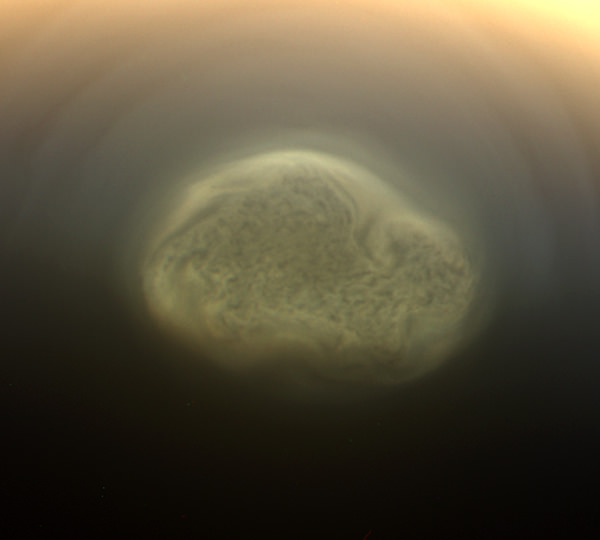
This true color image captured by NASA'S Cassini spacecraft before a distant flyby of Saturn's moon Titan on June 27, 2012, shows a south polar vortex, or a mass of swirling gas around the pole in the atmosphere of the moon.
Image credit: NASA/JPL-Caltech/Space Science Institute​
|
False-color images from NASA's Cassini spacecraft show the development of a hood of high-altitude haze - which appears orange in this image -- forming over the south pole of Saturn's moon Titan.
Image credit: NANASA/JPL-Caltech/University of Arizona/LPGNantes​
[/table]

7236_17251_1.gif


While the northern hood has remained, the circulation in the upper atmosphere has been moving from the illuminated north pole to the cooling south pole. This movement appears to be causing downwellings over the south pole and the formation of high-altitude haze and a vortex.

Cassini's visible light cameras saw the first signs of hazes starting to concentrate over Titan's south pole in March, and the spacecraft's visual and infrared mapping spectrometer (VIMS) obtained false-color images on May 22 and June 7.

"VIMS has seen a concentration of aerosols forming about 200 miles [300 kilometers] above the surface of Titan's south pole," said Christophe Sotin, a VIMS team member at NASA's Jet Propulsion Laboratory, Pasadena, Calif. "We've never seen aerosols here at this level before, so we know this is something new."

During a June 27 distant flyby, Cassini's imaging cameras captured a crow's-eye view of the south polar vortex in visible light. These new images show this detached, high-altitude haze layer in stunning new detail.

"Future observations of this feature will provide good tests of dynamical models of the Titan circulation, chemistry, cloud and aerosol processes in the upper atmosphere," said Bob West, deputy imaging team lead at JPL. The Cassini-Huygens mission is a cooperative project of NASA, the European Space Agency and the Italian Space Agency. The Jet Propulsion Laboratory, a division of the California Institute of Technology in Pasadena, manages the Cassini-Huygens mission for NASA's Science Mission Directorate, Washington. The Cassini orbiter and its two onboard cameras were designed, developed and assembled at JPL. The imaging team is based at the Space Science Institute in Boulder, Colo.

{...}


CICLOPS:
SpaceRef: Vortex Seen at Titan's South Pole

Discovery News: Mysterious Vortex Spotted in Titan's Atmosphere

Discover Magazine - Bad Astronomy: Titanic antarctic vortex antics
 
NASA JPL:
Cassini Spots Daytime Lightning on Saturn

July 18, 2012

PASADENA, Calif. - Saturn was playing the lightning storm blues. NASA's Cassini spacecraft has captured images of last year's storm on Saturn, the largest storm seen up-close at the planet, with bluish spots in the middle of swirling clouds. Those bluish spots indicate flashes of lightning and mark the first time scientists have detected lightning in visible wavelengths on the side of Saturn illuminated by the sun.

"We didn't think we'd see lightning on Saturn's day side - only its night side," said Ulyana Dyudina, a Cassini imaging team associate based at the California Institute of Technology in Pasadena. "The fact that Cassini was able to detect the lightning means that it was very intense."

[table="head;width=225"]
Click on image for details​


These nearly-true-color mosaics from NASA's Cassini spacecraft capture lightning striking within the huge storm that encircled Saturn's northern hemisphere for much of 2011.
[/table]​


Images can be found at http://www.nasa.gov/cassini, http://saturn.jpl.nasa.gov and http://ciclops.org.

The storm occurred last year. The lightning flashes appear brightest in the blue filter of Cassini's imaging camera on March 6, 2011. Scientists aggressively heightened the blue tint of the image to determine its size and location. Scientists are still analyzing why the blue filter catches the lightning. It might be that the lightning really is blue, or it might be that the short exposure of the camera in the blue filter makes the short-lived lightning easier to see.

What scientists do know is that the intensity of the flash is comparable to the strongest flashes on Earth. The visible energy alone is estimated to be about 3 billion watts lasting for one second. The flash is approximately 100 miles (200 kilometers) in diameter when it exits the tops of the clouds. From this, scientists deduce that the lightning bolts originate in the clouds deeper down in Saturn's atmosphere where water droplets freeze. This is analogous to where lightning is created in Earth's atmosphere.

In composite images that show the band of the storm wrapping all the way around Saturn, scientists have seen multiple flashes. In one composite image, they recorded five flashes, and in another, three flashes.

"As summer storm season descends upon Earth's northern latitudes, Cassini provides us a great opportunity to see how weather plays out at different places in our solar system," said Linda Spilker, Cassini project scientist, based at NASA's Jet Propulsion Laboratory, Pasadena, Calif. "Saturn's atmosphere has been changing over the eight years Cassini has been at Saturn, and we can't wait to see what happens next."

{...}


CICLOPS:
Discover Magazine - Bad Astronomy: Lightning strikes in a storm bigger than worlds

SPACE.com: Daytime Lightning on Saturn Spotted by Cassini Spacecraft

Universe Today: Bolt from the Blue: Giant Flash of Lightning Seen in Saturn’s Storm
 
CICLOPS: Rev170: Aug 2 - Aug 23 '12:
Cassini continues its exploration of the Saturn system with the 21-day Rev170, which begins on August 2 at its farthest distance from the planet. This is also called the orbit's apoapse. At this point, Cassini is 2.55 million kilometers (1.58 million miles) from Saturn's cloud tops. Rev170 is near the start of the first inclined phase of the Cassini Solstice Mission, a phase which lasts until March 2015. The inclined phase will allow for polar views of Saturn and Titan as well as better vistas of Saturn's rings than those Cassini had while in the earlier, equatorial phase of the Solstice Mission. Thirty-three ISS observations are planned for Rev170, the vast majority focused on Saturn's atmosphere.

ISS begins its observations for Rev170 on August 2, a couple of hours after apoapse, with a quick observation of Saturn using the wide-angle camera (WAC). This observation is part of a series of "Storm Watch" observation sequences designed to take advantage of short, two-minute segments when the spacecraft turns the optical remote sensing (ORS) instruments back to Saturn as a waypoint between other experiments' observations. These sequences include blue, clear, two methane band, and one full-frame, continuum band filter images. Another is planned for August 3, plus four more on August 8 and 9. Thirteen are planned between August 15 and 23. On August 9, ISS will acquire a time-lapse movie of the F ring that will include the Encke Gap as well.

On August 13 at 01:32 UTC, Cassini will reach periapse for Rev170 at an altitude of 286,380 kilometers (177,950 miles) from Saturn. During the periapse period, the Ultraviolet Imaging Spectrograph (UVIS) will observe an occultation of the star Kappa Orionis by Dione, and ISS will ride along. During the occultation of Kappa Orionis, UVIS will be measuring the density of gasses in Dione's vicinity while ISS will obtain color images at a distance of 709,470 kilometers (440,840 miles).

The periapse period observations continue with high resolution imaging of the F ring late on August 12. Afterward, during periapse early on August 13, ISS will image the C ring of Saturn in search of small, embedded moonlets. Much later that day, ISS will ride along with UVIS to observe Mimas at a very low phase angle. The ISS images will provide global color imaging of Mimas' sub-Saturn hemisphere from a distance of 802,000 kilometers (500,000 miles). Afterward, ISS will acquire another time-lapse movie of the F ring.

On August 17, ISS will ride along with the Composite Infrared Spectrometer (CIRS) to image Saturn's atmosphere. ISS will acquire a set of images every few hours for 10 hours. These images will be used to track clouds in Saturn's atmosphere. On August 19, ISS will take a look at Titan from a distance of 3.45 million kilometers (2.15 million miles). The observation is an effort to look for clouds in the moon's atmosphere as part of the "Titan Monitoring Campaign" (TMC). This observation of a gibbous-phase Titan is designed to monitor clouds over the moon's sub-Saturn hemisphere. ISS also will be taking shorter-wavelength images to study changes in Titan's upper haze layers. On August 21, ISS will image Titan's sub-Saturn hemisphere again, this time from a distance of 3.50 million kilometers (2.17 million miles). On August 19, ISS will acquire a five-hour observation of Saturn's atmosphere. Researchers will use clouds visible in these images to measure wind speeds and directions at different latitudes on the giant planet. Five more of these short movies of Saturn will be taken between August 19 and 23.

On August 23, Cassini will reach apoapse on this orbit, bringing it to a close and starting Rev171.

{...}
 
CICLOPS: Rev171: Aug 23 - Sep 13 '12:
Cassini continues its exploration of the Saturn system with the 21-day Rev171, which begins on August 23 at its farthest distance from the planet. This is also called the orbit's apoapse. At this point, Cassini is 2.55 million kilometers (1.58 million miles) from Saturn's cloud tops. Rev171 is near the start of the first inclined phase of the Cassini Solstice Mission, a phase which lasts until March 2015. The inclined phase will allow for polar views of Saturn and Titan as well as better vistas of Saturn's rings than those Cassini had while in the earlier, equatorial phase of the Solstice Mission. Thirty-five ISS observations are planned for Rev171, the vast majority focused on Saturn's atmosphere.

ISS begins its observations for Rev171 on August 24, a day after apoapse, with a pair of quick observations of Saturn using the wide-angle camera (WAC). These observations are part of a series of "Storm Watch" observation sequences designed to take advantage of short, two-minute segments when the spacecraft turns the optical remote sensing (ORS) instruments back to Saturn as a waypoint between other experiments' observations. These sequences include blue, clear, two methane band, and one full-frame, continuum band filter images. Eleven more are planned between September 4 and 8.

On August 25, ISS will ride along with an Ultraviolet Imaging Spectrometer (UVIS) observation of Saturn, acquiring wide-angle photometry and polarimetry. ISS will acquire a similar observation on August 28. On August 27, ISS will acquire a series of images of Saturn using the WAC. These images will be used to measure wind speeds in Saturn's atmosphere by tracking the motion of various clouds. Three more observations of this type will be acquired on August 28 and 30. Also on August 28, ISS will image a crescent Titan from a distance of 1.26 million kilometers (0.79 million miles). ISS will take another look at Titan on August 31 from a distance of 1.17 million kilometers (0.73 million miles). Titan will be at half phase at the time, providing a view of the moon's southern trailing hemisphere. Also on August 31, ISS will ride along with the Composite Infrared Spectrometer (CIRS) to observe Saturn's south polar region in order to monitor aurorae in the planet's upper atmosphere.

On September 3 at 07:39 UTC, Cassini will reach periapse for Rev171 at an altitude of 287,180 kilometers (178,450 miles) from Saturn. During the periapse period, ISS will observe the south polar plume of Enceladus from a distance of 375,000 kilometers (233,000 miles). ISS will also ride along with the Visual and Infrared Spectrometer (VIMS) in order to acquire numerous WAC image sets of Saturn's atmosphere. These images will be focused on Saturn's northern hemisphere near 35 degrees north latitude.

On September 4, ISS will take a look at Titan from a distance of 2.05 million kilometers (1.27 million miles). The observation is an effort to look for clouds in the moon's atmosphere as part of the "Titan Monitoring Campaign" (TMC). This observation of a gibbous-phase Titan is designed to monitor clouds over the moon's Fensal-Aztlan region. ISS also will be taking shorter-wavelength images to study changes in Titan's upper haze layers. On September 5, ISS will acquire a five-hour movie of Saturn's faint, inner, D ring. On September 7, ISS will image Titan again, covering its eastern Xanadu region from a distance of 2.31 million kilometers (1.43 million miles). Later that day, ISS will acquire a 10-hour light curve observation of the small, outer moon, Bestla. Similar observations of Bestla, designed to measure the moon's rotational period, are planned for September 8 and 9. On September 8, ISS will acquire an astrometric observation of Saturn's small, inner moons including Pandora, Epimetheus, Anthe, Pan, Prometheus, Pallene, Helene, Daphnis, Methone and Atlas. Astrometric observations are used to improve our understanding of the orbits of these small satellites, which can be influenced by Saturn's larger icy satellites. Between September 10 and 13, ISS will acquire four TMC observations of a half-phase Titan, covering its southern, anti-Saturn hemisphere. These observations will be acquired from distances ranging from 1.49 to 1.73 million kilometers (0.93 to 1.07 million miles).

On September 13, Cassini will reach apoapse on this orbit, bringing it to a close and starting Rev172. Rev172 includes a flyby of Titan.

{...}
 
NASA / NASA JPL:
Saturn and its Largest Moon Reflect Their True Colors

August 29, 2012

PASADENA, Calif. -- Posing for portraits for NASA's Cassini spacecraft, Saturn and its largest moon, Titan, show spectacular colors in a quartet of images being released today. One image captures the changing hues of Saturn's northern and southern hemispheres as they pass from one season to the next.

[table="head;width=450"]{colsp=2}
Click on images for details​

|

Colorful Colossuses and Changing Hues
A giant of a moon appears before a giant of a planet undergoing seasonal changes in this natural color view of Titan and Saturn from NASA's Cassini spacecraft.
Image Credit: NASA/JPL-Caltech/SSI​
|
Obscured by Rings
Saturn's rings obscure part of Titan's colorful visage in this image from NASA's Cassini spacecraft.
Image Credit: NASA/JPL-Caltech/SSI​

|

A Ring of Color
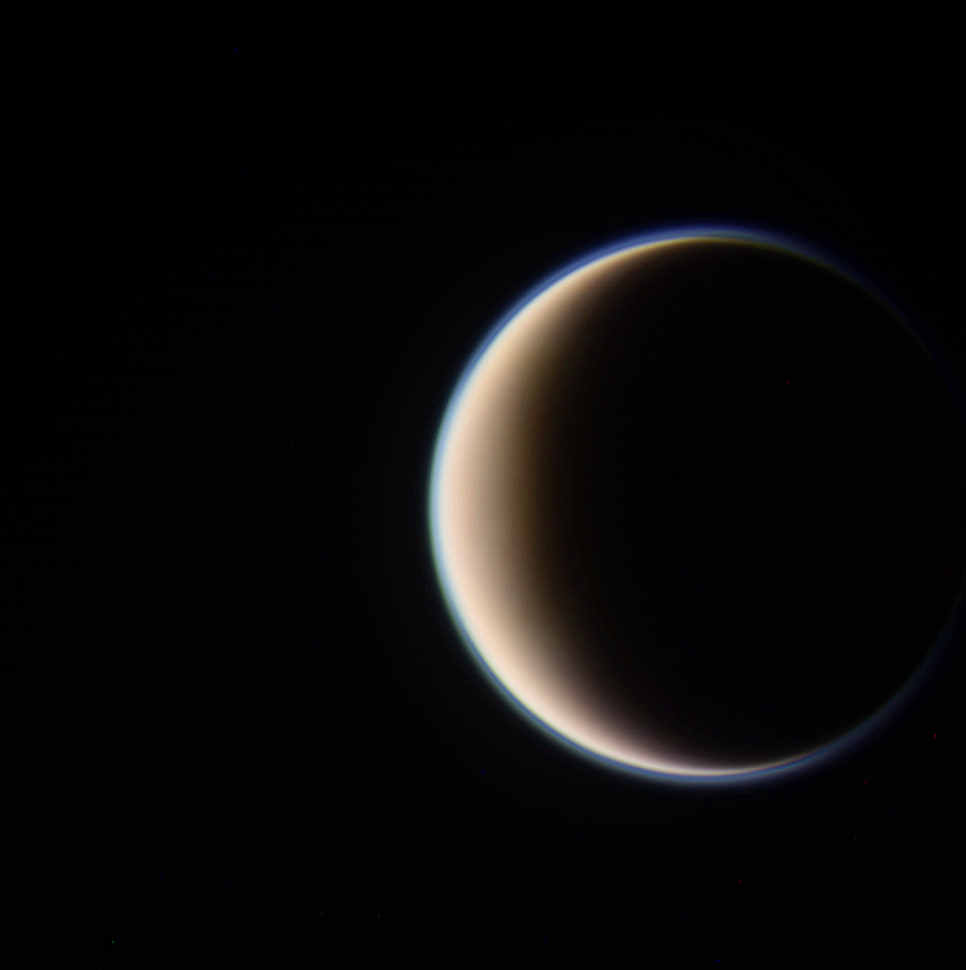
NASA's Cassini spacecraft looks toward the night side of Saturn's largest moon and sees sunlight scattering through the periphery of Titan's atmosphere and forming a ring of color.
Image Credit: NASA/JPL-Caltech/SSI​
|
Polar Vortex in Color
The recently formed south polar vortex stands out in the color-swaddled atmosphere of Saturn's largest moon, Titan, in this natural color view from NASA's Cassini spacecraft.
Image Credit: NASA/JPL-Caltech/SSI​
[/table]​


The images can be found at http://www.nasa.gov/cassini, http://saturn.jpl.nasa.gov and http://ciclops.org.

A wide-angle view in today's package captures Titan passing in front of Saturn, as well as the planet's changing colors. Upon Cassini's arrival at Saturn eight years ago, Saturn's northern winter hemisphere was an azure blue. Now that winter is encroaching on the planet's southern hemisphere and summer on the north, the color scheme is reversing: blue is tinting the southern atmosphere and is fading from the north.

The other three images depict the newly discovered south polar vortex in the atmosphere of Titan, reported recently by Cassini scientists. Cassini's visible-light cameras have seen a concentration of yellowish haze in the detached haze layer at the south pole of Titan since at least March 27. Cassini's visual and infrared mapping spectrometer spotted the massing of clouds around the south pole as early as May 22 in infrared wavelengths. After a June 27 flyby of the moon, Cassini released a dramatic image and movie showing the vortex rotating faster than the moon's rotation period. The four images being released today were acquired in May, June and July of 2012.

Some of these views, such as those of the polar vortex, are only possible because Cassini's newly inclined -- or tilted -- orbits allow more direct viewing of the polar regions of Saturn and its moons.

Scientists are looking forward to seeing more of the same -- new phenomena like Titan's south polar vortex and changes wrought by the passage of time and seasons -- during the remainder of Cassini's mission.

"Cassini has been in orbit now for the last eight years, and despite the fact that we can't know exactly what the next five years will show us, we can be certain that whatever it is will be wondrous," said Carolyn Porco, imaging team lead based at the Space Science Institute in Boulder, Colo.

Launched in 1997, Cassini went into orbit around Saturn on July 1, 2004. It is in its second mission extension, known as the Solstice Mission, and one of its main goals is to analyze seasonal changes in the Saturn system.

"It is so fantastic to experience, through the instruments of Cassini, seasonal changes in the Saturn system," said Amanda Hendrix, deputy project scientist, based at NASA's Jet Propulsion Laboratory in Pasadena, Calif. "Some of the changes we see in the data are completely unexpected, while some occur like clockwork on a seasonal timescale. It's an exciting time to be at Saturn."

{...}


CICLOPS:
SpaceRef: Saturn and Titan

SPACE.com: Spectacular Photos of Saturn and Titan Captured by NASA Spacecraft

Universe Today: Changing Hues Signal Transition of Seasons at Saturn
 
CICLOPS: Rev172: Sep 13 - Oct 6 '12:
Cassini continues its exploration of the Saturn system with the 21-day Rev172, which begins on September 13 at its farthest distance from the planet. This is also called the orbit's apoapse. At this point, Cassini is 2.56 million kilometers (1.59 million miles) from Saturn's cloud tops. Rev172 is near the start of the first inclined phase of the Cassini Solstice Mission, a phase which lasts until March 2015. The inclined phase will allow for polar views of Saturn and Titan as well as better vistas of Saturn's rings than those Cassini had while in the earlier, equatorial phase of the Solstice Mission. Fifty ISS observations are planned for Rev172, most focused on Saturn's atmosphere, a Titan flyby and Saturn's rings.

ISS begins its observations for Rev172 on September 17 with three quick observations of Saturn using the wide-angle camera (WAC). These observations are part of a series of "Storm Watch" observation sequences designed to take advantage of short, two-minute segments when the spacecraft turns the optical remote sensing (ORS) instruments back to Saturn as a waypoint between other experiments' observations. These sequences include blue, clear, two methane band, and one full-frame, continuum band filter images. Five more are planned between September 18 and 20, while another nine will be taken between October 1 and 4.

On September 17, ISS will acquire an astrometric observation of Saturn's small, inner moons. Astrometric observations are used to improve our understanding of the orbits of these small satellites, which can be influenced by Saturn's larger icy moons. Similar observations will be taken on September 18 and October 1. On September 18 and 19, ISS will acquire a series of images of Saturn rings using the WAC. These images will be tracking dust spokes over the B ring. With Cassini over the unlit side of the rings and with Saturn at a high phase angle, the spokes, if visible, will be brighter than the dark B ring. On September 20, ISS will image a half-phase Titan from a distance of 2.86 million kilometers (1.78 million miles). Later that day, ISS will acquire a long-range, narrow-angle camera (NAC) movie of the F ring. On September 22, ISS will ride along with a Visual and Infrared Mapping Spectrometer (VIMS) observation of a stellar occultation. During the occultation, the F ring will pass in front of the red giant star Beta Pegasi. Afterward, ISS will acquire a NAC movie of the Encke Gap, which includes the small moon Pan. Early on September 23, after the Encke movie, ISS will re-image several propellers in the A ring in order to improve our knowledge of their orbits. Propellers are small voids formed by large particles in Saturn's main rings.

On September 24 at 14:59 UTC, Cassini will reach periapse for Rev172 at an altitude of 286,850 kilometers (178,240 miles) from Saturn. During the periapse period late on September 23, ISS will search for water ice plumes on Mimas at a distance of 885,000 kilometers (550,000 miles). Next, ISS will ride along with the Ultraviolet Imaging Spectrometer (UVIS) to observe the occultation of the blue-white star Gamma Pegasi by the F ring. Following the UVIS occultation, ISS will monitor the south polar plume of Enceladus from a distance of 740,000 kilometers (460,000 miles). Afterward, ISS will observe the G ring arc and the tiny moon Aegaeon that produces it. Later on September 24, ISS will search for small, embedded moonlets within the C and D rings. Finally, on September 25, ISS will ride along with VIMS, taking a few images with the WAC of the B ring at very low phase angles.

Two days after periapse, Cassini encounters Titan on September 26 at 14:36 UTC for the 87th time. This is the seventh of nine Titan flybys planned for 2012, with the next encounter scheduled for November 13. T86 is a very low-altitude flyby with a close-approach altitude of 956 kilometers (594 miles). This flyby will allow for imaging of the Adiri region and the anti-Saturn hemisphere of Titan outbound from the encounter. Before the encounter, the Composite Infrared Spectrometer (CIRS) and UVIS will acquire spectral scans and other data of Titan's night side. CIRS will scan across Titan using its far-infrared and mid-infrared channels as well as perform a limb integration. In a limb integration, CIRS stares at Titan's sunlit limb, or edge of the visible disk, to build up high resolution spectra, or values that vary along a continuum, of Titan's aerosols. ISS will ride along to acquire images of Titan's upper haze layers, which are more easily visible at high phase angles.

At closest approach, the Ion and Neutral Mass Spectrometer (INMS) will be prime with RADAR riding along. INMS will measure the composition of Titan's upper atmosphere and will attempt to study how the exobase -- the boundary between the ionosphere and Titan's neutral atmosphere -- varies with time of day and location, both as a response to Titan's interaction (or lack thereof) with Saturn's magnetosphere or season. RADAR will ride along with INMS, acquiring a SAR swath over the north polar region of Titan. This swath will start over the large island Mayda Insula in northern Kraken Mare, continue east over southern Ligeia Mare, crossing a set of dry lakes southeast of that sea, and finishing up near 30 degrees north latitude, 215 degrees west longitude as Cassini heads south. RADAR will also acquire altimetry during this pass. As Cassini departs from Titan, CIRS will map surface temperatures across the visible disk to look for diurnal and albedo-related differences while UVIS will map the anti-Saturn hemisphere of Titan. ISS will ride along during these observations, searching for clouds across Adiri and the southern anti-Saturn hemisphere, including over the Huygens landing site. ISS will cover the same region on September 28 during a set of "caboose" observations designed for tracking clouds across Titan as well as observing the high-altitude south polar vortex.

On October 1, ISS will acquire a five-hour light curve observation of the small, outer moon, Bestla. Later that day, ISS will acquire a 16-hour movie of the Encke Gap in Saturn's A ring. On October 2, ISS will take a look at Titan from a distance of 2.89 million kilometers (1.80 million miles). The observation is an effort to look for clouds in the moon's atmosphere as part of the "Titan Monitoring Campaign" (TMC). This observation of a gibbous-phase Titan is designed to monitor clouds over the moon's Senkyo region. ISS also will be taking shorter-wavelength images to study changes in Titan's upper haze layers. On October 4, ISS will image Titan again from a distance of 3.37 million kilometers (2.09 million miles).

On October 6, Cassini will reach apoapse on this orbit, bringing it to a close and starting Rev173. Rev173 includes solar conjunction, a period every 12.5 months when Cassini is out of communications with Earth.

{...}
 
Universe Today: Pictures From T-86: Cassini’s Latest Flyby of Titan
On September 26-27 Cassini executed its latest flyby of Titan, T-86, coming within 594 miles (956 km) of the cloud-covered moon in order to measure the effects of the Sun’s energy on its dense atmosphere and determine its variations at different altitudes.

Titan_RGB_9-26-12.jpg

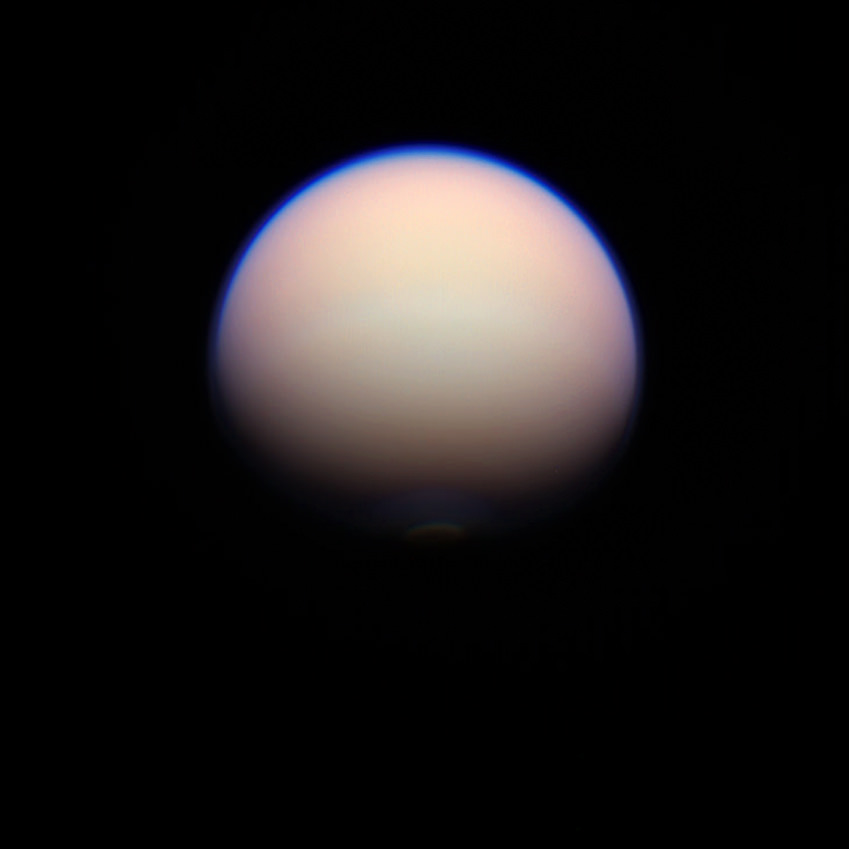
The image above was captured as Cassini approached Titan from its night side, traveling about 13,000 mph (5.9 km/s). It’s a color-composite made from three separate raw images acquired in red, green and blue visible light filters.


TitanHaze_RGB_9-26-12.jpg

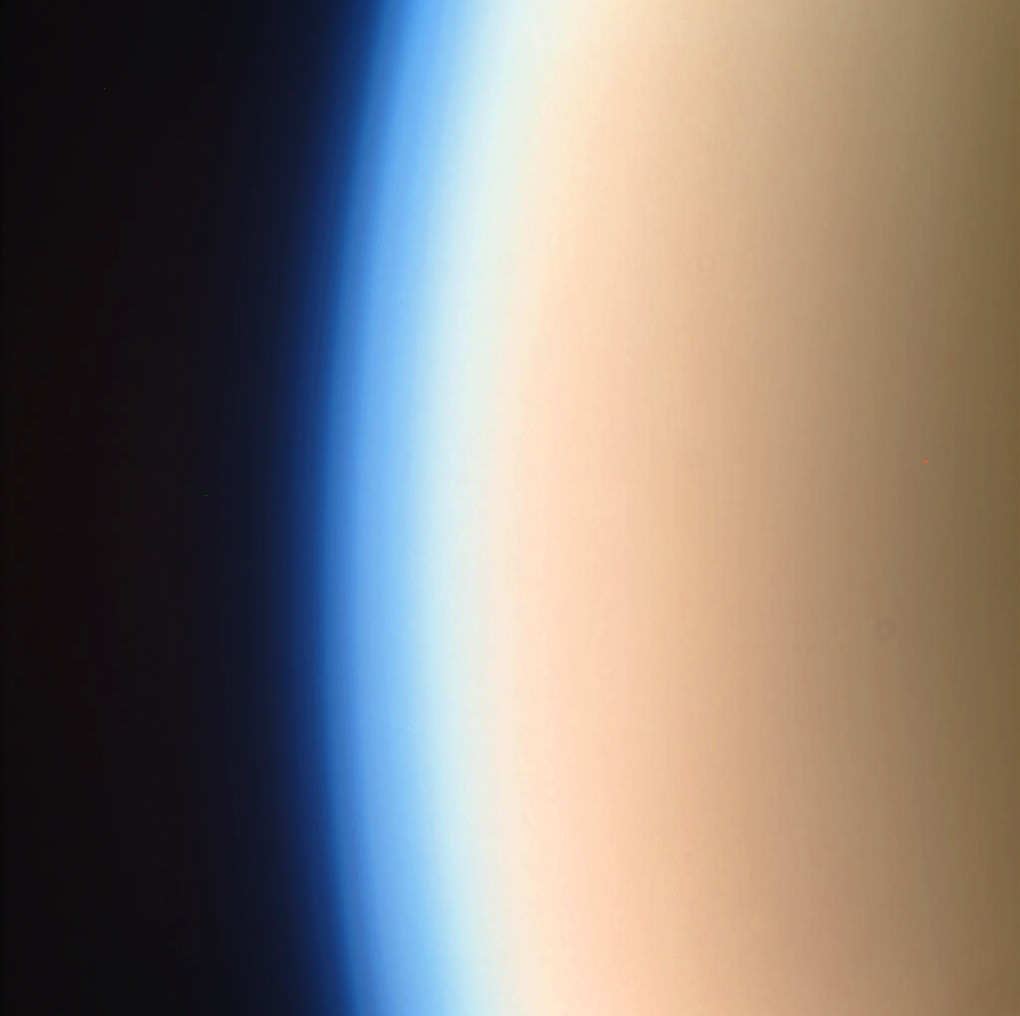
Cassini captured this image as it approached Titan’s sunlit limb, grabbing a better view of the upper haze. Some banding can be seen in its highest reaches.


Titan_RGB_9-27-12.jpg

In this image, made from data acquired on Sept. 27, Titan’s south polar vortex can be made out just within the southern terminator. The vortex is a relatively new feature in Titan’s atmosphere, first spotted earlier this year. It’s thought that it’s a region of open-cell convection forming above the moon’s pole, a result of the approach of winter to Titan’s southern half.

Image credits: NASA/JPL/Space Science Institute. Color composites by Jason Major. Images have not been validated or calibrated by the SSI team.​
 
CICLOPS: Rev173: Oct 6 - Oct 30 '12:
Cassini continues its exploration of the Saturn system with the 24-day Rev173, which begins on October 6 at its farthest distance from the planet. This is also called the orbit's apoapse. At this point, Cassini is 2.66 million kilometers (1.66 million miles) from Saturn's cloud tops. Rev173 is near the start of the first inclined phase of the Cassini Solstice Mission, a phase which lasts until March 2015. The inclined phase will allow for polar views of Saturn and Titan as well as better vistas of Saturn's rings than those Cassini had while in the earlier, equatorial phase of the Solstice Mission. Twenty-eight ISS observations are planned for Rev173, most focused on Saturn's atmosphere and rings. During the last week of the orbit, from October 22 to 29, Cassini will enter solar conjunction, when the spacecraft and Saturn will be on the other side of the Sun from Earth. Communications with the spacecraft are limited during this period due to interference from the sun's outer atmosphere. Thus, no ISS observations are performed during this orbit after October 19.

ISS begins its observations for Rev173 a few hours after apoapse on October 6 with three quick observations of Saturn using the wide-angle camera (WAC). These observations are part of a series of "Storm Watch" observation sequences designed to take advantage of short, two-minute segments when the spacecraft turns the optical remote sensing (ORS) instruments back to Saturn as a waypoint between other experiments' observations. These sequences include blue, clear, two methane band, and one full-frame, continuum band filter images. Seven more such observations are planned between October 12 and 16.

Also on October 6, ISS will image a half-phase Titan from a distance of 3.76 million kilometers (2.34 million miles). The observation is an effort to look for clouds in the moon's atmosphere as part of the "Titan Monitoring Campaign" (TMC). This observation is designed to monitor clouds over portions of the moon's sub-Saturn hemisphere. ISS also will be taking shorter-wavelength images to study changes in Titan's upper haze layers. After another Saturn storm watch observation, ISS will acquire an astrometric observation of Saturn's small, inner moons. Astrometric observations are used to improve our understanding of the orbits of these small satellites, which can be influenced by Saturn's larger icy moons. Another such observation will be taken on October 12. Also on October 6, ISS will acquire a series of images of Saturn rings using the WAC. These images will be tracking spokes -- a ring phenomenon Cassini has monitored throughout the mission -- over the B ring. With Cassini over the unlit side of the rings and with Saturn at a high phase angle, the spokes, if visible, will be brighter than the dark B ring. Additional spoke movies will be taken on October 10 and 12. Movies will also be taken of the faint, inner D ring and the narrow F ring on October 15 using the narrow-angle camera (NAC).

On October 18 at 09:02 UTC, Cassini will reach periapse for Rev172 at an altitude of 414,480 kilometers (257,550 miles) from Saturn. During the periapse period on October 17, ISS will acquire a 41-frame mosaic using the WAC of the inner Saturn system while Cassini is in eclipse. This observation will allow the dusty E and G rings to be imaged in detail. Afterward, ISS will monitor the south polar plume of Enceladus from a distance of 940,000 kilometers (580,000 miles). Next, ISS will acquire several short mosaics of the faint D ring at close range using the NAC. On October 18, ISS will ride along with the Ultraviolet Imaging Spectrometer (UVIS) to observe an occultation of the blue subgiant star Gamma Columbae by the F ring followed by a Visual and Infrared Mapping Spectrometer (VIMS) observation of an occultation of the red-orange giant star Lambda Velorum. Afterward, ISS will acquire high-resolution NAC images of the F ring.

Early on October 19, ISS will re-image several propellers in the A ring in order to improve our knowledge of their orbits. These propeller-shaped features are small voids formed by large particles or objects in Saturn's main rings. Afterward, ISS will ride along with a UVIS observation of Enceladus at a distance of 966,000 kilometers (600,000 miles). Finally, ISS will ride along again with UVIS to observe an occultation by Saturn's main ring system of the blue-giant star Spica, brightest star in the constellation Virgo.

On October 30, Cassini will reach apoapse on this orbit, bringing it to a close and starting Rev174. Rev174 includes the penultimate Titan flyby for 2012.

{...}
 
The Planetary Society Blog: Happy Cassini PDS Release Day!

20121008_saturn_dione_cassini_W1702383418ff_rgb.jpg

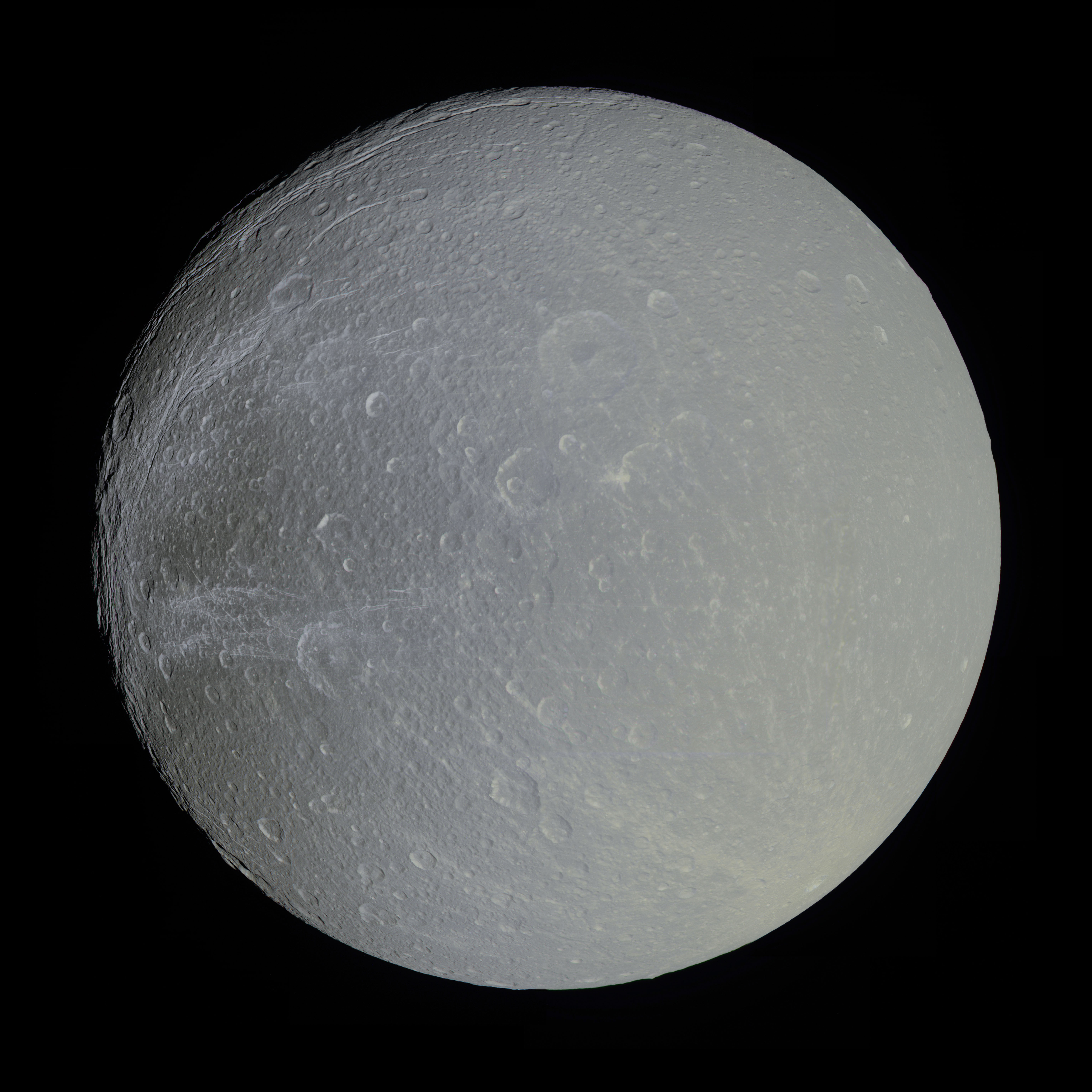
An infrared-green-violet approximate true-color composite of Dione poised in front of Saturn on December 13, 2011. Cassini is almost precisely in the ring plane, so the rings are vanishingly thin.
NASA / JPL / SSI / Emily Lakdawalla


20121008_enceladus_crescent_huge_N1697706900ff.png

A five-footprint mosaic of an extremely thin crescent Enceladus taken on October 19, 2011.
NASA / JPL / SSI / Emily Lakdawalla

dione_rotating_N1696121676ff.gif

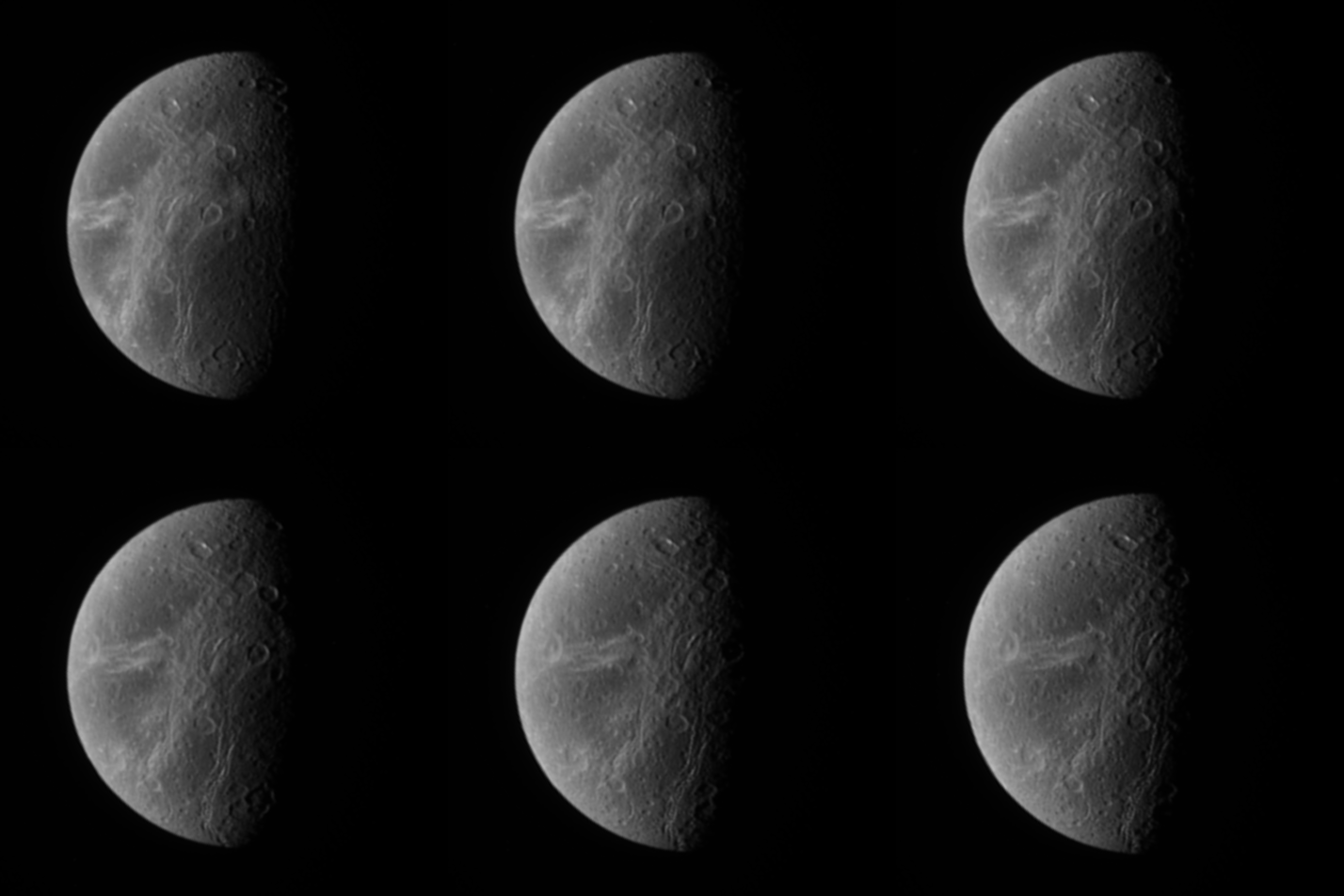
This animation consists of 13 images of Dione taken about twice per hour over a period of six hours. Over that time, Dione's "wispy terrain" -- now known to be networks of crisp fractures in Dione's icy crust -- passes from day into night, and the long shadows caused by the low sun at the dusk terminator trace the topography of the fractures.
NASA / JPL / SSI / Emily lakdawalla​
 
NASA / NASA JPL:
A Long and Winding Road: Cassini Celebrates 15 Years

October 15, 2012

Today, NASA's Cassini spacecraft celebrates 15 years of uninterrupted drive time, earning it a place among the ultimate interplanetary road warriors.

Since launching on Oct. 15, 1997, the spacecraft has logged more than 3.8 billion miles (6.1 billion kilometers) of exploration - enough to circle Earth more than 152,000 times. After flying by Venus twice, Earth, and then Jupiter on its way to Saturn, Cassini pulled into orbit around the ringed planet in 2004 and has been spending its last eight years weaving around Saturn, its glittering rings and intriguing moons.

And, lest it be accused of refusing to write home, Cassini has sent back some 444 gigabytes of scientific data so far, including more than 300,000 images. More than 2,500 reports have been published in scientific journals based on Cassini data, describing the discovery of the plume of water ice and organic particles spewing from the moon Enceladus; the first views of the hydrocarbon-filled lakes of Saturn's largest moon Titan; the atmospheric upheaval from a rare, monstrous storm on Saturn and many other curious phenomena.

[table="head;width=225"]
Click on image to enlarge​


NASA's Cassini spacecraft has been on an epicroad trip, as this graphic of its orbits around the Saturn system shows. This picture traces Cassini's orbits from Saturn orbit insertion, on June 30, 2004 PDT, through the planned end of the mission, on Sept. 15, 2017. Saturn is in the center, with the orbit of its largest moon Titan in red and the orbits of its six other inner satellites in white.
Image credit: NASA/JPL-Caltech​
[/table]​


"As Cassini conducts the most in-depth survey of a giant planet to date, the spacecraft has been flying the most complex gravity-assisted trajectory ever attempted," said Robert Mitchell, Cassini program manager at NASA's Jet Propulsion Laboratory in Pasadena, Calif. "Each flyby of Titan, for example, is like threading the eye of the needle. And we've done it 87 times so far, with accuracies generally within about one mile [1.6 kilometers], and all controlled from Earth about one billion miles [1.5 billion kilometers] away."

The complexity comes in part from the spacecraft lining up visits to more than a dozen of Saturn's 60-plus moons and sometimes swinging up to get views of poles of the planet and moons. Cassini then works its way back to orbiting around Saturn's equator, while staying on track to hit its next targeted flyby. The turn-by-turn directions that mission planners write also have to factor in the gravitational influences of the moons and a limited fuel supply.

"I'm proud to say Cassini has accomplished all of this every year on-budget, with relatively few health issues," Mitchell said. "Cassini is entering middle age, with the associated signs of the passage of years, but it's doing remarkably well and doesn't require any major surgery."

The smooth, white paint of the high-gain antenna probably now feels rough to the touch, and some of the blankets around the body of the spacecraft are probably pitted with tiny holes from micrometeoroids. But Cassini still retains redundancy on its critical engineering systems, and the team expects it to return millions more bytes of scientific data as it continues to sniff, taste, watch and listen to the Saturn system.

And that's a good thing, because Cassini still has a daring, unique mission ahead of it. Spring has only recently begun to creep over the northern hemisphere of Saturn and its moons, so scientists are only beginning to understand the change wrought by the turning of the seasons. No other spacecraft has been able to observe such a transformation at a giant planet.

Starting in November 2016, Cassini will begin a series of orbits that wind it ever closer to Saturn. Those orbits kick off just outside Saturn's F ring, the outermost of the main rings. Then in April 2017, one final close encounter with Titan will put Cassini on a trajectory that will pass by Saturn inside its innermost ring, a whisper away from the top of Saturn's atmosphere. After 22 such close passes, the gravitational perturbation from one final distant Titan encounter will bring Cassini ever closer. On Sept. 15, 2017, after entry into Saturn's atmosphere, the spacecraft will be crushed and vaporized by the pressure and temperature of Saturn's final embrace to protect worlds like Enceladus and Titan, with liquid water oceans under their icy crusts that might harbor conditions for life.

"Cassini has many more miles to go before it sleeps, and many more questions that we scientists want answered," said Linda Spilker, Cassini project scientist at JPL. "In fact, its last orbits may be the most thrilling of all, because we'll be able to find out what it's like close in to the planet, with data that cannot be gathered any other way."

A new illustrated timeline of Cassin's 15 years of exploration is available at: http://saturn.jpl.nasa.gov/photos/imagedetails/index.cfm?imageId=4646.

{...}


SPACE.com: NASA's Cassini Probe at Saturn Celebrates 15 Years in Space

Parabolic Arc: Timeline: 15 Years of Cassini
 
NASA JPL:
What's Baking on Titan?

October 16, 2012

Radar images from NASA's Cassini spacecraft reveal some new curiosities on the surface of Saturn's mysterious moon Titan, including a nearly circular feature that resembles a giant hot cross bun and shorelines of ancient seas. The results were presented today at the American Astronomical Society's Division of Planetary Sciences conference in Reno, Nev.

Steam from baking often causes the top of bread to lift and crack. Scientists think some similar process involving heat may be at play on Titan. The image showing the bun-like mound was obtained on May 22, 2012, by Cassini's radar instrument. Scientists have seen similar terrain on Venus, where a dome-shaped region about 20 miles (30 kilometers) across has been seen at the summit of a large volcano called Kunapipi Mons. They theorize that the Titan cross, which is about 40 miles (70 kilometers) long, is also the result of fractures caused by uplift from below, possibly the result of rising magma.

"The 'hot cross bun' is a type of feature we have not seen before on Titan, showing that Titan keeps surprising us even after eight years of observations from Cassini," said Rosaly Lopes, a Cassini radar team scientist based at NASA's Jet Propulsion Laboratory, Pasadena, Calif. "The 'bun' may be the result of what is known on Earth as a laccolith, an intrusion formed by magma pushing up from below. The Henry Mountains of Utah are well-known examples of this geologic phenomenon."

[table="head;width=675"]{colsp=3}
Click on images for details​

||

NASA's Cassini spacecraft obtained this image of a feature shaped like a hot cross bun in the northern region of Titan (left) that bears a striking resemblance to a similar feature on Venus (right).
Image Credit: NASA/JPL-Caltech/ASI​
|This image from NASA's Cassini spacecraft shows an ancient southern sea that used to sprawl out near the south pole of Saturn's moon Titan.
Image Credit: NASA/JPL-Caltech/ASI/Proxemy Research​
|These images obtained by NASA's Cassini spacecraft show Titan's stable northern lake district.
Image Credit: NASA/JPL-Caltech/ASI​

|| [/table]​


Another group of Cassini scientists, led by Ellen Stofan, who is based at Proxemy Research, Rectortown, Va., has been scrutinizing radar images of Titan's southern hemisphere. Titan is the only place other than Earth that has stable liquid on its surface, though the liquids on Titan are hydrocarbon rather than water. So far, vast seas have only been seen in Titan's northern hemisphere.

A new analysis of Cassini images collected from 2008 to 2011 suggests there were once vast, shallow seas at Titan's south pole as well. Stofan and colleagues have found two good candidates for dry or mostly dry seas. One of these dry seas appears to be about 300 by 170 miles (475 by 280 kilometers) across, and perhaps a few hundred feet (meters) deep. Ontario Lacus, the largest current lake in the south, sits inside of the dry shorelines, like a shrunken version of a once-mighty sea.

Scientists led by Oded Aharonson, another radar team member based at the California Institute of Technology in Pasadena, think that cycles analogous to Earth's Croll-Milankovich cycles, which explain climate changes in terms of the way Earth orbits around the sun, are at play on Titan, too. Such cycles on Titan would cause long-term transfer of liquid hydrocarbons from pole to pole. By this model, the south pole could have been covered with extensive seas less than 50,000 years ago.

"The seas on Titan are temporary hosts for experiments in prebiotic chemistry, and we know they are cycling from one hemisphere to the other over 100,000 years," said Stofan. "I'd love to get a closer look at the seas of the north or these dry seabeds to examine the extent to which this prebiotic chemistry has developed."

The Cassini team has confirmed some of the stability of Titan's northern seas by looking at radar images from Cassini taken about one Titan season (in this case, six Earth years) apart. The newer images, from May 22, 2012, on the same flyby as the hot cross bun images, show the shorelines stayed about the same, indicating the northern lakes are not transient weather events, in contrast to the temporary darkening of parts of the equator after a rainstorm in 2010.

{...}
 
NASA / NASA JPL:
NASA's Cassini Sees Burp at Saturn After Large Storm

October 25, 2012

PASADENA, Calif. -- NASA's Cassini spacecraft has tracked the aftermath of a rare massive storm on Saturn. Data reveal record-setting disturbances in the planet's upper atmosphere long after the visible signs of the storm abated, in addition to an indication the storm was more forceful than scientists previously thought.

Data from Cassini's composite infrared spectrometer (CIRS) instrument revealed the storm's powerful discharge sent the temperature in Saturn's stratosphere soaring 150 degrees Fahrenheit (83 kelvins) above normal. At the same time, researchers at NASA's Goddard Spaceflight Center in Greenbelt, Md., detected a huge increase in the amount of ethylene gas, the origin of which is a mystery. Ethylene, an odorless, colorless gas, isn't typically observed on Saturn. On Earth, it is created by natural and man-made sources.

[table="head;width=450"]{colsp=2}
Click on images for details​

|

These red, orange and green clouds (false color) in Saturn's northern hemisphere indicate the tail end of a massive storm that started in December 2010. Even after visible signs of the storm started to fade, infrared measurements continued to reveal powerful effects at work in Saturn's stratosphere.
Image credit:NASA/JPL-Caltech/Space Science Institute​
|The forceful storm generated unprecedented spikes in temperature and increased amounts of ethylene. In these two sets of measurements taken by Cassini's composite infrared spectrometer, yellow represents the highest temperatures. Each strip maps a single molecule (top: methane, bottom: ethylene), with temperature measurements taken in the northern hemisphere, all the way around the planet.
Image credit: NASA/JPL-Caltech/GSFC​
[/table]​

Goddard scientists describe the unprecedented belch of energy in a paper to be published in the Nov. 20 issue of the Astrophysical Journal.

"This temperature spike is so extreme it's almost unbelievable, especially in this part of Saturn's atmosphere, which typically is very stable," said Brigette Hesman, the study's lead author and a University of Maryland scientist who works at Goddard. "To get a temperature change of the same scale on Earth, you'd be going from the depths of winter in Fairbanks, Alaska, to the height of summer in the Mojave Desert."

First detected by Cassini in Saturn's northern hemisphere on Dec. 5, 2010, the storm grew so large that an equivalent storm on Earth would blanket most of North America from north to south and wrap around our planet many times. This type of giant disturbance on Saturn typically occurs every 30 Earth years, or once every Saturn year.

Not only was this the first storm of its kind to be studied by a spacecraft in orbit around the planet, but it was the first to be observed at thermal infrared wavelengths. Infrared data from CIRS allowed scientists to take the temperature of Saturn's atmosphere and to track phenomena that are invisible to the naked eye.

Temperature measurements by the composite infrared spectrometer, first published in May 2011, revealed two unusual beacons of warmer-than-normal air shining brightly in the stratosphere. These indicated a massive release of energy into the atmosphere. After the visible signs of the storm started to fade, the instrument's data revealed the two beacons had merged. The temperature of this combined air mass shot up to more than minus 64 degrees Fahrenheit (above 220 kelvins).

According to Hesman, the huge spike of ethylene generated at the same time peaked with 100 times more of the gas than scientists thought possible for Saturn. Goddard scientists confirmed the release of ethylene using the Celeste spectrometer mounted on the McMath-Pierce Solar Telescope on Kitt Peak in Arizona.

The team still is exploring the origin of the ethylene, but has ruled out a large reservoir deep in the atmosphere.

"We've really never been able to see ethylene on Saturn before, so this was a complete surprise," said Goddard's Michael Flasar, the CIRS team lead.

A complementary paper led by Cassini team associate Leigh Fletcher of Oxford University, England, describes how the two stratospheric beacons merged to become the largest and hottest stratospheric vortex ever detected in our solar system. Initially, it was larger than Jupiter's Great Red Spot.

Their paper in the journal Icarus, which combines CIRS data with additional infrared images from other Earth-based telescopes, including NASA's Infrared Telescope Facility at Mauna Kea, Hawaii, also reports a powerful collar of clockwise winds -- encompassing a bizarre soup of gases -- around the vortex.

"These studies will give us new insight into some of the photochemical processes at work in the stratospheres of Saturn, other giants in our solar system, and beyond," said Scott Edgington, Cassini deputy project scientist at NASA's Jet Propulsion Laboratory in Pasadena, Calif.

{...}


ESA: After-effects of Saturn’s super storm shine on

NASA News Release: RELEASE : 12-375 - NASA Spacecraft Sees Huge Burp At Saturn After Large Storm

Science Daily: NASA Spacecraft Sees Huge Burp at Saturn After Large Storm

SpaceRef: Huge Burp At Saturn After Large Storm

Universe Today: Giant “Invisible” Vortex Still Remains on Saturn Following Huge Storm

AmericaSpace: Saturn's 'Burp' Latest Discovery From Cassini Spacecraft

Discover Magazine - Bad Astronomy: Saturn storm cranks the heat WAY up

EurekAlert:
 
Back
Top