Project H-10-K Enterprises Gateway Station

This is an interesting project, and I'm sure its technically far more feasible than the 'near future' stuff I do. Kudos on the work. Anyhow...

Although I like the look of the solar panels, and look forward to seeing their deployment an animation, but they strike me as being a bit inefficient wrt surface area and required structure to support them. That is to say, would a more classic long rectangle style panel design not give you more panel surface area for your money/weight?
 
This is an interesting project, and I'm sure its technically far more feasible than the 'near future' stuff I do. Kudos on the work. Anyhow...

Although I like the look of the solar panels, and look forward to seeing their deployment an animation, but they strike me as being a bit inefficient wrt surface area and required structure to support them. That is to say, would a more classic long rectangle style panel design not give you more panel surface area for your money/weight?

Thanks for the input...

Scrolling back through the thread, you would discover that these arrays are just a startup measure, very cheap to build, and very easy to deploy. The system is nearly identical to the CEV system and others in use at NASA, this makes the system available right now. Another issue is to make them fit inside the hab module set I call the Hab Ring. Comprised of 8 modules, and 8 elbows, the circular ring would act as a sort of bumper for the very fragile arrays. The arrays are supported by aluminum square tube, more than strong enough to handle the minor load placed on them in space. Tension cables are an after thought, I did away with them in Phase 1 of this design as they proved to contribute very little to the design without them.

As the station takes shape the workhorse classic rectanglular arrays (see this post)will be deployed. Of course the new rectangle systems are far more efficient than the ISS arrays. 35%+- vs the 17%+- of ISS.
See this draft image (here)

I like your "near future" stuff, and I'd dare say most near tech projects here, have equal merrit but one major flaw in common, no funding!
 
Last edited:
GWS Update

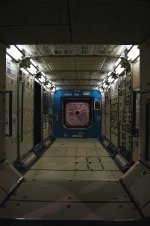
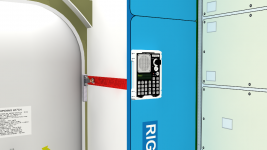
Been working on interior objects:

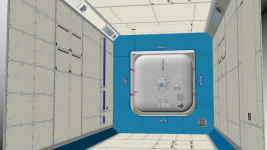
Blue Bulkhead panels with decals and vent
Blue Cove panels
Cream Light and Blank panels with vents and thermal control
Tunnel panels with door tracks
ISPR panels for all four racks
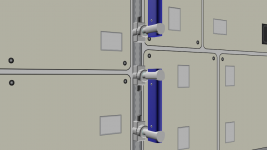
Track mounted hand grabs

I've been modeling it somewhat close to the source image included. I don't want to match it perfectly because each of the Gateway modules are different from the real ISS modules.

This module interior shows four ISPRs deep, but the power module will be 13.5 ISPRs deep. so you can imagine for now the work I have ahead of me. The interior of each module will be a separate Mesh with textures. I guess you would call them virtual cockpits. Of course they will have different appearance and location place cards and maps to tell you where you are in relationship to the rest of the station.

I'm not sure if I gave you a close up look at the interior grabs but I threw one in for good measure.
 

Attachments

  • Interior Pers.png
    Interior Pers.png
    261.7 KB · Views: 39
  • image550.jpg
    image550.jpg
    374.6 KB · Views: 43
  • Interior Grabs Pers.png
    Interior Grabs Pers.png
    73.8 KB · Views: 36
GWS Update

So I've got this little problem. In the image attached you can see my dilemma...

You can see the previous configuration with two ETs

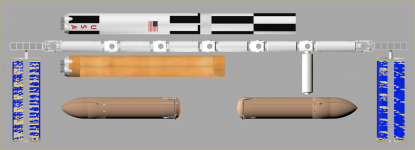
In NASA Livery, Should I go with the full length core of the SLS, and have 4 CBM attachment points? This arrangement gives me the storage capacity of the LO2 tank for station ATMO gasses

In Foam Orange, Or should I separate the LO2 tank and have only 3CBM attachment points? No Gas storage

In either case it moves the X module to the FWD most node instead of center as was the previous configuration.

Opinions and comments welcome. Please!
 

Attachments

  • TC_Draft1.png
    TC_Draft1.png
    218.7 KB · Views: 63
Last edited:
GWS Update

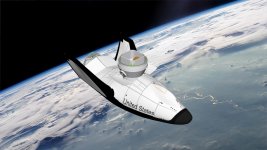
Posted the meshes for my CRV, It's a 99% solution so ver 10 will most likely be a final object. It included the CBM-LIDS adapter as used for this application.

Could still use feedback for the post above. Thanks.
 

Attachments

  • CRV.jpg
    CRV.jpg
    189.9 KB · Views: 52
Posted the meshes for my CRV, It's a 99% solution so ver 10 will most likely be a final object. It included the CBM-LIDS adapter as used for this application.

Could still use feedback for the post above. Thanks.

Is the port on that thing supposed to retract? It certainly looks different like that.
 
So I've got this little problem...

...Should I go with the full length core of the SLS, and have 4 CBM attachment points? This arrangement gives me the storage capacity of the LO2 tank for station ATMO gasses

...Or should I separate the LO2 tank and have only 3CBM attachment points? No Gas storage...

I suppose I'd go with the full core, but I've got a question first. How will the core stage make it to LEO, shouldn't it fall back to Earth in the drop area? I understand how the shuttle ET's make it (shuttle just hangs on to them after burnout). But I wouldn't think the SLS core would be able to make it without help.

Also, what is the altitude of the station as it is in it's construction stage? I'd assume it's built pretty low, then boosted to higher orbit?
 
Is the port on that thing supposed to retract? It certainly looks different like that.

The port you see is actually a module, its a CBM-LIDS adapter Module, it would remain attached to another module on the station, usually a node.

The LIDS portion of the CRV is internal when the doors are closed. The doors are just for aerodynamics. Otherwise they are not really needed. I thought about having radiators built in. Might still go that way.

Good question, Thanks

---------- Post added at 12:22 PM ---------- Previous post was at 12:17 PM ----------

I suppose I'd go with the full core, but I've got a question first. How will the core stage make it to LEO, shouldn't it fall back to Earth in the drop area? I understand how the shuttle ET's make it (shuttle just hangs on to them after burnout). But I wouldn't think the SLS core would be able to make it without help.

Also, what is the altitude of the station as it is in it's construction stage? I'd assume it's built pretty low, then boosted to higher orbit?


The Station will be at full altitude for the entire construction phase of it's lifetime.

The Core stage will be the primary load. Additional tanks where the second stage would normaly be, are for getting the entire rocket to GEO, where the second stage could be discarded and returned to earth. Since the core is the payload, all you need is additional fuel, and a bit of inertia to get the core up to GEO. As it get higher, it get lighter and easier to achieve it's destination at GEO.

Once to GEO, a tug will grab and attach the core to the station.

Great question.
 
Last edited:
GWS Update/Status

I'd like to make a couple of quick points to all.

First thanks for following this project, as stated in the first post, it's a long term project. None the less it is not finished yet, but still a Work In Progress.

Second having enrolled in my final project course, certain delays in this project have come to light. It's still in work, and while this thread may stagnate slightly as I work on non-mesh items, I assure all including the administrators, the thread and project are not dead or dropped.

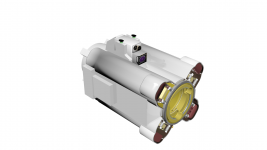
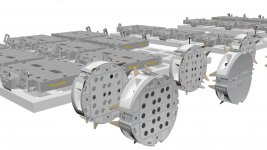
I've been working on the storage pallet system, came up with a few solutions and a few new problems. Been throwing the idea around that no matter what pallet I need in a particular place, It will use the same mounting/mooring adapter. I looked at the JEM and the external experiment pallet and decided it had the best options for powered and non-powered attachment systems.

See inserts, and texture. The configuration will be modular, but this adds additional weight to an already heavy set of modules, and there's the added size envelope to the 14' module making them slight under 15' with adapters on only one side. about 15'6" with two adapters. Still sorting this out.

This will be it for a while, I'll try to chime in at least once a month to keep the thread current, and update the non-mesh work details. Don't worry there's still lots of mesh work to accomplish with lots of images to follow.
 

Attachments

  • Pallet_1.jpg
    Pallet_1.jpg
    140.2 KB · Views: 26
  • Pallet_2.jpg
    Pallet_2.jpg
    108.6 KB · Views: 18
  • EFBM.jpg
    EFBM.jpg
    80.6 KB · Views: 15
GWS Update

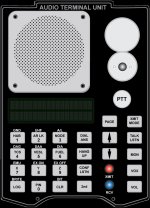
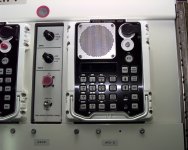
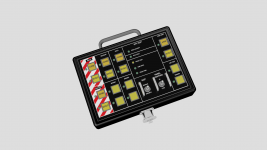
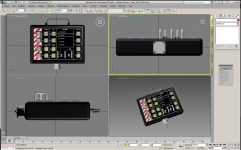
Com Panel, slightly modified for GWS
--- Added image ---
Found a font green digital that uses the same segment types and this display used a stock photo and added the text from it.

I had to rearrange the connectors at the top to allow for the unit text

The idea is that you can dial a module using it's xyz coordinates, of course this implies you have a directory handy, other wise you would need to memorize about 60 three digit numbers.

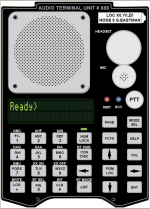
The display clearly shows the mode is set for push to talk(PTT) but I have no idea what the other items in the first line are.

----------Edit------------
Changed the last image to reflect the most recent iteration, it allows the location tag in the upper right to be changed, which in turn allows each ATU to be generic. Modified several buttons to be conducive to modern IP telephony operations, yet have a few specific buttons. I figure an electronic key set can be programmed, much like a router (Cisco 3985 or equivalent) this way each ATU is unique by a three digit-single digit (as in XYZ-1 thru 0), and each occupant is unique by a four digit number. Each visiting vessel is unique by two digit number. Now the comms system can be run from a Cat6 port tied into the internal switch(an ordinary switch just hidden inside a panel in one of the endcaps.
 

Attachments

  • Com Panel-01.jpg
    Com Panel-01.jpg
    127.3 KB · Views: 22
  • JSC2001E10777.jpg
    JSC2001E10777.jpg
    289.4 KB · Views: 26
  • Com Panel_3.png
    Com Panel_3.png
    94.2 KB · Views: 16
Last edited:
GWS Update

I just read a thread on L2, It discusses at length a design issue with the Nodes, that severely limits connections and tubing in the vestibules. This combined with Human Design Factors, makes my concept of a universally plumbed and electrified node an impossibility in the real world. I hate being a curios individual on occasion, and this was one of them. I have high hopes that technology has overcome most of these limitations.

I know data line issues are solved by fiber optics, but fluid and gas exchange remains the same, and with 3 power busses, cable diameter actually increases. Dedicated comms lines are still used, and a sensor array cables are added, unless a different pair of fiber is used.

Never the less, the fantasy world says it's not only possible, it's probable.

Any thoughts?

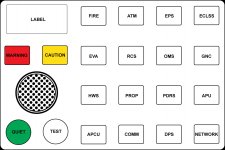
Find attached Caution and Warning panel for GWS
 

Attachments

  • CandW_Panel.jpg
    CandW_Panel.jpg
    116.1 KB · Views: 17
GWS Research Request

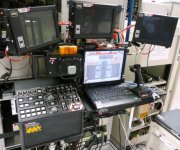
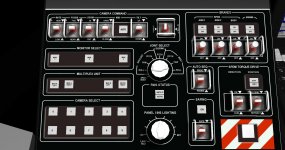
Been looking without success for a layout of the Camera and Light control panel for the Robotic Workstation, Its featured here, just left of the PC and under the translation control.

Can anyone help?

Line drawing or close up image, anything with readable text...
 

Attachments

  • nasa-space-station-1-620x.jpg
    nasa-space-station-1-620x.jpg
    244 KB · Views: 22
GWS Update

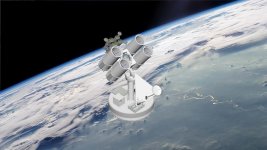
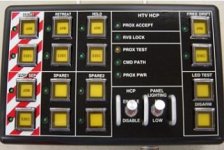
Latest doodle. This is the HTV-HCP
The first image is the reference image.
 

Attachments

  • Z6.jpg
    Z6.jpg
    19.6 KB · Views: 18
  • HTV HCP.png
    HTV HCP.png
    337.8 KB · Views: 13
  • HTV HCP_Quad.png
    HTV HCP_Quad.png
    273.8 KB · Views: 14
Been looking without success for a layout of the Camera and Light control panel for the Robotic Workstation, Its featured here, just left of the PC and under the translation control.

Can anyone help?

Line drawing or close up image, anything with readable text...

Check out the cupolaVC in my ISS AtoZ.
 

Attachments

  • cupcontrol.jpg
    cupcontrol.jpg
    213.3 KB · Views: 21
So what it looks like is I will combine all the control panels of possible VVs into one control panel with a mode switch, this will select a predefined CBM Equipped Cargo VVs like Dragon, ATV, Cygnus, or HTV.

And in addition I'll include modes for Docking vehicles like Dream Chaser, CST-100, Dragon, and Orion.

Also I'll include a few programmable selections for undefined VVs. These are vehicles from Orbiter: Delta Gliders and so on...

Finally programmable selections with non-IDA rings, and some legacy rings like APAS-95, Chinese DM, Salyut-1 type Probe and Drogue, and Hybrid. (my contention is that they all align to IDS, without question, this would make IDS truly international, and keep adapter modules to a minimum.)

I'll throw something together over the next few days, and post the results.
 
Back
Top