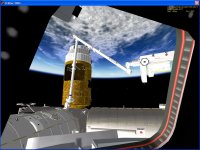
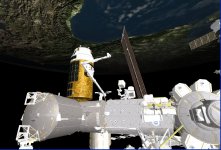
Updates JAXA's HTV-2 "Kounotori 2"

From ISS On-Orbit Status Report for 01/02/2011.

Cady enabled the Cupola RWS (Robotic Workstation) UOP (Utility Outlet Panel) for power-up in Node 3, installed the CCR (Cupola Crew Restraint) and readied the JEM (Japanese Experiment Module) RMS (Remote Manipulator System) equipment in the JPM (JEM Pressurized Module). Cady & Paolo then used the SSRMS (Space Station Remote Manipulator System) to release and extract the EP (Exposed Pallet) from the ULC (Unpressurised Logistics Carrier) in HTV-2's flank (~10:35 AM GMT) and hand it over to the JEM RMS, operated by Scott who berthed it to the JEF (JEM Exposed Facility) EFU-10 (Exposed Facility Unit-10). [The payloads on the EP will be transferred by ground control operations including SPDM (Special Purpose Dexterous Manipulator). Thrusters were inhibited during the transfer activity (7:00 AM to 1:05 PM GMT) due to load constraints.]

Scott afterwards disconnected the UOP DCP (Display & Control Panel) power bypass cable at the Cupola RWS and uninstalled the CCR (which stabilizes crewmembers during robot arm operations).

Working on the newly transferred Japanese KOBAIRO ("stork") rack in the JPM, Cady removed the launch locks on the front panel of the GHF (Gradient Heating Furnace) SCAM (Sample Cartridge Automatic Exchange Mechanism). [GHF is a vacuum furnace that contains three heating blocks. Their positions and temperatures can be independently controlled, and various temperature profiles can be configured. This facility will mainly be used for high quality crystal growth experiments using unidirectional solidification.]

Also transferred from HTV-2 yesterday (instead of today as planned) was the MSPR (Multipurpose Small Payload Rack) which provides a platform to accommodate small experiments. [Electrical power and data communications will be supplied to the individual experiments inserted in the MSPR.]
 
From ISS On-Orbit Status Report for 02/02/2011.

After yesterday's preliminary work on the new GHF (Gradient Heating Furnace), part of the HTV-2 delivered JAXA Kobairo rack, FE-6 Cady Coleman removed the MP (Materials Processing) front panel, opened the MP access door and removed two mechanical stoppers from the heating units inside. The access door was then re-closed. [GHF is a vacuum furnace that contains three heating blocks. Their positions and temperatures can be independently controlled, and various temperature profiles can be configured. This facility will mainly be used for high quality crystal growth experiments using unidirectional solidification.]

CDR Scott Kelly, FE-5 Paolo Nespoli & Cady had several hours between them set aside for unpacking HTV-2 and transferring cargo that will not impact the STS-133/ULF-5 stowage plan. At ~6:50 PM GMT, Scott reported on HTV-2 transfer ops in a teleconference with ground specialists

SSRMS Walkoff and MT Translation:
At ~2:00 PM to 6:30 PM GMT, ground controllers walked off the SSRMS (Space Station Remote Manipulator System) to the MBS (Mobile Base System) MT (Mobile Transporter), which then was to be moved along its rails from WS-5 (Worksite-5) to WS-7. The SSRMS will then grapple the SPDM (Special Purpose Dexterous Manipulator).
 
Last edited:
SPDM via Facebook said:
Today's the big day! First, I will remove the FHRC from the EP and place it on my EOTP (don't you love all the NASA acronyms!) To move stuff around today with precision, I'll be using force-moment accommodation, which essentially gives me the sense of touch and the ability to do contact operations gently.

Here's a great time-lapse video of yesterday's (02/02) SPDM ops.​
[ame="http://www.youtube.com/watch?v=csD-yCv-6EI"]YouTube - htv-2 ssrms spdm[/ame]
 
Last edited:
From ISS On-Orbit Status Report for 03/02/2011.

Working in HTV-2 (H-II Transfer Vehicle-2), Paolo had several hours reserved for cargo transfer ops, focused today on transferring equipment from the internal standoff volumes which required moving racks.

CDR Scott Kelly worked on the CubeLab payload, first reviewing OBT (Onboard Training) material for installing/activating the frame of the CubeLab payload, reconfiguring CubeLab modules and setting up/stowing the CubeLab Microscope, then using the video camcorder to record documentary footage on CubeLab operations. Later, Cube Modules were reconfigured inside CubeLab Frame 1002, and CubeLab was powered on before sleeptime. [CubeLab is a low-cost 1-kg platform for educational projects. It is a multipurpose research facility that interfaces small standard modules into the ERs (ExPrESS Racks). The modules can be used within the pressurized space station environment in orbit, with a nominal length, width, and height of 100 mm and a mass of no more than 1 g. Up to 16 CubeLab modules can be inserted into a CubeLab insert inside an ER.]

Continuing her work on the Kobairo rack's GHF(Gradient Heating Furnace) in JAXA's JPM (JEM Pressurized Module), FE-6 Cady Coleman used the MultiMeter instrument to take resistance measurements of HU (Heating Unit) insulation material, then closed the GHF MP (Material Processing) front panel which she had taken off yesterday.

Also on the Kobairo rack, Cady installed a rubber shim on the VEE (Vacuum Evacuation Equipment), then took documentary photography.

SPDM Operations:
6:30 PM GMT on 03/02 to 5:45 GMT on 04/02, ground controllers are using the SPDM (Special Purpose Dexterous Manipulator) "Dextre" to remove two NASA payloads from HTV-2's EP (Exposed Pallet), i.e. (1) the FHRC (Flex Hose Rotary Coupler) with Arm 1 for stowage on the SPDM's EOTP (Enhanced ORU Temporary Platform), and (2) the CTC (Cargo Transport Container) with Arm 2 with subsequent handover to Arm 1 which then grasps the CTC Hinge Fixture and applies CTC heater power through the SPDM umbilical. Finally, the SSRMS will be maneuvered to an MT (Mobile Transporter) translate configuration in preparation for tomorrow's ground ops. Russian thrusters are disabled during the operations due to load constraints.
 
Here's the time-lapse video of yesterday's (03/02) SPDM ops.​
[ame="http://www.youtube.com/watch?v=PCIb5-cLgD0"]YouTube - htv-2 ssrms spdm timelapse 2[/ame]
The FHRC is now off the EP and on the EOTP, and the SPDM OTCM has manoeuvred to the CTC-4 grapple position.
 
When is HTV-2 going to the Zenith port on Harmony?
 
Another shot
 

Attachments

  • EPmove.jpg
    EPmove.jpg
    124.2 KB · Views: 21
Dextre successfully completes its first task: Canadian Space Agency wraps up a week of intensive robotics on the ISS.

Dextre, the Canadian Space Agency's robotic handyman aboard the International Space Station (ISS), successfully completed its first official task early this morning after unpacking two critical pieces of equipment ferried to the Station by Japan's Kounotori2 spacecraft—the space equivalent of a moving van.

While riding on the end of Canadarm2, Dextre unbolted a spare Flex Hose Rotary Coupler (part of the ISS's cooling system) and placed it on its tool storage platform (also known by the technical term, the Enhanced Orbital Replacement Unit Temporary Platform, or EOTP). Next, Dextre unfastened the Cargo Transfer Container, which will remain in the robot's specialized "hands" until the Express Logistics Carrier 4 stowage platform can be installed on the Station during the upcoming STS-133 mission of the Space Shuttle Discovery. The operations marked Dextre's first scheduled task since the robot was commissioned in December 2010. Canadarm2 will return Dextre to its perch on the ISS later this evening.

"There were a few times tonight when Dextre's human operators had to recalibrate as we zeroed in on our target," says Tim Braithwaite, the Canadian Space Agency's representative at NASA's Johnson Space Center in Houston, Texas. "This seems to be the result of the Station's structure itself flexing, effectively making a moving target for the ground operator to grasp. It's a bit like standing on the end of a dive board at the pool, and using a long skimmer to scoop a tennis ball that keeps bouncing about in choppy water. We know from our early checkout sessions that Dextre's arms are stable and precisely controllable; however, when the target is literally drifting before the camera, it poses a unique challenge for our operators. Tonight, though, the team put their experience to good use, and Dextre went on to deliver a flawless performance."

Dextre's operations capped an intensive week for Canadian robotics on the ISS. On January 27, Canadarm2 made a "cosmic catch" when it reached out and grasped the free-flying Kounotori2 spacecraft and docked it to the ISS. The Space Station's Canadian-built robotic arm then removed Kounotori2's Exposed Pallet (a transportation rack that slides out of the spacecraft like a drawer) from the external cargo trunk. On February 1, Canadarm2 transferred the pallet to the Japanese robotic arm on the ISS's Kibo module. Canadarm2 and the Japanese robotic arm will work together again on February 7 to return the pallet to Kounotori2's trunk.

About the CSA

Established in 1989, the Canadian Space Agency (CSA) coordinates all civil, space-related policies and programs on behalf of the Government of Canada. The CSA directs its resources and activities through four key thrusts: Earth Observation, Space Science and Exploration, Satellite Communications and Space Awareness and Learning. The Agency conducts its activities through three key business lines: Space Utilization: serving the needs of Government Departments; Space Exploration: positioning Canadian science and technology to advantage in future international space exploration missions; and Space Science and Technology: which drives synergy and builds capacity in academia, industry and government to respond to the current and future needs of the Canadian Space Program. By leveraging international cooperation, the CSA generates world-class scientific research and industrial development for the benefit of humanity.

Video highlights are available at:
ftp://ftp.asc-csa.gc.ca/users/Medias/pub/dextre_operations
 
Last edited:
From ISS On-Orbit Status Report for 04/02/2011.

FE-6 Cady Coleman continued her work on the new Kobairo rack in the JPM (JEM Pressurized Module). [Cady finished the installation of a rubber shim on the VEE (Vacuum Evacuation Equipment) started yesterday and took documentary photography, then rotated the rack (at location Forward 3) down, installed the GHF (Gradient Heating Furnace) MMA (Microgravity Measurement Apparatus) TAA (Triaxial Acceleration Assembly) on Kobairo, returned the rack to its upright position and downloaded the imagery.]

SPDM Operations:
From 8:10 PM to 10:10 PM GMT, ground controllers will roll the MT (Mobile Transporter) with the SSRMS (Space Station Remote Manipulator System) and its "hand", the SPDM (Special Purpose Dexterous Manipulator), from WS-7 (Worksite-7) back to WS-5. SPDM Arm 2 will then release the NASA CTC (Cargo Transport Container) and maneuver to a stow configuration. SPDM Arm 1, still applying CTC heater power via the SPDM umbilical, will also maneuver to Stow. The SSRMS will then leave the SPDM at the Lab PDGF (Power & Data Grapple Fixture), walkoff to Node 2 and maneuver to EP (Exposed Pallet) Overnight Park Position, ready for the upcoming EP handoff from the Japanese RMS (Remote Manipulator System) and re-insertion into HTV-2. Russian thrusters are disabled from 7:25 PM GMT 04/02 to 8:55 AM GMT 05/02 due to load constraints.
 
From Chris Hadfield via Twitter - a view of SPDM arm 2's OTCM installing the FHRC onto the EOTP. The failed PM is visible on the POA at the far left.

attachment.php
 
Last edited:
This morning, the JEM RMS grappled and removed the now empty EP from the JEF, and handed it off to the SSRMS. The SSRMS then re-inserted the EP into HTV-2's ULC, and ungrappled it.

----------------------------------------​

KOBAIRO Rack's Function Check Continues.

The Payload Flight Control Team (PL FCT) at the Kibo Mission Control Room (MCR) at the Tsukuba Space Center (TKSC) activated the KOBAIRO Rack on February 3. Right after the activation, the team detected some communication errors within the KOBAIRO Rack and stopped the checkout activities. Currently, the team is examining the initial data obtained during the activation. Setup of the sample cartridge into the rack by the ISS crew, which is originally scheduled on February 4, will be postponed until after the team confirms that all the rack's systems are functioning well.
 
From ISS On-Orbit Status Report for 07/02/2011.

For covering today's HTV-2 robotics operations, FE-6 Cady Coleman activated the VSW (Video Streaming Workstation) and SSC-1 (Station Support Computer-1) laptops for downlinking converted NTSC MPEG-2 (Moving Pictures Expert Group-2) "streaming video" packets via US OpsLAN and Ku-band.

Cady also enabled the Cupola RWS (Robotic Workstation) UOP (Utility Outlet Panel) for power-up in Node 3, connected the UOP DCP (Display & Control Panel) power bypass cable at the Cupola RWS and installed the CCR (Cupola Crew Restraint) in the Cupola. [After the Robotics ops, the setup was returned to its original conditions, including VSW.]

CDR Scott Kelly, FE-5 Paolo Nespoli & Cady then worked with the JEM (Japanese Experiment Module) RMS (Remote Manipulator System) in the JPM (JEM Pressurized Module) and the Canadian SSRMS (Space Station Remote Manipulator System) in the Cupola to return the EP (Exposed Pallet) to HTV-2. [After the very successful transfer of the two NASA payloads, the FHRC (Flex Hose Rotary Coupler) and CTC-4 (Cargo Transportation Container-4) from the EP on last week with the SPDM (Special Purpose Dexterous Manipulator), Scott today set up the DOUG (Dynamic Onboard Ubiquitous Graphics) in the JPM, grappled the EP on its location on the JEF (Japanese Exposed Facility) and handed it off to the SSRMS, operated by Paolo & Cady. After the handover, the EP was moved to HTV-2 and installed in the ULC (Unpressurised Logistics Carrier) in HTV's flank. Cady finally parked the SSRMS at the HTV-2 pre-grapple position.]

In preparation of HTV-2 departure viewing, Paolo executed an uplinked procedure to calibrate the external TV camera on the MBS (Mobile Base System) MT (Mobile Transporter) and the lower outboard video camera on the S1 truss (S1LOOB).

Scott continued HTV-2 cargo ops, unloading equipment and also replacing it with excessed hardware and trash for disposal. Later, Scott tagged up with ground specialists for the regular HTV cargo transfer debrief.
 
ISS camera shot
 

Attachments

  • ISSnow.jpg
    ISSnow.jpg
    139.5 KB · Views: 26
KOUNOTORI2 Mission Activities Continue Smoothly.

Aboard the International Space Station (ISS), the ISS crew continues to unload the pressurized cargo delivered by the KOUNOTORI2.

Of all the Cargo Transfer Bags (CTBs) carried on the Pressurized Logistics Carrier (PLC) of the KOUNOTORI2, 71% of them have already transferred to the ISS. Besides the unpacking activities, the ISS crew is also loading trash bags into the PLC. Of all the waste and discarded items listed on a trash list, 40 percent of them have loaded into the PLC.

On February 18, the ISS crew will perform relocation of the KOUNOTORI2 using the SSRMS. This relocation is a preparation for arrival and docking of Discovery (STS-133), which is currently scheduled to launch on February 25. If the KOUNOTORI2 stayed in its current position, the Space Station Remote Manipulator System (SSRMS) will not be able to remove and transfer the payloads in Discovery's payload bay. The KOUNOTORI2 will be moved from the Common Berthing Mechanism (CBM) at the nadir port of Harmony to the zenith port of Harmony with the SSRMS manipulated by the ISS crew. After Discovery undocks from the ISS, the KOUNOTIORI2 will be returned to the Earth-facing port of Harmony.

The KOUNOTORI2's relocation by the SSRMS will begin at 8:30 p.m. on February 18. The relocation is expected to be completed around 6:00 a.m. on February 19.
 
Quick-look transfer status:

HTV-2 cargo unloading is 71% complete, which leaves 29% remaining.

HTV-2 trash loading is 40% complete, which leaves 60% remaining.
 
From ISS On-Orbit Status Report for 16/02/2011.

FE-6 Cady Coleman worked in Node 2 to remove the Nadir port vestibule W6005 power jumper (Channel 2) and then use it to build the W6005 contingency power jumper for the Zenith vestibule, in preparation for HTV-2 relocation to the latter [the HTV contingency jumpers provide power from the Node 2 Fwd OVHD bulkhead to HTV-2. Ready-made cables for this Nadir-Zenith-Nadir berthing scenario (for providing sufficient clearance for STS-133 docking to Node 2 FWD) are currently in the PMM (Permanent Multipurpose Module), to be launched on ULF-5.]
 
From ISS On-Orbit Status Report for 17/02/2011.

FE-5 Paolo Nespoli removed the spare Pump/Separator ORU (Orbital Replacement Unit) from the HTV-2 (H-II Transfer Vehicle-2) (location Forward 1) and stowed it in the JAXA JLP (JEM Logistics Platform) at rack Port 1, front.

CDR Scott Kelly & FE-6 Cady Coleman worked for several hours on HTV-2, making preparations for its relocation tomorrow morning from the Node 2 Nadir port to the Zenith port. [After Cady had removed PEP (Portable Emergency Provisions) systems (i.e., PBA/Portable Breathing Apparatus, PFE/Portable Fire Extinguisher and R&MA/Restraint & Mobility Aid) from the HTV PLC (Pressurized Logistics Carrier), she and Scott closed the hatch, then demated the PLC Vestibule (disconnecting ARS/Atmosphere Revitalization System, IMV/Intermodule Ventilation, 1553A & 1553B jumpers and partially installing the PCBM/Passive Common Berthing Mechanism thermal cover), they checked the CBM CPA (Controller Panel Assembly) J5 connector by removing its backshell, taking documentary photography and replacing the backshell, fastening it with tape, and then installed the CPA. Finally, the Node 2 camcorder was configured to support PCBM survey by the ground.]
 
Back
Top