The answer to everything in the universe is 0, not 42.

most of this is over my head, but there I thought that 1Kgm was 1 cubic decimeter of water.. or very close to it.
Urwumpe, Heilor; dudes... quit wasting your talents...
get to work on the SSU... ;)

Joking here, of course discuss what you like...

But the answer is to every thing in the universe is.... "it exists"...
 
When you see motion, you're getting another dimension of measurement: time.

Wrong assumption. Time also passes for static non-moving objects. In fact, without time, you could neither say, that something is moving, nor that it is not.

But I can also explain why you arrived at this assumption: You use the Lorentz transformation, without ever having understood it's basic premise. The Lorentz transformations are using displacements between two events in space-time. You use it as absolutes or as a measure of time, depending of your argumentation, but you never use it in a consistent way. Or in the physical correct form.

Also, you do another big error all the time: You ignore the units of the values. Big big error in physics, and explains about 99% of the stuff you do wrong. Of course, you will not admit to be wrong, because you are just trolling here with the same method and the same copy and pasted material, as in the other forums.

---------- Post added at 11:59 PM ---------- Previous post was at 11:57 PM ----------

Urwumpe, Heilor; dudes... quit wasting your talents...
get to work on the SSU... ;)

Which talents? The only real talent of mine is the capability of destroying a brick building in one morning with no other tools than a good large hammer.
 
Which talents? The only real talent of mine is the capability of destroying a brick building in one morning with no other tools than a good large hammer.
I prefer to call mine a maul. :)
 
And when you have a balance you're getting a 3d measurement: time, distance and acceleration. That's why m^3 kg^-1 and s^-2 are all the same thing. Just think about it. When you measure out a supposedly 2d object, you have to put something there to keep the shape. The differences between those various shapes in distance, collectively, provide you a frame of reference, distance wise. Motion provides you a frame of reference time/distance wise. Difference in acceleration gives you a 3d time/distance/inertial comparison.
So now 3d is time, distance and acceleration? :rofl:

Urwumpe has already pointed out that you fail to consider that time also passes for objects which are not moving, and that you fail at basic physics.

Please also spend some fraction of your clearly immense brainpower doing the following two things:
1. Actually RESPONDING to our comments rather than ignoring them and blasting off on some other tangent (which is presumably at a 60 degree angle)
2. Learning to quote individual bits of a post and respond to them individually, rather than block-quoting something and then block-replying. This should help with #1, so you can easily see how much of a tangent you're heading off on.

most of this is over my head, but there I thought that 1Kgm was 1 cubic decimeter of water.. or very close to it.
Urwumpe, Heilor; dudes... quit wasting your talents...
get to work on the SSU... ;)
Slow day at work.

---------- Post added at 03:22 PM ---------- Previous post was at 03:08 PM ----------

So now 3d is distance, time and acceleration? :rofl:
I'll be more explicit as to why I laugh at your choice of those three "dimensions"--your third "dimension" is the second derivative of the first (distance) with respect to the second (time). The point of dimensions (which you missed when you proposed that the triangle coordinate system is better than the grid) is that they should independent of each other. If not, they're effectively useless.
 
We should be more specific and refer to it as position, not distance. Distance begs the question of to what? Now describing something as a simple linear coordinate in an apparently three axis space may have some other problems.

It is possible to describe a granular three space with a single coordinate, but it gets easily confusing and choosing a bad numbering system can cause some big math headaches. An example would be:
(0)=(0,0,0), (1)=(0,0,1), (2)=(0,1,0), (3)=(1,0,0), (4)=(0,1,1), (5)=(1,0,1), (6)=(1,1,1), (7)=(0,0,2)...and so on. There also needs to be a method to deal with the other 7 octants in euclidean 3 space.

Now what is (1) + (2) = ?... Is it (3) or (4)? Is (5) - (3) equal to (2) or (1)? Sometimes its easier to keep all three coordinates to simplify the math.

---------- Post added at 07:04 PM ---------- Previous post was at 06:51 PM ----------

Oh, fun fact. If we assume (there's that word again) every property of everything in this universe can be described an integer value of some minimum quanta we could create a method to represent everything in the universe as a single integer value.

However we have a problem. Because this number contains all of the information in present the Universe, it would take at least the entire Universe to represent this number. More likely more material than exists in the universe because we're likely to have some inefficiencies in our numbering schemes.

EDIT: You could probably come up with an estimate of the order of this number. There are some estimates available for the size and mass of the known Universe to use. Maybe find out how many Planck volumes can fit in the known Universe to find out how many positions exist in the Universe. Then use the mass and average temperature of the universe to get an estimate of how many quanta of energy you need to deal with. You're going to end up having to exponentiate each new thing on the original to get a unique number for each state. Good luck if anyone wants to attempt it.

Its going to take a lot of BAD assumptions to get a number, but you may be entertained at the result.
 
Last edited:
Oh, fun fact. If we assume (there's that word again) every property of everything in this universe can be described an integer value of some minimum quanta we could create a method to represent everything in the universe as a single integer value.

However we have a problem. Because this number contains all of the information in present the Universe, it would take at least the entire Universe to represent this number. More likely more material than exists in the universe because we're likely to have some inefficiencies in our numbering schemes.
Yeah, I'm thinking integer overflow, there.
 
Wrong assumption. Time also passes for static non-moving objects. In fact, without time, you could neither say, that something is moving, nor that it is not.

But I can also explain why you arrived at this assumption: You use the Lorentz transformation, without ever having understood it's basic premise. The Lorentz transformations are using displacements between two events in space-time. You use it as absolutes or as a measure of time, depending of your argumentation, but you never use it in a consistent way. Or in the physical correct form.

Also, you do another big error all the time: You ignore the units of the values. Big big error in physics, and explains about 99% of the stuff you do wrong. Of course, you will not admit to be wrong, because you are just trolling here with the same method and the same copy and pasted material, as in the other forums.

---------- Post added at 11:59 PM ---------- Previous post was at 11:57 PM ----------


Which talents? The only real talent of mine is the capability of destroying a brick building in one morning with no other tools than a good large hammer.
Is anything really ever not moving? You just don't think it's moving, but that's compared to your frame of reference. I seem to remember this planet rotates pretty quickly. You can't say anything is stationary. Just stationary in relation to one another.

Animated_Lorentz_Transformation_Frame.png

This is what I'm talking about. Look at the two dotted lines. They're missing acceleration, which should be what makes them proportional. You also have to have equal and opposite lines going the other way to have 2d rotational symmetry, which is what anti-matter has to matter.

It all just looks 4d, but what you're doing is comparing TONS of points of reference, there's not just a spaceship and Earth, there's everything in the spaceship in relationship to itself. What happens to ice near c? You're using up all the acceleration. Are you saying that you can define the complex interactions between matter any other way? Point mass is quaint, and isn't the way things work, and ignores a gigantic part of the picture. Why do you ever see different things? Why not all just 2d?

When you measure a meter up, and you graph it on a number line, that's only a one dimensional number. That's the key here. You have to have multiple one dimensional numbers to really have definition. Time is always motion. Change in motion is acceleration. It's really all quite simple.

The problem with Einsteins diagram is that it's a right triangle. It should be an equilateral triangle with c*c*c on each side. It's like this:
150px-Vivani.svg.png

1 m^3/89875517873681764 m^3
That's the scale.
L is mass, m is time, and n is distance.

"This theorem can be easily proven by comparing areas of triangles. Let ABC be an equilateral triangle where h is the height, and s is the length of each side. P is any point inside the triangle, and , m, n are the distances of point P from the sides."

1ae3380cb5a37d96b2dce3439c9738a5.png

13e03fbe9478f4902e0f583e5c88c2e4.png

7e86c2decd8c6f8b91a1d3e324f96e8e.png


When you have equal areas in everything, then you have the 1:1:1.
 
Also please describe a Universe in your notation where I have three bowling balls, two of which are on a collision course. They will collide at a 90 degree angle at a location that is not on the origin or a principal axis. All objects can be assumed to be moving within the same plane.
 
Is anything really ever not moving? You just don't think it's moving, but that's compared to your frame of reference. I seem to remember this planet rotates pretty quickly. You can't say anything is stationary. Just stationary in relation to one another.

Animated_Lorentz_Transformation_Frame.png

This is what I'm talking about. Look at the two dotted lines. They're missing acceleration, which should be what makes them proportional. You also have to have equal and opposite lines going the other way to have 2d rotational symmetry, which is what anti-matter has to matter.

It all just looks 4d, but what you're doing is comparing TONS of points of reference, there's not just a spaceship and Earth, there's everything in the spaceship in relationship to itself. What happens to ice near c? You're using up all the acceleration. Are you saying that you can define the complex interactions between matter any other way? Point mass is quaint, and isn't the way things work, and ignores a gigantic part of the picture. Why do you ever see different things? Why not all just 2d?

When you measure a meter up, and you graph it on a number line, that's only a one dimensional number. That's the key here. You have to have multiple one dimensional numbers to really have definition. Time is always motion. Change in motion is acceleration. It's really all quite simple.

The problem with Einsteins diagram is that it's a right triangle. It should be an equilateral triangle with c*c*c on each side. It's like this:
150px-Vivani.svg.png

1 m^3/89875517873681764 m^3
That's the scale.
L is mass, m is time, and n is distance.

"This theorem can be easily proven by comparing areas of triangles. Let ABC be an equilateral triangle where h is the height, and s is the length of each side. P is any point inside the triangle, and , m, n are the distances of point P from the sides."

1ae3380cb5a37d96b2dce3439c9738a5.png

13e03fbe9478f4902e0f583e5c88c2e4.png

7e86c2decd8c6f8b91a1d3e324f96e8e.png


When you have equal areas in everything, then you have the 1:1:1.
That diagram has nothing to do with what you claim it has anything to do with. The original is http://en.wikipedia.org/wiki/File:Animated_Lorentz_Transformation.gif .

Also:
:blahblah:
Until you start actually responding to us and not just posting additional random junk, I'm done with this thread.
 
I'll be more explicit as to why I laugh at your choice of those three "dimensions"--your third "dimension" is the second derivative of the first (distance) with respect to the second (time). The point of dimensions (which you missed when you proposed that the triangle coordinate system is better than the grid) is that they should independent of each other. If not, they're effectively useless.

That's the point. If you think about it on a graph, time v. distance, you can find the acceleration by shading in squares for the meters and seconds. To find acceleration, take the maximum value and draw a line back to the y-axis. The complimentary area is the acceleration over time. A derivative is just an instantaneous measurement of acceleration, but you always have to have to two measurements between time and distance to make a meaningful measurement.

Difference in acceleration is mass when you compare that, shade in. Draw a line back to the y-axis. Why is it I can do this on a graph, but not in 3d? You can graph it in 3d if you use a tetrahedral shape. The bottom would be time/distance, and because of the way a tetrahedron works, that's one half of what you need. The other half is difference in acceleration. That's the third point. From your point of origin, you only need three points to make a 3d shape. This is the basis of my argument. That's variations in the passage of time, the masses, and the distance. If you want to figure out two masses, you connect to tetrahedrons. Now, when I say tetrahedron, all I'm referring to is the general 4 point 3d shape. You can make the angles scalene for more time, distance, or difference in acceleration. When one of the angles gets bigger in one, in the other tetrahedron it gets smaller. This changes acceleration if you keep it as a relatively fixed point.

Now just think of tons of tetrahedron's relating to one another. That's what we're used to. The structure of the simplest atom is a tetrahedron with one of the points all screwy (the electron.) My thinking is that in the anti-normal sides of the dimensions, that the other electron is doing the opposite thing. The base of the tetrahedron with form a hexagon with the anti-normal versions of the quarks, at least in hydrogen. All the other elements are more complex versions of this same thing.

Think of the balance three measurements:
1. The mass of object one v. the other in the presence of a third mass.
2. The distance between the center of either of the three masses.
3. The time they stay like that.

You might say the universe itself is the 4th dimension of time in which all of this varies, but time-time is a fictitious time. You bounce back and forth between the past and the future. That's gravity/entropy. That's why entropy only goes one way in "time", goes backwards in a star, or even to the start of the universe in a black hole when everything was a singularity. The clock is running a little slower for all the various points in our world, when compared to one another 1d of time passage variation. The 1 d distance between all points. 1d for difference in resistance to acceleration for all points. That's where the m^3 comes from, it's the volume of that tetrahedron. Just make a tetrahedron and label everything time/distance/inertia. It works out in the long run, except that you end up putting two different things on the same side. It's all just a measure of the same distance.

The key to this is hexagon and the quarks. There are really probably symmetries where there are two down quarks per every up quark, but it's all just three things creating this, moving out from the center of the hexagon.

If Everything has to be symmetrical/conserved, this below shouldn't be true:
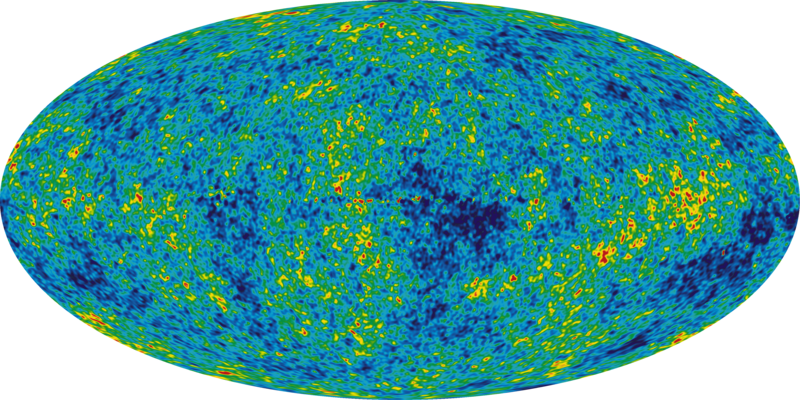
800px-WMAP_2008.png


It is all lumpy because some parts of the universe we see are more in the "past" than others, when there was more compression. This weirdness of different points in time is inherent in Einstein's ideas, even if you don't listen to me, if time passes slower for one place, that means it's faster in another. When stuff goes faster, it's using up more of it's volume in time/distance, and it can achieve less acceleration. Photons, I suspect have an inertia/resistance to acceleration dimension that's 1 proportional universal unit. That's why they can go faster. Other things have to change the dimension of inertia into more time/distance. Think of the tetrahedron collapsing down to two, back to back equilateral triangles. The amplitude and frequency are the two things that other "massive" things have: time and distance. You just distort those two triangles for different wave lengths or amplitudes. That's why you can figure out e with only wavelength and amplitude. c^3 It's a huge number, and I think that's the maximum possible volume in these different dimensions.

It's all the same thing, it's what we call energy, but I think energy is really just a measure of probability, which is why you can't find the smallest thing with 100% accuracy, and why we don't do all the weird stuff those things down there do. They have a smaller inertial width than the whole thing together. Over all, the inertial dimension is much larger. They can move around weird and unpredictably. Electron cloud. Think of how light electrons are. I think that's why they are so unpredictable. Their "energy" (aka probability) is just more spread out in the time/distance dimension.

Without two points of reference, you can't have have any velocity. Without another point, you can't tell the relationship between three things that there's anything more than just a 1 d number line-ish thing, and you can't tell change in velocity. Without another point, you cannot figure out 3d movement between points it just looks 2d, and you can't figure out the difference in acceleration. Just think of it yourself in your own head. That's the simplest 3d shape. A tetrahedron. 4 points of reference. In only 3 dimensions. Each of the sides of the tetrahedron is a different measure of distance when compared to the others, or in more accurate terms one component in determining probability.

These string theorists all have tons of dimensions, but if you do x^4, it just looks like x^2 only steeper. There's not any shape difference, no difference in the way information is represented.

I figured this whole information thing out while curious about the difference between $100 and one hundred dollars. I think the reason one is longer than the other is that it has more dimensions to it.
$0123456679 versus:
abcdefghijklmnopqrstuvwxyz

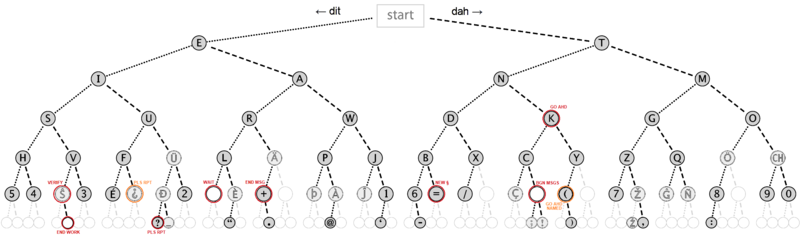
"One hundred dollars" has more dimensions to it, and more places. If you convert both to ASCII binary, $100 is not as long as "one hundred dollars". Why is it the same meaning, but longer? You lose spelling information. You lose some representation of the dimensions. That's what I think a hologram does when it comes to the substance we feel when we touch something. Particles/waves going through the two slits in the two slit experiment are losing 1 dimension and they are then defined by a dichotomic path. That's the bands. Look at this thing called a dichotomic search tree:
800px-Morse_code_tree3.png

Turn it on its side, and graph it. It's all adds up at different points.

800px-Single_%26_double_slit_experiment.jpg


I graphed $100 dollars in binary, by going up for 1 or down for 0. I realized that if I changed the scale of my graph to make a single square more than than one in the previous scale, I could lose information, if only one of the jumps up or down was one in size. I also realized that my graphing technique kind of looked like the above effect.

Binary. Two choices. Two slits. 2d information. Distance and time.

Red shift around very massive objects: distorting the graph scale, then enlarging it on the other side, when light moves past a gravity well.
Red shift for objects further away: expanding the scale or of the universe, causing the traditional doppler effect.

I think gravity waves are the opposite of light waves, they have the anti-time and intertia dimension.

Both have momentum but are missing something.

 
Last edited:
It is all lumpy because some parts of the universe we see are more in the "past" than others, when there was more compression. This weirdness of different points in time is inherent in Einstein's ideas. When stuff goes faster, it's using up more of it's volume in time/distance, and it can achieve less acceleration. Photons, I suspect have an inertia/resistance to acceleration dimension that's 1 proportional universal unit. That's why they can go faster. Other things have to change the dimension of inertia into more time/distance.
Wrong. Wrong. Wrong. I'm done with this topic.
 
That's the point. If you think about it on a graph, time v. distance, you can find the acceleration by shading in squares for the meters and seconds. To find acceleration, take the maximum value and draw a line back to the y-axis. The complimentary area is the acceleration over time. A derivative is just an instantaneous measurement of acceleration, but you always have to have to two measurements between time and distance to make a meaningful measurement.
No. The first derivative of distance with respect to time is velocity, not acceleration. Moreover, the method you describe ("take the maximum value and draw a line back to the y-axis") would give you nothing at all useful. If you take the area under the average value, then you have the average velocity. If you take the area under the maximum value, you have a quantity that doesn't mean anything.

Difference in acceleration is mass when you compare that, shade in. Draw a line back to the y-axis.
No. Difference in acceleration is "jerk", not mass. How the hell is mass difference in acceleration? If I'm in a rocket which has an acceleration of 2g, and then the acceleration switches to 4g, my mass has not changed.

Thus far, you have proven nothing more than that you fail to understand basic principles of physics and calculus.

I would suggest that you complete high school before you start thinking about things that are way over your head.
 
That diagram has nothing to do with what you claim it has anything to do with. The original is http://en.wikipedia.org/wiki/File:Animated_Lorentz_Transformation.gif .

Also:
:blahblah:
Until you start actually responding to us and not just posting additional random junk, I'm done with this thread.

It does, that's the point. We're having a discussion about relativity, that's a Lorentz transformation, it means everything to relativity. You obviously have no clue what that is, or what that means in this context. Get a clue dude. Just ask the other posters.

Just read this part:
http://en.wikipedia.org/wiki/Lorentz_transformation#Special_relativity

I'm arguing that one of the dimensions is the various clocks. Haven't you read a single thing I've written? Goodness gracious! It's pointless in trying I give up. I'm tired of this already myself. It's a simple, simple idea. Difference in clocks is one of the three dimensions. That's what I'm saying here. Don't you get that? Doesn't every place in the universe have different clocks? Yes. Why make that a 4th dimension? If everything is relative to everything else, it's like a way we think about normal x,y,z space. I'm trying to say you get one of the three dimensions from the various clocks of everything. You're so close-minded. So unwilling to ask fundamental questions.

---------- Post added at 08:16 PM ---------- Previous post was at 08:02 PM ----------

No. The first derivative of distance with respect to time is velocity, not acceleration. Moreover, the method you describe ("take the maximum value and draw a line back to the y-axis") would give you nothing at all useful. If you take the area under the average value, then you have the average velocity. If you take the area under the maximum value, you have a quantity that doesn't mean anything.


No. Difference in acceleration is "jerk", not mass. How the hell is mass difference in acceleration? If I'm in a rocket which has an acceleration of 2g, and then the acceleration switches to 4g, my mass has not changed.

Thus far, you have proven nothing more than that you fail to understand basic principles of physics and calculus.

I would suggest that you complete high school before you start thinking about things that are way over your head.

Between two things it is. We always seem to think that movement comes out of nowhere. Between two different masses. When you balance something you're changing the geometry between the masses.

You simply cannot have an instantaneous measurement of anything. You have to have at least two points of reference. That's what a meter is. Anything else is an average. The area under the curve is equal to the area above the curve from the maximum points, for the equal and opposite thing that happened.

If everything has an equal and opposite reaction, don't both sides count? And you cannot have an instantaneous measurement, that's zeno's paradox. If you don't know what that is, and you can understand it's significance look here:
http://en.wikipedia.org/wiki/Zeno%27s_paradox
200px-Tangent_to_a_curve.svg.png

I you draw lines back, you get both sides of what happened. It's symmetrical.

Why wouldn't the universe be symmetrical if everything is conserved?
That's my whole point. Just think of orbiter and how it's easier to get something to space as you burn up more fuel. You get more acceleration because of less mass. It's like entropy. Run the clock in reverse. If you filmed it, put it back where it came from. There must be an equal and opposite thing for everything if the universe is conserved. If it isn't conserved, then fine, you can have open ended things. But if it is? Think about the Lagrange points again and remember an equal and opposite thing.
330px-Lagrange_points.jpg


It looks like the symmetry between two masses and a third more massive body:
balance.jpg
 
Is anything really ever not moving? You just don't think it's moving, but that's compared to your frame of reference. I seem to remember this planet rotates pretty quickly. You can't say anything is stationary. Just stationary in relation to one another.

You have not understood relativity. The position/movement/acceleration/jerk/momentum relative to your selected inertial frame of reference is all that matters.

If I ram my finger into your nose, then I have a finger in your nose and you have a finger in your nose as well. But I am sure, you will admit that I have a slightly more comfortable situation relative to you.
 
This reminds me of a creationist I've run into named Gordon Mullings. He will often state there is little to discuss on a subject, followed by pages and pages of babbling. Never will he admit error, and his responses are just more walls of meaningless text. You guys should get together, do an act.
 
My thoughts:

First of all, it's interesting to see that many things (velocity, acceleration, momentum, force, energy etc.) can be expressed in terms of just three things: kilograms, meters and seconds. This is all you need for Newtonian physics and related subjects.

There are exceptions however: on example is electrical charge. There is no way to say "one Coulomb is this or that many kilograms per meter", or "seconds per meter kilogram^2", or something like that. And, as Garrett Lisi explains in the previously mentioned video, there are many other types of 'charge' discovered in quantum physics.

Next thing: the actual size of a second or a kilogram is quite arbitrary from a cosmological point of view: their definition is based on what happens to be convenient on this small blue planet (e.g. a second originally was 1/60th of 1/60th of 1/24 of a rotation of this planet). So, when you say 1 second = 1 kg = 1 meter, the very least thing you forget is the conversion factor, to go from our self-invented units to the real, 'natural' units of the universe.

What would these units be like? Well, if your goal is to demonstrate that everything is the same, then I think I know what you want. For instance, if you say "length and time are the same", that is basically the same as what the theory of relativity says, and its conversion factor is the speed of light:

c = 299 792 458 m/s

That is not a nice value, but that's just because meters and seconds are such odd units. With different units, we can make sure that c = 1. This also gives another nice effect: E = m * c^2 simplifies to E = m. So, energy and mass become the same.

With only one known constant (c = 1), we can only relate two basic quantities (length and time in this case). So we need a second constant to relate all three units. My choice for the second constant would be h_bar. With h_bar = 1, we can relate energy to time, and (as energy was already related to mass), we can relate the basic quantities time and mass.

With these constants set to 1, we know the ratios between the natural units, but we don't know their actual size yet. We can add a third constant to fix that. For instance we can define that G=1.

With these choices, and some additional choices to add other basic units such as charge, you come to a system of units called 'Planck units' (see link below). The main advantage is that you get rid of a lot of irrelevant conversion factors and constants, so you can get a clearer picture of what is really happening.

With such a system of units, some constants obviously become 1, and some get very simple values, such as 2*pi, because they are somehow mathematically related to those other 'basic' constants. Now, the interesting thing is that some constants will not get an 'elegant' value. These are dimensionless, so they have the same value in all unit systems. The question what causes them to be what they are remains an interesting unanswered question in physics.

Does this add anything to the discussion? I don't know anymore, though I think it's definitely cool stuff. I started this because I saw some confusion on units: e.g. 1kg = 1m = 1s is not true. Maybe, when the theory can be translated into some natural unit system, it says something more about physics and less about coincidental numerical similarities. And it will be harder to understand, so if you bring it the right way (like Garett Lisi) you might be able to impress people ;).

See also:
http://en.wikipedia.org/wiki/Natural_units
http://en.wikipedia.org/wiki/Planck_units
http://en.wikipedia.org/wiki/Dimensionless_physical_constant
 
Back
Top