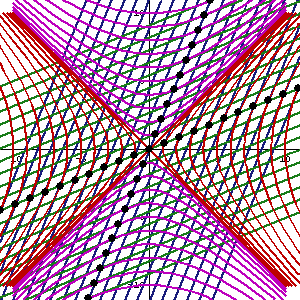
I'll be more explicit as to why I laugh at your choice of those three "dimensions"--your third "dimension" is the second derivative of the first (distance) with respect to the second (time). The point of dimensions (which you missed when you proposed that the triangle coordinate system is better than the grid) is that they should independent of each other. If not, they're effectively useless.
That's the point. If you think about it on a graph, time v. distance, you can find the acceleration by shading in squares for the meters and seconds. To find acceleration, take the maximum value and draw a line back to the y-axis. The complimentary area is the acceleration over time. A derivative is just an instantaneous measurement of acceleration, but you always have to have to two measurements between time and distance to make a meaningful measurement.
Difference in acceleration is mass when you compare that, shade in. Draw a line back to the y-axis. Why is it I can do this on a graph, but not in 3d? You can graph it in 3d if you use a tetrahedral shape. The bottom would be time/distance, and because of the way a tetrahedron works, that's one half of what you need. The other half is difference in acceleration. That's the third point. From your point of origin, you only need three points to make a 3d shape. This is the basis of my argument. That's variations in the passage of time, the masses, and the distance. If you want to figure out two masses, you connect to tetrahedrons. Now, when I say tetrahedron, all I'm referring to is the general 4 point 3d shape. You can make the angles scalene for more time, distance, or difference in acceleration. When one of the angles gets bigger in one, in the other tetrahedron it gets smaller. This changes acceleration if you keep it as a relatively fixed point.
Now just think of tons of tetrahedron's relating to one another. That's what we're used to. The structure of the simplest atom is a tetrahedron with one of the points all screwy (the electron.) My thinking is that in the anti-normal sides of the dimensions, that the other electron is doing the opposite thing. The base of the tetrahedron with form a hexagon with the anti-normal versions of the quarks, at least in hydrogen. All the other elements are more complex versions of this same thing.
Think of the balance three measurements:
1. The mass of object one v. the other in the presence of a third mass.
2. The distance between the center of either of the three masses.
3. The time they stay like that.
You might say the universe itself is the 4th dimension of time in which all of this varies, but time-time is a fictitious time. You bounce back and forth between the past and the future. That's gravity/entropy. That's why entropy only goes one way in "time", goes backwards in a star, or even to the start of the universe in a black hole when everything was a singularity. The clock is running a little slower for all the various points in our world, when compared to one another 1d of time passage variation. The 1 d distance between all points. 1d for difference in resistance to acceleration for all points. That's where the m^3 comes from, it's the volume of that tetrahedron. Just make a tetrahedron and label everything time/distance/inertia. It works out in the long run, except that you end up putting two different things on the same side. It's all just a measure of the same distance.
The key to this is hexagon and the quarks. There are really probably symmetries where there are two down quarks per every up quark, but it's all just three things creating this, moving out from the center of the hexagon.
If Everything has to be symmetrical/conserved, this below shouldn't be true:
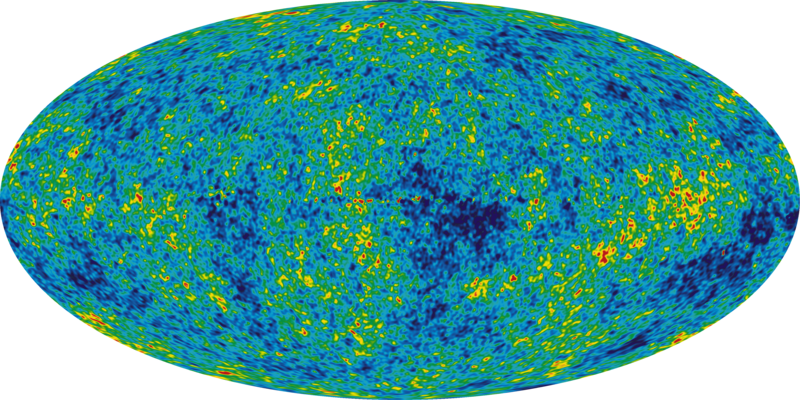
It is all lumpy because some parts of the universe we see are more in the "past" than others, when there was more compression. This weirdness of different points in time is inherent in Einstein's ideas, even if you don't listen to me, if time passes slower for one place, that means it's faster in another. When stuff goes faster, it's using up more of it's volume in time/distance, and it can achieve less acceleration. Photons, I suspect have an inertia/resistance to acceleration dimension that's 1 proportional universal unit. That's why they can go faster. Other things have to change the dimension of inertia into more time/distance. Think of the tetrahedron collapsing down to two, back to back equilateral triangles. The amplitude and frequency are the two things that other "massive" things have: time and distance. You just distort those two triangles for different wave lengths or amplitudes. That's why you can figure out e with only wavelength and amplitude. c^3 It's a huge number, and I think that's the maximum possible volume in these different dimensions.
It's all the same thing, it's what we call energy, but I think energy is really just a measure of probability, which is why you can't find the smallest thing with 100% accuracy, and why we don't do all the weird stuff those things down there do. They have a smaller inertial width than the whole thing together. Over all, the inertial dimension is much larger. They can move around weird and unpredictably. Electron cloud. Think of how light electrons are. I think that's why they are so unpredictable. Their "energy" (aka probability) is just more spread out in the time/distance dimension.
Without two points of reference, you can't have have any velocity. Without another point, you can't tell the relationship between three things that there's anything more than just a 1 d number line-ish thing, and you can't tell change in velocity. Without another point, you cannot figure out 3d movement between points it just looks 2d, and you can't figure out the difference in acceleration. Just think of it yourself in your own head. That's the simplest 3d shape. A tetrahedron. 4 points of reference. In only 3 dimensions. Each of the sides of the tetrahedron is a different measure of distance when compared to the others, or in more accurate terms one component in determining probability.
These string theorists all have tons of dimensions, but if you do x^4, it just looks like x^2 only steeper. There's not any shape difference, no difference in the way information is represented.
I figured this whole information thing out while curious about the difference between $100 and one hundred dollars. I think the reason one is longer than the other is that it has more dimensions to it.
$0123456679 versus:
abcdefghijklmnopqrstuvwxyz
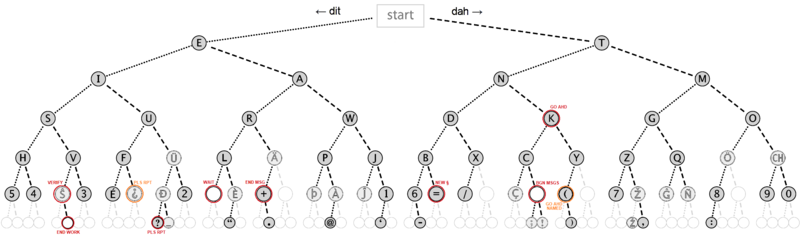
"One hundred dollars" has more dimensions to it, and more places. If you convert both to ASCII binary, $100 is not as long as "one hundred dollars". Why is it the same meaning, but longer? You lose spelling information. You lose some representation of the dimensions. That's what I think a hologram does when it comes to the substance we feel when we touch something. Particles/waves going through the two slits in the two slit experiment are losing 1 dimension and they are then defined by a dichotomic path. That's the bands. Look at this thing called a dichotomic search tree:
Turn it on its side, and graph it. It's all adds up at different points.
I graphed $100 dollars in binary, by going up for 1 or down for 0. I realized that if I changed the scale of my graph to make a single square more than than one in the previous scale, I could lose information, if only one of the jumps up or down was one in size. I also realized that my graphing technique kind of looked like the above effect.
Binary. Two choices. Two slits. 2d information. Distance and time.
Red shift around very massive objects: distorting the graph scale, then enlarging it on the other side, when light moves past a gravity well.
Red shift for objects further away: expanding the scale or of the universe, causing the traditional doppler effect.
I think gravity waves are the opposite of light waves, they have the anti-time and intertia dimension.
Both have momentum but are missing something.