The answer to everything in the universe is 0, not 42.

I would be totally surprised too :dry:

BTW, triangle graph paper:
http://incompetech.com/graphpaper/triangle/

Thanks to Google for the link. It will find you the most amazing things, even real academic papers on the subject of maths and dimensions...
Hey that's cool!

The snark is amazing, just think of a tetrahedron, if you don't think I'm right, then you just tell me how. You can't, however, because I even described a form of trigonometry, although it may already have been explored, which fully describes this all. C is a right angle in that trig.

You even have a fairly good explanation of Lagrange points. Why exactly do you think it is 60 degrees, if not this? Why should they be? Now we know. It's a 3-body problem, and there are only 3 dimensions. Why do we have fusion in stars? Now we know. Time is going backward. Even if you accept it's not going backward, you have to admit that's it's not as forward as much as time from other perspectives. Why do black holes act so weird? Now we know. They're really just the same thing as the big bang. Why is something "random"? What would cause randomness in a universe where there is conservation of everything? What would cause symmetry to break? Now we know. If you smoosh everything together, even anti-matter will probably cometogether with matter.

Do not be a jerk because you fail to understand the simplicity.

---------- Post added at 10:35 PM ---------- Previous post was at 10:28 PM ----------

The answer you want is "tetrahedron" because that is the simplest 3d shape that you can make by connecting a few points, since any three points are coplanar and the fourth point defines a volume (instead of a plane). However, that does not mean that all objects are composed of tetrahedrons (more on that thought later). I would say that the "simplest" 3d thing is a sphere. Spheres are certainly more natural than tetrahedrons--spheres form naturally all over the place; tetrahedrons do not.


Actually, you only need two sides to create all the points necessary to form a tetrahedron.


Just because you can visualize a cube as being composed of two (squashed) tetrahedrons does not mean that there's any physical meaning behind that. There are 6 ways to divide a cube into two (squashed) tetrahedrons, not just one.

It's similar to how Orbiter requires 3d models to be divided into triangles--it's simply more convenient and simpler for the renderer. The fact that triangles are used to define the surface (rather than n-gons) carries no information about the surface. It's simpler for (normal) humans to think of 3-space in terms of cubes and right angles, so we do.

---------- Post added at 09:23 PM ---------- Previous post was at 09:19 PM ----------


Er, no...cubes have six sides. I don't know what you've been smoking that's causing you to think that cubes only have four sides, but you should probably stop.


Coordinate systems where you cannot change one coordinate without changing the other suck. They're not particularly useful for anyone's needs, and it's not going to blow anyone's mind (except yours, apparently).

You're right about that. And about the coordinate systems, isn't that the point of general relativity? That Euclidean things don't work, and aren't real? Minkowski space. 4d, but what if you only need 3d for time?

I'm done talking, until you figure this out for yourself. I have provided all things necessary to figure it out. You are intent on proving me wrong rather than listening to what I have to say, and the things you are saying do not hold as valid criticisms. You won't admit the math: x*x*x. Debate me all you want, but until you get it through your head that that only describes things with the same side, you'll just keep up these pointless and nonsensical arguments. Are you saying that x*x*x isn't true for all things with x*x*x length/width/height? If you are, then you're simply arguing against reality, and there's really no point in debating you any further, at least until it sinks in.
 
I'm done talking, until you figure this out for yourself. I have provided all things necessary to figure it out.
Except for anything that makes sense.

You are intent on proving me wrong rather than listening to what I have to say, and the things you are saying do not hold as valid criticisms. You won't admit the math: x*x*x.
I have no idea what x*x*x means when taken out of context. Are you saying that the volume of a cube with sides of length x is x*x*x? Not exactly a groundbreaking discovery, that.

Debate me all you want, but until you get it through your head that that only describes things with the same side, you'll just keep up these pointless and nonsensical arguments. Are you saying that x*x*x isn't true for all things with x*x*x length/width/height? If you are, then you're simply arguing against reality, and there's really no point in debating you any further, at least until it sinks in.
You are using random and nonstandard terminology in an attempt to explain your ideas, which is making it very hard to understand them.
 
Except for anything that makes sense.


I have no idea what x*x*x means when taken out of context. Are you saying that the volume of a cube with sides of length x is x*x*x? Not exactly a groundbreaking discovery, that.


You are using random and nonstandard terminology in an attempt to explain your ideas, which is making it very hard to understand them.

There's just one thing I take back. I was sitting in bed about to go sleep, when I realized that light is two equilateral triangles back to back. And then two more back to back perpendicular to the first two. You can very the width and height of that shape to account for amplitude and wavelength, of course, it stops being an equilateral triangle then, but that's the whole point. And that's just like everything else with at least m^2. Hence the reason that light has momentum.

If you don't think x*x*x applies to a tetrahedron, you can try to disprove it. You won't be able to, because it does. We just never though "hey, wait a second, a tetrahedron is the simplest 3d shape for which that is true!" Well, aside from a sphere. But do you really have any points on a sphere? It's like it's undefined. Hmm... :)

Goodnight, and if you don't believe me, make your own tetrahedron, you silly 3d thing you! Thinking you're 4d! :cheers: Here's to being 3d! It's better than light! Take that light, we're one dimension MORE than you are! About the terminology, I'm struggling with this idea too. It's so hard to believe, you tend to switch to the old way of thinking about it all, then pull yourself back realizing it's all the same unit.
 
What is h-bar?
0a9fc3f71a862a9883e3b8922319eabe.png
What does that have to do with spheres being simple or not?

It's similar to how Orbiter requires 3d models to be divided into triangles--it's simply more convenient and simpler for the renderer. The fact that triangles are used to define the surface (rather than n-gons) carries no information about the surface. It's simpler for (normal) humans to think of 3-space in terms of cubes and right angles, so we do.
A rendering engine still interprets 3-space with three orthogonal axes. Triangles are used because they are constructed from just 3 points - the minimum number of points required to define a plane.

You even have a fairly good explanation of Lagrange points. Why exactly do you think it is 60 degrees, if not this? Why should they be? Now we know. It's a 3-body problem, and there are only 3 dimensions.
Lagrange points arise in a 2-body system. No third body is required.

You're right about that. And about the coordinate systems, isn't that the point of general relativity? That Euclidean things don't work, and aren't real? Minkowski space. 4d, but what if you only need 3d for time?
Minkowski space was developed for special relativity, not because Euclidean geometry didn't work but because special relativity was easier to formulate in Minkowski space. General relativity does not work in Minkowski space because Minkowski space assumes that space is flat, just like you can assume sufficiently small areas on the surface of a sphere are flat. For general relativity you need Riemannian geometry because at scales where gravitation becomes a significant force, space is not flat.

You are intent on proving me wrong rather than listening to what I have to say, and the things you are saying do not hold as valid criticisms.
That may be true but I currently hold the same opinion about your criticisms of the commonly accepted science. I'm happy to keep debating it, however, rather than packing away my bat and ball and going home.

You started this thread with "The answer to everything in the universe is 0, not 42.". Has anyone claimed that the answer to everything in the universe is 42, other than the author of a fiction novel (who more correctly claimed that the "Answer to the Ultimate Question of Life, the Universe and Everything" was 42)?

---------- Post added at 16:19 ---------- Previous post was at 16:06 ----------

I realized that light is two equilateral triangles back to back. And then two more back to back perpendicular to the first two. You can very the width and height of that shape to account for amplitude and wavelength, of course, it stops being an equilateral triangle then, but that's the whole point. And that's just like everything else with at least m^2. Hence the reason that light has momentum.
I don't see how representing light by perpendicular equilateral triangles implies that light has momentum. I don't dispute that photons have momentum, but that is due other experimental results such as radiation pressure.

If you don't think x*x*x applies to a tetrahedron, you can try to disprove it.
How does x*x*x apply to a tetrahedron? Are you suggesting the volume of a tetrahedron is x*x*x? How do you define "x" in this context?

Goodnight, and if you don't believe me, make your own tetrahedron, you silly 3d thing you! Thinking you're 4d! :cheers: Here's to being 3d! It's better than light! Take that light, we're one dimension MORE than you are! About the terminology, I'm struggling with this idea too. It's so hard to believe, you tend to switch to the old way of thinking about it all, then pull yourself back realizing it's all the same unit.
Units are not the same thing as dimensions. Unless you are trying to argue that too...
 
What does that have to do with spheres being simple or not?


A rendering engine still interprets 3-space with three orthogonal axes. Triangles are used because they are constructed from just 3 points - the minimum number of points required to define a plane.


Lagrange points arise in a 2-body system. No third body is required.


Minkowski space was developed for special relativity, not because Euclidean geometry didn't work but because special relativity was easier to formulate in Minkowski space. General relativity does not work in Minkowski space because Minkowski space assumes that space is flat, just like you can assume sufficiently small areas on the surface of a sphere are flat. For general relativity you need Riemannian geometry because at scales where gravitation becomes a significant force, space is not flat.


That may be true but I currently hold the same opinion about your criticisms of the commonly accepted science. I'm happy to keep debating it, however, rather than packing away my bat and ball and going home.

You started this thread with "The answer to everything in the universe is 0, not 42.". Has anyone claimed that the answer to everything in the universe is 42, other than the author of a fiction novel (who more correctly claimed that the "Answer to the Ultimate Question of Life, the Universe and Everything" was 42)?

"Triangles are used because they are constructed from just 3 points - the minimum number of points required to define a plane." Uh duh, that's the point here. When you get it, it will blow your mind. Just take those and make them 3d and equilateral for 1 meter, 1 second, 1 kilogram.

Just look at the units in the gravitational constant. If they are all the same thing, then G m^3 kg^-1 s^-2 can be converted to a fraction:
Gm^3/Gm^3. Something divided by itself, is always it self, so simplify further:
G m^3.

I would think that constant all by itself is the proof of all this. If we're 4d, why not m^4 and then four negative exponents in other units?

Light is 2d, but the two components of light a magnetic and an electric wave are at 90 degree angles to one another.

And the beginning of the thread was a joke. Lighten up a little, life sucks without fun once and a while. I'm trying to use humor to break in a weird concept to everyone, it's bound to be entirely shocking to people. On the other hand, it makes sense, and it's not much of a change. We're used to thinking time goes poof, and then we have 3d space, but it's really just 3d space. We're bouncing back and forth between the future. Move your arm up, you're going to the future. Let it fall, you're going to the past. It's a freaky idea. Hence the humor, and actually when I posted this, I was just pretty sure there was conservation of everything, it seemed like a logical idea. And I had the two momentum equations from special relativity. And I knew they probably had to equal zero. And that made sense, because 0 is really no division. After all, if the universe is a closed system, shouldn't there be conservation of everything and no division?

The universe is the reverse idea of the atom (in the sense of Democritus) it is the thing that is not the product of division. The atom is the thing that cannot be divided any further.

It's a very understandable thing to have trouble with this idea. It is that strange. But just look at the tetrahedron. 1 meter, 1 second, 1 kilogram = the same thing. x^3 = x*x*x. The tetrahedron is the simplest shape that holds true for that, any thing with fewer points would simply be flat.

Mass v. weight. Weight is really force (m*a), and mass is just mass. Stand on a scale that's not metric and mass measuring, and what you're doing is comparing the force between two things. When you use a balancing scale to find kilograms, you are comparing the mass of two like things v. one different thing.

I really should have said force, but considering that it's all just m^2 when you're talking about two dimensions, it's interchangeable. That's the key here, once you get it. What's mass now? m^1 What's acceleration now? m^2. Do you see how simple that is? Think of power. It's a meaningless term now. That's where I made my mistake saying there was m^4. At least for us, there is no m^4. It might actually be the thing in which all of the variations occur, but it has no impact on us, that I can tell so far, if it does exist.

All this is simple stuff, just tying up the loose ends. So many people have worked so hard, and this isn't really anything why you consider all the hard work that went into figuring out everything else. Think of Marie Curie. That lady died of cancer in the name of science. Just to think that time and space are of the same thing is a mind blowing concept, let alone think that time/gravity are the same thing opposed to one another. I've done very little here, just reconciled the things we think are loose ends.

I can't even begin to imagine what this means for us a species. What applications will there be? What problems solved now? Only meters will tell. :)
 
A rendering engine still interprets 3-space with three orthogonal axes. Triangles are used because they are constructed from just 3 points - the minimum number of points required to define a plane.
I know that. I was pointing out that triangles are used to define the surfaces because it's convenient, but has nothing to do with the actual overall geometry of the object (ie, that cube can just as easily be defined as being 6 primitive squares (if your renderer supports n-gons, as many do) as 12 triangles). I said nothing about the coordinate axes.

The universe is the reverse idea of the atom (in the sense of Democritus) it is the thing that is not the product of division. The atom is the thing that cannot be divided any further.
We've been there, on page 1. I pointed out that you then proceeded to hypothesize about things outside of the universe and created a contradiction for yourself. You never responded to that.

It's a very understandable thing to have trouble with this idea. It is that strange. But just look at the tetrahedron. 1 meter, 1 second, 1 kilogram = the same thing. x^3 = x*x*x. The tetrahedron is the simplest shape that holds true for that, any thing with fewer points would simply be flat.
So a one-second snapshot of a tetrahedron which is 1 meter long(...in what dimension? you need 3 to define a 3 dimensional object) and weighs 1 kilogram has a "value" of 1*1*1?

Are you attempting to define the three dimensions as length, time, and mass?
 
You can also use barycentric coordinates when dealing with triangles or pyramids. You can even make a bijective projection from a orthogonal coordinate system into a barycentric coordinate system. As long as you are inside the volume spanned by the reference coordinates.

But what does that tell you about the universe? Nothing at all. It is just a new, more sophisticated way, to describe a position inside it. You could also use cylindrical or spherical coordinates for dealing with the universe, and both would actually work much better for many calculations related to general relativity.

Does that mean now you discovered something new, strange or that the universe has a special geometry? No. It just means you have too much time converting between coordinate systems.

Also, it does still not prove the claim of "all inertial frames of reference being the same". All that the discussion did, was lowering the signal to noise ratio even more.

originalpckelly is not interested in scientifically and rational discussion about his claims. He only tries to choke all smarter opposition against his pseudo-science by mass of non-related text.

Light for for example not 2D. I alone get five independent attributes of a photon: four-momentum (four element vector) and polarity. The universe, does also not appear 2D to a photon, despite it traveling at the speed of light, limit calculations (v->infinity) are not applying to photons, photons are special cases.
 
You can also use barycentric coordinates when dealing with triangles or pyramids. You can even make a bijective projection from a orthogonal coordinate system into a barycentric coordinate system. As long as you are inside the volume spanned by the reference coordinates.

But what does that tell you about the universe? Nothing at all. It is just a new, more sophisticated way, to describe a position inside it. You could also use cylindrical or spherical coordinates for dealing with the universe, and both would actually work much better for many calculations related to general relativity.

Does that mean now you discovered something new, strange or that the universe has a special geometry? No. It just means you have too much time converting between coordinate systems.

Also, it does still not prove the claim of "all inertial frames of reference being the same". All that the discussion did, was lowering the signal to noise ratio even more.

originalpckelly is not interested in scientifically and rational discussion about his claims. He only tries to choke all smarter opposition against his pseudo-science by mass of non-related text.

Light for for example not 2D. I alone get five independent attributes of a photon: four-momentum (four element vector) and polarity. The universe, does also not appear 2D to a photon, despite it traveling at the speed of light, limit calculations (v->infinity) are not applying to photons, photons are special cases.

So if we now know that 1 kilogram = meter = second, what does that mean light is? If you scale the 1:1:1 down to the Planck length, does that mean that light does have inertia, just 1 intertia unit?
Think about it: how many times can you divide one? An infinite number of times, it's undefined. Doesn't that explain why when something in the bottom of the relativistic KE equation hits the speed of light, it becomes undefined? 1/1 = 1/0. Undefined (with no divisions) = undefined (no division, which is one possible interpretation of 0 in the bottom of division.)

So light is practically flat, but not really flat-flat, it's 1. You can't divide it anymore. Think about quantum foam. Think about the fact that there are three primary types of particles. Doesn't it make sense?

Think about the two slit experiment now. How would that apply there? You can do that with electrons:
http://en.wikipedia.org/wiki/Two_slit_experiment

If the strong anthropic principle is true, should we be able to do math that isn't based in reality, one the way the universe isn't? Isn't math sort of like the source code for the universe? How can we think things that are rational, like numbers and do science, and not be thinking with the way of the universe?

Think of the prime numbers. Is three prime? What about five? What about seven?

Continue the lines that make a tetrahedron. It just kind of flows into itself, doesn't it, if you think about it in your head?

We're used to be 3d, because that's all we've ever been. It's just that Newton didn't have long exposure photography to help him figure it all out, that and the breakthroughs that helped Einstein realize there was no aether. If he did, I think we can assume someone as gifted as Newton would have seen this.

I am by no means as gifted as Newton or Einstein, it's just logical, that's all. It would be weird if it weren't true.

And it's a mathematical truth, and not one person has to believe me. It's all there for them for them to see themselves.

Go do x^an even number. Go do x^an odd number. After a certain point the graphs aren't different. Just more extreme versions of the same thing/general shape. Light v. everything else.

However, they aren't symmetrical. Think of rotation, can you have any more types of rotation than two in only 2d? You have clockwise and counterclockwise. That explains why we have three quarks and why they are the same anti-type in the symmetrical companion of the universe in which we live with a different "rotation". If you put a minus sign in front of those expressions, then it becomes a symmetrical picture.

Three classes of observed particles. Now it makes sense, doesn't it?
http://en.wikipedia.org/wiki/List_of_particles

If there are only 3 dimensions it makes perfect sense.

http://en.wikipedia.org/wiki/Viviani's_theorem
150px-Vivani.svg.png

If the angle of the intersection between lines m and n is zero, then you have an equilateral triangle. Now, what if 0 and 1 are the same thing for these purposes? After all, can you divide 0? Can you divide one by itself and get anything other than one? No, 1*1*1. Now Viviani's theorum can be seen as the way the universe does business. 1 is practically 0 for these purposes, because you can't cut the fundamental unit of everything in half, or it wouldn't be the fundamental unit.

difference in division = numerator of division - denominator of division

If the difference in division is zero, then there is no meaningful difference. By that definition, anything that scales up or down in x*x or x*x*x is the same thing for the dimensions, which is the number of times you multiply. Number of mutiplications = number of dimensions.

If you have a 3*3 square it's divisible area is 9. If you have a 3*3*3 shape, then it's area in terms of shapes like itself is 81. That's why we have square cubes and triangular cubes. A triangular cube (and remember, now we have to define cube as a thing that's all equal length sides) and a square cube have the same proportions, in terms of self-defined shape.
A triangular cube is just the simplest type of cube.

That's why when you have something 1 kilogram, 1 meter, and 1 second, it's all the same. We should have seen this long, long ago. But on the other hand, the idea that time and space were the same thing in 4d was just new to the people who really got going on figuring this out, that they never considered the simplest cubic (x*x*x) shape in the universe: a tetrahedron.

To me, all my life that I've thought about science (from the time of elementary school) I have always accepted that we have 4d, and that time and space are one thing in 4d. That makes the jump to thinking they are the same thing in 3d very easy, comparitively. The simple question I had: why don't we call seconds time meters, if space and time are the same thing?

It's actually quite easy to see how we all made the mistake. Then you see how it's also so natural for us to be only 3d. You might call the other side of this universe, the counter-clockwise version a different set of dimensions, but do you do that with the negative side of the x or y axis on a piece of graph paper? No, and like I said before, you probably shouldn't for the three dimensions of the universe.

I guess I'm going to have to write a paper on this now.

It will include the number divisions as the basis of information storage capacity, something I figured out a few days ago, and created a law for. (Some mathematician may have beat me out to that, so I'm going to have to do some hard research into that.)

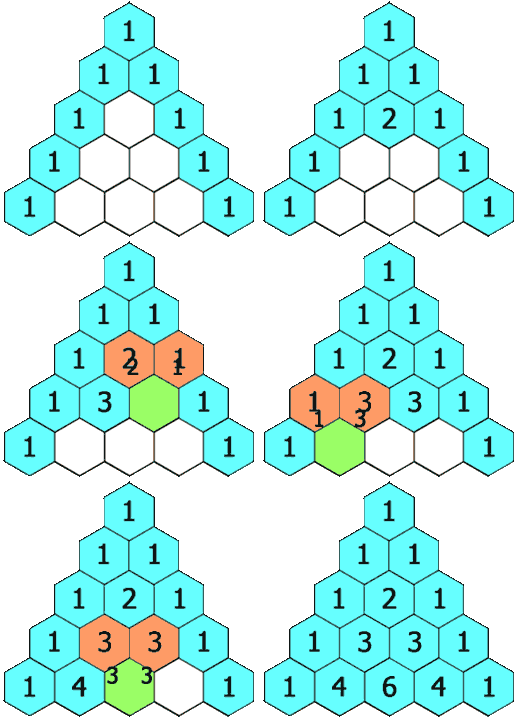
Look at Pascal's triangle:
http://en.wikipedia.org/wiki/Pascal's_triangle

PascalTriangleAnimated2.gif


Now you're going to go, hey wait a second, you can divide one of those hexagons into six equilateral triangles, can't you?

Yes, you can, and that's the point here. :) Isn't this universe BEAUTIFUL!??!

I was on to this, without really knowing it.

Why is pi such a weird, some might say IRRATIONAL number? http://en.wikipedia.org/wiki/Irrational_number
http://en.wikipedia.org/wiki/Pi

Now we know. And think of c, it must somehow be related to pi.

This really IS the theory of everything people. Or rather, the theorum of everything, since it's all just math, and we can only do math the way the universe is.
 
You are again wrong. You can't even divide a block of Iron. Let alone a soft cake.

A mathematical division operation (depending on the types of the two inputs, etc) is not the same as a "division" for real physical objects. If you take a cake and split it into two even halves, you don't divide. You cut. If you fission a Uranium atom, you also don't divide at all.

And numerology is no science. It is "I like that number". 3 is the smallest odd prime number. But what about 2? It is the smallest prime number and appears far more often. You have many dipoles, but no tripoles. Even monopoles are hard to find.

And again, you wrote a long, boring post, for distracting from the question.

PS: Pi is no irrational number. It is just assumed as best practice to be one.
 
e^(2 pi i) = 1

Isn't that exciting. It has all of my favorite numbers. :)

EDIT: I lied. :P I like Phi too.

phi = ( e^(2 pi i) + sqrt(5) ) / 2

There, now its a super happy equation.
 
Last edited:
You are again wrong. You can't even divide a block of Iron. Let alone a soft cake.

A mathematical division operation (depending on the types of the two inputs, etc) is not the same as a "division" for real physical objects. If you take a cake and split it into two even halves, you don't divide. You cut. If you fission a Uranium atom, you also don't divide at all.

And numerology is no science. It is "I like that number". 3 is the smallest odd prime number. But what about 2? It is the smallest prime number and appears far more often. You have many dipoles, but no tripoles. Even monopoles are hard to find.

And again, you wrote a long, boring post, for distracting from the question.

PS: Pi is no irrational number. It is just assumed as best practice to be one.
Think of a movie of cutting the cake run in reverse. That's what I'm saying here. That's time. When you go closer to c, you're really going back in time a little more. That's why there are black holes. It's really just the big bang represented at the current "time" from our perspective.

I made a tetrahedron out of paper, it's pretty shabby looking because I'm no professional 3d artist, but I labeled the triangles that make up the sides time, distance, and mass. Eventually, you will get around to labeling two "different things" the same thing.

When you put something in terms of c, you're really just putting the sides in the universal unit of measurement. That's kind of the idea with the Planck length, but everyone, even the most sophisticated and well educated physicists believe time + x, y, z not that time is one of the three x, y, z dimensions. So even if they have this:
981c4a7801639525969c8d798aca28ce.png

Staring them in the face, with it's obviously reducible units, they keep looking for extra dimensions and all that baloney, when really there are just 3. x, y, z. If you go graph them on a calculator, eventually you'll realize that m^4 = m^2. It's not different in real shape, just a more drastic rise. Shape is what this is about.

The only thing missing from that picture is spin. That's the other dimension. Spin is just

And if you don't believe me about pi being an irrational number, just look it up yourself. If you deny that, then you're denying a mathematical truth, and we know that pi is that. It's probably all weird and irrational because it's really the manifestation of the indivisible unit. Math is the source code for the universe. So, when you start fooling around with the indivisible unit, you're bound to get some pretty irrational answers. Pi is the relationship between one half of a circles dimensions.
c89ca8d1a8d2b51c3887d7ea7833ff18.png


What about a sphere?
2a395048087cce6b618012a9b61ce769.png


If volume is meter^3 and time is the same thing...Then you've always been measuring time as a distance. Just think about the sphere squishing down. Then, think of it extending out to encompass everything. That's probably the lower and upper limit.

How many points are there in a tetrahedron? How many dimensions does it have?
4 points, 3 dimensions. Looks oddly similar to me. What if some kind of version of pie is the indivisible thing? Would our math ever be able to accurately reflect the indivisible thing?.

Just think of the hands on a clock throughout time. If you had long exposure photography, it would be a circle. Were the hands of the clock really a circled? No, it was a really wide cylinder.
f4158dab7968d0898a95f83495604c73.png

π*r*r*thickness of the clock's hands.
Three things multiplied by pi? 3d? How is that possible?
4 points with three references between them.

2a395048087cce6b618012a9b61ce769.png


Look at h-bar, part of the Planck length definition:
0a9fc3f71a862a9883e3b8922319eabe.png

h = h-bar * π
What's a circle's radius?
c89ca8d1a8d2b51c3887d7ea7833ff18.png

Are you eventually going to wake up and see it? It's common sense. "Hello, name is common sense, and I'm trying to tell you something!" I'm really getting sick of you people being so dense.
 
Watch this.
http://www.ted.com/index.php/talks/garrett_lisi_on_his_theory_of_everything.html

If you think you understand it, you don't. The presented model deals with symmetry, but not the way you use it.

I'm trying to be as polite as I can, but your model is wrong. You have also made many bad assumptions. There is nothing intrinsic to the Gravitational constant, it is used to get the unit ratios right to make calculations easier.

---------- Post added at 02:40 PM ---------- Previous post was at 02:26 PM ----------

If you really, really feel you are correct. You need to make some predictions with your model that can be experimentally proved or disproved.

Providing some equations would be a good start. Equations that use your model, not just common equations.
 
So if we now know that 1 kilogram = meter = second, what does that mean light is? If you scale the 1:1:1 down to the Planck length, does that mean that light does have inertia, just 1 intertia unit?
You have never sufficiently explained why 1 kilogram = 1 meter = 1 second. You've just stated it and assumed it to me true and used it in all your x*x*x nonsense.

Given sufficient conversion factors, you could say that 1 kilogram "is" 1 meter (ie, a kilogram is the mass of a meter-long rod of radius r of a given material) or that 1 meter "is" 1 second (ie, a meter is the distance travelled by a 1.85-meter tall human at average walking speed), but they have no intrinsic equality.

I could just as easily say that one stone per furlong is equal to a light-second per hectare, but those conversions are only valid given proper converting factors and they have no intrinsic meaning.

So please, without writting a two-page-long wall of text to distract from the point, state (and prove) concisely why 1 meter = 1 kilogram = 1 second.
 
Watch this.
http://www.ted.com/index.php/talks/garrett_lisi_on_his_theory_of_everything.html

If you think you understand it, you don't. The presented model deals with symmetry, but not the way you use it.

I'm trying to be as polite as I can, but your model is wrong. You have also made many bad assumptions. There is nothing intrinsic to the Gravitational constant, it is used to get the unit ratios right to make calculations easier.

---------- Post added at 02:40 PM ---------- Previous post was at 02:26 PM ----------

If you really, really feel you are correct. You need to make some predictions with your model that can be experimentally proved or disproved.

Providing some equations would be a good start. Equations that use your model, not just common equations.

Of course. It's just a conversion factor. So is C.

You people just do not seem to have any common sense.

Don't you get it?

Let me try the umpteenth time to say the simplest thing:
Even if you do not believe that there is time and anti-time, you have to accept that even in the 3d we know and can prove, a cubic meter is simply not a cubic meter.

Our six sided cube is simply not a cube. You don't have a proportional measurement in a six sided cube without adding another set of 90 degree angles on the opposing side.

If you do not believe me, and I'm really getting sick of you people being lazy and not trying to even measure out (in any system of your choice because it doesn't actually matter, you're just scaling the natural proportional units meters are just base ten and very tidy, the real measure of units is how they scale down. And inches will scale down to the fundamental unit a little differently.)

Inches/feet to meters does need a conversion factor, but within those systems, you simply do not need a conversion factor, if you measure the right way. That's why we need G. Planck's length is the representation of this all. Why should be this:
b90bac42665de0e9578869aa0d7f742d.png

and not one?

Why would you have proportional things on a piece of graph paper and not in real life? The problem with our graph paper is that it's two right angle triangles put together to form a square, instead of an equilateral triangle. If you cut an equilateral triangle in half you're going to get two right angle triangles.

If you cut a six sided "real" cube in half, by only measuring out the distance for three lines the right way. If you cut them out, you're going to have a weird looking shape. It will have all this extra junk left over, won't you? Why do you think that is?

That's because a cube with right angles isn't a cube. Look at the angles of that thing 3*90 degrees and 3*45 degrees, because it's only half of a "cube" and no one seems to have enough common sense to figure it out. Look at the Planck length.

90-60 = 30
60-45 = 15
90 is twice than 45, so it should be an error rate of 30.
15 degrees. What's the Planck length again?
b90bac42665de0e9578869aa0d7f742d.png


And that's approximately equal, the reason they had to go down there is that they didn't measure it up here. And down there you simply cannot help but have the error rate of 15 degrees. It's not perfect, don't get me wrong, but that's approximately equal and it's very difficult to accurately measure x*10^-35 anything, and in the weirdest way, that's what's going on. That's where photons come in. I think they are 1 natural proportional unit wide, this is what makes them c. For their actual dimensions, just take the wavelength and the frequency and multiply them by it.
785ef575f2108312d502889af077e095.png

Waves are just two dimensional and are missing that third dimension, for all practical purposes. Joules are really just m^3. That's why you can convert all these things between each other and joules is that they're all one the same thing. It's the craziest most irrational nonsensical thing I've ever heard to say that if time and space are one thing, even in 4d, that they wouldn't share the same units. Think about how crazy that really is. Does your graphing paper work that way? No, one proportional unit up and over. Why wouldn't everything else be just the same way? It would be insane to say it wasn't so, it defies all logic, and complex baloney explanations have been getting dreamed up to explain it. But you know what's really wrong? We're all measuring 3d things the wrong way. We have simply accepted as fact on it's face that a cube is a non-proportional thing, which is what you really have to do. You don't get a fouth mysterious/magical point from 3 measurements, you have to jump to the conclusion that's the way it is.

But we know from math that a cube isn't that, it's x*x*x. That's all I've been saying. You simply cannot get that with three measurements at 90 degree angles.

Just look at the Pythagorean theorem:
pythagoreantheorem.gif


Make that right angle triangle an equilateral one, make all the sides equal and you have the basis for a 3d hexagon, a shape that's natural:
Honey_comb.jpg


Why do you think the bees do that?

It's hard to appreciate that when you assume x, y, z is a six sided cube with a time dimension, but when you understand that everything is really tetrahedron, and hexagons are just a bunch of equilateral triangles, and 3d hexagons are really the only shapes. (in both the normal and anti-normal version of all the dimensions. Add the tetrahedrons together...)

It just looks like a six sided cube, just look at that honeycomb. You can see the "cubes" in it in the bottom left. But to described everything, you don't need that, you just need a tetrahedron to have all the things we know.

Can you graph m/s on a graph? Of course you can, you go one over on the x-axis one up on the y-axis.

Why would the universe work any differently with it's real geometry?

You can graph out the change in acceleration on a square graph. Resistance to acceleration is inertia. Difference between two objects accelerating is possible to graph out in proportional units. The problem is when you start thinking about how to manage getting all this information together. If time and distance and acceleration were all different things, you wouldn't be able to have a 1:1 ratio anywhere. If one kilogram is multiplied by one meter and that's multiplied by one second, what do you have? 1 of something. Joules are just the nice number thing. But you really do not need to multiply something by the speed of light to get 1 m^3.

The speed of light is just a conversion factor for this screwed up nonsense way of measuring a cube. If you do it the right way, it should all just melt away. That's what proportion is about.

That's why I maintain this idea. When you have different proportions, then it's not the same.

1 m^3 is a meter * meter * meter, measured out the real way, in a tetrahedron. If you don't have the mass, then it's really not x^3. That's why light is screwed up and you should be able to just move your hand through it. Think of a balance:
balance.jpg


Get your meter stick. Measure. Measure again. Measure again. You've only measured one meter. Duh. You're only making a comparison between two points, it's only one dimension of measurement. Even if you have something that's tetrahedral shaped 1 meter by 1 meter 1 meter, you still are not really measuring anything more than 1 meter just measuring it three times at three different points. That's the distance component. Everything you see has a distance in relation to everything else. You can only compare distance between two points. That's it. All you see is a 2d comparison between TONS of points, but nothing more.
Drop something while measuring it's fall accurately. You're finally measuring two meters. Time and distance.
Weight something one kilogram v. something else one kilogram and you'll finally be measuring an m^3.

This is why there are holograms. It looks "3d" but it's just time * distance. You're seeing the 2d comparison of many different points. Only when there is mass are you getting the 3d and real world.

How could light carry such information, if it's only 2d and right angles? That's because what you're looking at in a hologram is only 2d.

Don't you guys get it yet?

A tetrahedron of the most elementary particles is always a measurement of those things. That's what hydrogen is. Only, you've also got anti-hydrogen hanging out in the negative axis of the 3 dimensions. That's why there's a hexagonal shape for the quarks. The electrons make it a tetrahedron, and make it all 3d.

Everything you are looking at is at a slightly different point in time, distance and the inertial dimension, or more than slightly.

Maybe you guys can't get this. I think it's amazing.

 
Last edited:
You people just do not seem to have any common sense.
Ooohhh, insult your audience. That's likely to help your case.

Don't you get it?
No, because you're just babbling on and on and not actually explaining anything.

Let me try the umpteenth time to say the simplest thing:
Okay, I doubt you will have any more success this time than you've had previously.

Even if you do not believe that there is time and anti-time, you have to accept that even in the 3d we know and can prove, a cubic meter is simply not a cubic meter.
Now who doesn't have any common sense? In the "3d we know and can prove", a cubic meter is tautologically a cubic meter. I do not have to accept the inverse, because you have not (and cannot) prove that a cubic meter is not a cubic meter.

Our six sided cube is simply not a cube. You don't have a proportional measurement in a six sided cube without adding another set of 90 degree angles on the opposing side.
Again, the cube is, by definition, a cube. What are you talking about, "adding another set of 90 degree angles on the opposing side"? Are you saying that you need 2 corners (each with 3 90 degree angles) to define a cube? Well duh....

If you do not believe me, and I'm really getting sick of you people being lazy and not trying to even measure out (in any system of your choice because it doesn't actually matter, you're just scaling the natural proportional units meters are just base ten and very tidy, the real measure of units is how they scale down. And inches will scale down to the fundamental unit a little differently.)
And I'm getting really sick of you insulting us for not understanding your poorly explained ideas.

If you cut a six sided "real" cube in half, by only measuring out the distance for three lines the right way. If you cut them out, you're going to have a weird looking shape. It will have all this extra junk left over, won't you? Why do you think that is?
Um, what? A diagram, please.

That's because a cube with right angles isn't a cube.
Yes it is, by definition.

Look at the angles of that thing 3*90 degrees and 3*45 degrees, because it's only half of a "cube" and no one seems to have enough common sense to figure it out. Look at the Planck length.
What the hell does the planck length have to do with you sawing cubes in random (and poorly explained) manners?


.... [snip out random junk]
Don't you guys get it yet?
No, because you have explained nothing and are not responding to our questions. You're just making more up as you go along.

Maybe you guys can't get this. I think it's amazing.
I think that without the same drugs that you are using, no, we can't get this.
 
"Assuming the tin is open..."

Sorry, but I am pretty happy to not share your "common sense". Because it is wrong. One cubic meter is always a cubic meter. Even in the most distorted region of space-time. This does not even change by you calling us lazy. Actually, I can scientifically correctly claim, that you are more lazy than we are: While we react to your nonsense and try to communicate with us, you ignore us, bombard us with more nonsense until we shut up and then insult us if we still have the not succumbed in awe of the long random posts your write.

What you don't get, is something, we are trying to tell you for a while now:

"Don't assume, because it makes an ass out of U and me"
 
Ooohhh, insult your audience. That's likely to help your case.


No, because you're just babbling on and on and not actually explaining anything.


Okay, I doubt you will have any more success this time than you've had previously.


Now who doesn't have any common sense? In the "3d we know and can prove", a cubic meter is tautologically a cubic meter. I do not have to accept the inverse, because you have not (and cannot) prove that a cubic meter is not a cubic meter.


Again, the cube is, by definition, a cube. What are you talking about, "adding another set of 90 degree angles on the opposing side"? Are you saying that you need 2 corners (each with 3 90 degree angles) to define a cube? Well duh....


And I'm getting really sick of you insulting us for not understanding your poorly explained ideas.


Um, what? A diagram, please.

Yes it is, by definition.

What the hell does the planck length have to do with you sawing cubes in random (and poorly explained) manners?


No, because you have explained nothing and are not responding to our questions. You're just making more up as you go along.


I think that without the same drugs that you are using, no, we can't get this.
The planck length is what we need to reconcile our crummy 90*90*90*90 measurements with real 60*60*60 measurements. Just think of a hologram.

Distance between all objects is just a one dimensional comparison of those objects versus one another.

When you see motion, you're getting another dimension of measurement: time.

And when you have a balance you're getting a 3d measurement: time, distance and acceleration. That's why m^3 kg^-1 and s^-2 are all the same thing. Just think about it. When you measure out a supposedly 2d object, you have to put something there to keep the shape. The differences between those various shapes in distance, collectively, provide you a frame of reference, distance wise. Motion provides you a frame of reference time/distance wise. Difference in acceleration gives you a 3d time/distance/inertial comparison.

Think of Einstein's clock. Motion is just time. Change in motion is acceleration. The clock has motion, and because of the way it works, it probably has acceleration too. If you picked up the clock and it was heavy, that's acceleration or resistance to it. That's the 3rd dimension.

Just think of the hologram again, why does it look 3d? It's folding information down from 3d into a 2d medium. Graphing x^2 on a number line, which is what all graphing calculators do when they do their thing, is doing the same thing.

Maybe someone else will see and help you out. Either that or I'll be the weird guy who thinks we're 3d instead of 4.

Why do holograms work? If light is 2 2d things, why would we be able to see something that looks 3d? Do you see mass? Never. You feel it when you touch something. Why does light have to be coherent to get a hologram? To get an accurate measurement of the 3d information. Mass makes matter come together, and have distance/time differences. And you can't have acceleration while making a hologram, too much information to get a clear picture, it will just look like a blur. Like long exposure photography. That's why light can go c. It doesn't have that.

Change in time, is going a little forward of backward. If you drop something, made a film, and reverse the film, it will look like it fell into your hand. Take the full picture, you picked it up, moving forward in time, then when you dropped it, it went a little further back in time.

If you had an ice cube melt, and ran it backward, that would be anti-time. Gravity is anti-time. When something goes back a little, it gets compressed, when it comes forward to a difference frame of reference in time, it's OK. That's why light redshifts when it goes around a massive object. It's a little further back in time. It can do that, because it's just time/distance. In the past the universe was more compressed.
 
Last edited:
Back
Top