
originalpckelly
New member
I'm not understanding the problem of having v1 as 0 in your equation. First of all momentum has to do with your reference frame.
So something moving at the same velocity as the observer has zero momentum relative to the observer. Mass is independent. So v2 must also be zero for momentum to be conserved. Unless the 'universe' has a nonzero total momentum in which case you need to add a constant value to one side of the equation.
(universe in the experimental sense of whatever environment you define, can be two balls in Newtonian space or the real Universe)
---------- Post added at 10:22 AM ---------- Previous post was at 10:13 AM ----------
Consider using the equation:
C is a vector representing the total momentum of the system (assumed zero for the Universe). n is just the number of things you are summing.Code:n C = SUM ( (m_i * v_i) / (1 - (v_i / c)^2 )) i
And of course the value of C may not be independent of the reference frame.
Let me ask you some questions:
1. If I have a room that has no windows in it, no clocks, no people, and only artificial lighting, if I take two pictures of that room 24 hours apart, will I see any real difference?
2. In the 24 hours a bunch of people entered and left the room.
3. Why couldn't I tell from those two pictures?
4. If an exposure time is not short enough, will I not get a motion blur with fast movement?
5. If nothing is lost or gained from the universe, what happens to the seconds when we can no longer see them? If I can't see the other side of the world, does it mean it's not there? Do things tend to disappear when you're not looking at them?
6. What if the maximum velocity you could attain was dependent upon the frame rate?
7. What if c is the frame rate of the universe?
8. If I tell you I walked ten miles in 2 hours, does that tell you anything in particular about my velocity during that time? No, just that I walked on average 5mph. It stands to reason someone would accelerate (by either walking faster or slower) during that time, right? But without further information, all you know is that I walked 5 miles per hour.
9. If you get really close to a wall move along it, and you can't see the other part, does it mean the other part of the wall disappears when you can no longer see it?
Look at this formula:
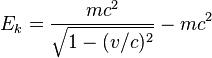
How many c^2 do you have? You have m c^2.
How many v's do you have? you have (v/c)^2.
How many apples do I have? m apples^2
How many apple do I have? (v/apples)^2
You are putting one thing in common terms with another. m^3
Velocity is meters per second.
If you graph that out, but instead of using points, you use squares = 1 meter * 1 second, you can describe velocity as an area.
If you graph out acceleration, which is the change in velocity, it is the complimentary area, if you draw a rectangle.
If you graph out one masses acceleration versus another, but on a different piece of graph paper, mass is just the complimentary area in the ability to accelerate.
meters per second = m^2
meters per acceleration = m^2
mass per meters per acceleration = m^3
If you have a 4 meter * 4 meter space you can find the area by squaring it 4^2. Meters length * width are the same thing.
If you have a 4 meter * 4 meter * 4 meter volume you can find the volume by 4^3. Meters length * width * height are the same thing. A meter up is the same meter down, a meter going left is the same as a meter going right. A meter going forward is a meter going backward, but it's also the same as a meter going up/down or a meter going up/down.
Squares and cubes are just ways of multiplying the same thing 1 type unit squared * 4 * 4, or 1 thing unit type cubed * 4 * 4 * 4.
If you don't have the same type of units length or width or height, you still can multiply, I remember when I first learned multiplication, I was told it was an easier way of adding the same thing over and over. Why do 1 apple + 1 apple + 1 apple, when you can do 3 * 1 apple? Why do 3 apples multiplied by 3 apples, when you can just call it 3 apples^2? Why multiply 3 apples * 3 apples * 3 apples, when you can call it 3 apples^3?
1 meter * 1 second * 1 kilogram = 1 meter^3
1 joule = 1 meter^3
e = mc^2
But if mass and meters and second are all the same thing?
e in joules = 1 meter^3
1 joule/second = 1 watt = 1 meter^4
Something is non-linear when try to you plot linear 3d information on a 2d graph, because doing that means you don't have a 1:1 thing you have a 1
 y*z) thing. Something would be non-linear in 3d if you were trying to plot 4d information.
Just remember the motion blur on a camera with a frame rate too slow to capture the motion. Just think of Hollywood where they have to use high frame rate cameras for "slow motion" video, or not have motion blurs on everything.
If the maximum rate of velocity is c, and you are limited to that, wouldn't things only have so much meter/second left over in which to move/accelerate? Think of the frames on a piece of film. If you put all of them on top of each other, the things that didn't "move" would be OK to see, while the things that did would be all blurry and all spread out, like an area.
Just look at this long exposure photography, it's just like doing that:

You can see it with your own two eyes, don't take my word for it.
I guess you could call the blurry stuff "Undefined," now couldn't you?
It kind of looks like a non-linear area, now doesn't it? Imagine the hands of a clock being photographed with long exposure photography. They would form a symmetrical circle. Even the numbers on a digital clock would be blurred together.
The film of a movie camera would be kind of weird looking and not as smooth, because you're chopping time up into discrete points and comparing the difference between them. It almost looks like that "wormhole" scene in Star Trek: The Motion Picture, where everything is drawn out and blurry, but and if something moves to much, you can see discrete things of it. (I am not trying to imply wormholes exist by that comment, I'm just giving you a possibly familiar reference.)
 Meters and seconds are the same thing. And if you believe e = mc^s, then joules are just m^3. And if you have the resistance to acceleration, mass, time and distance it's probably the same, but m^4.
When you go x^2 on a graphing calculator, you're really plotting 2d information on a 1d number line. If you just put in x, you're getting a linear increase, because you're plotting one unit up and over. If you do -x, you'll get a line that's equal and opposite the other. If you do the relativistic momentum equation, you get a straight un-curved line. You put it in parenthesis, you get the opposite of the line if you put a - sign infront of it. If you don't believe me, just go here http://www.coolmath.com/graphit/
((x)/(sqrt(1-((x/299792458)^2))))
-((x)/(sqrt(1-((x/299792458)^2))))
You can then try out 2x in the top, to represent mass. Your line will be steeper but in a linear fashion.
If, however, you put x^2 in the top of the division, you'll get a non-linear graph. x*x*x = x^3.
If you put in x^3, you'll get an equal and opposite non-linear graph. Think x*x*x*x
x^4 is like the first non-linear graph, but steeper.
X^5 is just like x^3, but steeper.
If you do the equal and opposite for all of the previous, you'll get something that's in all quadrants of the graph. Something that's equal and opposite.
* I must note that the original post I referred to a "you" and I realize that it sounds weird, re-reading what I wrote, I was replying to the person I was talking to who helped me to see this, by telling me I couldn't add up all the energy in the universe (which of course seems absurd now, knowing that there's an equal and an opposite for everything, and energy is just a measure of a volumish thing.)
Last edited:




 (that means IT BETTER GET AROUND!), anyone with questions should contact the following e-mail:


